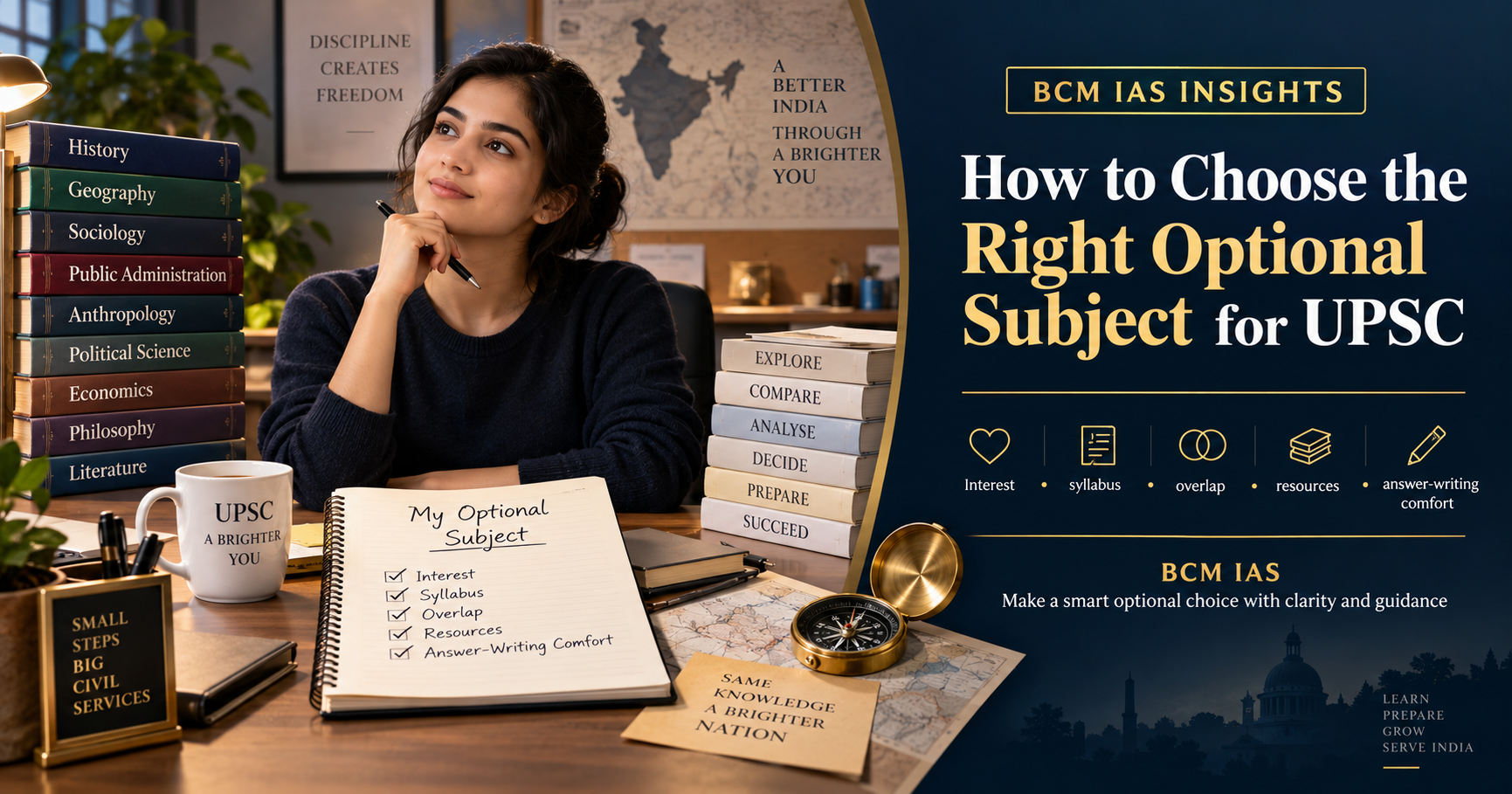
Why Choosing the Right Optional Matters
For many UPSC aspirants, choosing the Optional becomes one of the most confusing decisions in preparation. A student may hear: “This Optional is scoring.” Someone else says: “That Optional has more overlap.” A topper interview recommends another subject. A friend says: “Take the subject I am taking. We can study together.” And within a few days, the aspirant has a list of five Optionals and no clarity.
The Optional should not be selected because a subject is fashionable. It should be selected because you can understand it, complete it, revise it, write good answers in it and sustain your interest over a long preparation period. A useful principle is:
The right Optional is not the subject everyone recommends. It is the subject whose demands fit your preparation better.
Do Not Choose Optional on One Factor Alone
A common mistake is to choose an Optional based on only one consideration. For example:
“I studied it in graduation.”
“It has a short syllabus.”
“A topper had this Optional.”
“There is GS overlap.”
“My friend joined its coaching.”
“People say it is scoring.”
Each of these may be relevant. None of them should normally decide the subject alone. A better decision comes from looking at several factors together. Think of Optional selection as:
Interest + Syllabus Comfort + PYQ Understanding + Available Resources + Quality Guidance + GS Linkage + Answer-Writing Comfort + Time Available
Step 1: Read the Syllabus Before Making a Decision
For a wider view of preparation, see the UPSC preparation roadmap for beginners.
Before asking which Optional is “best”, download the syllabus of the subjects you are considering. Read it calmly. Do not ask: “Is this syllabus short?” Ask: “Can I imagine studying these topics repeatedly for the next several months?” Some subjects may look attractive because the first few topics appear familiar. But the complete syllabus may contain areas you have never studied before. That is normal.
The purpose of reading the syllabus is not to know everything already. The purpose is to understand what the subject will demand.
Step 2: Look at PYQs Early
Previous-year questions are extremely useful while selecting an Optional. They reveal:
the language of the subject,
the depth expected,
the type of analysis required,
how concepts are applied,
whether you feel comfortable reading and thinking in that style.
Suppose a syllabus looks interesting, but the PYQs feel completely alien even after basic reading. That is useful information. On the other hand, if you read a question and feel: “I would like to understand how to answer this properly,” that is also useful information. Do not wait until after finalising the subject to look at PYQs. Use PYQs before finalising.
Step 3: Interest Matters — But Define Interest Properly
Students often hear: “Choose the subject you are interested in.” That advice is useful, but incomplete. Interest does not mean: “I watched three videos and liked the subject.” Real interest means:
you are willing to read the subject in depth,
you can tolerate difficult portions,
you are curious enough to revise it repeatedly,
you can imagine discussing its concepts analytically,
you do not lose interest once basic topics become complex.
Every Optional has interesting chapters. Every Optional also has difficult chapters. The real question is:
Can you remain engaged even when the subject stops being easy?
Step 4: Does Your Graduation Background Matter?
Yes, but it is not compulsory that your Optional must match your graduation subject. A student who has studied a subject in college may have advantages such as:
familiarity with terminology,
prior conceptual exposure,
comfort with basic readings.
But graduation background is only one factor. Students from engineering, commerce, science, humanities and other backgrounds often choose Optionals outside their graduation discipline. What matters more is whether you can build sufficient command over the subject before the examination.
If you are planning UPSC preparation after Class 12 or preparing alongside college, consider how Optional preparation will fit your graduation schedule.
Previous exposure can give you a head start. It does not automatically give you the finish line.
Step 5: Check the Nature of the Subject
Different Optionals require different kinds of preparation. Some may involve:
theoretical interpretation,
thinkers and scholars,
historical analysis,
administrative application,
contemporary examples,
diagrams or maps,
case-based understanding,
conceptual precision.
Ask yourself: What kind of thinking do I enjoy? Do you enjoy understanding institutions and governance? Do you enjoy theories? Do you like connecting concepts with practical administration? Do you enjoy social analysis? Do you prefer historical narratives? Optional preparation becomes easier when the subject’s intellectual style matches your comfort.
Step 6: GS Overlap Is Useful — But Use It Correctly
Overlap can save preparation time. If concepts studied in Optional also help you understand GS, Essay, Ethics or Interview themes, that is a genuine advantage. But overlap should not be understood as: “If I choose this Optional, half my GS is automatically complete.” Optional demands greater depth and a different style of answer writing. The benefit of overlap is usually:
conceptual reinforcement,
better examples,
deeper understanding,
reduced duplication of some topics.
It should be a supporting factor, not the only factor.
Why Public Administration Deserves Serious Consideration
Public Administration is worth serious consideration for aspirants who are interested in:
governance,
administration,
institutions,
public policy,
accountability,
administrative behaviour,
implementation,
Indian administration.
Its strength lies in the fact that it combines theory with practical administration. A student studies administrative thinkers and concepts, but also learns to apply those ideas to:
governance,
bureaucracy,
accountability,
public institutions,
reforms,
citizen-centric administration,
Indian administrative realities.
This can make the subject intellectually connected with the actual functioning of government.
Public Administration and GS Linkages
Public Administration can also support understanding in several areas of General Studies, including GS-II governance, institutions, public policy and civil services, and GS-IV administrative ethics. Governance understanding can also support relevant Essay and Interview discussions. Its conceptual relevance can be useful in themes related to:
governance,
accountability,
transparency,
administrative reforms,
civil services,
institutions,
public policy,
citizen charters,
ethics in administration,
leadership,
decision-making.
This does not mean Optional and GS answers are identical. But good Optional preparation can deepen understanding of many governance-related issues. For students who like the administrative side of government rather than only memorising facts, this can be a meaningful advantage.
Public Administration Is Open to Students from Different Backgrounds
You do not need to have studied Public Administration in graduation to consider it. Students from:
Arts,
Commerce,
Science,
Engineering,
Law,
Management,
other backgrounds
can study it. The important question is whether you are comfortable with its concepts and answer-writing style. A beginner may initially find thinkers such as Weber, Simon, Follett or Riggs unfamiliar. That is not unusual. With proper conceptual teaching, these topics can become systematic.
Theory Alone Is Not Enough in Public Administration
One reason some students struggle with Public Administration is that they treat it as a subject of definitions and thinkers only. A strong answer usually needs more than that. For example, if you study accountability, you should understand:
theoretical meaning,
institutional mechanisms,
Indian administrative examples,
practical challenges,
reforms.
Similarly, if you study decision-making, you should be able to connect theory with administrative situations. This is why answer-writing guidance and feedback can become particularly valuable.
Availability of Guidance Is a Genuine Selection Factor
Students sometimes hesitate to count coaching or mentorship availability as a factor. But it is practical to consider it. Ask:
Are reliable notes available?
Can difficult concepts be explained properly?
Can someone evaluate my answers?
Are tests available?
Will I receive feedback?
Can I get doubts resolved?
Is there structured coverage of Paper I and Paper II?
A subject may suit you intellectually, but preparation can become inefficient if you spend months trying to understand the correct approach. Quality guidance can reduce trial-and-error.
BCM IAS Public Administration Optional: How the Preparation Can Be Structured
At BCM IAS, Public Administration Optional preparation can be organised around a systematic cycle.
Conceptual Understanding
First understand the topic rather than memorising definitions.
Thinkers and Theories
Study thinkers in context:
what problem they were addressing,
what they proposed,
their limitations,
their continuing relevance.
Paper I to Paper II Connection
Theories should not remain isolated. Students should learn how administrative concepts connect with Indian Administration.
PYQ Orientation
After completing a topic, analyse:
how UPSC has asked it,
what dimensions recur,
what kind of answer is expected.
Answer Writing
Practise converting knowledge into structured UPSC answers.
Test
Check whether the student can reproduce and apply the subject under exam conditions.
Faculty Feedback
Identify:
missing dimensions,
weak introductions,
poor structure,
insufficient thinkers,
lack of examples,
weak conclusions.
Revision
Convert the subject into a manageable revision framework. The cycle becomes:
Concept → Thinker → Application → PYQ → Answer → Test → Faculty Feedback → Revision
Paper I and Paper II Should Not Be Studied Like Two Unrelated Subjects
This is especially important in Public Administration. Paper I builds administrative theory. Paper II deals with Indian Administration. The real advantage comes when the student learns to connect them. For example: A theory of organisation should help you understand administrative structures. Accountability concepts should help analyse Indian institutions. Administrative behaviour should help explain how organisations actually function.
The stronger these connections become, the more mature the answers can become.
Current Affairs: How Much Does an Optional Need?
Every Optional has some relationship with contemporary developments. The intensity differs by subject and topic. In Public Administration, current developments are especially useful for giving practical examples in areas such as:
governance,
civil-service reforms,
accountability,
welfare administration,
digital governance,
decentralisation,
public service delivery.
But the foundation remains conceptual. Current examples should enrich the answer rather than replace theory. This is useful for students who prefer a stable theoretical base with focused contemporary application.
Do Not Choose an Optional Only Because a Topper Chose It
Topper strategies can be helpful. But Optional selection should not become: “AIR X had this subject, therefore I should take it.” A topper may have:
different graduation background,
different interest,
different teacher,
different preparation time,
different academic strengths.
Learn from toppers by asking:
Why did they choose the subject?
How did they revise?
How did they use PYQs?
How did they improve answer writing?
Do not blindly copy the subject.
Learn from a topper’s decision process—not only the final decision.
“Scoring Optional” Is a Dangerous Shortcut
Students frequently ask: “Which Optional is most scoring?” The question sounds logical. But marks depend on many things:
quality of preparation,
paper difficulty,
answer quality,
conceptual command,
interpretation of questions,
evaluation.
A subject does not produce marks automatically. The better question is: “Which subject gives me the best chance to develop strong command and write good answers?”
Do Not Keep Changing Optional Subjects
Optional uncertainty can consume months. A student starts one subject. After two weeks, watches a topper video and changes. Then someone recommends another subject. Then a Telegram discussion creates doubt again. This cycle is costly. Take time before finalising. But once you make an informed choice, give the subject sufficient time before judging it. Do not confuse initial difficulty with wrong selection.
Every serious subject becomes difficult at some stage.
Use a Short Trial Before Finalising
If you are confused between two or three subjects, try a small academic experiment. For each subject:
Read the syllabus.
Look at recent PYQs.
Study one introductory topic.
Watch or attend a proper concept class if available.
Try to understand what the answer-writing style requires.
Then compare. This gives you much more information than social-media opinions.
A Practical Optional Selection Scorecard
You can evaluate each subject on a simple scale. Score each factor from 1 to 5. For the time factor, use a realistic study-hours plan.
Interest — Your score: ___ /5
Comfort with syllabus — Your score: ___ /5
PYQ comfort — Your score: ___ /5
Availability of resources — Your score: ___ /5
Quality guidance available — Your score: ___ /5
GS/Essay linkage — Your score: ___ /5
Answer-writing comfort — Your score: ___ /5
Time required vs time available — Your score: ___ /5
Revision manageability — Your score: ___ /5
Long-term willingness to study — Your score: ___ /5
Do not treat the final total as a mechanical formula. Use it to expose your assumptions. You may discover that the subject you “liked” has poor resource availability. Or that the subject you initially ignored actually fits your preparation better.
When Public Administration May Suit You
Public Administration may deserve serious consideration if:
governance interests you,
you like understanding how institutions work,
you enjoy connecting theory with practical examples,
you want meaningful governance-related GS linkage,
you are comfortable with conceptual answer writing,
you value structured guidance,
you want a subject that connects administrative theory with Indian Administration.
It should still be selected after looking at the syllabus and PYQs. But for such students, it can be a very practical Optional.
When You Should Think Again Before Choosing Public Administration
A credible decision guide should also tell you when to pause. Think again if:
administrative themes do not interest you at all,
you strongly dislike theoretical concepts,
you are unwilling to practise answer writing,
you expect GS overlap to eliminate Optional preparation,
you are choosing it only because someone called it short or scoring.
Public Administration still needs serious preparation. It is not a shortcut.
Illustrative Decision Example
Imagine a student named Riya. She has a Commerce background. Initially she assumes she must choose a Commerce-related Optional because of graduation. But while exploring subjects, she discovers she enjoys:
governance,
administrative reforms,
institutional functioning,
citizen-service delivery.
She reads the Public Administration syllabus. Then she looks at PYQs. She attends a few introductory discussions. The subject starts making sense to her. Her Commerce background did not decide the Optional. Her comfort with the subject’s nature and preparation requirements did. This is the kind of decision process an aspirant should follow.
How BCM IAS Can Help You Decide Before You Commit
Optional selection is important enough to discuss before spending months on preparation. BCM IAS Academic Counselling can help you examine:
graduation background,
subjects you are considering,
interests,
preparation time,
GS preparation stage,
target attempt,
answer-writing comfort,
availability of academic guidance.
The purpose should not be to force every student into the same Optional. The purpose is to help the student make a more informed decision.
Considering Public Administration Optional?
If Public Administration is on your shortlist, you can discuss:
complete syllabus,
Paper I,
Paper II,
thinkers,
Indian Administration,
PYQ approach,
answer-writing requirements,
testing,
revision strategy
with the BCM IAS academic team before finalising. BCM IAS Public Administration support can include:
Structured Classes → Notes & Resources → Paper I + Paper II Coverage → PYQ Orientation → Answer Writing → Tests → Faculty Feedback → Personal Mentorship
This allows a student to see not only what the syllabus contains, but also how it will actually be prepared.
Book an Optional Subject Counselling Session
If you are confused about your Optional, do not finalise it only after watching a few strategy videos. Bring your actual questions. Discuss:
your graduation subject,
your interests,
Optionals you are considering,
available preparation time,
target attempt,
GS stage,
previous exposure,
answer-writing comfort.
Book Free Academic Counselling with BCM IAS
Fill the counselling/enquiry form and discuss whether Public Administration—or another Optional you are considering—fits your preparation profile. An informed choice today can save months of confusion later.
Frequently Asked Questions
Q: Which Optional subject is best for UPSC?
A: There is no universally best Optional. Suitability depends on interest, syllabus comfort, PYQs, resources, guidance, time available and answer-writing ability.
Q: Should I choose my graduation subject as Optional?
A: It can provide an advantage if you already have strong command, but it is not compulsory.
Q: Is GS overlap important while choosing an Optional?
A: Yes, meaningful overlap can be useful, but it should be considered along with other factors such as interest, syllabus and answer-writing comfort.
Q: Should I choose an Optional because a topper recommended it?
A: Topper strategies can provide useful insights, but your final decision should reflect your own background, interest and preparation circumstances.
Q: Is Public Administration a good Optional for students from non-Arts backgrounds?
A: Students from different academic backgrounds can consider Public Administration. Prior graduation study in the subject is not compulsory.
Q: Does Public Administration help in GS preparation?
A: It has conceptual relevance to governance, public institutions, accountability, administrative ethics, reforms and related themes.
Q: Does Public Administration require Current Affairs?
A: Contemporary governance and administrative examples can strengthen answers, while conceptual understanding remains important.
Q: Is Public Administration easy because its syllabus looks manageable?
A: No serious Optional should be treated as easy. Public Administration requires conceptual clarity, application, PYQ understanding and answer-writing practice.
Q: When should I finalise my Optional?
A: Ideally after examining the syllabus, PYQs, resources, guidance availability and your own comfort rather than making an impulsive choice.
Q: Can BCM IAS help me decide whether Public Administration suits me?
A: Yes. Academic counselling can help you discuss your background, available time, target attempt, subject interests and preparation requirements before finalising.
Final Takeaway
Choosing an Optional is not about finding a magical subject. It is about finding a subject you can prepare deeply, repeatedly and intelligently. Do not choose only because:
a topper chose it,
a friend chose it,
someone called it scoring,
or the syllabus looked short.
Look at the complete picture.
Interest + Syllabus + PYQs + Resources + Guidance + GS Linkage + Answer Writing + Revision + Available Time
Public Administration can be a strong choice for students who are comfortable with governance, administration, institutions and conceptual application. But even then, the decision should be informed.
The best Optional is not the one that looks easiest today. It is the one you can build command over by the time you write the examination.
Still Confused About Your Optional?
Book a Free Academic Counselling Session with BCM IAS. Discuss your:
graduation background,
shortlisted Optionals,
interests,
available preparation time,
target attempt,
answer-writing comfort.
And if you are considering Public Administration Optional, understand the complete preparation approach before making the final decision. Fill the enquiry/counselling form and speak with the BCM IAS academic team.