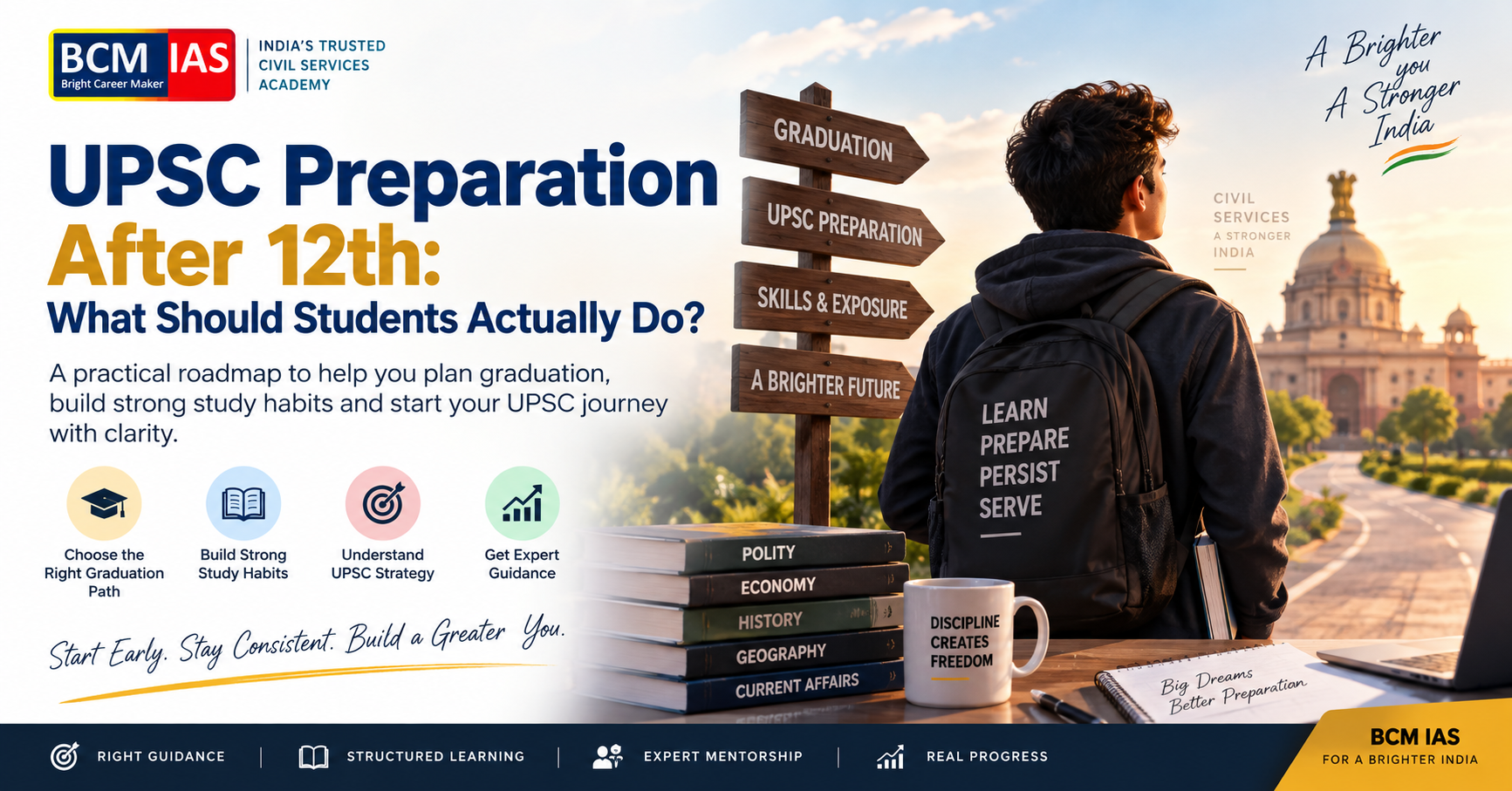
Should You Start UPSC Preparation After Class 12?
For many students, Class 12 is the first stage when career decisions begin to feel serious. Some students are already clear that they want to appear for the Civil Services Examination one day. Others are still exploring graduation options, college life, career choices and different competitive examinations. At this stage, one question comes up again and again: “Should I start preparing for UPSC after Class 12?” There is no single answer that fits every student.
Some students may prefer to begin gradually alongside graduation. Others may decide to give UPSC preparation a much higher priority from the beginning. Both approaches have advantages. What matters most is not whether you start “early” or “late”. What matters is whether you start with clarity, the right resources, realistic planning and consistency.
Starting early does not always mean studying more. It often means getting more time to understand, practise, revise and improve.
First Understand What UPSC Actually Demands
A student who has just completed Class 12 may hear words like: Prelims, Mains, Optional, CSAT, Current Affairs, Answer Writing, Ethics, Essay and PYQs. At first, the exam may look very large. That is normal. The mistake is to react by collecting dozens of books and random online videos. A better starting point is simple: Understand the examination first.
Know the broad structure of Prelims and Mains. Read the syllabus. Look at previous-year questions. Understand the role of General Studies, CSAT, Current Affairs and Optional. Before increasing the quantity of study, improve the direction of study. “If you do not know where you are going, even a fast road may take you to the wrong place.” This is where structured academic guidance can save a young student months of confusion.
At BCM IAS, the first objective should not be to overload a Class 12 pass-out with material. It should be to help the student understand the journey ahead.
Can Students from Any Stream Prepare for UPSC?
Yes. A student may come from: Arts, Commerce, Science, Humanities, engineering-oriented preparation, or another academic background. UPSC preparation is not restricted to one school stream. Different backgrounds may provide different advantages.
A Humanities student may already be familiar with History, Political Science or Geography. A Commerce student may find parts of Economy familiar. A Science student may bring analytical discipline. A student with strong mathematics may feel comfortable with parts of CSAT. But no stream gives an automatic guarantee.
What ultimately matters is how well the student develops the knowledge, analytical ability, writing skills, revision discipline and examination temperament required for the Civil Services Examination.
Your school stream does not decide your UPSC future. Your preparation quality does.
What Should You Do About Graduation?
After Class 12, graduation remains an important academic decision. Some students try to select a degree only because they think it will “help in UPSC”. That may be one factor, but it should not be the only factor. A student may consider:
interest in the subject,
academic strengths,
college opportunities,
career backup,
possible overlap with UPSC,
long-term comfort with the course.
For example:
Political Science may offer useful exposure to Polity and International Relations.
Economics may support understanding of GS-III.
History may help in GS-I.
Sociology may strengthen understanding of social issues.
Public Administration may help with governance-related concepts.
But a student from BCom, BSc, BTech or another course can also prepare successfully. The better question is not: “Which degree guarantees UPSC?” The better question is: “Which graduation path suits me, and how can I use these years intelligently?”
Two Valid Ways to Begin After Class 12
Students broadly follow two kinds of approaches. One student may choose an integrated approach, where graduation remains the main academic structure and UPSC preparation develops gradually alongside it. This can offer:
more space for college exposure,
skill development,
reading habits,
gradual conceptual development,
a relatively lower-pressure preparation phase.
Another student may choose a more UPSC-priority approach, where a larger part of available time is devoted from an early stage to syllabus understanding, core subjects, PYQs, writing, testing and revision. This can offer:
deeper early exposure,
stronger continuity,
more revision cycles,
more exam-oriented practice before a serious attempt.
Neither model is automatically superior for everyone.
The right intensity depends on the student’s: current maturity + academic responsibilities + available time + personal goals + target attempt. This is why a personalised discussion can be more useful than copying a generic timetable from the internet.
What Should a Student Start Building After Class 12?
The biggest advantage of beginning early is not the ability to finish the syllabus in a hurry. It is the time available to build strong habits. A student can gradually develop:
reading ability,
conceptual understanding,
Current Affairs awareness,
disciplined note-making,
writing clarity,
revision habits,
CSAT comfort,
familiarity with PYQs.
These skills become more valuable as preparation becomes serious. Across many topper discussions, some themes repeatedly appear: limited resources, repeated revision, PYQ awareness, regular practice, testing and consistency. The lesson is not to copy somebody’s exact timetable. The lesson is to understand the principles behind successful preparation. Toppers can give direction. Your own routine must still fit your own life.
Do Not Turn UPSC Preparation into a Book-Collecting Exercise
One of the easiest mistakes after Class 12 is to believe that serious preparation means buying many books. It does not. A student can easily become surrounded by:
NCERTs,
standard books,
coaching notes,
PDFs,
Telegram channels,
YouTube playlists,
Current Affairs compilations.
The result? A lot of material, but very little completion. A better sequence is:
Understand → Study → Revise → Practise → Test → Improve
The value of a book comes from how well you understand and revise it. The value of a class comes from how well you convert it into usable knowledge. The value of a test comes from how honestly you analyse your mistakes.
The BCM IAS Study System: Why Structure Matters
A young aspirant often does not fail because of lack of information. There is already too much information available. The real difficulty is deciding: What should I study? In what order? From which source? How much is enough? When should I revise? When should I practise? How do I know whether I am improving? The BCM IAS Study System can help reduce this randomness. A structured learning cycle can look like this:
Concept → Study Resource → PYQ Orientation → Practice → Assignment → Test → Faculty Feedback → Revision
This system keeps preparation active. A student is not only listening. The student is also:
reading,
practising,
being tested,
receiving feedback,
revising.
That process can improve preparation quality because weak areas become visible earlier. It also helps students remain focused because there is a clear next step. And it can help motivation because progress becomes visible. A student who knows: “This week I completed one topic, solved PYQs, submitted an assignment and improved after feedback” usually feels more in control than a student who simply says: “I studied for many hours.” No study system can guarantee selection.
But a structured system can improve the quality of preparation by reducing confusion, increasing accountability and creating more opportunities for correction.
How BCM IAS Can Help from the Beginning
For a student entering this journey after Class 12, support should not mean simply giving more content. It should mean helping the student build the right preparation environment. BCM IAS can support this journey through a combination of:
academic planning,
classes,
resources,
portal access,
testing,
personal mentorship.
A student may use the hybrid class model depending on college schedule and personal convenience. If regular classroom attendance becomes difficult because of college, travel or examinations, online academic support can help maintain continuity. The BCM IAS Student Portal can help organise learning resources and academic activity in a more structured manner. Books and structured study resources can reduce the tendency to keep changing sources.
Tests and assignments can show whether concepts are actually being understood. Faculty feedback can help the student identify mistakes before they become habits. And personal mentorship can help the student adjust preparation when college workload, exams, timetable or target attempt changes. The purpose is not to make every student follow the same routine. The purpose is to help each student build a routine that can actually work.
How BCM IAS Can Help Students Stay Focused and Motivated
UPSC is a long journey. The challenge is not only understanding difficult subjects. It is also maintaining continuity. A student may feel highly motivated one week and distracted the next. College examinations may interrupt study. A difficult topic may reduce confidence. Too much online advice may create confusion. This is where academic structure and mentorship can make a difference. A good system keeps bringing the student back to the next practical task.
Instead of thinking: “I have so much left to study.” the student can focus on: “What is my next topic? What is my next assignment? What mistake did I make in the test? What should I revise this week?” Motivation becomes more stable when the student can see progress. Confidence often comes after consistent action, not before it. BCM IAS mentorship can help students review progress, identify weak areas, discuss academic problems and adjust their study schedule.
This can be especially useful for students who are still learning how to manage college and a long-term UPSC goal together.
Current Affairs After Class 12
Many beginners think UPSC preparation means reading a newspaper for several hours every day. That is not necessary. The objective is to gradually understand issues. A student should learn to connect news with:
Polity,
Economy,
Environment,
International Relations,
Society,
Government Policy.
For example, instead of simply memorising that a new policy was announced, ask:
Why was it introduced?
Which problem is it trying to solve?
What are its advantages?
What are the challenges?
Which part of the UPSC syllabus does it connect with?
This habit is more valuable than simply collecting newspaper cuttings.
Why PYQs Matter Even for Beginners
Previous-year questions are one of the best ways to understand the nature of UPSC. They help students see:
what UPSC asks,
how deeply a topic should be understood,
what kind of analytical thinking is expected,
which themes appear repeatedly.
A student does not need to wait until the entire syllabus is completed. Even early exposure to PYQs can improve study direction. Think of PYQs as a conversation with the examiner. They tell you: “This is the way we expect you to think.”
Should You Start Answer Writing Very Early?
Answer writing should develop gradually. A beginner does not need to produce perfect 250-word UPSC answers immediately. First build concepts. Then learn to structure thoughts. Then practise short explanations. Later, move towards more exam-oriented answer writing. Good writing develops through practice, feedback and revision. A student who starts gradually may gain more comfort by the time serious Mains preparation begins.
What About CSAT?
CSAT should not be ignored simply because a student is young or academically strong. Different students have different comfort levels with:
comprehension,
reasoning,
mathematics,
time management.
Early light practice can help identify weak areas without creating unnecessary pressure. The objective is not to study CSAT all day. The objective is to avoid discovering a serious weakness too late.
Should You Choose Optional Immediately After Class 12?
Not necessarily. A student can explore Optional subjects, but an immediate final choice is not compulsory. Optional selection should ideally consider:
interest,
syllabus,
availability of guidance,
answer-writing comfort,
academic background,
long-term willingness to study the subject deeply.
Do not choose an Optional only because a topper had it. And do not reject an Optional only because someone online called it difficult. A topper’s choice worked in that topper’s circumstances. Your choice should work in yours.
What About College Life, Activities and Skill Development?
Different students will make different choices. Some may actively participate in societies, internships, debates or college activities while preparing gradually. Others may prefer to devote a larger share of their time to academic preparation. Both choices can offer benefits. College activities may help develop:
communication,
leadership,
teamwork,
confidence.
Higher UPSC study intensity may create:
earlier syllabus exposure,
stronger revision cycles,
more exam-oriented practice.
The important thing is that the student understands the trade-off. A deliberate choice is better than drifting without a plan.
A Simple Example
Imagine two students who have just entered college. Aditi wants to prepare gradually. She gives limited but regular time to UPSC, develops reading habits, understands basic Polity and follows Current Affairs. Rohan decides to make UPSC a much higher priority. He spends more time on core GS subjects, PYQs and structured practice. Both can be reasonable approaches. The important difference is not who studies more. The important question is:
Does the student's plan match the student's goals and circumstances? That is where counselling and mentorship become useful.
Parents Also Need Clarity
After Class 12, UPSC planning is often not only a student decision. Parents naturally have questions:
Which graduation course should be selected?
When should serious UPSC preparation begin?
Will coaching help now?
How much time should the student study?
Should preparation be online, offline or hybrid?
How should college and preparation be balanced?
What if the student later changes career direction?
These are reasonable questions. They are better discussed calmly than answered through random internet opinions. A good academic counselling session should help the family understand options rather than push them into one fixed model.
Book an Academic Counselling Session with BCM IAS
If you are in Class 12, have recently completed Class 12, or are planning your graduation with UPSC in mind, you do not need to make every decision alone. You can book a Free Academic Counselling Session with BCM IAS and discuss your actual situation. Bring your questions. Bring your college timetable if you already have one. Discuss your:
stream,
graduation options,
available study time,
strengths,
weak areas,
target attempt,
preparation level.
The counselling session can help you understand what level of preparation may be realistic for you. It can also help you explore whether you need:
offline classes,
online support,
a hybrid model,
structured books and resources,
personal mentorship,
tests,
assignments,
or a combination of these.
Understand your situation first. Build the study plan second.
Fill the counselling/enquiry form and let the BCM IAS academic team discuss your studies, schedule and UPSC goal with you.
What Should You Do Today?
If UPSC is already in your mind after Class 12, start with five practical actions:
Understand the UPSC exam structure.
Read the syllabus once without trying to memorise it.
Look at some recent PYQs.
Think honestly about how much time you want to give to preparation.
Discuss your graduation and preparation plan with someone who understands the exam.
Do not wait for a perfect plan. Plans improve after you begin. “A journey of a thousand miles begins with a single step.”
Frequently Asked Questions
Q: Can I start UPSC preparation immediately after Class 12?
A: Yes. Students can begin developing basic understanding, reading habits, Current Affairs awareness and familiarity with the UPSC syllabus after Class 12.
Q: Which stream is best for UPSC after Class 12?
A: There is no single compulsory stream for UPSC preparation. Students from Arts, Commerce, Science and other backgrounds can prepare.
Q: Which graduation course should I choose for UPSC?
A: The choice depends on your interests, academic strengths, college options, career goals and possible overlap with UPSC. No single degree guarantees success.
Q: Should I join UPSC coaching immediately after Class 12?
A: It depends on the student. Some may benefit from structured guidance early, while others may begin independently and seek guidance later.
Q: Is gradual preparation better or should I give UPSC high priority early?
A: Both approaches can work. The right choice depends on your available time, goals, graduation workload and target attempt.
Q: Should I read NCERTs after Class 12?
A: NCERTs can be useful for building basic conceptual clarity in several subjects. They should be used selectively as part of a structured preparation plan.
Q: Should I start Current Affairs from the first year of college?
A: Students can gradually develop Current Affairs understanding early, but the focus should be on meaningful syllabus-connected issues rather than collecting excessive information.
Q: Can Science and Commerce students prepare for UPSC?
A: Yes. UPSC aspirants come from many academic backgrounds.
Q: Should I choose Optional immediately after Class 12?
A: Not necessarily. You may explore subjects first and make a more informed choice later.
Q: How can BCM IAS help a student after Class 12?
A: BCM IAS can provide academic counselling, structured classes, hybrid and online support, books and resources, Student Portal access, assignments, tests, faculty feedback and personal mentorship depending on the student's needs.
Final Takeaway
Class 12 can be a useful stage to start thinking seriously about UPSC. Not because every student must begin full-scale preparation immediately. But because time gives you options. You can build habits gradually. You can understand the exam before pressure increases. You can make better decisions about graduation and preparation. You can practise, revise and improve over a longer period. And if you choose to prepare more seriously, you can build a structured system early.
The most important thing is not to follow somebody else’s journey blindly. Understand your own situation. Choose your level of commitment. And prepare with direction.
Starting early is valuable when early preparation has clarity.
Planning UPSC After Class 12?
BCM IAS can help you at every stage of the journey. From understanding the exam and planning graduation to structured classes, books, portal resources, tests, assignments, feedback and personal mentorship—the aim is to help you remain focused, organised and motivated. Discuss your studies, stream, graduation choice, college schedule, available study time and UPSC goal with the BCM IAS academic team.
Fill the enquiry/counselling form today and start with a plan that is built around you—not around a generic internet timetable.