


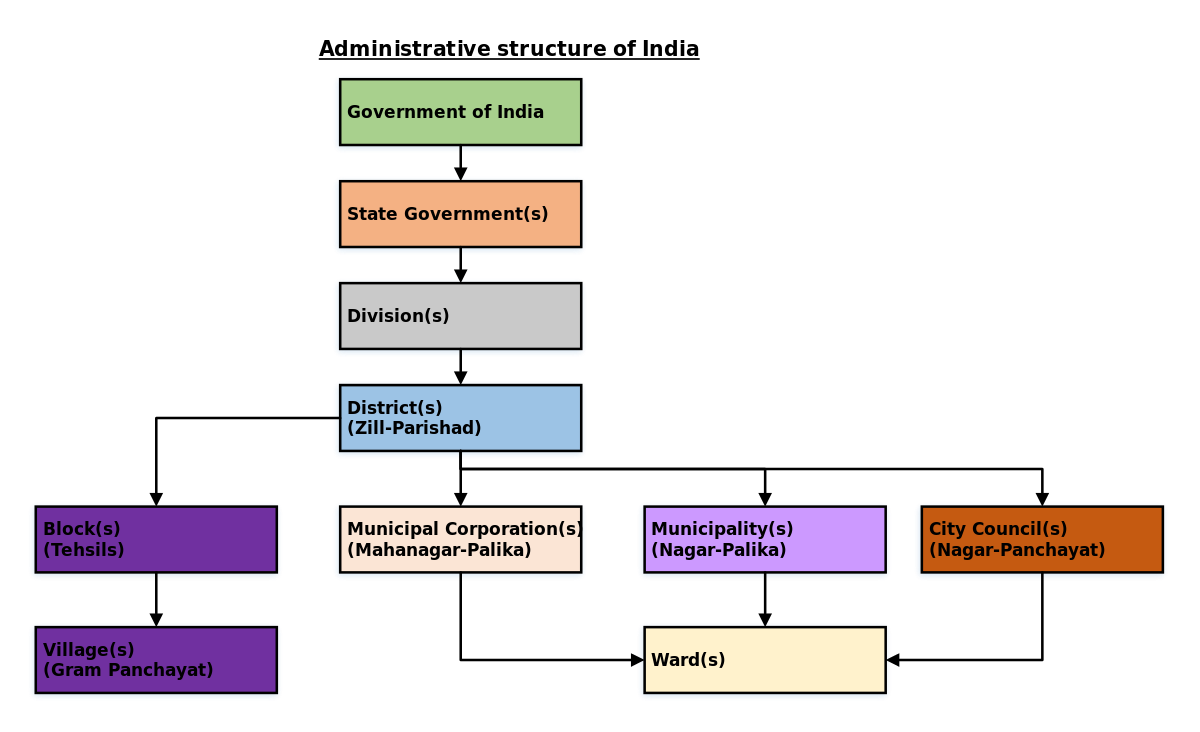
Urban Local Government in India
Topics Discussed: -
·
Introduction
·
74th Constitutional Amendment Act, 1992
·
Composition of Urban Local Bodies
·
Qualification for Membership (Art 243V)
·
Powers, authority and responsibilities of Municipalities (243W)
·
District Planning Committees (243ZD) and Metropolitan Planning
Committees (243E)
·
Introduction
The
term urban local government in India signifies the governance of an urban area
by the People through their elected representatives. The jurisdiction of an
urban local government is limited to a specific Urban area which is demarcated
for this purpose by the State Government.
·
74th
Constitutional Amendment Act, 1992
This
Amendment Act has inserted a new Part IX an into the Constitution which deals
with the administration of the Municipalities and Nagar Palikas. It Consists of
Articles 243P to 243ZG. In addition, the act also added a new twelfth Schedule
to the Constitution. The act gave Constitutional Status to the municipalities.
Some
of the compulsory provisions which are binding on all States are:
1.
Constitution of Nagar panchayats, municipal councils and municipal corporations in
transitional areas (areas in transition from a rural area to urban area),
smaller urban areas and larger urban areas respectively;
2.
Reservation
of seats in urban local bodies for Scheduled Castes / Scheduled Tribes roughly
in proportion to their population; (Article
243 T)
3.
Reservation
of seats for women up to one-third seats (Article
243 T)
4.
The State
Election Commission, constituted in order to conduct elections in the
panchayati raj bodies (see 73rd
Amendment) will also conduct elections to the urban local self- governing
bodies (Article 243 ZA)
5.
The State Finance Commission, constituted to deal with financial affairs of the Panchayati Raj
bodies will also look into the financial affairs of the local urban self-governing
bodies (Article 243 Y)
6.
Tenure
of urban local self-governing bodies
is fixed at five years and in case of earlier dissolution fresh elections
are to be held within six months (Article
243 Q)
Some
of the voluntary provisions which are not binding, but are expected to be
observed by the States are:
1.
Giving
representation to members of the Union and State Legislatures in these bodies;
2.
Providing
reservation for backward classes;
3.
Giving
financial powers in relation to taxes, duties, tolls and fees etc.;
4.
Making
the municipal bodies autonomous and devolution of powers to these bodies to
perform some or all of the functions enumerated in the Twelfth Schedule added
to the Constitution through this Act and/or to prepare plans for economic
development.
In
accordance with the 74th Amendment, municipal corporations and municipalities
(municipal boards or municipal committees) are now regulated in a fairly
uniform manner in all the States. However, one must remember that local
self-government continues to be a subject in the State List.
Thus,
the 73rd and 74th amendments provide a framework for the States in respect of
local government. Thus, each State has its own Election Commission which
conducts elections to all local bodies after regular intervals of five years.
Each
State has its Finance Commission to regulate finances of the local bodies.
Seats are reserved in the corporations and municipalities for Scheduled Castes
and Tribes. One-third seats are reserved for women in all local bodies – urban
and rural.
·
Composition
of Urban Local Bodies (Art 243R)
Ø The members of a Municipality would generally be elected by direct
election from territorial Constituencies. The Chairperson Shall is elected in
the manner provided by the Legislature. The Legislature of a State may by law
provide for representation in a municipality, without right to vote in the
meetings of the Municipality, of following people.
Ø Persons having Special Knowledge or experience in municipal
administration,
2. Members of Lok Sabha, State Assembly, Rajya Sabha and ‘Legislative Council
and
3. The Chairpersons of Committees Constituted under CI. (5) of Art 243S.
·
Qualification
for Membership (Art 243V)
The
Qualification is the same as is required for being Chosen as a member of State
Legislature. The Only difference is that whereas the minimum age for Contesting
election here is 21 years [years in case of State Legislature (Article 173)].
·
Powers,
authority and responsibilities of Municipalities (243W)
Ø Legislatures
of States have been Conferred the Power to Confer on the Municipalities All
Such Powers and authority as may be necessary to enable them to function as
institutions of self-government. It has specifically been mentioned that they
may be given the responsibility of: -
o Preparation of plans for economic development and Social Justice.
b. implementation of Schemes as may be entrusted to them, and
c. in regard to matters listed in the 12th Schedule. This Schedule Contains 18
items, e.g., Urban Planning, Regulation of Land Use, Roads and Bridges, Water
Supply, Public Health, Fire Services Urban Forestry, Slums etc.
·
Powers to
impose taxes and financial resources
o A State Legislature may by law authorize a Municipality to levy,
Collect and appropriate taxes, duties, tolls etc. The law may lay down the
limits and prescribe the procedure to be followed. It Can also assign to a
Municipality Various taxes, duties etc. Collected by the State Government.
Grants-in-aid may be given to the Municipalities, from the Consolidated Fund of
the State.
·
District
Planning Committees (243ZD) and Metropolitan Planning Committees (243E)
Ø Apart
from giving Constitutional recognition to Municipalities the 74th Amendment
lays down that in every State two Committees Shall be Constituted.
1. At the district level a District Planning Committee [Art. 243D]
2. In every metropolitan area a Metropolitan Planning Committee [Art. 243ZB].
Ø The
Composition of the Committees and the manner in which the Seats are to be
filled are to be provided by a law to be made by the State Legislature. But it
has been laid down that,
Ø In Case of the District Planning Committee at least 4/5th of the
members Shall be elected by the elected members of the District Level Panchayat
and of the Municipalities in the district from amongst themselves. Their
proportion would be in accordance with the ration of urban and rural population
of the district.
Ø In Case of Metropolitan Planning Committee at least 2/3rd of the
members of the Committee Shall be elected by the Members of the Municipalities
and Chairpersons of the Panchayats in the Metropolitan area from amongst
themselves. The proportion of seats to be shared by them would be based on the
ratio of the population of the Municipalities and the Panchayats in the area.
Ø While
the District Planning Committee is to prepare a development plan for the whole
district, the Metropolitan Planning Committee Will prepares a development plan
for the whole Metropolitan area.
Ø The
State Legislature Would by law makes provision with respect to:-
1. The functions relating to district planning/metropolitan planning that may
be assigned to the district Committees, and
2. The manner in which the Chairperson of a district Committee may be Chosen.
3. The representation of the Central and State Governments and of such
organization and institutions in the Metropolitan Planning Committee as may be
deemed necessary.
Ø The respective Committee shall prepare and forward the development plan to the State Government.


Comments on “Urban Local Government in India”