


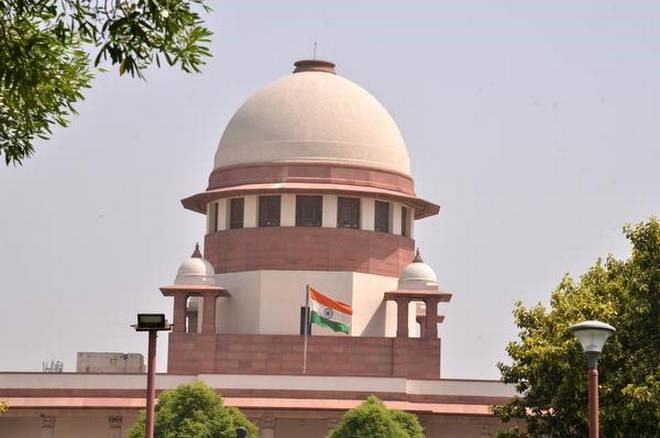
Supreme
Court of India
Topics Discussed: -
·
Introduction
·
Organization of the Supreme court
·
Appointment of Judges of SC
·
Qualification of Judges of SC
·
Oath or Affirmation of Supreme Court Judges
·
Tenure of Supreme Court Judges
·
Removal of Supreme Court Judges
·
Important Terms relating to SC
·
Seat of Supreme Court
·
Independence of Supreme Court
·
Jurisdiction and Powers of Supreme Court
·
Introduction
I.
India
has a single unified and integrated judicial system and the Supreme Court is
the highest court in India. This is unlike the dual court system in USA- the
federal and state courts, adjudicating under separate Constitutions.
II.
A
single, integrated judiciary represents a hierarchy of courts. The Supreme
Court stands at the top of this single integrated judicial system with High
Courts at the State level.
III.
The
Indian constitution provides for a provision of Supreme Court under Part V
(The Union) and Chapter 6 (The Union Judiciary).
IV.
Articles
124 to 147 in Part V of the Constitution deal with the organisation,
independence, jurisdiction, powers and procedures of the Supreme Court.
V.
Article
124 provides for the establishment and constitution of Supreme Court of India,
which is the apex court of India. It was established on 28th January, 1950 i.e.
two days after the commencement of the Constitution.
·
Organization of the Supreme court
I.
Article
124(1) – “There shall be a Supreme Court of India consisting of a Chief Justice
of India and, until Parliament by law prescribes a large number, of not more
than seven other judges.”
II.
The
Parliament is competent to increase the number of judges if it deems necessary.
To begin with, besides the Chief Justice, there were only 7 other judges. The
Parliament has increased the number of judges from time to time. As in 2014,
there are 29 judges besides the Chief Justice who is also called the Chief
Justice of India.
III.
The
sanctioned strength of the judges is 34, consisting of the Chief Justice and 33
other judges.
Note: Supreme Court (Number of Judges) Bill of 2019 has
added four judges to strength. It increased the judicial strength from 31 to
34, including the CJI.
·
Appointment of Judges of SC

I.
The judges
of the Supreme Court are appointed by the President. The CJI is
appointed by the President after consultation with such judges of the
Supreme Court and high courts as he deems necessary.
II.
The
other judges are appointed by the President after consultation with
the CJI and such other judges of the Supreme Court and the high courts as he
deems necessary. The consultation with the chief justice is obligatory in
the case of appointment of a judge other than Chief justice.
III.
Appointment
of Chief Justice from 1950 to 1973: The practice has been to appoint the
senior most judge of the Supreme Court as the chief justice of India. This
established convention was violated in 1973 when A N Ray was
appointed as the Chief Justice of India by superseding three senior
judges. Again in 1977, M U Beg was appointed as the chief justice of India
by superseding the then senior-most judge.
v This discretion of the government was curtailed by the Supreme
Court in the Second Judges Case (1993), in which the Supreme Court
ruled that the senior most judge of the Supreme Court should alone
be appointed to the office of the Chief Justice of India.
·
Collegium System
ü Collegium system was born through “Third judges case” and
it is in practice since 1998. It is used for appointments and transfers of
judges in High courts and Supreme Courts.
ü There is no mention of the Collegium either in the original
Constitution of India or in successive amendments

Note: Controversy over Consultation and Evolution of Collegium system
·
The
Supreme Court has given different interpretations of the word ‘consultation’ in
the above mentioned provisions.
ü In the First Judges case (1982), the Court held that
consultation does not mean concurrence and it only implies exchange of views.
ü In the Second Judges case (1993), the Court reversed its
earlier ruling and changed the meaning of the word consultation to concurrence.
ü In the Third Judges case (1998), the Court opined that
the consultation process to be adopted by the Chief Justice of India requires ‘consultation
of plurality judges’.
ü The sole opinion of the CJI does not constitute the consultation
process. He should consult a collegium of four senior most judges of the
Supreme Court and even if two judges give an adverse opinion, he should
not send the recommendation to the government.
ü The court held that the recommendation made by the chief
justice of India without complying with the norms and requirements of the
consultation process are not binding on the government.
·
Qualification of Judges of SC
As
per Article 124, an Indian citizen
who is below 65 years of age is
eligible to be recommended for appointment as a judge of the SC if:
1.
He/she
has been a judge of one or more High Courts, for at least 5 years, or
2.
He/she
has been an advocate in one or more High Courts for at least 10 years, or
3.
He/she
is in the opinion of the President, a distinguished jurist.
Note: The
Constitution has not prescribed a
minimum age for appointment as a judge of the Supreme Court.
·
Oath or Affirmation of SC Judges

A
person appointed as a Supreme Court Judge, before entering upon his office
takes in the form prescribed an Oath or Affirmation before the President or
some person appointed by him (Article
124 (6).
In his oath, a judge of the Supreme
Court swears:
I.
to
bear true faith and allegiance to the Constitution of India;
II.
to
uphold the sovereignty and integrity of India;
III.
to
duly and faithfully and to the best of his ability, knowledge and judgement to perform the duties of the
Office without fear or favour, affection or ill-will; and
IV.
to
uphold the Constitution and the laws.
·
Tenure of SC Judges
The
Constitution has not fixed the tenure of a judge of the Supreme Court. However,
it makes the following three provisions in this regard:
I.
He
holds office until he attains the age of 65 years. Any question regarding his
age is to be determined by such authority and in such manner as provided by
Parliament.
II.
He
can resign his office by writing to the President.
III.
He
can be removed from his office by the President on the recommendation of the
Parliament.
· Removal of SC Judges
 1)
A
motion support removal must be supported by 100 Lok Sabha / 50 Rajya Sabha
members. The presiding officer may or may not admit it.
1)
A
motion support removal must be supported by 100 Lok Sabha / 50 Rajya Sabha
members. The presiding officer may or may not admit it.
2)
If
admitted an inquiry committee of Chief justice of India or a Supreme Court
judge; Chief justice of high court and distinguished jurist checks if judge is
guilty
3)
If
the committee finds the judge guilty then parliament can pass a motion by
special majority in both houses.
4)
An
address supported by this motion must be presented to the president on the same
day. Then by a presidential order the judge can be removed.
·
Important Terms relating to SC
1.
Acting Chief Justice (Art. 126)
·
When
the Office of the Chief Justice of India is vacant or when the Chief Justice,
by reason of absence or otherwise, is unable to perform the duties of his
office, the duties of the office shall be performed by such one of the other
Judges of the Court as the President may appoint for the purpose.
2.
Ad Hoc Judges (Art. 127)
·
If
at any time there is a lack of quorum of the Judges of the Supreme Court to
hold or continue any session in the Court, the Chief Justice of India may
with the previous consent of President and after consultation with the Chief
Justice of the High Court concerned, request in writing the attendance at the
sittings of the Court, as an ad hoc Judge, for such period as may be necessary,
of a Judge of a High Court duly qualified for appointment as a Judge of the
Supreme Court to be designated by the Chief Justice of India.
3.
Retired Judges (Art. 128)
·
The
Chief Justice of India with the previous consent of the President may request a
retired Judges of the Supreme Court or Federal Court or a retired Judge of a
High Court who is duly qualified to be appointed as a Judge of the Supreme
Court to sit and act as a Judge of the Supreme Court. Such a judge is entitled
to such allowances as the President may determine.
·
Seat of Supreme Court (Art. 130)
The
SC shall sit in Delhi or, in such other place or places, as the Chief Justice
of Indian may, with the approval of the President, from time to time appoint.
·
Independence of Supreme Court
I.
The
Supreme Court is a Federal court,
the highest court of appeal, the guarantor of the fundamental rights of the
citizens and guardian of the Constitution.
·
Therefore,
its independence becomes very essential for the effective discharge of the
duties assigned to it. It should be free from the encroachments, pressures and
interferences of the executive (council of ministers) and the Legislature
(Parliament). It should be allowed to do justice without fear or favour.
II.
The
Constitution has made the following provisions to safeguard and ensure the independent and impartial functioning
of the Supreme Court:
1.
Mode
of appointment
2.
Security
of tenure
3.
Fixed
service conditions
4.
Expenses
charged on the consolidated fund
5.
Conduct
of judges cannot be discussed
6.
Ban
on practice after retirement
7.
Power
to punish for its contempt
8.
Freedom
to appoint its staff
9.
Its
jurisdiction cannot be curtailed
10.
Separation
from Executive
· Jurisdiction and Powers of Supreme Court

·
Original Jurisdiction
1.
As
a Federal court, the Supreme Court decides disputes between different units of
the Indian Federation. More elaborately, any dispute between:
Ø the Centre and one or more states; or
Ø the Centre and any state or states on one side and one or more
states on the other; or
Ø between two or more states.
2.
In
the above federal disputes, the Supreme Court has exclusive original jurisdiction.
3.
Further,
this jurisdiction of the Supreme Court does not extend to
the following:
ü A dispute arising out of any pre-Constitution treaty, agreement,
covenant,
ü engagement, sanad or other similar instrument.
ü A dispute arising out of any treaty, agreement, etc., which
specifically provides that the said jurisdiction does not extend to such a
dispute.
ü Inter-state water disputes.
ü Matters referred to the Finance Commission.
ü Adjustment of certain expenses and pensions between the Centre and
the states.
ü Ordinary dispute of Commercial nature between the Centre and the
states.
ü Recovery of damages by a state against the Centre.
·
Writ Jurisdiction
1.
The
Supreme Court is empowered to issue writs, including habeas corpus,
mandamus, prohibition, quo-warranto and certiorari for the enforcement of
the fundamental rights of an aggrieved citizen.
ü In this regard, the Supreme Court has original jurisdiction in
the sense that an aggrieved citizen can go directly to the Supreme Court, not
necessarily by way of appeal.
ü However, the writ jurisdiction of the Supreme Court is not
exclusive. The High Courts are also empowered to issue writs for the
enforcement of the Fundamental Rights.
·
Appellate Jurisdiction
1.
The
Supreme Court is primarily a court of appeal and hears appeals against the
judgements of the lower courts. It enjoys a wide appellate jurisdiction which
can be classified under four heads:
ü Appeals in constitutional matters
ü Appeals in civil matters
ü Appeals in criminal matters
ü Appeals by special leave
·
Advisory Jurisdiction
1.
The
Constitution under Article 143 authorises the President to seek the
opinion of the Supreme Court in the two categories of matters:
ü On any question of law or fact of public importance which has
arisen or which is likely to arise.
ü On any dispute arising out of any pre-constitution treaty,
agreement, covenant, engagement or other similar instruments.
· A Court of Record
1.
As
a Court of Record, the Supreme Court has two powers:
ü The judgements, proceedings and acts of the Supreme Court are
recorded for perpetual memory and testimony. These records are admitted to be
of evidentiary value and cannot be questioned when produced before any court.
ü They are recognized as legal precedents and legal references.
ü It has power to punish for contempt of court, either
with simple imprisonment for a term up to six months or with fine up to 2,000
or with both.
·
Power of Judicial Review
1.
Judicial
review is the power of the Supreme Court to examine the constitutionality of
legislative enactments and executive orders of both the Central and state
governments.
2.
On
examination, if they are found to be violate of the Constitution
(ultra-vires), they can be declared as illegal, unconstitutional and
invalid (null and void) by the Supreme Court. Consequently, they cannot be
enforced by the Government.
|
Don’t Miss -Important resources for
your dream - IAS Exam preparation |
|
Click here to practice UPSC CSE Prelims exam
- Previous Year Question Papers |
|
Click here to practice UPSC CSE Mains exam
–Previous Year Question Papers |
|
Click here to practice Optional Paper - Public administration- Question Papers |
|
Stay updated by Studying Daily Current
Affairs |
|
Don’t
forget to access valuable notes on telegram-click here to Join telegram |
|
Having
doubts while preparing? – Simply ask on WhatsApp “9717724350” |


Comments on “Supreme Court of India”