


Prime
Minister and Council of Ministers
Topics Discussed: -
·
Introduction
·
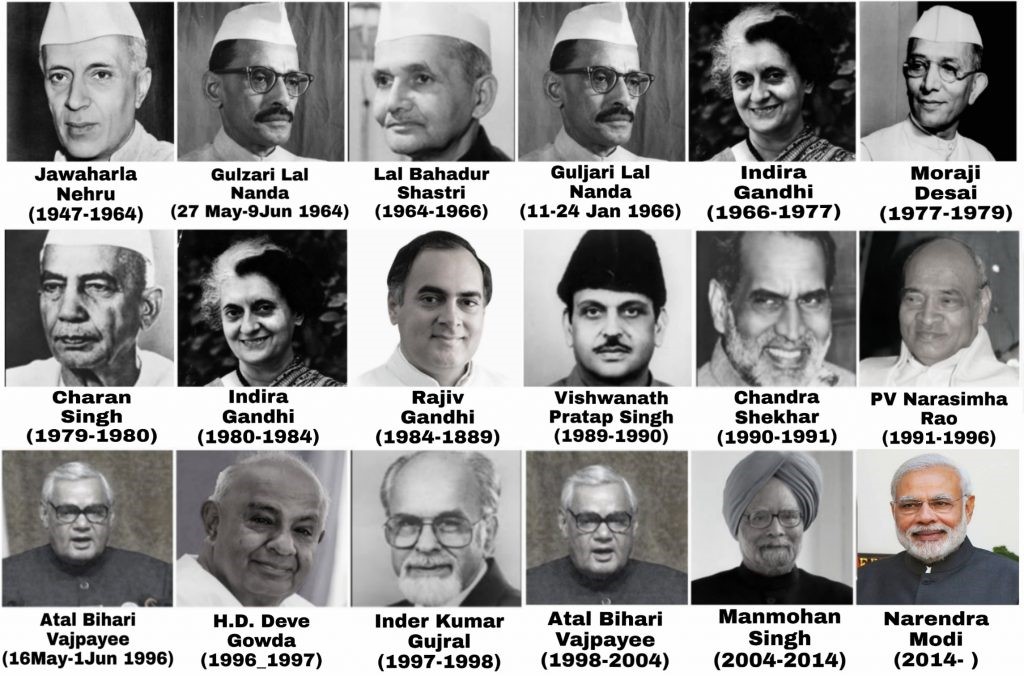
Prime Minister of India
·
Term of the Indian Prime Minister
·
Powers of the Prime Minister
·
Eligibility of becoming PM
·
Council of Ministers
·
Categories of Ministers
·
PRACTICE QUESTIONS
·
Introduction
I.
Article
75 of the Indian Constitution mentions that a Prime Minister is one who is
appointed by the President.
II.
There
is no specific procedure for his election or appointment. Article 74(1) states
that there shall be a Council of Ministers with a Prime Minister at the head to
aid and advise the President.
III.
Here
the word “shall” means that the President cannot function without the
Council of Ministers. This implies that, the President is the
constitutional head of State, but the real head of the government is
the PM. Thus, the Indian Constitution itself recognizes a Council of
Ministers.

·
Prime
Minister of India

1.
He
is the head of government or the real executive in the Indian system.
2.
President
appoints the prime minister however no system of appointment is given in the
constitution.
3.
However,
by convention of a parliamentary democracy the leader of the largest party of
parliament becomes the PM.
4.
The
President can exercise discretion when no party has clear majority. He appoints
a person and asks him to prove his majority in the house.
5.
If
the PM dies and no successor is in sight, then again the president can appoint
a suitable person at his discretion as caretaker for continuity. However if
winning party has a candidate then the president has no choice.
6.
To
be a PM a person need not be an MP but he has to become one within 6 months of
being appointed or else his appointment become void.
7.
As
per the Govt of India (Allocation of business) Rules created by
the president, different departments were created to handle governments
business.
8.
Ministers
and subject distribution was done to each ministry by the president on advice
of the prime minister.
·
Term of
the Indian Prime Minister
1.
Once
appointed, the Prime Minister holds office so long as he/she enjoys the
support of the majority of members of Lok Sabha. He cannot be removed by the
President.
2.
If
he loses the majority support in the Lok Sabha, he should resign or the
President must dismiss him.
·
Powers of
the Prime Minister
I.
Prime
Minister of India serves the country by following various functions. He
performs his functions taking responsibilities as:
II.
The
leader of Country: The Prime Minister of India is the Head of the
Government of India.
III.
Portfolio
allocation: The Prime Minister has the authority to assign portfolios to
the Ministers.
IV.
Chairman
of the Cabinet: The Prime Minister is the chairman of the cabinet and
presides the meetings of the Cabinet. He can impose his decision if there is a
crucial opinion difference among the members.
V.
Official
Representative of the country: Prime minister represents the country for
high-level international meetings
VI.
The
link between the President and the Cabinet: The Prime Minister acts as the
link between President and cabinet. He communicates all decisions of the
Cabinet to the President which is related to the administration of the affairs
of the Union and proposals for legislation.
VII.
Head: The
Prime Minister is the head of Nuclear Command Authority, NITI Aayog,
Appointments Committee of the Cabinet, Department of Atomic Energy, Department
of Space and Ministry of Personnel, Public Grievances and Pensions.
VIII.
Chief
Advisor: He acts as the chief advisor to the President
Hence, in a Parliamentary system like
in India, Prime Minister is the “Keystone of the Cabinet Arch”
·
Eligibility
of becoming PM
To become an Indian prime minister one
has to be
I.
A
citizen of India.
II.
A
member of either Rajya Sabha or Lok Sabha
III.
He
should have completed his 30 years if he is a member of the Rajya Sabha or can
be 25 years of age if he is a member of the Lok Sabha
· Council of Ministers

I.
The
PM + Council of ministers are the real executives of the union.
II.
They
aid and advice the president in the exercise of his functions but such advice
is binding on the president.
III.
No
court shall inquire into the advice given by the Council of
ministers to the President which means they are liable for official acts
of the president done on their advice. Constitution however doesn’t grant any
immunity either for personal or official acts hence ministers can be treated
like ordinary citizens.
IV.
The
total strength of the PM + Council of ministers shall not exceed 15%
of the strength of the Lok Sabha [91st amendment]. The person who has been
disqualified on grounds of defection shall also be disqualified to be appointed
as the PM [91st amendment].
V.
Council
of ministers is collectively responsible to the Lok Sabha. A minister who
isn’t a MP for six consecutive months shall cease to be the minister. A
minister can take part in proceeding of both houses as he is member of the
government but can vote only in the house of which he’s a member.
VI.
Collective responsibility: This means that entire Council of ministers is a team
that sinks or swims together. So if the Lok Sabha passes a no confidence motion
against the Council of ministers then all have to resign. Only the
Lok Sabha can pass the motion of no confidence; it can’t be against a single
minister but the entire Council of ministers only.
VII.
Individual responsibility: Every minister is answerable individually to the Lok Sabha for
steps taken by his ministry. If Lok Sabha does not approve the act of the
minister. The whole cabinet has to resign, because of collective
responsibility.
· Categories of Ministers

I.
Cabinet:
They attend cabinet meetings and play important role in central government.
II.
Minister
of state: They can be independent in charge of department that aren’t attached
to cabinet ministries or in charge of specific department part of a ministry
/specific work in a ministry which is headed by a cabinet minister.
III.
Deputy
Minister: They are attached to cabinet ministers or ministers of state and
assist them in their work.
Note: -
I.
The
last two categories don’t form part of cabinet meetings.
II.
Cabinet
isn’t mentioned in the original text of the constitution but only in
44th amendment it was inserted in article 352.
·
PRACTICE
QUESTIONS
Q.1: Head of the government is
President
PM
Both
none
Q.2: Powers of the PM:
As
head of the council of ministers he recommends people to be appointed as
ministers to the president.
He
allocates and reshuffles portfolios amongst them. He can ask the minister to
resign or tell the president to dismiss him.
All
He
supervises activities of all ministers. His resignation or death leads to
dissolution of the council of ministers.
Q.3: PM + Council of ministers are
immune
from prosecution
immune
from criminal proceedings
immune
from civil proceedings
not
immune
Q.4: total strength of the PM +
Council of ministers shall not exceed 15% of the strength of the Lok Sabha is
by amendment
91
86
77
45
Q.5: Council of ministers is
collectively responsible to the
PM
President
Courts
Lok
Sabha


Comments on “Prime Minister and Council of Ministers”