


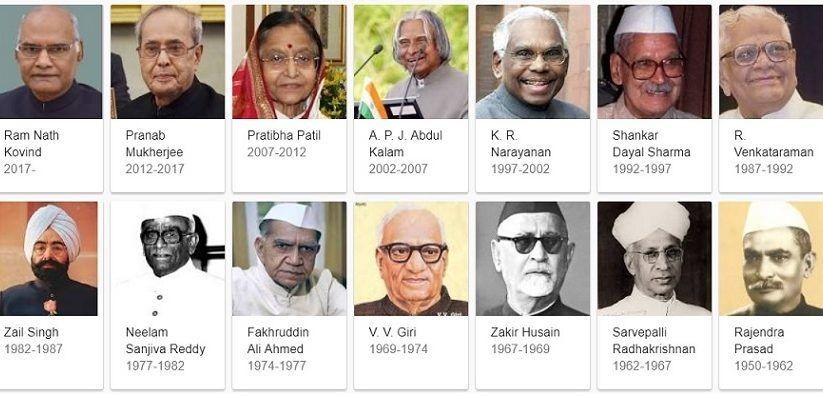
President
of India
Topics Discussed: -
·
Introduction
·
Election Qualifications
·
Manner of Election
·
Oath or Affirmation
·
Conditions of President’s Office
·
Term of President’s Office
·
Impeachment of President of India
·
Vacancy of President’s Office
·
Powers and Functions of President of India
·
Introduction
Indian
President is the head of the state. He is the first citizen of India and is a
symbol of solidarity, unity and integrity of the nation.
He is a part of Union Executive
along with Vice-President, Prime Minister, Council of Ministers and
Attorney-General of India.
·
Election
Qualifications
I.
He/she
should be a citizen of India;
II.
Should
have completed the age of 35 years;
III.
Should
be qualified to be elected as a member of
Lok Sabha;
IV.
Should
not hold any office of profit i.e. the
candidate should not be a government servant. (The office of the President, the Vice-President, the Governor
or the Minister of the Union or the State is not considered as an office
of profit for this purpose).
· Manner
of Election

There
is no direct election for the Indian President. An electoral college elects
him. The electoral college responsible
for President’s elections comprises elected members of:
Lok
Sabha and Rajya Sabha
Legislative
Assemblies of the states (Legislative
Councils have no role)
Legislative
Assemblies of the Union Territories of
Delhi and Puducherry
Note:
·
Value
of the vote of an MLA is given below:

·
Value
of the vote of MP is given below:

The following group of people are
not involved in electing the President of India:
I.
Nominated
Members of Lok Sabha (2) and Rajya Sabha (12)
II.
Nominated
Members of State Legislative Assemblies
III.
Members
of Legislative Councils (Both elected and nominated) in bicameral legislatures
IV.
Nominated
Members of union territories of Delhi and Puducherry
·
Proportional
Representation
I.
The
election is held by a single
transferable vote system of proportional representation.
II.
The
voting is done by secret ballot.
III.
Names
of all the candidates are listed on the ballot paper and the elector gives
them numbers preferences. Every voter may mark on the ballot paper as many
preferences as there are candidates. Thus the elector shall place the
figure “1” opposite the name of the candidate whom he/she chooses for
first preference and so on.
IV.
To
be elected, a candidate must get more than 50% of the total valid votes polled.
This is known as Quota. The Quota
is determined by calculating the total number of votes polled divided by
the number of candidates to be elected plus one.
· Oath
or Affirmation

Every
President and every person acting as President or discharging the functions of
the President shall, before entering upon his office, make and subscribe in the
presence of the Chief Justice of India or, in his absence, the senior most Judge
of the Supreme Court available, an oath or affirmation in the following form,
that is to say – “I, A.B., do swear in
the name of God / solemnly affirm that I will faithfully execute the office of
President (or discharge the function of the President) of India and will to the
best of my ability preserve, protect and defend the Constitution and the law
and that I will devote myself to the service and well-being of the people of
India.”
·
Conditions
of President’s Office

A.
There
are a few conditions for the candidate running for the President’s elections:
B.
He
cannot be a member of Lok Sabha and Rajya Sabha. If he has been a member of
either of the house, he should vacate the seat on his first day as President in
the office
C.
He
should not hold any office of profit
D.
For
his residence, Rashtrapati Bhavan is provided to him without the payment of
rent
E.
Parliament
decides his emoluments, allowances and privileges
F.
Parliament
cannot diminish his emoluments and allowances during his term of office
G.
He
is given immunity from any criminal proceedings, even in respect of his
personal acts
H.
Arrest
or imprisonment of President cannot take place. Only civil proceedings can be
initiated for his personal acts that too after giving two months’ of prior
notice.
·
Term of
President’s Office
A.
Once
President is elected, he holds office for five years.
B.
He
sits in the office even after the completion of five years given no new
election have taken place or no new President has been elected till then.
C.
He
can also be re-elected and there is no cap on his re-election.
·
Impeachment
of President of India
A.
The
only condition for the initiation of impeachment of Indian president is the
‘violation of the constitution.’
B.
Both
the Lok Sabha as well as Rajya Sabha can initiate impeachment charges.

·
Vacancy
of Presidents of Office

1.
If the
office of the President falls vacant either due to death or resignation
or impeachment, the Vice-President
officiates it for a period, not more than six months.
2.
The Constitution
makes it obligatory that in case of vacancy of President’s office, the election must be held within six months. The
newly elected President then holds office for five years.
·
POWERS
OF PRESIDENT OF INDIA

·
Legislative
Powers
A.
The
President summons and prorogues the
Houses of Parliament. He summons the Parliament at least twice a year,
and the gap between two sessions cannot be more than six months.
B.
The
President has the power to dissolve the
Lok Sabha even before the
expiry of its term on the recommendation
of the Prime Minister.
C.
The
President nominates twelve members to
Rajya Sabha from amongst
persons having special knowledge in the field of literature, science, art
and social service.
D.
The
President may also nominate two members
of the Anglo-Indian community to the Lok Sabha in case that community
is not adequately represented in the House.
E.
The President can call a joint sitting of the two Houses of
Parliament in case of a disagreement between Lok Sabha and Rajya Sabha on a non-money bill.
F.
The
President has the right to address and send messages to Parliament. The President addresses both Houses of
Parliament jointly at the first session after every general election as
well as the commencement of the first session every year. These addresses contain policies of the
government of the day.
G.
Every
bill passed by Parliament is sent to the President for his/her assent. The
President may give his/her assent,
or return it once for the reconsideration of the Parliament. If passed
again the President has to give her assent.
H. Without
his/her assent no bill can become a law.
I.
The President may promulgate an ordinance when the Parliament is
not in session. The
ordinance so issued has the effect of a law.
J.
Such
ordinance should be laid before both Houses of Parliament when they
reassemble. If no action is taken, it automatically lapses six weeks after
the commencement of the next
session of Parliament.
Executive Powers
1.
Head of the Union:
·
The
President is at the head of the Union Executive.
·
Consequently,
all the executive powers are exercised in his name.
·
The
executive power of the Union to be exercised by the President is extended to
the matters with respect to which Parliament has power to make laws and to
conclude treaty and agreement.
2.
Appointments:
·
As
the head of the executive, the President appoints the Governors of States, the
Judges of the Supreme Court and the High Courts, the Auditor General of India
and many other high officials, such as the members of Finance Commission,
Election commission, Union Public commission etc.
3.
Appointment of the Prime Minister and other Ministers:
·
The
President appoints the Prime Minister and with his advice the other Ministers
of the Union Council of Ministers.
·
But
here too, as in all other appointments, the President can seldom use his
discretion.
·
He
is, ordinarily, duty-bound to summon the leader of the political party which
secures an absolute majority in the Lok Sabha to become the Prime Minister and
form the Ministry.
·
He
does enjoy some discretionary powers in the matter only under exceptional
circumstances.
·
When
no single political party wins a clear absolute majority and, as a result, no
Council of Ministers can be formed without a coalition of parties the President
can exercise his discretion judiciously in appointing the Prime Minister.
·
Such
situations developed in the past.
·
India
has entered into an age of coalition politics. And it may so happen that
no single party will be able to secure an absolute majority, and the President
may be required to exercise his discretionary power for some time to come, in
appointing Prime Minister.
4.
Can ask to prove majority in Lok Sabha:
·
The
Union Council of Ministers normally remains in office for five years, unless
dissolved earlier for any reason.
·
The
President must be satisfied that the Council of Ministers enjoys the confidence
of the majority of the Lok Sabha.
·
In
case of any doubt he can ask the Council of Ministers to prove its majority in
the Lok Sabha, as the Prime Ministers Sri H.D. Deve Gowda was asked by the
President after the official withdrawal of support by the Congress Party from
Ministry.
·
The
President can also dissolve the Union Council of Ministers in accordance with
Article 75(2) of the constitution, if he finds that the Ministry does not enjoy
the support of the majorities in the Lok Sabha.
5.
Supreme Commander
·
As
head of State, the President is the Supreme Commander of the Armed
1.
Financial Powers
·
The
President causes the annual budget of the Union Government to be laid before
Parliament every year.
·
No
proposal for spending money or raising revenues for purposes of government can
be introduced in Parliament without previous permission of the President.
2.
Military and Diplomatic Powers
The
constitution vests the supreme command
of the Defence Forces in the President, but he is required to exercise that
power in accordance with law Parliament
has exclusive Legislative Power relating to defence forces.
It
means that though the President may have the power to take action as to
declaration of war or peace or the employment of the defence forces. It is Parliament that is to regulate or
control the exercise of such powers.
The
executive power relating to foreign and diplomatic affairs is exercised by the Union Government, and all diplomatic
business is conducted in the name of the President.
Diplomatic
envoys and consular agents are accredited to him, and he sends diplomatic
envoys and consular agents are accredited to him and he sends diplomatic envoys
to foreign countries. All treaties and
international agreements are negotiated and concluded in the name of the
President.
·
Diplomatic Powers of the President of India:
1.
The
president receives ambassadors, High
Commissioners and diplomatic envoys from foreign nations.
2.
All
treaties and international agreements are concluded in the name of the President.
The President represents India in International Conferences.
3.
The
President has the powers of appointing Indian
Ambassadors to other countries.
3.
Judicial Powers
The President has the power to grant pardon reprieves, respites
& remission of punishment or to
suspend remit or commute the sentence of any person convicted of any offence.
1.
In
all cases where the punishment & sentence is by court martial.
2.
In
all cases where the punishment or sentence for an offence against a law
relating to a matter to which the, executive power of the Union extends.
3.
In
all cases where the sentence is a death sentence.
4.
Emergency Powers
He
deals with three types of emergencies given in the Indian Constitution:
1.
National
Emergency (Article 352)
2.
President’s
Rule (Article 356 & 365); and
3. Financial Emergency (Article 360)


Comments on “President of India”