


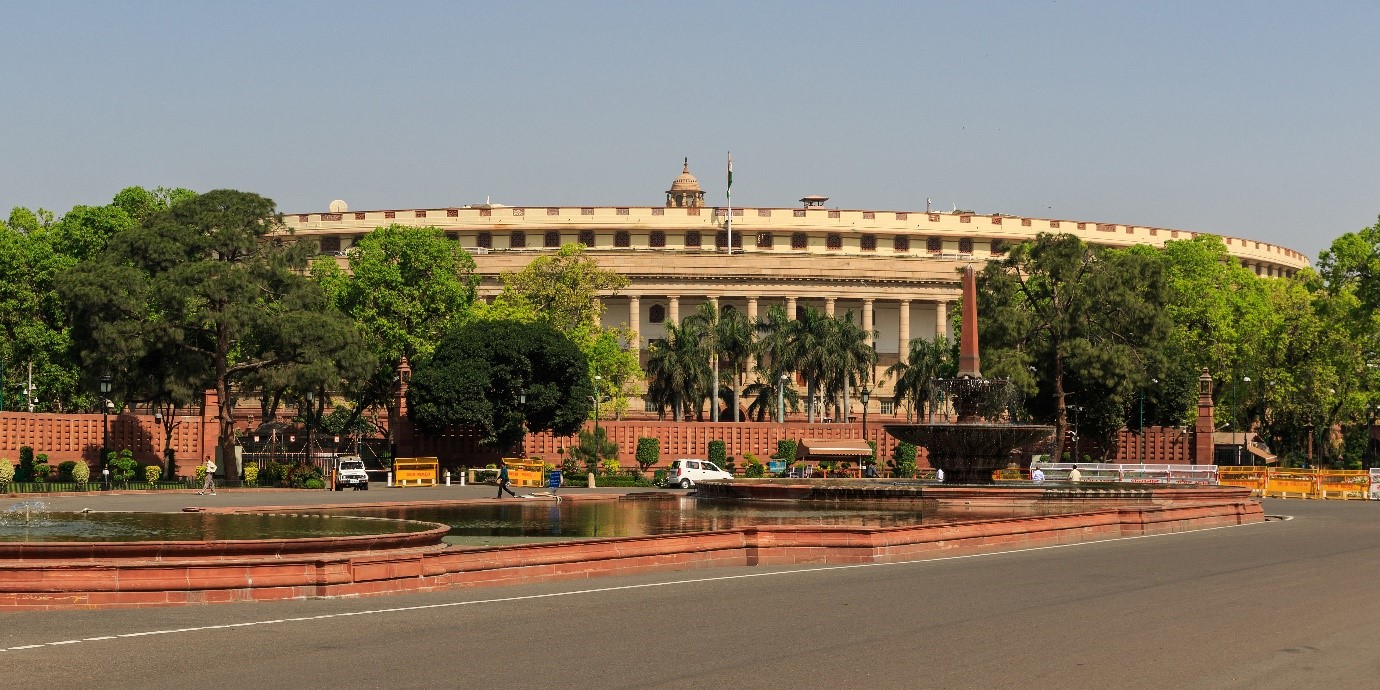
Parliament
in India
Topics Discussed: -
·
Resolutions
·
Legislative Procedure in Parliament
·
Funds
·
Multifunctional Role of Parliament
·
Parliamentary Committees
·
Resolutions
According
to Subhash Kashyap, former secretary general of Loksabha all resolutions
should be voted upon (Our Parliament, page 145); this factor
differentiates them from motions which are otherwise similar to resolutions.
Resolutions
come under ‘substantive motions’ (there are 3 kinds of motions – substantive,
substitute and subsidiary motions). Substantive motion is a self-contained
independent proposal submitted for the approval of the House and drafted in
such a way as to be capable of expressing a decision of the House.
Other
examples of substantive motions are motion of no confidence, motions for
election or removal of Speaker, Deputy Speaker etc.
The
resolution passed by parliament come under ‘government resolutions’.
What
is important is whether the standing committee accepts the resolution or not.
As the resolution is not voted upon, it may not be binding on the government.
This might be an excuse for the government if standing committee doesn’t
incorporate recommendations of the resolution.
· Legislative
Procedure in Parliament
|
Types of Bills in India |
||
|
S.No |
Name of the Bill |
Significance |
|
1 |
Ordinary Bill
(Article 107, Article 108) |
Concerned with
any matter other than financial subjects |
|
2 |
Money Bill
(Article 110) |
Concerned with
financial matters like taxation, public expenditure, etc |
|
3 |
Financial Bill
(Article 117 [1], Article 117[3]) |
Concerned with
financial matters (but are different from money bills) |
|
4 |
Constitutional
Amendment Bill (Article 368) |
Concerned with
the amendment of the provisions of the Constitution. |
|
Difference |
Ordinary Bill |
Money Bill |
|
Introduction |
In either Lok Sabha or Rajya Sabha |
Only in Lok Sabha |
|
Introduced By |
Minister or a Private Member |
Only a Minister |
|
President’s Recommendation |
Not Need |
Only after he recommends |
|
Rajya Sabha’s Role |
|
|
|
|
|
|
President’s Assent |
Sent for his assent only after being approved by both the houses |
Send for his assent only after Lok Sabha’s approval. (Rajya Sabha
approval is not required) |
|
Can be rejected, approved, or returned for reconsideration by the
President. |
Can be rejected or approved but cannot be returned for reconsideration
by the President. |
|
|
Joint Sitting of Both Houses |
In case of deadlock, there is a provision of a joint sitting |
No chance of disagreement, hence, no provision of a joint sitting |
·
Process
of passing bills:
1. Ordinary bill- The
five stages through, which and ordinary bill passes to become a law are as
follows:
(a) First reading- It includes
the introduction of the bill in either of the houses of the Parliament by a
minister or by a private member. It is followed by the grant of leave and its
publication in the Gazette of India.
(b) Second Reading: At this stage,
the bill undergoes detailed scrutiny including discussion of every clause. This
stage can be further divided into the stages of general discussion, committee
stage and consideration stage.
(c) Third Reading: At this stage, no
amendments are allowed. The bill needs to be passed by a simple majority of
members present and voting in the House. When bill is authenticated by the
presiding officer, it is sent to the other house for consideration and
approval.
(d) Bill in the second House: In the
second House also, the bill needs to be passed by a simple majority of members
present and voting in the House. If the second House passes the bill without
any amendments, the bill is sent to the president for his assent.
(e) Assent of the President: If the
president gives his assent to the bill, the bill becomes an act and placed on
the Statute Book. If the president withholds the assent to the bill, the bill
ends.
2. Money Bill: Under article
110(1) of the Constitution, a bill is deemed to be a money bill if it contains
only provisions dealing with imposition, abolition, remission, alteration or
regulation of any tax, matters of Consolidated Fund, provides imposition of
fines etc. The Speaker’s certificate on a money bill once given is final and
cannot be challenged. A money bill can be introduced in Lok Sabha only on the
recommendation of the President.
3. Finance Bills: Financial
bills are those bills which relates to revenue and expenditure. Financial bills
are of three Kinds-Money Bills-Article 110, financial bills (I) - Article 117
(1), Financial bills (II)-Article 117 (3). All money bills are financial bills,
but all financial bills are not money bills. Financial bill (I) can be
introduced only in the Lok Sabha and not in the Rajya Sabha and can be
introduced only on the recommendation of the president. Financial bill (II) can
be introduced in either House of parliament and recommendation of the President
is not necessary for its introduction. Both the houses have power to reject or
amend the bill.
4. Constitution Amendment Bills: Bills seeking
to amend all other provisions of the Constitution including those enumerated in
the proviso to article 368(2) are called as Constitution Amendment Bills. These
Bills can be introduced in either House of Parliament, but not in the state
legislature. These bills do not require prior permission of the president and
can be introduced either by a minister or by a private member.
There are three types of
constitutional amendment bills:
(1)
Bills that need to be passed by parliament by simple majority
(2) Bills that need to be passed by Parliament by the special majority
(3) Bills that need to be passed by Parliament by the special majority and also
to be ratified by not less than one-half of the state legislatures
Assent to Constitution Amendment
Bills: Constitution
Amendment Bills passed by Parliament by the special majority and, where
necessary, ratified by the requisite number of state legislatures are presented
to the President. The president must give his assent to the bill. He can
neither withhold his assent nor return the bill for reconsideration of the
parliament. The bill becomes an act after president’s assent.
Joint Sitting of two houses: The joint
sitting is a provision provided by the constitution to resolve the deadlock on
a bill between the two houses. A deadlock might arise, if after a bill has been
passed by one House and transmitted to the other House.
· Funds
provided to Government of India

|
Fund. |
Income |
Expenditure |
Parliamentary Authorisation required |
Article under which constituted |
|
Consolidated Fund |
Taxes and non-tax revenue |
All expenditure |
Prior to expenditure |
266 (1) |
|
Public Fund |
Public money other than those under consolidated fund |
Not required |
266 (2) |
|
|
Contingency Fund |
Fixed corpus of Rs. 500 crore |
Unforeseen expenditure |
After the expenditure |
267 (1) |
·
Multifunctional
role of Parliament
The
Constitution of India enumerates the powers and functions of the Indian
Parliament in Chapter II of Part V of the constitution.
The
powers and functions of the Indian Parliament may be generalized in the
following heads. While discussing these powers it should be borne in mind that
they are enjoyed and exercised by both the Houses of Parliament with a few
difference
1.
Law-making Powers: The Parliament of the Union Government is competent to legislate
on all matters that are enumerated in the Union List and the Concurrent List of
the Constitution.
2.
In
the Concurrent List, the Parliament and the State Legislatures have joint
jurisdiction. However, in case of conflict over any law made under the
Concurrent List, the Union Law will prevail upon the State Law provided the
State Law has not received the earlier assent of the President.
3.
The
Union Parliament is also competent to make law over the State List under the
following circumstances: -
4.
When
the proclamation of Emergency is in operation the Parliament can make law in
any item included in the State List. In case of the declaration of President’s
Rule in any State under Article 356 of the Constitution, the Parliament is
competent to legislate on any matter included in the State List (Article 250).
5.
In
normal times when Rajya Sabha passes a resolution by two-thirds majority of its
members present and voting that it is necessary in the national interest that
Parliament should make law with regard to any matter enumerated in the State
List, then Parliament is competent to make law in that matter for the whole or
any part of India (Article 249).
6.
The
Parliament is competent to legislate on any matter pertaining to the State List
if such legislation is deemed necessary for the implementation of international
treaties or agreements concluded with foreign States (Article 253).
7.
If
the legislatures of two or more States pass a resolution to the effect that it
is desirable to have a parliamentary law in any matter in the State List, then
the Parliament can make law for those States (Article 252).
8.
Except
in the above-mentioned occasions, the Parliament of India is not competent to
make law in the State List. If at any time, the Parliament encroaches upon the
rights of the States, the Supreme Court can prevent such encroachment of the
Parliament through its power of Judicial Review. The Parliament must make law
in accordance with the provisions of the Constitution.
9.
Financial Powers: In the financial domain the Parliament is the supreme authority.
Not a single paisa can be spent by the Executive without parliamentary
sanction.
10.
The
budget is annually prepared by the Cabinet and it is submitted for the approval
of the Parliament. The Parliament also approves all proposals of the Union
Government to impose taxes.
11.
Money
Bills can originate only in the Lok Sabha. After they have been passed by the
Lok Sabha, they are sent to the Rajya Sabha for approval. Within 14 days the
Rajya Sabha is expected to give its consent. Thus the power of the Rajya Sabha
is limited with regards to money Bills.
12.
Further,
to keep a vigil on the way the Executive spends the money granted by the
legislature, there are two Standing Committees of the Parliament. They are the
Public Accounts Committee and the Estimates Committee. These two Committees
exercise legislative control over the Executive on behalf of the Parliament.
13.
There
are certain items of expenditure included in the Budget which are not vatable
in the Parliament. These items include salary of the President, the Judges of
the Supreme Court, and the members of the Union Public Service Commission etc.
They are charged from the Consolidated Fund of India.
Control over the Executive
1.
The
Parliament keeps a day-to-day watch over the activities of the Executive. As
ours is a parliamentary system of Government, the Executive is responsible to
the Parliament for all acts of omissions and commissions.
2.
The
Parliament may remove a Cabinet out of power by a vote of no confidence. It may
reject a bill or a budget proposal of the Cabinet.
3.
The
Members of the Parliament have the right to ask questions and supplementary
question to the Ministers. Any lapses or mishandling on the part of the
Government can be exposed in the Parliament.
4.
Adjournment
motions may be moved to discuss serious administrative lapses. Through
adjournment motions, matters of public importance can be brought to the notice
of the Government by the members of the Parliament.
5.
There
is a Committee on ministerial assurances appointed by the Parliament to see
that the promises made to the Parliament by the respective ministers are
fulfilled. In this matter the Lok Sabha is more powerful than the Rajya Sabha.
Amending Power
1.
The
Parliament is competent to amend the Constitution.
2.
Both
the Houses have equal powers so far amendment of the Constitution is concerned.
3.
A
bill to amend the Constitution may originate either in the Rajya Sabha or in
the Lok Sabha.
4.
Unless
it is passed by both the Houses with the required majority, the amendment
cannot be effective.
Judicial Functions
1.
The
Constitution vested in the Parliament the power to impeach the President, the
Vice-President, and the other High Federal Officers like the Judges of the
Supreme Court and High Courts, Auditor-General, Members of the Public Service
Commission etc.
2.
Impeachment
is a judicial trial of the Parliament to remove high federal officers. While
the resolution for impeachment is moved in one House, the other House sits as a
Court of Trial. Approval of both the Houses is necessary for any impeachment.
3.
Further,
the Parliament possesses punitive powers to punish its members, and non-members
who have broken the privileges of the House. This power is not ordinarily
subject to the review of the Court.
4.
In
a Parliamentary system of Government, legislative privileges are immune from
judicial control.
Electoral Function
1.
The
Parliament participates in the election of the President and the
Vice-President.
2.
It
also elects some of its members to various Committees of the Parliament. The
Vice- President is elected by both the Houses of the Parliament.
3.
He
is removable by a resolution of the Rajya Sabha agreed to by the Lok Sabha.
4.
Deliberative Function: The Parliament is a forum for deliberation on questions of public
importance.
5.
It
also serves as a ventilating chamber of public grievances.
6.
The
Parliament is a mirror of national life. Whatever happens in various parts of
the country can be discussed in its forum.
7.
It
is often described as “a nation in miniature”. Of all the functions of the
Parliament this is an important function in a democratic country.
8.
Resolutions
passed by the Parliament after days of deliberation may have the force of law.
·
Parliamentary
Committees
Ø Parliamentary committees are established to study and deal with
various matters that cannot be directly handled by the legislature due to their
volume and complexity.
Ø These committees are made up of MPs either from one or both
Houses.
Ø Both Houses of Parliament have a similar committee structure, with
a few exceptions.
Ø Their appointment, terms of office, functions and procedure of
conducting business are also more or less similar.
Ø They are regulated as per rules made by the two Houses under
Article 118(1) of the Constitution.
Ø Broadly, Parliamentary Committees are of two kinds - Standing
Committees and ad hoc Committees.
Ø The former is elected or appointed every year or periodically and
their work goes on, more or less, on a continuous basis.
Ø The latter are appointed on an ad hoc basis as need arises and
they cease to exist as soon as they complete the task assigned to them.
How does it work?
·
A
bill can usually be referred to a parliamentary committee in 3 ways.
·
First,
the minister piloting the bill can seek the permission of the House
to refer the Bill to a committee.
·
Second,
the Chairman/Speaker has the discretion in referring the bill to a
committee.
·
Usually,
when ministers are trying to build political consensus on a bill, they welcome
its referring to a committee.
·
However,
when in a hurry, they impress upon the Chairman/ Speaker not to refer the bill
to a committee.
·
This
is when the third mechanism comes into play.
·
When
a bill reaches a House where the government does not have a majority, the MPs
can mobilise the numbers to move a motion to refer the bill to a
committee.
·
However,
there is an additional dimension to the scrutiny of bills by committees.
·
Whenever
the government and Opposition are at extremes in terms of the provisions, the
bills are generally not referred to a committee.
How significant are Parliamentary Committees?
·
The
idea behind the committee system in Parliament is to provide a specialised
forum for deliberation on policy issues.
·
This
ensures that the deliberations are not constrained by the limited number of
sitting days as in the case of Parliament.
·
Debates
in committees are more technical and so, the deliberations require time and
stretch for a few months.
·
[Unlike
this, a debate on the floor of the House allows for political debate and
can be wrapped up in a few hours.]
·
Besides
this, the main purpose is to ensure the accountability of Government to
Parliament through more detailed consideration.
·
The
purpose is to strengthen the administration by investing it with more
meaningful parliamentary support.
·
The
committee, over the years, has worked well in strengthening the country’s
legislative process.
·
Moreover,
if a bill is referred to a committee, its legislative journey slows down.
·
This
is because the Bill can be debated in the house only after the committee has
submitted its report.
·
This
slowdown of legislation provides the much needed time in building consensus,
despite being a source of continued tension between the ruling party and
Opposition.
What is the way forward?
·
A
robust law making process requires thorough scrutiny by Parliament.
·
Such
scrutiny should not be impacted by either the strength of numbers in Parliament
or political agreement on issues.
·
This
robustness can be ensured by requiring that all Bills be referred to
Parliamentary committees.
·
Exceptions
to this rule should be strictly defined and the exceptions explained to
Parliament.
·
In
addition, the committees should be strengthened to scrutinise and present their
reports in a timely fashion.
·
These
mechanisms will ensure that all bills passed by Parliament, irrespective of the
party in power, go through a well laid-out process of debate.


Comments on “Parliament in India 2”