

Inter
State Relations in India
Topics Discussed: -
·
Introduction
·
Constitutional provisions related to Inter State Relations
·
Inter States Water Disputes
·
Inter States Councils
·
Freedom of Inter State, Commerce and Discourse
·
Mutual Recognition of public acts, records and judicial
proceedings
·
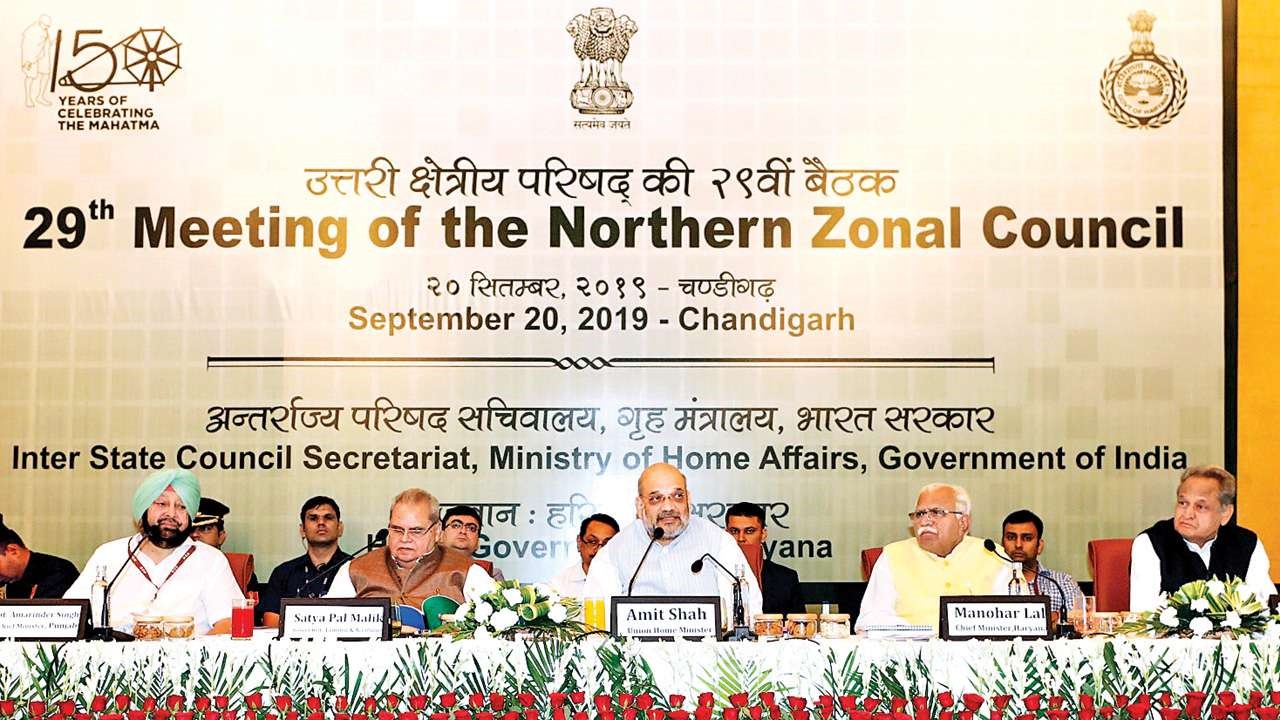
Zonal Councils
·
PRACTICE QUESTIONS
·
Introduction
I.
Though
a federal Constitution involves the sovereignty of the Units within their
respective territorial limits.
II.
It
is not possible for them to remain In complete isolation from each other and
the very exercise of Internal sovereignty by a state would require its
recognition by, and co-operation of the other Units of the federation.
III.
All
federal Constitutions, therefore, lay down certain rules of comity which the
Units are required to observe, In their treatment of each other. These rules
and agencies relate to such matters as-
(a) Recognition of the public acts,
records and judicial proceedings of each other.
(b) Extrajudicial settlement of
disputes.
(c) Co-ordination between States.
(d) Freedom of Inter-Stale trade, commerce and Intercourse
·
Constitutional provisions related to Inter State Relations
I.
Adjudication
of inter-state water disputes – Art. 262
II.
Coordination
through inter-state council – Art.263
III.
Mutual
recognition of public acts, records and judicial Proceedings-Art 261
IV.
Freedom
of inter-state trade, commerce and intercourse – Art. 301
V.
STATUTORY
provision – Zonal Councils
·
Inter
States Water Disputes (Art 262)
Art. 262 provides for
adjudication of inter-state water disputes and contains 2 provisions: -
1.
Parliament
may by law provide for the adjudication of any dispute or complaint with
respect to the use, distribution and control of waters of any inter-state river
and river valley.
2.
Parliament
may also provide that neither the Supreme Court nor any court is to exercise
jurisdiction in respect of any such dispute or complaint.
·
The
Parliament has enacted River Boards Act (1956) and the Inter-State Water
Disputes Act (1956).
·
The River
Board Act provides for the establishment of river boards, on the request
of the state governments concerned, for regulation and development of
inter-state river and river valleys.
·
The Inter-State
Water Disputes Act empowers the Central government to set up an ad hoc
tribunal for the adjudication of a dispute between two or more states. The
decision of the tribunal is final and binding.
·
Inter
States Councils (Art 263)
What is ISC?
I.
The
Inter-State Council is a Constitutional Body to facilitate coordination between
states and the centre
II.
It
is a recommendatory body to investigate and discuss subjects, in which some or
all of the states or the Central government have a common interest.
III.
It
is set up on the basis of provisions in Article 263 of the Constitution of
India by a Presidential Order, 1990 based on the recommendation of Sarkaria
Commission.
IV.
The
Inter-state council is not a permanent constitutional body for coordination
between the states and Central government. Rather, President can establish it
at any time if it appears to him that the public interests would be served by
the establishment of such a council
What is the composition of new ISC?
I.
Members:
Chief Ministers of all states and Union Territories (having legislative
Assembly), Six Union Ministers.
II.
Besides,
administrators of Union Territories which do not have legislative Assembly are
also members of the Council.
III.
Six Union Ministers: Home Minister, Finance Minister, Defense Minister, External
Affairs Minister, Minister for Information and Broadcasting and Road Transport
Highways and Shipping Minister.
IV.
ISC is headed by Prime Minister (Chairman)
V.
The
Standing Committee of the Inter State Council will be headed by Union Minister of Home Affairs
About standing committee of
Interstate council:
I.
The
standing committee of Interstate council is constituted under the chairmanship
of Union Home Minister.
II.
Apart
from Home minister the committee consists of 5 union cabinet ministers and 9
chief Ministers.
III.
The
key functions of standing committee include:
· To monitor the implementation of decisions taken on the
recommendations of the Interstate Council an
· To process all matters relating to Centre State Relations before
they are taken up for consideration in the inter-State Council.
· To consider any other matter referred to it by the
Chairman/Interstate Council.
· Freedom of Inter
State, Commerce and Discourse (Art 301)
In
the Indian Constitution, the provisions regarding the freedom of trade,
commerce and intercourse were adopted from the Constitution of Australia.
Articles 301 to 307 in
Part XIIl of the Constitution deal with the trade, commerce and intercourse
within the territory of India.
Article
301 declares that trade, commerce and intercourse throughout the territory of
India shall be free. The object of this provision is to break down the border
barriers between the states and to create one unit with a view to encourage the
free flow of trade, commerce and intercourse in the country. The freedom under
this provision is not confined to inter-state trade, commerce and intercourse
but also extends to intra-state trade, commerce and intercourse. Thus, Article
301 will be violated whether restrictions are imposed at the frontier of any
state or at any prior or subsequent stage.
The
freedom guaranteed by Article 301 is a freedom from all restrictions, except
those which are provided for in the other provisions (Articles 302 to 305) of
Part XIII of the Constitution itself. These are explained below:
(i) Parliament can impose restrictions on the freedom
of trade, commerce and intercourse between the states or within a state in
public interest. But, the Parliament cannot give preference to one state over
another or discriminate between the states except in the case of scarcity of
goods in any part of India.
(ii) The legislature of a state can impose reason able
restrictions on the freedom of trade, commerce and intercourse with that state
or within that state in public interest. But, a bill for this purpose can be
introduced in the legislature only with the previous sanction of the president.
Further, the state legislature cannot give preference to one state over another
or discriminate between the states.
(iii) The legislature of a state can impose on goods
imported from other states or the union territories any tax to which similar
goods manufactured in that state are subject. This provision prohibits the imposition
of discriminatory taxes by the state.
(iv) The freedom (under
Article 301) is subject to the nationalization laws (i.e. laws providing for monopolies in favour of the Centre or the
states). Thus, the Parliament or the state legislature can make laws for
the carrying on by the respective government of any trade, business, industry
or service, whether to the exclusion, complete or partial, of citizens or
otherwise.
The Parliament can appoint an
appropriate authority for carrying out the purposes of the above provisions
relating to the freedom of trade, commerce and intercourse and restrictions on it. The Parliament
can also confer on that authority the necessary powers and duties. But, no such
authority has been appointed so far
· Mutual Recognition of public
acts, records and judicial proceedings (Art 261)
I.
As
power and jurisdiction of each of the states is limited to its territory, the
acts and records of one state may not get recognition in other state without
any binding provision to do so.
II.
So,
the Constitution provides that “Full faith and credit shall be given throughout
the territory of India to public acts, records and judicial proceedings of the
Union and of every State” (Article 261).
III.
So laws
or statutes of one state get similar recognition in other states. The
Parliament has power to law down manner and conditions to enforce above
provisions. Similarly, final judgments or orders delivered or passed by civil
courts in any part of the territory of India shall be capable of execution
anywhere within that territory according to law.
·
Zonal Councils
What are Zonal Councils?
I.
Zonal
councils have been established by the Parliament to promote
interstate cooperation and coordination.
II.
They
are statutory bodies established under the States Reorganization Act
1956 and not constitutional bodies.
III.
They
are only deliberative and advisory bodies
How many Zonal Councils are there?
There
are 5 five Zonal councils namely:
I.
The Northern Zonal Council, comprising the States of Haryana, Himachal Pradesh, Jammu &
Kashmir, Punjab, Rajasthan, National Capital Territory of Delhi and Union
Territory of Chandigarh.
II.
The Central Zonal Council, comprising the States of Chhattisgarh, Uttarakhand, Uttar
Pradesh and Madhya Pradesh.
III.
The
Eastern Zonal Council, comprising the States of Bihar, Jharkhand, Orissa, and
West Bengal.
IV.
The Western Zonal Council, comprising the States of Goa, Gujarat, Maharashtra and the Union
Territories of Daman & Diu and Dadra & Nagar Haveli.
V.
The Southern Zonal Council, comprising the States of Andhra Pradesh, Karnataka, Kerala,
Tamil Nadu and the Union Territory of Puducherry.
The North Eastern States i.e. (i) Assam (ii) Arunachal Pradesh (iii) Manipur
(iv) Tripura (v) Mizoram (vi) Meghalaya (vii) Sikkim and (viii) Nagaland are not included in the Zonal
Councils and their special problems are looked after by the North Eastern
Council, set up under the North Eastern
Council Act, 1972.
What is the composition of Zonal Councils?
I.
Chairman – The Union Home Minister is the Chairman of
each of these Councils.
II.
Vice Chairman – The Chief Ministers of the States included in each zone act
as Vice-Chairman of the Zonal Council for that zone by rotation, each holding
office for a period of one year at a time.
III.
Members-
Chief Minister and two other Ministers as nominated by the Governor from each
of the States and two members from Union Territories included in the zone.
IV.
Advisers-
One person nominated by the Planning Commission (which has been replaced by
NITI Aayog now) for each of the Zonal Councils, Chief Secretaries and another
officer/Development Commissioner nominated by each of the States included in
the Zone.
V.
Union Ministers are also invited to participate in the meetings of
Zonal Councils depending upon necessity.
What is the objective of zonal councils?
The
main objectives of setting up of Zonal Councils are:
I.
Bringing out national integration.
II.
Arresting the growth of acute State consciousness, regionalism,
linguism and
particularistic tendencies.
III.
Enabling
the Centre and the States to co-operate
and exchange ideas and experiences.
IV.
Establishing
a climate of co-operation amongst the
States for successful and speedy execution of development projects.
·
PRACTICE
QUESTIONS
Q.1. The
chairman of Zonal Council is -
a. The home minister of central government.
b. Vice-President
of India.
c. The
chief minister & is nominated by PM of India.
d. A
union minister & is nominated by President of India.
ANS: A
Q.2 Which of the following is/are?
1) Full faith and credit is to be given throughout India to judicial
proceedings of the Centre and every state.
2) Courts of a state in India need to apply penal laws of any other state of
India.
a. Only 1
b. Only
2
c. Both
1 and 2
d. Neither
1 nor 2
ANS: A
Q.3 Consider the following
statements:
1. The idea of
creation of zonal council was mooted by the first Prime Minister of India,
Pandit Jawahar Lal Nehru in 1956.
2. He suggested that
the states proposed to be reorganized may be grouped into four or five zones
having an Advisory Council to develop cooperative working among these states.
Which of the above statements is/are
correct?
a. Only 1
b. Only 2
c. Both 1 nor 2
d. Neither 1 nor 2
ANS: C
Q.4. Consider the following
statements about the issues which may not be brought up before the Inter-State
Council:
1. Any issues which
relates to discharge of any duty or special responsibility of the union under
the provisions of the constitution or any law of parliament.
2. Any issue relating
to a matter which, under the constitution, is left or the decision of a
specified authority other than the central Government such as Election
Commission or the Supreme Court etc.
Which of the above statements is/are
correct?
a. Only 1
b. Only 2
c. Both 1 nor 2
d. Neither 1 nor 2
ANS: C


Comments on “Inter State Relations in India”