


Daily Current
Affairs Analysis- 19 June 2024
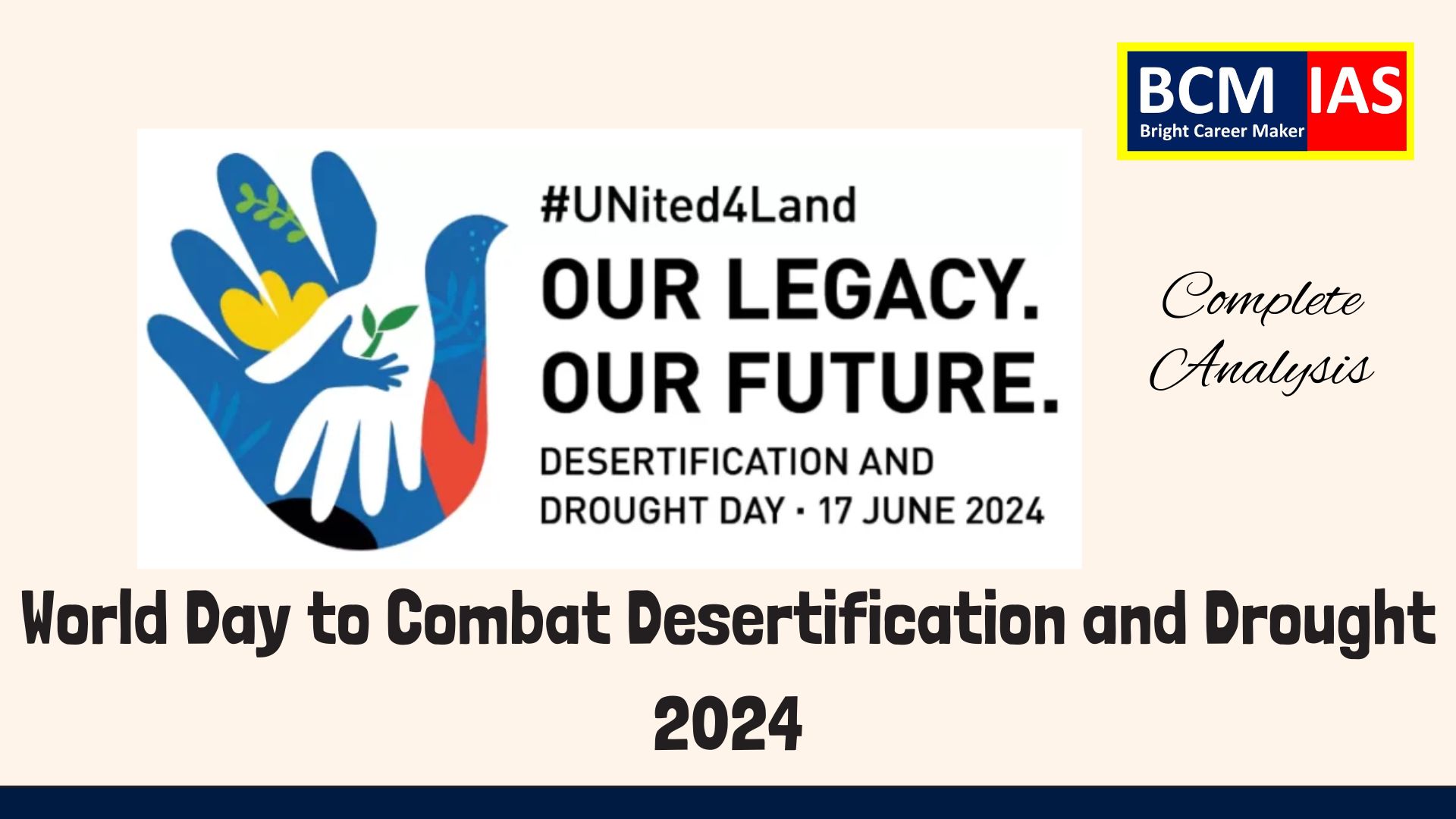
World Day to Combat
Desertification and Drought 2024
Introduction
·
The World Day to Combat Desertification and Drought is
observed annually on June 17th. In 2024, this day marks the 30th anniversary of
the adoption of the United Nations Convention to Combat Desertification
(UNCCD).
·
This day aims to promote awareness of international
efforts to combat desertification and drought and highlights the importance of
sustainable land management.
The Event of 2024
Location and Host:
The 2024 event will be
held at the UNCCD Secretariat in Bonn, Germany.
UN Call to Action:
Ahead of the 16th
Conference of Parties (COP16) to the UNCCD in Riyadh, Saudi Arabia, the United
Nations has called for support from all generations for sustainable land
stewardship.
Theme:
The theme for 2024 is “United for Land: Our Legacy. Our
Future.”
Recognition:
Ten youngsters will be
felicitated as ‘Land Heroes’ for their efforts in land restoration, drought
resilience, sustainable agriculture, and innovative solutions to environmental
challenges.
Land Degradation
Definition:
According to the UNCCD,
land degradation refers to the reduction or loss of biological or economic
productivity in arid, semi-arid, and dry sub-humid areas due to various
factors, including human activities.
Components of Land
Degradation:
- Soil
Degradation:
Decline in soil productivity due to erosion and changes in soil
properties.
- Vegetation
Degradation:
Reduction in natural biomass and ground cover.
- Water
Degradation:
Deterioration of surface and groundwater resources.
- Climate
Deterioration:
Changes in climatic conditions increasing crop failure risks.
- Urban/Industrial
Development Losses: Conversion of agricultural land to urban and industrial uses.
Need to Halt Land
Degradation:
- Extent: Up to 40% of the world’s land
and nearly half of its population are affected, with the loss of four
football fields’ worth of land every second.
- Affected
Communities:
Marginalized groups, including indigenous communities, rural households,
and smallholder farmers, are most impacted.
- Economic
and Sustainability Opportunities: Engaging youth in land restoration could create 600
million jobs over the next 15 years, contributing to economic growth and
environmental sustainability.
Land Degradation in
India:
- Extent: In 2018-19, India had an
estimated 97.84 million hectares of degraded land.
- Government
Measures:
- Observation: An online portal developed by
the Space Application Center (SAC), Ahmedabad, visualizes degraded land
areas and the processes causing degradation.
- South-South
Collaboration:
A Centre of Excellence at the Indian Council for Forestry Research and
Education (ICFRE) Dehradun focuses on knowledge sharing, best practices,
and capacity building.
- Bonn
Challenge:
India pledged to restore 21 million hectares of degraded land by 2030,
increased to 26 million hectares during COP14 in 2019.
- Coastal
Habitat Rehabilitation: Tamil Nadu is implementing a bio shield formation
project to rehabilitate coastal habitats from 2023 to 2026.
About: The United Nations Convention to Combat
Desertification (UNCCD)
About:
The UNCCD is the only legally binding international agreement linking
environment and development to sustainable land management.
Members:
There are 197 parties to
the convention, including 196 countries and the European Union.
Secretariat:
The permanent
secretariat is located in Bonn, Germany.
Principles:
The convention is based
on participation, partnership, and decentralization.
Areas of Focus:
The convention
specifically addresses drylands, including arid, semi-arid, and dry sub-humid
ecosystems.
Conferences of the
Parties (COPs):
Held every two years,
these conferences bring together parties to discuss and implement strategies.
Financial Mechanism:
The Global Mechanism
facilitates the mobilization of financial resources to address desertification,
land degradation, and drought.
UNCCD 2018-2030
Strategic Framework:
This framework aims to
achieve Land Degradation Neutrality (LDN) by restoring degraded land, improving
livelihoods for over 1.3 billion people, and reducing drought impacts on
vulnerable populations.
Conclusion
The World Day to Combat Desertification and Drought 2024
serves as a critical reminder of the urgent need for sustainable land
management practices. Through global cooperation and innovative solutions, we
can combat land degradation, support affected communities, and build a
sustainable future for all.
Relevance in UPSC Exam
Prelims
- Facts and Data: Questions may revolve around
factual data such as the date of the adoption of the UNCCD, key
anniversaries, themes of international days, and statistics on land
degradation.
- Current Events: Keeping track of significant
events and international conferences related to desertification and
drought.
Mains
- Essay: Topics related to environmental sustainability,
land degradation, and international efforts to combat desertification can
be important themes for essays.
- GS Paper I (Geography): Detailed questions on the
processes and impacts of land degradation, examples of affected regions,
and measures to combat these issues.
- GS Paper II (International Relations): Detailed analysis of
international conventions like the UNCCD, India’s role in global
environmental governance, and bilateral or multilateral initiatives.
- GS Paper III (Environment and Ecology): Questions on conservation
efforts, specific case studies of land restoration, and government
measures to combat land degradation in India
Probable Mains Question
"Discuss the impact of land degradation on
sustainable development and the role of international conventions in mitigating
its effects."
Suggested Answer-
Introduction
Land degradation is a significant environmental issue affecting nearly 40% of
the world's land and impacting almost half of the global population. It
involves the deterioration of land quality and productivity due to various
factors such as deforestation, unsustainable agricultural practices,
urbanization, and climate change. The United Nations Convention to Combat
Desertification (UNCCD), adopted on June 17, 1994, plays a crucial role in
addressing these challenges. As we mark the 30th anniversary of the UNCCD in
2024, it is imperative to evaluate the impact of land degradation on
sustainable development and the effectiveness of international conventions in
combating this issue.
Demand of the Question
Impact of Land Degradation on Sustainable Development:
1.
Environmental Impact:
o Biodiversity
Loss: Land
degradation leads to habitat destruction, resulting in the loss of plant and
animal species.
o Soil Erosion: The productive capacity of soil
declines, affecting agricultural output and food security.
o Water
Quality: Degradation
leads to sedimentation in water bodies, reducing water quality and
availability.
2.
Economic Impact:
o Agricultural
Productivity:
Reduced soil fertility directly impacts agricultural yields, leading to
economic losses for farmers.
o Economic
Opportunities: Land
degradation affects livelihoods, particularly in rural areas dependent on
agriculture.
o Cost of
Restoration: The
financial burden of restoring degraded land is substantial and often exceeds
the economic benefits derived from the land.
3.
Social Impact:
o Food
Security: Declining
agricultural productivity threatens food security, particularly in vulnerable
regions.
o Migration: Degraded lands force communities to
migrate, leading to urban overpopulation and associated socio-economic
challenges.
o Health: Poor soil and water quality can lead
to health issues among populations relying on these resources.
Role of International Conventions:
1.
United Nations Convention to Combat Desertification
(UNCCD):
o Framework and
Goals: UNCCD
provides a legally binding framework to combat desertification and mitigate
drought impacts through sustainable land management.
o Global
Commitment: It has
197 parties committed to addressing land degradation, focusing on arid,
semi-arid, and dry sub-humid areas.
o Strategic
Framework (2018-2030): The framework aims to achieve Land Degradation Neutrality (LDN), improve
livelihoods for over 1.3 billion people, and reduce drought impacts.
2.
Conferences of the Parties (COPs):
o Collaborative
Efforts: COPs
facilitate international collaboration, knowledge sharing, and the development
of innovative solutions to combat land degradation.
o Financial
Mechanism: The
Global Mechanism under the UNCCD mobilizes financial resources to implement
sustainable land management practices.
3.
National and Regional Initiatives:
o Bonn
Challenge: India’s
commitment to restore 26 million hectares of degraded land by 2030 under the
Bonn Challenge highlights the role of national initiatives in supporting
international goals.
o South-South
Collaboration:
Initiatives like the Centre of Excellence at the Indian Council for Forestry
Research and Education (ICFRE) in Dehradun focus on knowledge sharing and
capacity building in sustainable land management.
Way Forward
Strengthening International Cooperation:
1.
Enhanced Collaboration: Strengthen partnerships between
countries to share best practices, technology, and resources for land
restoration.
2.
Financial Support: Increase financial contributions to the Global
Mechanism to support large-scale land restoration projects.
National and Local Actions:
1.
Policy Integration: Integrate land degradation and sustainable land
management into national development policies and plans.
2.
Community Involvement: Engage local communities in land
restoration efforts, ensuring their participation and ownership of the
initiatives.
Technological and Innovative Solutions:
1.
Research and Development: Invest in research to develop
innovative solutions for sustainable land management and restoration.
2.
Technology Transfer: Facilitate the transfer of technology and knowledge
from developed to developing countries to enhance their capacity to combat land
degradation.
Educational and Awareness Programs:
1.
Awareness Campaigns: Conduct awareness campaigns to educate the public on
the importance of sustainable land management.
2.
Capacity Building: Provide training and capacity-building programs for
farmers, policymakers, and other stakeholders involved in land management.
Monitoring and Evaluation:
1.
Regular Assessment: Implement regular monitoring and evaluation of land
restoration projects to assess their effectiveness and make necessary
adjustments.
2.
Data Collection: Enhance data collection and analysis to inform policy
decisions and track progress towards achieving Land Degradation Neutrality
(LDN).
Climate Change Mitigation:
1.
Sustainable Practices: Promote sustainable agricultural
practices that reduce land degradation and enhance resilience to climate
change.
2.
Carbon Sequestration: Implement land management practices
that enhance carbon sequestration and contribute to climate change mitigation
efforts.
Conclusion
The impact of land degradation on sustainable development is
profound, affecting environmental health, economic stability, and social
well-being. International conventions like the UNCCD play a crucial role in
mitigating these effects through collaborative efforts and strategic
frameworks. However, achieving sustainable land management requires concerted
efforts at global, national, and local levels, involving policy integration,
technological innovation, and community engagement. By strengthening international
cooperation, enhancing financial support, and promoting sustainable practices,
we can combat land degradation and ensure a sustainable future for generations
to come.
Practice MCQs for Prelims
1.
When was the United Nations Convention to Combat
Desertification (UNCCD) adopted?
o a) June 17, 1992
o b) June 17, 1994
o c) June 17, 1996
o d) June 17, 1998
Answer: b) June 17, 1994
Explanation: The UNCCD was adopted on June 17, 1994, in Paris, to
address desertification and mitigate the effects of drought.
2.
What is the theme for World Day to Combat
Desertification and Drought 2024?
o a) Land and Life
o b) Restore Our
Earth
o c) United for
Land: Our Legacy. Our Future
o d) Sustainable
Land Management
Answer: c) United for Land: Our Legacy. Our Future
Explanation: The theme for 2024 is "United for Land: Our Legacy.
Our Future," emphasizing sustainable land stewardship.
3.
Which body facilitates the mobilization of financial
resources to implement the UNCCD?
o a) United
Nations Environment Programme (UNEP)
o b) Global
Mechanism (GM)
o c) World Bank
o d) International
Monetary Fund (IMF)
Answer: b) Global Mechanism (GM)
Explanation: The Global Mechanism, established under Article 21 of the
UNCCD, facilitates the mobilization of financial resources for combating
desertification.
4.
What is the estimated extent of land degradation and
desertification in India as per the 2018-19 Desertification and Land
Degradation Atlas?
o a) 47.84 million
hectares
o b) 67.84 million
hectares
o c) 87.84 million
hectares
o d) 97.84 million
hectares
Answer: d) 97.84 million hectares
Explanation: The 2018-19 Desertification and Land Degradation Atlas of
India estimates the extent of degraded land at 97.84 million hectares.
5.
Which initiative did India join to restore degraded
land, pledging to restore 26 million hectares by 2030?
o a) Paris
Agreement
o b) Bonn
Challenge
o c) Kyoto
Protocol
o d) Glasgow Pact
Answer: b) Bonn Challenge
Explanation: India joined the voluntary Bonn Challenge, pledging to
restore 26 million hectares of degraded land by 2030.


Comments on “World Day to Combat Desertification and Drought 2024”