

World's Oldest Cave Painting
Discovered in Indonesia
Analysis
Introduction
· A recent discovery in the limestone cave of
Leang Karampuang in the Maros-Pangkep region of the Indonesian island of
Sulawesi has unveiled what is now considered the world's oldest known
cave painting.
· This
significant archaeological find has provided new insights into the early
artistic expressions of human ancestors.
Details of the Discovery
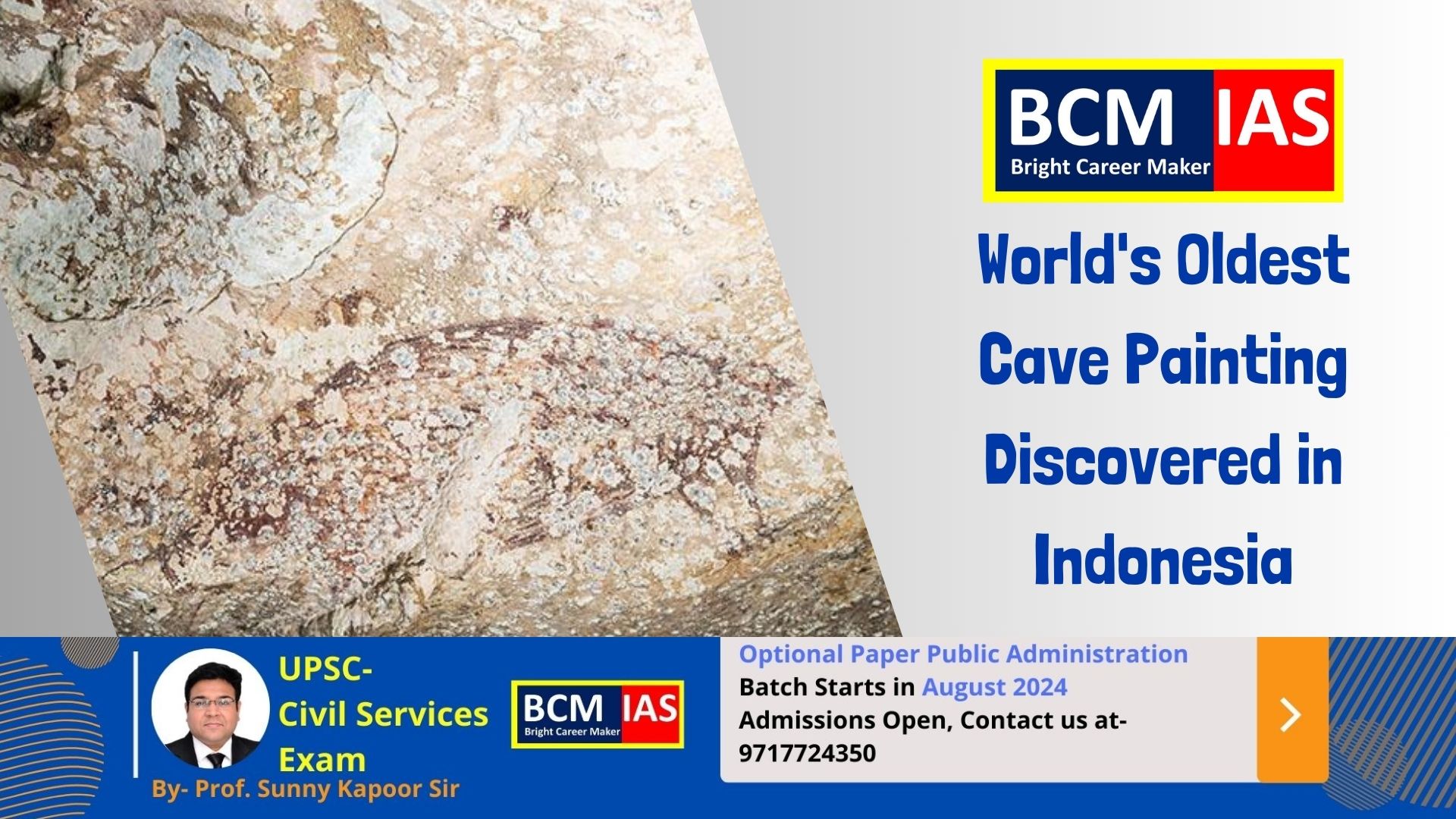
The cave painting, which dates back at least
51,200 years, depicts three human-like figures interacting with a wild pig. The
artwork, located on the ceiling of the cave, showcases a narrative scene,
indicating early forms of storytelling through art. The painting measures 92 cm
by 38 cm and is rendered in a single shade of dark red pigment. Additionally,
the cave contains other images of pigs, highlighting the importance of this
animal in the prehistoric period.
Scientific Analysis
Researchers employed a new scientific method
to determine the painting's age. They used a laser to date calcium carbonate
crystals that had naturally formed on top of the painting. This method is a
significant advancement over previous techniques and has revolutionized rock
art dating worldwide.
Maxime Aubert, a specialist in archaeological
science at Griffith University in Australia and one of the study leaders,
emphasized the importance of this method. The dating process confirmed the
painting's age, making it the oldest-known evidence of storytelling in art.
Interpretation of the Scene
The researchers interpreted the scene as a
deliberate narrative, with the human-like figures and the pig depicted in a way
that suggests interaction and action. The juxtaposition and positioning of the
figures imply a story being told, although the exact narrative remains unknown.
Adam Brumm, an archaeologist at Griffith
University, noted that the figures were not depicted in isolation but were part
of a coherent scene, suggesting an early form of artistic storytelling.
Reassessment of Other Findings
The same dating method was used to reassess
the age of another cave painting from the Sulawesi site, Leang Bulu' Sipong 4.
This painting, which depicts a narrative scene of figures hunting pigs and
dwarf buffalo, was determined to be at least 48,000 years old, significantly
older than previously thought.
Conclusion
The discovery of the world's oldest cave
painting in Sulawesi is a monumental achievement in the field of archaeology.
It provides profound insights into the cognitive and artistic capabilities of
early human ancestors. This find not only pushes back the timeline of human
artistic expression but also underscores the importance of advanced dating
techniques in unraveling the mysteries of our prehistoric past.
The interaction between human-like figures
and animals in these ancient artworks suggests a deep-rooted connection between
early humans and their environment, reflecting their social and cultural
dynamics. The narrative nature of these paintings highlights the early
development of storytelling, an intrinsic part of human identity and culture.
Multiple Choice Questions
Question 1:
Consider the following statements
regarding the recently discovered cave painting in the Leang Karampuang cave:
1. It is
believed to be at least 51,200 years old.
2. The painting
depicts three human-like figures interacting with a wild buffalo.
3. The painting
was discovered in a limestone cave in the Indonesian island of Borneo.
Which of the statements given
above is/are correct?
a) 1 only
b) 2 and 3 only
c) 1 and 2 only
d) 1, 2, and 3
Answer: a) 1 only
Question 2:
Which scientific method was used
to determine the age of the world's oldest known cave painting found in
Sulawesi?
a) Radiocarbon dating
b) Thermoluminescence dating
c) Laser dating of calcium
carbonate crystals
d) Dendrochronology
Answer: c) Laser dating of
calcium carbonate crystals
Question 3:
Which of the following statements
is true regarding the depiction in the Leang Karampuang cave painting?
a) The painting shows a single
human-like figure interacting with a wild pig.
b) The figures in the painting
are isolated and not interacting with each other.
c) The painting includes three
human-like figures and a pig depicted in a narrative scene.
d) The painting is rendered in
multiple colors.
Answer: c) The painting includes
three human-like figures and a pig depicted in a narrative scene.
Question 4:
What significance do researchers
attribute to the scene depicted in the Leang Karampuang cave painting?
a) It represents the oldest known
evidence of religious rituals.
b) It is considered the oldest
known evidence of storytelling in art.
c) It depicts the daily life
activities of prehistoric humans.
d) It illustrates early forms of
written communication.
Answer: b) It is considered the
oldest known evidence of storytelling in art.
Question 5:
Which other site in Sulawesi was
reassessed using the same dating method, and what was depicted in the cave
painting there?
a) Leang Timpuseng; paintings of
marine life
b) Leang Bulu' Sipong 4; figures
hunting pigs and dwarf buffalo
c) Leang Lompoa; abstract
geometric patterns
d) Leang Pajae; scenes of
agricultural activities
Answer: b) Leang Bulu' Sipong 4;
figures hunting pigs and dwarf buffalo


Comments on “World's Oldest Cave Painting Discovered in Indonesia”