


Daily Current Affairs Analysis
22-24 May 2024
-------------------------------------------------------------------------------------------------------------
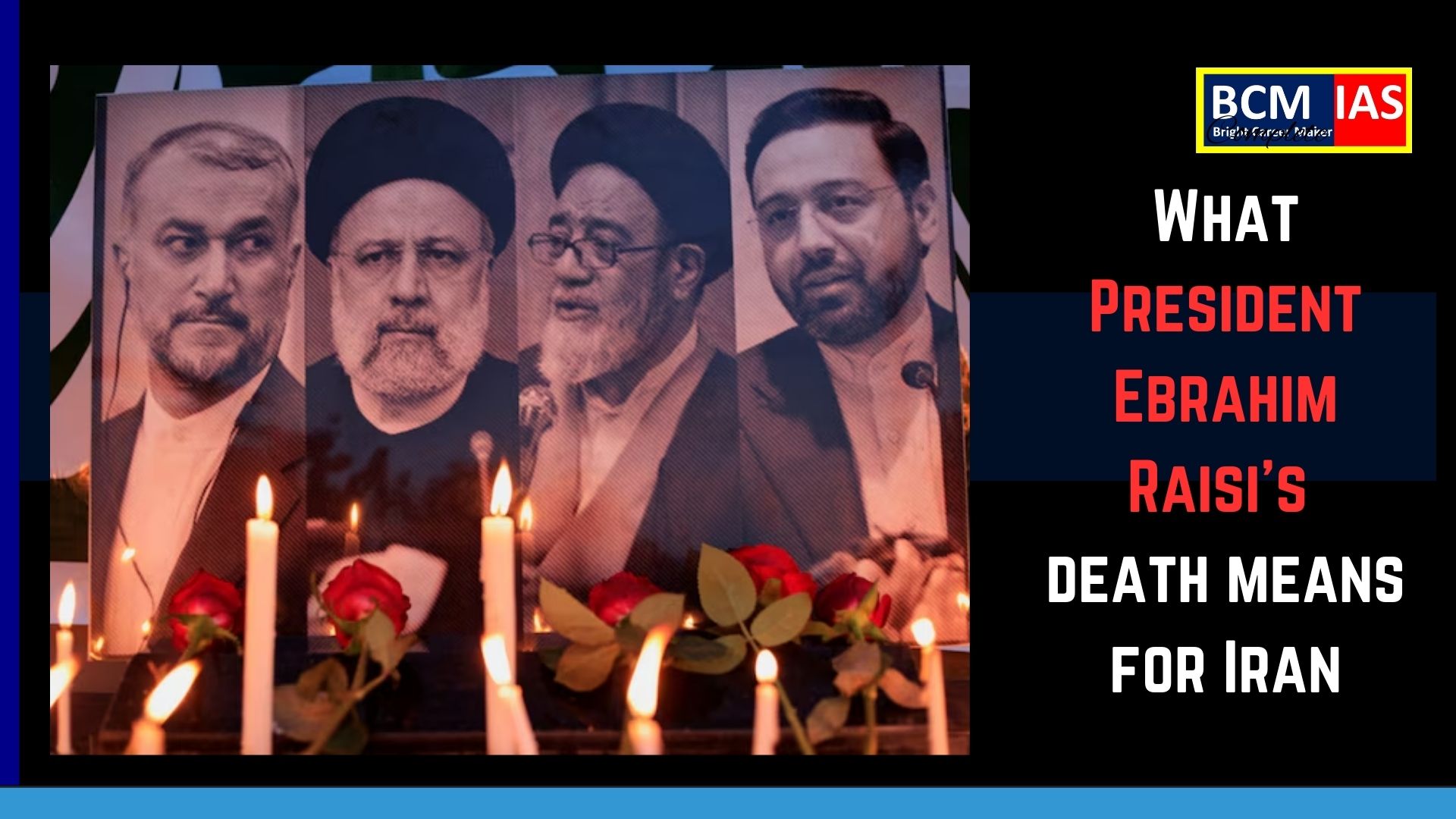
What President Ebrahim Raisi’s death means for Iran
Meaning of Headline-
The news headline refers to an analysis of the political
implications following the death of Iran's President Ebrahim Raisi in a
helicopter crash. The article explains the potential impact of his death on
Iran's political system, the balance of power, and future succession plans,
especially considering the role of the Supreme Leader. Despite the tragedy, no
significant political or policy shocks are expected in Iran due to the existing
power structures and constitutional provisions.
Related Topic (as per UPSC
Syllabus)
Prelims
1. Current Events of
National and International Importance
o
Awareness of recent significant events in global
politics and their implications.
2. Polity and Governance
o
Comparative political systems, international
relations, and governance structures.
Mains
1. General Studies Paper
II
o
Governance, Constitution, Polity, Social Justice and
International Relations
§
Important aspects of governance, transparency, and
accountability.
§
Role of various constitutional and statutory bodies.
§
Effect of policies and politics of developed and
developing countries on India's interests.
§
Important international institutions, agencies, and
fora, their structure and mandate.
Interview
1. Current Affairs
o
Understanding and articulation of recent global
political developments.
2. Personality Test
o
Ability to critically analyze and discuss the
implications of significant international events on global and regional
politics.
News
Analysis
Introduction
The sudden death of Iran's President
Ebrahim Raisi and Foreign Minister Hossein Amirabdollahian in a helicopter
crash on May 19, 2024, has significant implications for Iran's political
landscape. Although this tragedy is not expected to cause a political crisis,
it brings to light the intricacies of Iran's political system, the balance of
power between conservatives and reformists, and the implications for future
leadership dynamics and foreign policy. This analysis explores the potential
impacts of Raisi's death on Iran's internal politics and its interactions on
the international stage.
Political Structure and Balance
of Power in Iran
Role of the President and Supreme
Leader:
- Supreme
Leader's Dominance: In Iran, the Supreme Leader holds ultimate authority over all
branches of government, including the military and judiciary. The
President, although powerful, operates within the constraints set by the
Supreme Leader. Ayatollah Ali Khamenei, the current Supreme Leader, has
significant influence over the Guardian Council, which vets presidential
candidates.
- President's
Influence:
Despite the Supreme Leader's overarching authority, the President plays a
crucial role in the administration of the government, mediating between
the legislature and executive, appointing ministers, and making key
foreign policy decisions.
Conservative vs. Reformist
Dynamics:
- Conservative
Dominance: Since
the Islamic Revolution of 1979, Iranian politics has been characterized by
a struggle between conservative hardliners and reformists. Conservatives
emphasize adherence to Twelver Shi'ism and resistance to Western
influence, while reformists advocate for more social freedoms, civil
rights, and diplomatic engagement with the West.
- Current
Political Climate: The conservative faction, to which Raisi belonged, has maintained
a dominant position, especially after the suppression of reformist
elements and the imposition of Western sanctions. Raisi's presidency was
marked by efforts to fortify Iran's "resistance economy" and
strengthen ties with countries like Russia and China.
Implications of Raisi's Death
Immediate Political Impact:
- Succession
Protocol:
Following Raisi's death, Mohammad Mokhber, the First Vice President, has
been appointed as acting President. According to Iran's constitution, an
election must be held within 50 days to elect a new President.
- Continuity
of Policies:
Mokhber, being a close ally of Raisi, is expected to maintain policy
continuity, particularly in foreign relations and domestic governance.
This transition aims to prevent any immediate political instability.
Long-term Political Consequences:
- Impact
on Supreme Leader Succession: Raisi was considered a potential successor to Khamenei. His death
opens up the field for other contenders, potentially leading to a power
struggle within the conservative faction. The Assembly of Experts,
responsible for selecting the Supreme Leader, will play a crucial role in
this process.
- Reformist
Prospects: The
reformist camp, although currently marginalized, may view this as an
opportunity to reassert their influence. However, given the conservative
grip on power, significant shifts in the political landscape are unlikely
in the near term.
Foreign Policy and International
Relations:
- JCPOA
Negotiations:
Raisi's administration took a hardline stance on the Joint Comprehensive
Plan of Action (JCPOA), the nuclear deal with Western powers. The change
in leadership might affect the pace but not the direction of these
negotiations, as the overarching policy is guided by the Supreme Leader.
- Regional
Relations: Raisi
and Amirabdollahian played key roles in strengthening Iran's regional
alliances, particularly with anti-Western states and non-state actors. The
new leadership will need to continue these efforts to maintain regional
influence.
Analysis and Conclusion
Impact on Domestic Politics:
- Political
Stability: Iran's
constitutional mechanisms for presidential succession ensure a level of
political stability. The appointment of Mokhber as acting President and
the forthcoming elections are designed to prevent a power vacuum.
- Public
Sentiment:
Raisi's death may evoke sympathy and strengthen conservative support in
the short term. However, long-term political dynamics will depend on how
effectively the new leadership addresses economic challenges and public
discontent.
Foreign Policy Continuity:
- Regional
Alliances: Iran's
strategy of building alliances with countries like Russia and China, and
supporting regional groups opposed to Western influence, is likely to
continue. The new leadership will aim to uphold these ties to
counterbalance Western sanctions and geopolitical pressures.
- JCPOA
and Western Relations: The death of Raisi might slightly alter the dynamics of JCPOA
negotiations, but significant changes are unlikely without a shift in the
Supreme Leader's stance. The broader trajectory of Iran's foreign policy
will remain consistent with its strategic goals.
Future Leadership Dynamics:
- Succession
Planning: The
eventual succession of the Supreme Leader will be a critical juncture for
Iran. The process will involve intense internal negotiations and could
reshape the power structure depending on the chosen successor's political
orientation.
- Conservative
Cohesion:
Maintaining unity within the conservative faction will be essential to
ensure a smooth transition. Any internal rifts could weaken the
conservatives' hold on power and provide an opening for reformist
resurgence.
In conclusion, the death of President
Ebrahim Raisi is a significant event in Iran's political landscape, but it is
unlikely to cause immediate political upheaval. The established
constitutional processes and the conservative control over key institutions
will facilitate a smooth transition. However, the long-term implications for
Iran's political dynamics, especially regarding the succession of the Supreme
Leader and the balance between conservatives and reformists, remain to be seen.
Probable Mains Question
Q. "Discuss the implications of President
Ebrahim Raisi’s death on Iran’s political stability and future leadership
dynamics."
Model
Answer (hints):
Introduction
The sudden death of Iran’s President
Ebrahim Raisi in a helicopter crash has raised questions about the immediate
and long-term political implications for Iran. As a key figure in Iran’s
conservative establishment and a close associate of Supreme Leader Ayatollah
Ali Khamenei, Raisi’s death has created a temporary vacuum in the executive
leadership. This essay examines the potential impact on Iran’s political
stability, the succession plan for the Supreme Leader, and the broader
implications for Iran’s domestic and foreign policies.
Iran’s Political System and the
Role of the President:
1. Supreme Leader's
Authority: The Supreme Leader
holds the ultimate authority in Iran, overseeing the military, judiciary, and
key political appointments. The President, while influential, operates under
the Supreme Leader’s overarching control.
2. President’s Functions: The President mediates between the
executive and legislative branches, appoints ministers, and plays a significant
role in foreign policy and economic management. Raisi’s presidency was marked
by a hardline stance and efforts to strengthen ties with non-Western countries
like Russia and China.
Impact on Political Stability:
1. Smooth Transition: Iran’s constitution provides for a clear
line of succession, with the First Vice President, Mohammad Mokhber, appointed
as acting President. An election is mandated within 50 days to elect a new
President, ensuring a smooth transition.
2. Conservative Dominance: The conservative faction has maintained
control over Iran’s political landscape, and this is expected to continue.
Mokhber, being a close ally of Raisi, indicates policy continuity in the
immediate term.
Succession of the Supreme Leader:
1. Potential Power
Struggle: Raisi was considered
a potential successor to Khamenei, but his death leaves the succession open to
other contenders. The selection process may lead to a power struggle within the
conservative and clerical elite.
2. Supreme Leader’s
Influence: Despite Khamenei’s
age and health concerns, his influence remains strong. The eventual succession
will depend on the balance of power within the Assembly of Experts and other
influential bodies.
Foreign Policy Implications:
1. JCPOA and Relations
with the West: Raisi’s
administration had a confrontational stance towards the West, particularly
regarding the Joint Comprehensive Plan of Action (JCPOA). The death of Raisi
and the election of a new President might affect the pace but not necessarily
the direction of negotiations.
2. Regional Dynamics: Raisi played a significant role in
fostering closer ties with regional players and strengthening the “Axis of
Resistance.” The continuity of this policy will depend on the new President’s
approach and alignment with Khamenei’s strategic vision.
Way Forward
Ensuring Political Stability:
- Constitutional
Adherence:
Strict adherence to constitutional provisions and a transparent electoral
process are crucial for maintaining political stability. The Guardian
Council must ensure a fair vetting process for presidential candidates to
uphold public confidence.
- Balancing
Factions:
Efforts should be made to balance the interests of various political
factions, including conservatives and reformists, to prevent internal
discord and foster a more inclusive political environment.
Addressing Economic Challenges:
- Economic
Reforms: The
new administration must focus on economic reforms to address the pressing
issues of unemployment, inflation, and the impacts of international
sanctions. Policies promoting economic self-sufficiency and
diversification can mitigate the adverse effects of external pressures.
- International
Engagement:
Renewed efforts to engage with the international community, particularly
regarding the JCPOA, can help lift economic sanctions and spur economic
recovery. Constructive diplomacy and adherence to international agreements
are essential.
Preparing for Leadership Transition:
- Succession
Planning: The
Assembly of Experts should proactively prepare for the eventual succession
of the Supreme Leader. Clear criteria and a transparent selection process
can prevent power struggles and ensure a smooth transition.
- Leadership
Training:
Investing in the development and training of future leaders within the
clerical and political establishments can create a pool of qualified
candidates for both the presidency and the position of Supreme Leader.
Enhancing Domestic and Foreign
Policies:
- Human
Rights and Civil Liberties: The new administration should take steps to improve human rights
and civil liberties, addressing the concerns of the international
community and fostering a more open and just society.
- Regional
Cooperation:
Strengthening regional cooperation with neighboring countries and
participating in multilateral forums can enhance Iran’s regional influence
and contribute to regional stability and security.
In conclusion, the death of President
Ebrahim Raisi poses challenges but also offers opportunities for Iran to
reassess its political and economic strategies. By ensuring a smooth
political transition, addressing economic challenges, and preparing for future
leadership transitions, Iran can navigate this period of uncertainty and
continue to assert its role on the global stage.
MCQs for Prelims Practice
Question 1
What is the immediate constitutional requirement in
Iran following the death of President Ebrahim Raisi?
A) The Supreme Leader directly appoints a new President
B) The First Vice President becomes the permanent President
C) An election must be held within 50 days
D) The Parliament selects a new President
Answer: C
Explanation: According to Iran’s constitution, following the death of
the President, an election must be held within 50 days to elect a new
President. The First Vice President, Mohammad Mokhber, has been appointed as
acting President until then.
Question 2
Which body in Iran is responsible for selecting the
Supreme Leader?
A) The Guardian Council
B) The Assembly of Experts
C) The Expediency Discernment Council
D) The Islamic Consultative Assembly (Parliament)
Answer: B
Explanation: The Assembly of Experts is responsible for selecting the
Supreme Leader in Iran. This body, composed of Islamic scholars, monitors and
appoints the Supreme Leader and ensures that he meets the necessary
qualifications.
Question 3
What was one of President Ebrahim Raisi’s significant
achievements in foreign policy during his tenure?
A) Signing a peace treaty with Israel
B) Negotiating the Joint Comprehensive Plan of Action (JCPOA)
C) Brokering the Iran-Saudi deal
D) Joining the European Union
Answer: C
Explanation: One of President Ebrahim Raisi’s significant foreign policy
achievements was brokering the Iran-Saudi deal, which aimed to improve
relations between the two countries and was facilitated by China.
Question 4
How does the death of President Raisi affect the
balance of power between conservatives and reformists in Iran?
A) It guarantees a shift towards reformist dominance
B) It significantly weakens the conservative grip on power
C) It opens up the field for a potential power struggle within the
conservative faction
D) It immediately leads to increased reformist representation in
government
Answer: C
Explanation: The death of President Raisi opens up the field for a
potential power struggle within the conservative faction. While conservatives
currently dominate, the succession dynamics for the Supreme Leader may become
more complex and contentious.
Question 5
Which international agreement’s future negotiations
might be influenced by the death of Raisi, although the overall policy
direction is guided by the Supreme Leader?
A) The Paris Agreement
B) The Comprehensive Economic Partnership Agreement (CEPA)
C) The Joint Comprehensive Plan of Action (JCPOA)
D) The North American Free Trade Agreement (NAFTA)
Answer: C
Explanation: The future negotiations of the Joint Comprehensive Plan of
Action (JCPOA), which is related to Iran’s nuclear program and its relationship
with Western powers, might be influenced by the death of Raisi. However, the
overall policy direction is still primarily guided by the Supreme Leader.


Comments on “What President Ebrahim Raisi’s death means for Iran”