


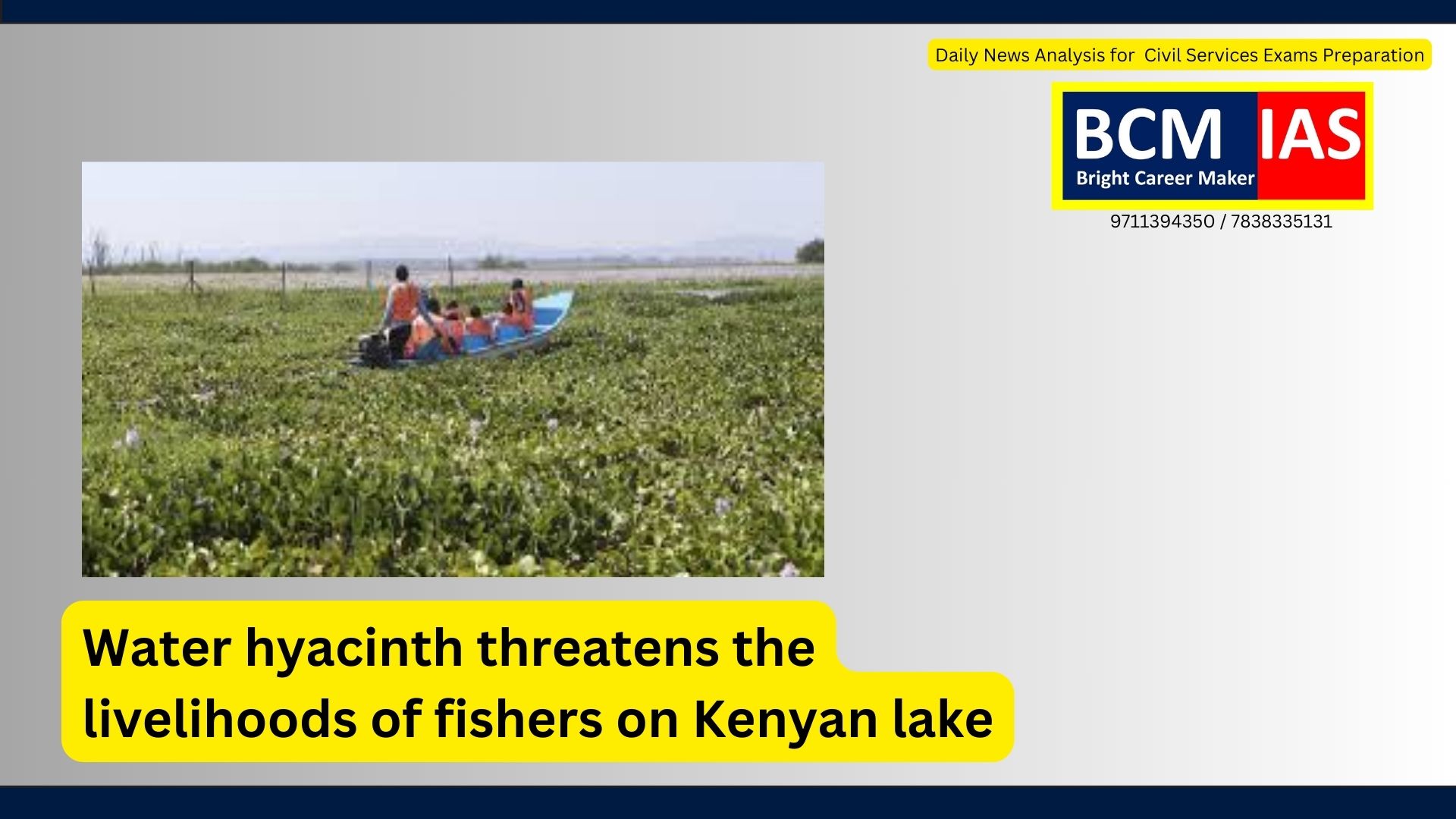
Water hyacinth threatens the livelihoods of fishers on
Kenyan lake
Key Issue: Invasive
Water Hyacinth
1. Introduction:
o Native
to South America, water hyacinth was introduced to Kenya in the 1980s as an
ornamental plant.
o It
has since become one of the most invasive aquatic species globally,
significantly impacting ecosystems and local economies.
2. Impact
on Lake Naivasha:
o Water
hyacinth forms dense, floating mats that block sunlight and restrict oxygen
flow, harming aquatic life.
o Fish
populations have drastically declined, reducing daily fish catch from 90 kg to 10-15 kg,
leading to a 83% drop in
fishers’ earnings.
o Tourism
and transport are also affected, as the plant hampers boat movement and
degrades the lake's aesthetic value.
3. Broader
Economic Impact:
o Kenyan
lakes, including Naivasha and Victoria, face annual losses of $150-$350 million
across fishing, transport, and tourism sectors.
Response to the
Crisis
1. Mitigation
Measures:
o Traditional
solutions include:
§ Physical
removal of the plant.
§ Biological
control using organisms that feed on water hyacinth.
§ Chemical
treatment, though harmful to other aquatic life.
2. Innovative
Solution: HyaPak:
o About
HyaPak:
§ A
Kenyan start-up founded in 2022 at Egerton University.
§ Converts
water hyacinth into biodegradable
packaging to address both the hyacinth crisis and plastic
pollution.
o Process:
§ Fishers
harvest and sun-dry the plant.
§ HyaPak
processes it into biodegradable
paper, producing 4,500 packages weekly from 150 kg of hyacinth.
o Economic
and Environmental Benefits:
§ Fishers
earn additional income by harvesting hyacinth.
§ Promotes
sustainable packaging, reducing reliance on single-use plastics.
Challenges and Future
Prospects
1. Challenges:
o Scaling
the HyaPak initiative to process larger volumes of hyacinth.
o Balancing
ecological concerns with solutions (e.g., avoiding harmful chemical
treatments).
o Limited
awareness and resources among local communities to combat the spread of
hyacinth.
2. Opportunities:
o Expanding
partnerships between local stakeholders and start-ups like HyaPak.
o Using
biological and mechanical removal methods to complement innovative projects.
o Leveraging
government and international funding for large-scale removal and utilization
projects.
Conclusion
The water hyacinth crisis in Kenyan lakes
represents a severe ecological and economic challenge. While it threatens
fishers’ livelihoods and regional industries, innovative solutions like HyaPak
demonstrate the potential to turn environmental problems into opportunities.
Scaling such initiatives, combined with sustainable management practices, can
mitigate the plant's impact and create new economic avenues, benefiting both
people and the environment.
Mains Question:
Discuss the impact
of the invasive water hyacinth on livelihoods and ecosystems in Kenya’s Lake
Naivasha and evaluate the innovative measures taken to address this issue.
Answer:
The water hyacinth, an invasive species
native to South America, poses severe ecological and economic challenges in
Kenya’s Lake Naivasha. Introduced in the 1980s as an ornamental plant, it has
spread rapidly, disrupting livelihoods and ecosystems.
Impact of Water
Hyacinth
1. Economic
Impact:
o The
invasive plant has caused a drastic decline in fish populations due to reduced
sunlight and oxygen in the water.
o Fishers’
daily catch has dropped from 90
kg to 10-15 kg, reducing their income by over 80%, from $210 to
$35 per day.
o Tourism
and transport sectors face annual losses, contributing to the $150-$350 million
economic burden caused by water hyacinth in Kenyan lakes.
2. Environmental
Impact:
o The
plant forms dense mats that block sunlight, affecting photosynthesis and
leading to oxygen depletion.
o This
harms aquatic biodiversity, threatening the balance of ecosystems in affected
lakes.
o Pollution
and nutrient run-off exacerbate the hyacinth’s growth, creating a feedback loop
of degradation.
3. Social
Impact:
o The
livelihoods of fishers and communities dependent on Lake Naivasha have been
jeopardized.
o Stranded
boats and lost fishing nets further hinder daily activities and income
generation.
Innovative Measures
1. Traditional
Mitigation Approaches:
o Physical
Removal: Labor-intensive but effective on a small
scale.
o Biological
Control: Introducing organisms that feed on
hyacinth; requires careful management to prevent unintended consequences.
o Chemical
Treatment: Deters growth but risks harming aquatic
life, making it less favorable.
2. HyaPak
Initiative:
o Overview:
§ A
Kenyan start-up converting water hyacinth into biodegradable packaging.
§ Provides
a dual solution: addressing hyacinth overgrowth and reducing plastic waste.
o Process:
§ Fishers
harvest and sun-dry hyacinth for a negotiable fee.
§ HyaPak
processes it into biodegradable paper, producing 4,500 packages weekly
from 150 kg of hyacinth.
o Benefits:
§ Generates
alternative income for fishers.
§ Promotes
sustainable packaging, reducing plastic pollution.
§ Fosters
environmental sustainability by repurposing an invasive species.
Challenges and
Recommendations
1. Challenges:
o Limited
scale and capacity of initiatives like HyaPak.
o High
costs and labor requirements for physical removal.
o Lack
of awareness and resources among affected communities.
2. Recommendations:
o Scaling
Innovative Solutions: Increase funding and partnerships to
expand initiatives like HyaPak.
o Integrated
Management: Combine mechanical, biological, and
innovative solutions to manage hyacinth spread.
o Policy
Support: Government incentives for sustainable
projects and stricter regulations on pollutants contributing to hyacinth growth.
o Community
Engagement: Involve local communities in removal
efforts and benefit-sharing mechanisms.
Conclusion
The water hyacinth crisis in Kenya’s Lake
Naivasha highlights the far-reaching impact of invasive species on livelihoods,
ecosystems, and economies. While it poses significant challenges, innovative
initiatives like HyaPak offer promising solutions. Scaling such efforts,
supported by government policies and community participation, can turn the
crisis into an opportunity for sustainable development and environmental
conservation.
MCQs
Question 1:
Water hyacinth, an invasive aquatic plant, was introduced in Kenya:
a) As a food crop for livestock.
b) For medicinal purposes.
c) As an ornamental plant by tourists.
d) As a biofuel crop.
Answer: c)
As an ornamental plant by tourists.
Question 2:
Which of the following is NOT a direct impact of water hyacinth on aquatic
ecosystems?
a) Blocking sunlight and reducing photosynthesis.
b) Depleting oxygen levels in water.
c) Increasing the salinity of freshwater lakes.
d) Disrupting aquatic biodiversity.
Answer: c)
Increasing the salinity of freshwater lakes.
Question 3:
The annual economic losses caused by water hyacinth in Kenyan lakes are
primarily attributed to which sectors?
1.
Fishing
2.
Tourism
3.
Agriculture
4.
Transport
Options:
a) 1 and 2 only
b) 1, 2, and 4 only
c) 2 and 3 only
d) 1, 3, and 4 only
Answer: b)
1, 2, and 4 only
Question 4:
The HyaPak initiative, started in Kenya, addresses the water hyacinth crisis
by:
a) Using the plant as feed for livestock.
b) Converting the plant into biodegradable packaging.
c) Developing medicines from plant extracts.
d) Composting the plant for agricultural use.
Answer: b)
Converting the plant into biodegradable packaging.
Question 5:
Which of the following methods to manage water hyacinth is least favorable due
to environmental concerns?
a) Physical removal.
b) Biological control using natural predators.
c) Chemical treatment of the plant.
d) Utilizing hyacinth for sustainable packaging.
Answer: c)
Chemical treatment of the plant.


Comments on “Water hyacinth threatens the livelihoods of fishers on Kenyan lake”