


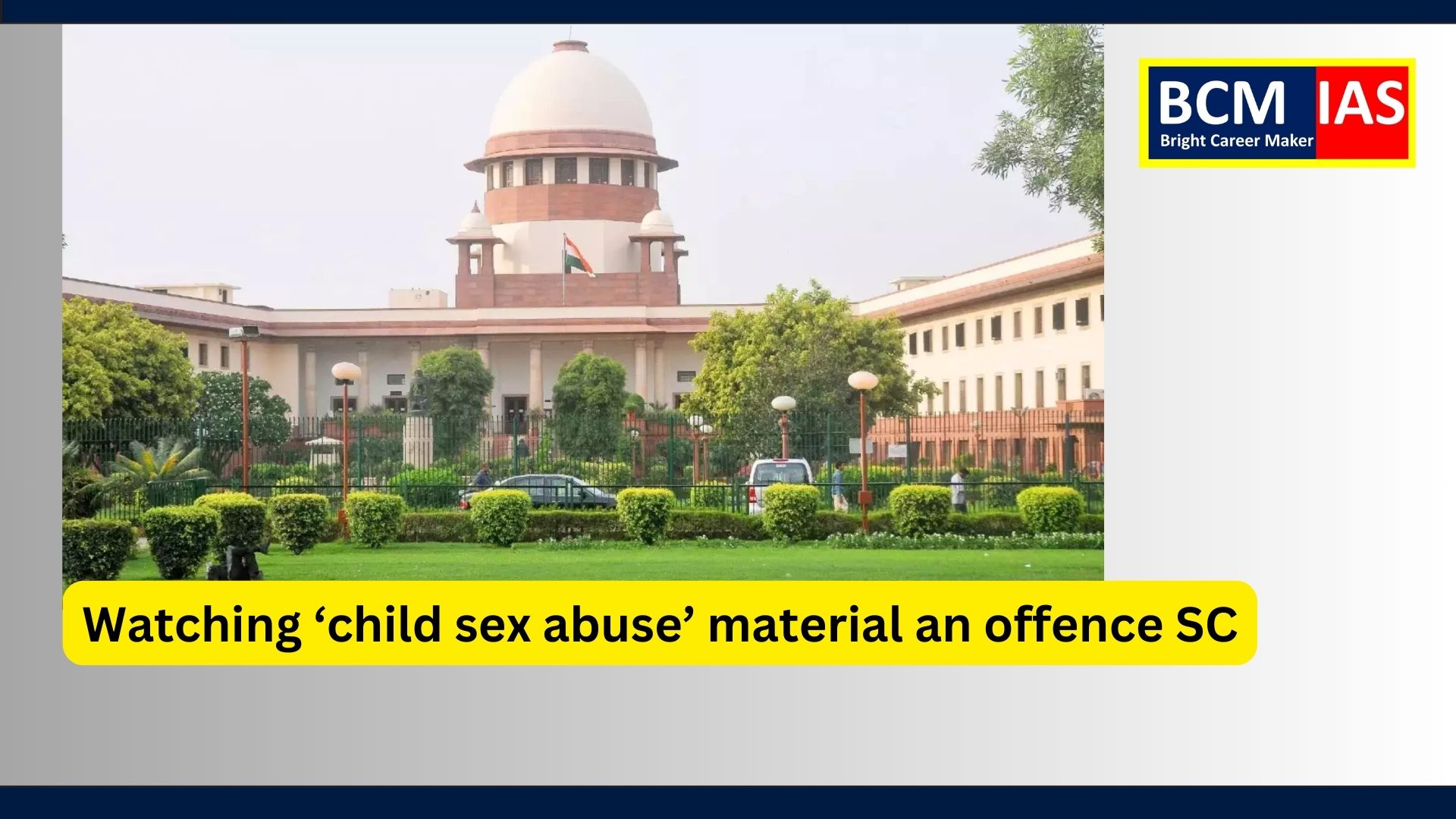
Watching ‘child sex abuse’ material an offence: SC
Analysis
and Explanation of the Supreme Court Verdict on Child Sexual Exploitative and
Abuse Material
Introduction
The recent ruling by the Supreme Court of India has
significant implications for the legal treatment of child sexual exploitation
and abuse material (CSEAM). The court has established that viewing,
downloading, storing, and distributing such material constitutes a criminal
offense under the Protection of Children from Sexual Offences (POCSO) Act and
the Information Technology (IT) Act. This verdict marks a critical evolution in
the legal discourse surrounding child exploitation, emphasizing the need for
clarity in terminology and legal definitions.
Key
Points of the Judgment
1. Terminology
Shift:
o The Supreme
Court has directed the replacement of the term "child pornography"
with "Child Sexual Exploitative and Abuse Material" (CSEAM). The
court deemed the previous term a misnomer that trivializes the severity of the
crime.
o The ruling
highlights that existing terminology fails to reflect the gravity of child
exploitation and perpetuates a misunderstanding of the nature of the crimes
involved.
2. Legal
Implications:
o The court held
that actions such as viewing, downloading, and possessing CSEAM attract
criminal liability. This position rejects a previous ruling from the Madras
High Court, which suggested that mere possession of such material did not
constitute a crime.
o The ruling
underscores the principle that there is no distinction between viewing such
material and committing actual acts of child sexual abuse, emphasizing that
both share the same malicious intent.
3. Psychological
Impact on Victims:
o Justice J.B.
Pardiwala, who authored the judgment, articulated the profound psychological
harm inflicted on child victims. The availability of such material online
exacerbates their trauma, depriving them of the opportunity to heal and
recover.
o The judgment
pointed out that the perpetuation of such material leads to ongoing
victimization, as children become aware that their abuse is being viewed and
shared online.
4. Constructive
Possession:
o The court
introduced the concept of "constructive possession," stating that
individuals could be held criminally liable if they have the ability to control
or manipulate the material, regardless of whether they physically stored it.
o This principle
aims to close loopholes that individuals may exploit to evade responsibility,
such as deleting links or utilizing online platforms to access CSEAM without
direct possession.
5. Call
for Legislative Action:
o The Supreme
Court urged Parliament to amend the POCSO Act to reflect the new terminology
and legal interpretations. It recommended the promulgation of an ordinance to
facilitate immediate changes pending formal legislative processes.
o The directive to
lower courts to adopt the new terminology in their judgments is a significant
step toward a uniform legal approach across the country.
Conclusion
The Supreme Court's ruling serves as a pivotal moment in the
fight against child sexual exploitation and abuse in India. By redefining
terminology and emphasizing the criminality of all actions related to CSEAM,
the court aims to strengthen legal frameworks and improve the protection of
vulnerable children. This landmark decision not only seeks to hold offenders
accountable but also aims to raise public awareness about the serious
implications of child exploitation, calling for a more informed and proactive
approach in society and law enforcement. As the court pointed out, the
psychological and emotional toll on victims necessitates a comprehensive
response that prioritizes their well-being and recovery.
Mains Question
Question:
Critically analyze the recent Supreme Court judgment that recognizes the
viewing, downloading, and possession of Child Sexual Exploitative and Abuse
Material (CSEAM) as a criminal offense under the Protection of Children from
Sexual Offences (POCSO) Act. Discuss the implications of this ruling on legal
terminology, victim rights, and the challenges of enforcement.
Answer
Introduction
The recent ruling by the Supreme Court of India concerning
Child Sexual Exploitative and Abuse Material (CSEAM) marks a significant legal
milestone in the protection of children against sexual offenses. By declaring
that actions such as viewing, downloading, storing, and distributing CSEAM
constitute criminal offenses under the POCSO Act and the Information Technology
(IT) Act, the court has emphasized the seriousness of child exploitation. This
judgment not only seeks to amend legal definitions but also highlights broader
implications for victim rights and enforcement challenges.
Body
1. Legal Terminology and Its Significance
The Supreme Court's decision to replace the term "child
pornography" with "Child Sexual Exploitative and Abuse Material"
(CSEAM) reflects a critical understanding of the nature of the crime.
- Trivialization
of Crime: The
term "child pornography" has been criticized for trivializing
the severity of the crime by implying consent and adult-like scenarios. In
contrast, CSEAM underscores the reality of exploitation and abuse,
portraying it as a heinous violation of a child's rights and dignity.
- Legal
Clarity: This
redefinition brings clarity to legal discourse, aiding law enforcement,
legal practitioners, and the judiciary in appropriately addressing
offenses related to child sexual exploitation.
2. Victim Rights and Psychological Impact
The judgment articulates a profound recognition of the
psychological trauma inflicted on child victims.
- Ongoing
Victimization:
Justice J.B. Pardiwala’s observations regarding the lasting psychological
impact on victims emphasize that the availability of CSEAM exacerbates
their trauma, denying them the chance for healing and closure. The
acknowledgment of this reality is vital for framing laws that prioritize
victim rights and rehabilitation.
- Empowerment
of Victims: By
recognizing the severe impact of such crimes, the court's ruling empowers
victims by validating their experiences and reinforcing the importance of
safeguarding their rights throughout legal processes.
3. Enforcement Challenges
While the ruling marks progress in legal protection, it also
presents several enforcement challenges.
- Constructive
Possession: The
introduction of the principle of constructive possession expands the scope
of liability, making it crucial for law enforcement to adapt to this
interpretation. Investigating online spaces, identifying perpetrators, and
ensuring accountability require significant resources and training for
police and judicial officials.
- Technological
Advancements:
The proliferation of digital technology complicates enforcement. Offenders
may use sophisticated methods to conceal their activities, such as
utilizing encrypted platforms or cloud storage. Law enforcement agencies
must enhance their capabilities to combat such tactics effectively.
- Public
Awareness:
There is a pressing need for awareness campaigns to educate the public
about the implications of viewing or sharing CSEAM. Misconceptions
surrounding consent and legality may hinder reporting and enforcement
efforts.
Conclusion
The Supreme Court's ruling is a landmark decision in the
fight against child sexual exploitation, redefining legal terminology, and
enhancing the recognition of victim rights. However, it also necessitates a concerted
effort to address the enforcement challenges that arise from technological
advancements and the need for comprehensive public education. The implications
of this judgment extend beyond the courtroom, calling for a societal commitment
to protecting children and ensuring justice for victims of exploitation and
abuse. As the legal landscape evolves, continued advocacy for child rights and
robust mechanisms for enforcement will be crucial in realizing the judgment's
full potential.
MCQs
Question: What term did the Supreme Court of India recently direct to replace
"child pornography" in legal discourse?
A) Child Sexual Abuse Material
B) Child Exploitation Material
C) Child Sexual Exploitative and Abuse Material (CSEAM)
D) Child Sexual Offense Material
Answer: C) Child Sexual Exploitative and Abuse Material (CSEAM)
Explanation: The Supreme Court emphasized that the term "Child
Sexual Exploitative and Abuse Material" (CSEAM) better reflects the nature
of the crime than "child pornography," which trivializes the offenses
involved.
2. Legal Implications
Question: According to the Supreme Court ruling, which of the following actions
related to CSEAM is considered a criminal offense under the POCSO Act?
A) Only distribution of CSEAM
B) Viewing, downloading, storing, and distributing CSEAM
C) Only possession of CSEAM
D) None of the above
Answer: B) Viewing, downloading, storing, and distributing CSEAM
Explanation: The Supreme Court clarified that all actions including
viewing, downloading, storing, and distributing CSEAM constitute criminal
offenses under the POCSO Act and the Information Technology Act.
3. Psychological Impact on Victims
Question: What was a key concern highlighted by the Supreme Court regarding the
impact of CSEAM on child victims?
A) It primarily affects their physical health.
B) It leads to increased legal penalties for offenders.
C) It exacerbates the psychological trauma experienced by the victims.
D) It encourages further criminal behavior among offenders.
Answer: C) It exacerbates the psychological trauma experienced by the victims.
Explanation: The Supreme Court emphasized that the knowledge that their
abuse is being viewed and shared perpetuates the psychological trauma
experienced by child victims, hindering their recovery.
4. Constructive Possession Principle
Question: What principle did the Supreme Court introduce to address liability
concerning CSEAM?
A) Direct possession
B) Constructive possession
C) Intentional possession
D) Temporary possession
Answer: B) Constructive possession
Explanation: The Supreme Court introduced the principle of constructive
possession, stating that individuals could be held liable if they have the
ability to control or manipulate CSEAM, regardless of whether they physically
possess it.
5. Legislative Action
Question: Following the Supreme Court ruling, what action did the court urge the
Indian Parliament to take regarding the POCSO Act?
A) To repeal the POCSO Act entirely
B) To amend the Act to reflect the new terminology regarding CSEAM
C) To increase penalties for all offenses under the Act
D) To make CSEAM legal for educational purposes
Answer: B) To amend the Act to reflect the new terminology regarding CSEAM
Explanation: The Supreme Court urged Parliament to amend the POCSO Act to
replace the term "child pornography" with "Child Sexual
Exploitative and Abuse Material" (CSEAM) to accurately reflect the gravity
of the offenses.


Comments on “Watching ‘child sex abuse’ material an offence: SC”