

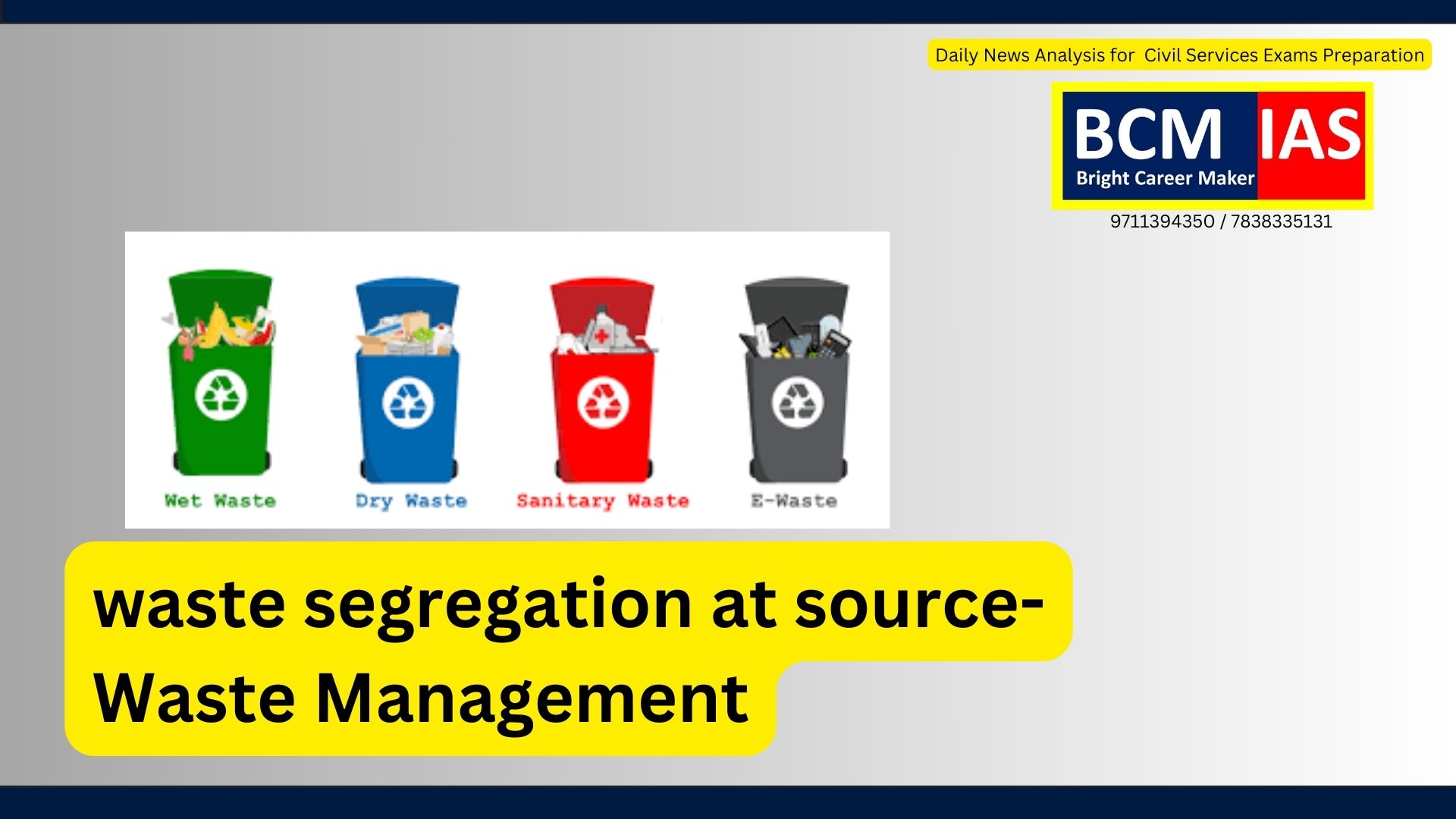
Waste
segregation at source-Waste
Management
1. Relevance in UPSC CSE Syllabus
This topic is relevant to the UPSC CSE (Civil Services Exam) syllabus
under the following sections:
- General
Studies (GS) Paper II: Governance, Constitution, Polity, Social Justice
& International Relations
- Environmental
governance & judicial intervention
- Policies
& implementation related to waste management
- Solid
Waste Management Rules, 2016
- General
Studies (GS) Paper III: Environment, Disaster Management & Science
& Technology
- Sustainable
development and waste management
- Urbanization
and associated challenges
- Waste-to-Energy
projects
- Essay
Paper:
- Sustainable
urban development and environment
- Judicial
activism in environmental protection
- Prelims
Exam:
- Solid
Waste Management Rules, 2016
- Central
Pollution Control Board (CPCB)
2. News in Short
The Supreme Court (SC) has directed the National Capital Region (NCR)
States (Delhi, Haryana, Uttar Pradesh, and Rajasthan) to submit plans for proper
waste segregation at source in compliance with the Solid Waste
Management Rules, 2016. The court expressed concerns about poor waste
management, noting that Delhi alone generates over 11,000 tonnes of waste
daily, out of which 3,000 tonnes remain untreated, leading to a potential public
health emergency.
3. Why in News?
- Solid
waste mismanagement: The SC noted that urban bodies in NCR States
are failing to properly segregate and manage waste.
- Public
health concerns: The court warned that untreated waste could
lead to a health emergency.
- Environmental
impact: The court criticized that waste-to-energy
projects could lead to more pollution if waste is not properly
segregated before processing.
- Government
inefficiency: SC questioned smart city projects
lacking proper waste management.
- Judicial
intervention: SC has demanded compliance reports
from States by March-end.
4. Key Ideas in the News
- Judicial
oversight in environmental governance
- Waste
segregation at source is crucial for efficient processing
- Failure
in urban solid waste management
- Waste-to-energy
projects require pre-segregation to be effective
- Need
for smart city projects to integrate sustainable waste management
practices
- Potential
public health risks due to unprocessed waste
- Solid
Waste Management Rules, 2016, not being implemented effectively
- Role
of the Central Pollution Control Board (CPCB) in monitoring
waste-to-energy projects
5. Concepts & Provisions Involved
A. Solid Waste Management Rules, 2016:
- Issued
by the Ministry of Environment, Forest, and Climate Change (MoEFCC)
- Key
Provisions:
- Segregation
of waste at source (wet, dry, hazardous)
- Extended
producer responsibility (EPR) for plastic waste
- Scientific
disposal of solid waste
- Promotion
of waste-to-energy and composting
- Role
of municipal bodies in implementing segregation
B. Waste-to-Energy (WTE) Projects:
- Convert
solid waste into electricity or fuel.
- Require
segregated waste to avoid toxic emissions.
- Challenges:
Poor segregation leads to more pollution.
C. Role of Central Pollution Control
Board (CPCB):
- CPCB
monitors compliance with Solid Waste Management Rules, 2016.
- It
evaluates the environmental impact of waste-to-energy plants.
6. Analysis of the News
A. Social Impact
- Health
hazards due to unprocessed waste.
- Poor
waste management increases urban diseases
(e.g., respiratory issues, infections).
- Citizen
participation in waste segregation is lacking.
B. Economic Impact
- Inefficient
waste processing increases municipal expenses.
- Failure
of waste-to-energy projects leads to financial losses.
- Proper
segregation could generate employment in waste management.
C. Political & Legal Analysis
- Judicial
activism in environmental issues.
- Failure
of state governments in enforcing waste segregation rules.
- Violation
of Solid Waste Management Rules, 2016.
- Role
of municipal bodies and urban governance failure.
7. Views
Legal Perspective
- SC’s
intervention ensures environmental justice.
- Failure
to comply with the Solid Waste Management Rules, 2016 is leading to
judicial action.
Opposition View
- Criticism
of state governments for poor urban governance.
- Need
for community participation in waste management.
- Concerns
over judiciary encroaching into executive functions.
8. Impact Analysis
Social Impact
✔ Better
waste management will reduce diseases and pollution.
✔ Citizens
will become more aware of waste segregation.
✖ Lack of
awareness & community participation may hinder progress.
Economic Impact
✔ Improved
waste processing can create job opportunities.
✔
Waste-to-energy projects can become more viable with segregation.
✖ Poor
implementation can increase municipal costs.
Political Impact
✔ SC's
intervention forces governments to act.
✔ Raises
questions on failure of governance in urban areas.
✖ May be
seen as judicial overreach.
Legal Impact
✔
Reinforces Solid Waste Management Rules, 2016.
✔
Strengthens CPCB’s role in monitoring waste management.
✖ Need for
clearer enforcement mechanisms.
9. Important Facts
|
Aspect |
Details |
|
Issue |
Poor
waste segregation in NCR states (Delhi, Haryana, UP, Rajasthan) |
|
SC’s
Concern |
Waste-to-energy
projects will increase pollution if segregation is not done |
|
Public
Health Risk |
3,000
tonnes of untreated solid waste in Delhi |
|
Daily
Waste Generation |
11,000+
tonnes |
|
Solid
Waste Management Rules, 2016 |
Mandates
segregation, processing, and proper disposal |
|
Deadline |
NCR
states to submit compliance reports by March-end |
|
Waste
Treatment Capacity |
Only 8,073
tonnes processed daily |
|
SC’s
Directive |
Governments
must present a comprehensive waste management plan |
10. Critical Evaluation
- SC’s
intervention is necessary due to failure of urban
governance.
- State
governments should have acted earlier rather than waiting for
judicial orders.
- Need
for better implementation of the Solid Waste
Management Rules, 2016.
- Public
awareness and behavioral change are equally important.
- A
long-term policy solution rather than crisis-based
intervention is needed.
11. Exam Relevance
Prelims (MCQs) can be asked on-
- Provisions
of Solid Waste Management Rules, 2016.
- Role
of CPCB in environmental regulation.
- Functions
of waste-to-energy plants.
- Supreme
Court’s power under Article 142 (judicial intervention in
governance).
Mains (GS-II & GS-III)
- Judicial
intervention in environmental governance.
- Urbanization
and waste management challenges.
- Implementation
issues of environmental laws in India.
- Role
of state governments and municipal bodies in waste management.
Interview
- "How
can waste management be improved in Indian cities?"
- "Do
you think SC’s intervention is necessary in governance issues?"
- "What
role can technology play in waste disposal?"
12. Probable Mains Questions
Q1. "Discuss the role of judicial activism in
environmental governance in India. Use the example of the SC’s intervention in
waste segregation."
Hint: Judicial role, Article 142, environmental
justice, effectiveness.
Q2. "Critically examine the challenges in
implementing the Solid Waste Management Rules, 2016 in Indian cities."
Hint: Urban governance failure, lack of awareness,
waste-to-energy challenges.
Q3. "How can smart cities integrate
sustainable waste management practices?"
Hint: Role of technology, waste segregation, urban
planning.
Final Thoughts
- SC’s
intervention is a wake-up call for state governments.
- Proper
waste segregation is key to successful waste-to-energy projects.
- Urban
governance needs structural reforms to prevent crisis-driven
interventions.
- Public
awareness & behavioral change are critical for effective
implementation.


Comments on “Waste segregation at source-Waste Management”