


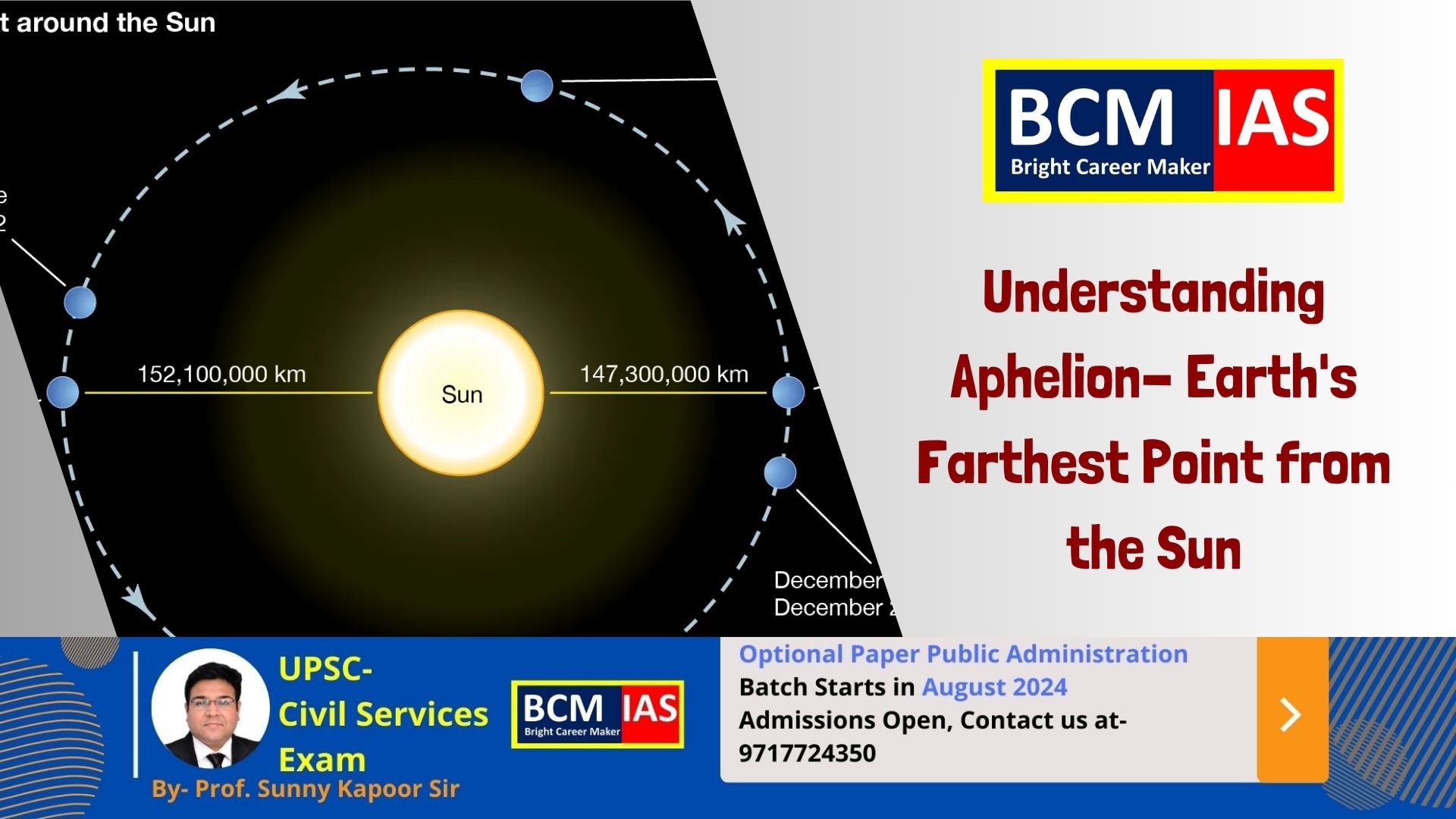
Understanding Aphelion: Earth's
Farthest Point from the Sun
Analysis
Every July, Earth reaches a point in its orbit known as
aphelion, where it is the farthest from the Sun. This phenomenon, rooted in the
elliptical nature of Earth’s orbit, offers insights into planetary movements
and the intricate dance of celestial bodies governed by gravity.
What is Aphelion?
Aphelion is the point in the orbit of a planet, asteroid, or
comet at which it is farthest from the Sun. For Earth, this occurs every July,
with the distance from the Sun being about 152.1 million kilometers.
The Elliptical Nature of Orbits
Unlike perfect circles, the orbits of planets in our solar
system are elliptical. This means that the distance between a planet and the
Sun varies over the course of its orbit. The degree of this variation is
measured by the orbit's eccentricity. Earth’s orbit has a low eccentricity of
0.017, making it almost circular but still elliptical enough to have distinct
aphelion and perihelion points.
Gravitational Influences
The elliptical orbits are a result of gravitational
interactions among planets. These interactions cause slight deviations from a
perfect circular orbit. Jupiter, being the most massive planet in the solar
system, exerts the most significant gravitational influence, contributing to
these orbital shapes.
Distance at Aphelion and Perihelion
At aphelion, Earth is approximately 152.1 million kilometers
from the Sun. Six months later, at perihelion, Earth is closest to the Sun, at
about 147.1 million kilometers. This 5 million kilometer difference is due to
the elliptical shape of Earth’s orbit.
Impact on Earth's Seasons
A common misconception is that the distance from the Sun
causes seasonal changes. While it is true that Earth receives about 7% less
sunlight at aphelion than at perihelion, the tilt of Earth's axis plays a more
significant role in creating seasons. The axial tilt causes the Northern and
Southern Hemispheres to receive varying amounts of sunlight throughout the
year, leading to seasonal changes.
Hypothetical Scenarios
If Earth’s Orbit Were Perfectly Circular
- The
lengths of the seasons would be identical, with spring and summer
currently being slightly longer than fall and winter in the Northern
Hemisphere.
- Overall,
not much would change in terms of seasonal experience.
If Earth’s Orbit Became More Eccentric
- Increased
eccentricity could lead to extreme seasonal variations, particularly in
the Southern Hemisphere.
- Summers
could become unbearably hot, and winters intolerably cold, potentially
leading to agricultural challenges and severe climatic conditions.
- Such
extremes could make advanced civilization challenging to sustain.
Conclusion
Aphelion is a fascinating aspect of Earth’s orbit,
highlighting the complexity of planetary movements and gravitational
influences. While the slight variations in distance from the Sun at aphelion
and perihelion do not significantly affect Earth's climate, understanding these
orbital mechanics enhances our appreciation of the delicate balance that
sustains life on our planet. The current near-circular orbit of Earth places it
in a "sweet spot," ensuring a stable environment conducive to advanced
civilization.
Mains Question: Understanding the Concept and Implications of Aphelion
in Earth's Orbit
Question:
What is aphelion, and how does it influence
Earth’s climatic conditions and seasons? Discuss the potential consequences if
Earth’s orbit were to become more eccentric.
Answer:
Introduction
Aphelion is a significant event in Earth's orbital journey
around the Sun, occurring every July when Earth is at its farthest point from
the Sun. Understanding aphelion and its implications provides insight into the
intricate dynamics of Earth's orbit and its effects on our planet's climate and
seasons.
Body
What is Aphelion?
Aphelion refers to the point in the orbit of a planet where
it is farthest from the Sun. For Earth, this occurs around early July each
year, with the distance from the Sun being approximately 152.1 million
kilometers. This phenomenon is a result of Earth's elliptical orbit, which
deviates from a perfect circle due to gravitational influences.
The Elliptical Nature of Earth's Orbit
- Elliptical
Orbit: Earth's
orbit is not a perfect circle but an elongated ellipse. The extent of this
elongation is measured by the orbit's eccentricity.
- Eccentricity: Earth's orbital eccentricity
is 0.017, which is relatively low, indicating a near-circular orbit.
Higher eccentricity would result in a more elongated orbit.
Gravitational Influences
- Planetary
Interactions:
Gravitational forces from other planets, particularly Jupiter, cause
Earth's orbit to deviate from a perfect circle. Jupiter, being the most
massive planet, exerts the greatest influence, contributing to the
elliptical shape of Earth's orbit.
Aphelion and Perihelion
- Aphelion: Occurs in early July, when
Earth is about 152.1 million kilometers from the Sun.
- Perihelion: Occurs in early January, when
Earth is closest to the Sun at approximately 147.1 million kilometers. The
5 million kilometer difference is due to the elliptical nature of the
orbit.
Influence on Climatic Conditions and Seasons
- Seasonal
Misconception:
A common misconception is that Earth's varying distance from the Sun
causes the seasons. While Earth receives about 7% less sunlight at
aphelion compared to perihelion, this difference is not the primary driver
of seasonal changes.
- Axial
Tilt: The tilt
of Earth's axis (approximately 23.5 degrees) plays a more crucial role in
creating seasons. The axial tilt causes different hemispheres to receive
varying amounts of sunlight throughout the year, leading to seasonal
changes.
- Milder
Summers and Winters: The reduced sunlight at aphelion contributes to slightly milder
summers and winters in the Northern Hemisphere. However, this effect is
offset by the axial tilt, which dominates seasonal temperature variations.
Potential Consequences of Increased Orbital
Eccentricity
- Extreme
Seasonal Variations: If Earth's orbit were to become more eccentric, the difference in
distance from the Sun at aphelion and perihelion would increase, leading
to more pronounced seasonal changes.
- Southern
Hemisphere:
Summers could become unbearably hot, and winters intolerably cold,
especially in the Southern Hemisphere, which would experience more
extreme seasonal variations.
- Agricultural
Impact: Extreme
temperatures could lead to crop failures, adversely affecting food
security.
- Human
Habitation:
Severe climatic conditions might make certain regions uninhabitable,
challenging advanced civilizations to adapt or relocate.
Current Stability and Future Considerations
- Current
Near-Circular Orbit: Earth's current orbit places it in a "sweet spot,"
ensuring relatively stable climatic conditions conducive to advanced
civilization.
- Hypothetical
Changes: Any
significant change in Earth's orbital eccentricity could disrupt this
balance, highlighting the importance of understanding and preserving the
current orbital dynamics.
Conclusion
Aphelion is a critical aspect of Earth's orbit, influenced by
gravitational forces and resulting in a slight variation in distance from the
Sun. While it has a minor effect on seasonal temperatures, the primary driver
of Earth's seasons is its axial tilt. Understanding the implications of
aphelion and the potential consequences of increased orbital eccentricity
underscores the delicate balance that sustains life on our planet. Preserving
this balance is crucial for maintaining the stable environment necessary for
advanced civilization.
MCQs for UPSC Prelims on Aphelion and Earth's Orbit
1. What is aphelion?
A. The point in Earth’s orbit when it is closest to the Sun
B. The point in Earth’s orbit when it is farthest from the Sun
C. The point in Earth’s orbit when it is closest to the Moon
D. The point in Earth’s orbit when it is farthest from the Moon
Answer: B
2. At aphelion, approximately how far is Earth from the Sun?
A. 147.1 million kilometers
B. 150.1 million kilometers
C. 152.1 million kilometers
D. 155.1 million kilometers
Answer: C
3. Which of the following factors primarily causes Earth’s
orbit to be elliptical rather than circular?
A. The tilt of Earth's axis
B. Gravitational influences from other planets
C. The distance from the Sun
D. The speed of Earth's rotation
Answer: B
4. Which of the following statements about Earth's orbit and
seasons is correct?
1.
Earth’s varying distance from the Sun is the primary
cause of the seasons.
2.
Earth's axial tilt is the primary cause of the
seasons.
3.
Earth receives about 7% less sunlight at aphelion than
at perihelion.
4.
A more eccentric orbit would lead to more extreme
seasonal variations.
Select the correct answer using the codes given below: A. 1 and 2 only
B. 2 and 3 only
C. 2, 3, and 4 only
D. 1, 3, and 4 only
Answer: C
5. What would be the potential consequence if Earth’s orbit
became more eccentric?
A. The lengths of the seasons would become exactly the same.
B. Earth's climate would become more stable.
C. Seasonal variations in the Southern Hemisphere would become more extreme.
D. Advanced civilization would face fewer challenges.
Answer: C


Comments on “Understanding Aphelion: Earth's Farthest Point from the Sun”