


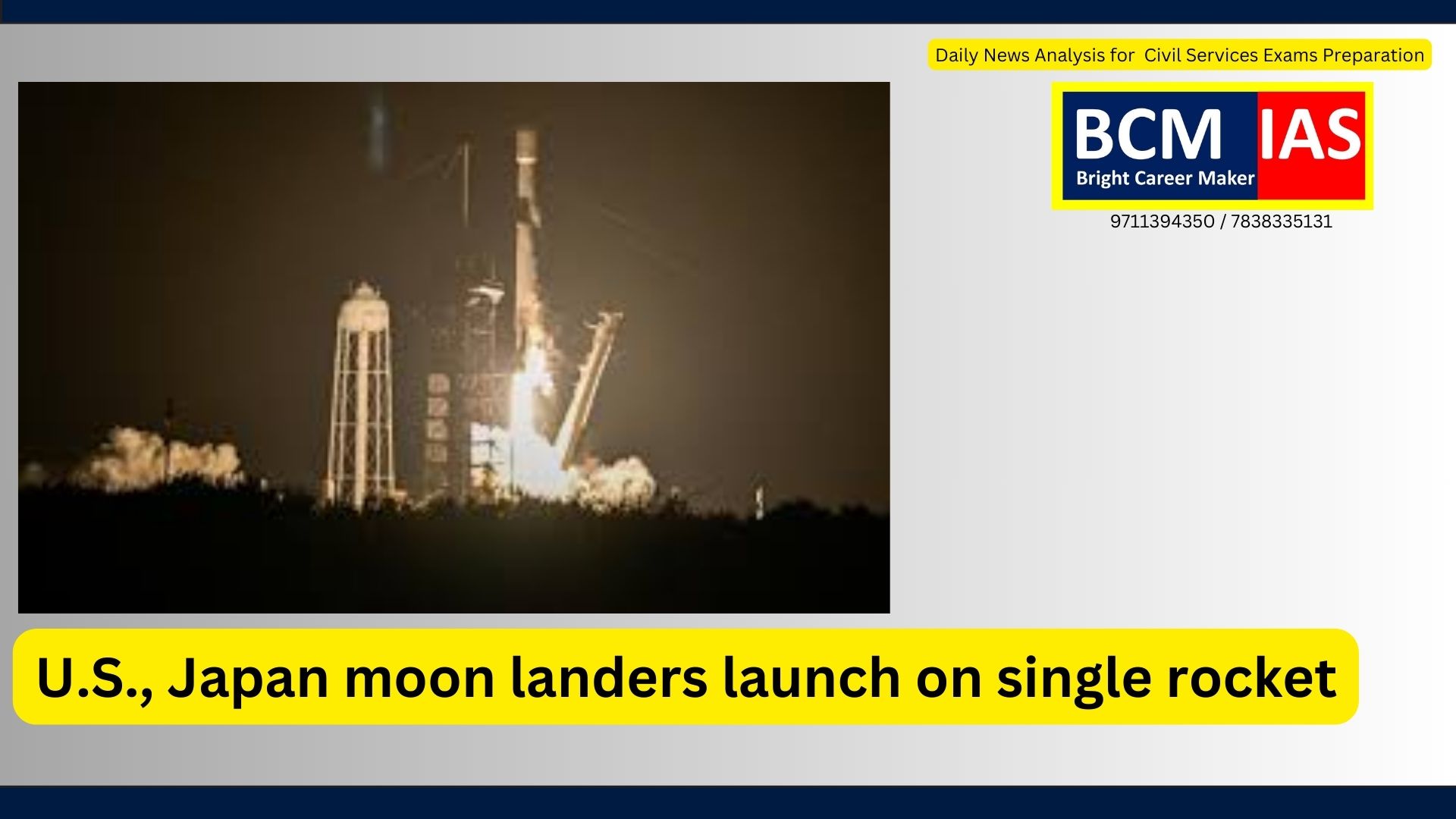
U.S., Japan moon landers launch on
single rocket
Overview:
The successful launch of the SpaceX Falcon 9
rocket carrying the U.S.-based Firefly Aerospace's Blue Ghost and Japan's ispace Resilience lunar landers
signifies a pivotal moment in modern space exploration. This
"rideshare" mission highlights the growing role of private companies
in advancing lunar exploration.
Key Elements of the
Mission:
1. The
Launch:
o Rocket
and Payload:
§ SpaceX’s
Falcon 9 rocket launched the two lunar landers: Blue Ghost and Resilience.
§ The
mission is a collaborative effort involving U.S. and Japanese private space
companies.
o Launch
Site: Kennedy Space Center, Florida, USA.
2. Private
Sector Involvement:
o Reflects
a shift from government-dominated space missions to private sector-led
initiatives.
o This
mission supports NASA’s Commercial
Lunar Payload Services (CLPS) program, aimed at reducing costs
and fostering a lunar economy.
3. Objectives
of the Lander Missions:
o Blue
Ghost (U.S.):
§ Carries
10 NASA instruments for scientific investigations (e.g., studying the Earth’s
magnetosphere, lunar dust, and thermal properties).
§ Will
land near Mons Latreille, a volcanic feature on the Moon’s northeast near side.
§ Includes
technology demonstrations for navigation and computing under harsh lunar
radiation.
o Resilience
(Japan):
§ To
land in Mare Frigoris on the Moon’s far north after 4-5 months.
§ Carries
scientific instruments and the Tenacious
micro rover, which will collect and study regolith (lunar surface material).
4. Challenges
in Soft Landings:
o Soft
lunar landings require precise navigation and thruster-based controlled
descents due to the lack of an atmosphere.
o Risks
include avoiding craters and boulders, managing lunar dust, and ensuring
operational functionality in extreme conditions.
o Ispace's
previous attempt in April 2023 ended in a hard landing, showcasing the
high-risk nature of these missions.
Significance of the
Mission:
1. Technological
Advancement:
o Demonstrates
innovative technologies like autonomous navigation, radiation-resistant
computing, and regolith sampling capabilities.
o Advances
understanding of lunar science and potential resource utilization.
2. Boosting
Lunar Economy:
o Aligns
with NASA’s Artemis program goals to establish a sustained human presence on
the Moon by leveraging private sector contributions.
o Provides
a cost-effective alternative to government-led missions, stimulating commercial
investments in space exploration.
3. Global
Collaboration:
o Highlights
the collaborative efforts of U.S. and Japanese private companies.
o Reinforces
international cooperation in scientific and technological pursuits.
4. Path
to Sustainable Space Exploration:
o Sets
the stage for long-term human exploration and utilization of the Moon.
o Paves
the way for future Mars missions by developing expertise in deep-space
exploration and technology.
Conclusion:
The U.S.-Japan rideshare mission marks a
significant milestone in lunar exploration, reflecting the increasing role of
private entities in space. Through innovative technologies and international
collaboration, these missions not only expand the frontiers of space science
but also lay the groundwork for a sustainable and economically viable lunar
presence under NASA’s Artemis program. However, the mission’s success depends
on overcoming the inherent challenges of soft lunar landings.
MCQs
Q1. With reference to the growing role of
private companies in space exploration, consider the following statements:
1.
NASA's Commercial Lunar Payload Services
(CLPS) program is designed to encourage private sector participation in lunar
exploration.
2.
Soft landings on the Moon have historically
been achieved exclusively by national space agencies.
3.
Private companies have reduced the costs of
lunar missions significantly.
Which of the above statements is/are correct?
(a) 1 only
(b) 1 and 2 only
(c) 1 and 3 only
(d) 1, 2, and 3
Answer:
(d) 1, 2, and 3
Q2. Why are soft landings on the Moon
challenging compared to Earth landings?
1.
The Moon lacks an atmosphere to support parachute-based
descent systems.
2.
Lunar terrain is covered with boulders and
craters that complicate navigation.
3.
Dust particles on the Moon pose significant
risks to equipment and technology.
Select the correct answer using the codes
given below:
(a) 1 and 2 only
(b) 2 and 3 only
(c) 1 and 3 only
(d) 1, 2, and 3
Answer:
(d) 1, 2, and 3
Q3. What is the primary objective of NASA’s
Artemis program?
(a) Establishing a permanent human presence
on the Moon.
(b) Launching the first commercial space station in Earth’s orbit.
(c) Developing a rover capable of exploring Mars.
(d) Creating a satellite-based communication network for deep space missions.
Answer:
(a) Establishing a permanent human presence on the Moon.
Q4. The Blue Ghost lunar lander launched
recently carries instruments to study:
1.
The Earth’s magnetosphere.
2.
Lunar dust and the Moon’s interior structure.
3.
Effects of cosmic radiation on living
organisms.
Which of the above is/are correct?
(a) 1 and 2 only
(b) 2 and 3 only
(c) 1 only
(d) 1, 2, and 3
Answer:
(a) 1 and 2 only
Q5. What is the significance of studying
regolith (lunar surface material) on the Moon?
1.
Understanding the composition of the Moon’s
surface.
2.
Developing technologies for in-situ resource
utilization.
3.
Assessing the potential for human colonization
on the Moon.
Select the correct answer using the codes
given below:
(a) 1 only
(b) 1 and 2 only
(c) 2 and 3 only
(d) 1, 2, and 3
Answer: (d) 1, 2, and 3


Comments on “U.S., Japan moon landers launch on single rocket”