


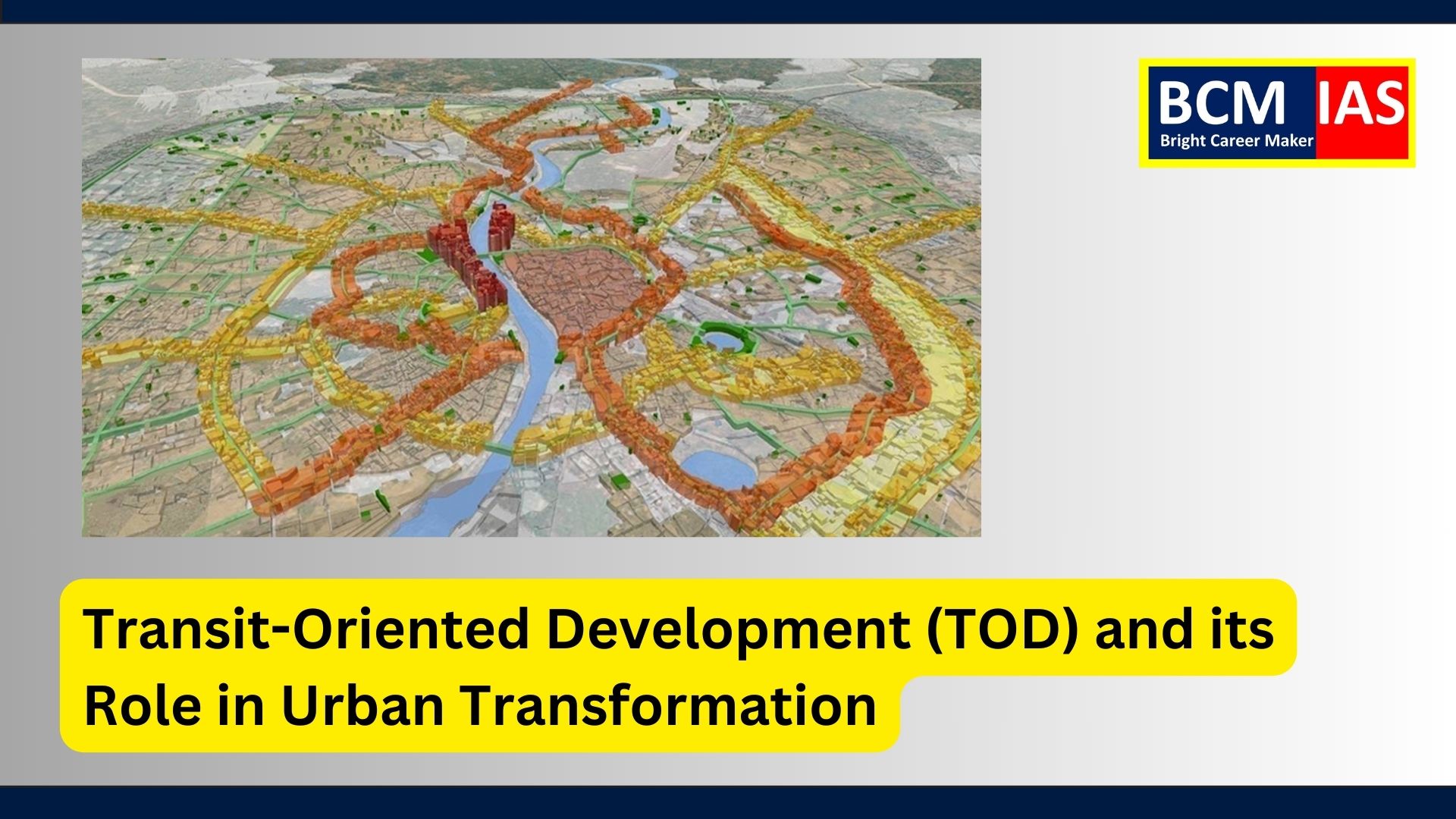
Transit-Oriented
Development (TOD) and its Role in Urban Transformation
Introduction:
Urbanization in India is accelerating rapidly, and with this
growth comes the challenge of creating sustainable, efficient, and livable
cities. One of the major obstacles faced by urban centers is the increased
reliance on private vehicles, resulting in congestion, pollution, and longer
commute times. In response, Transit-Oriented Development (TOD) has emerged as a
key urban planning strategy that aims to integrate land use and transportation
planning to create high-density, mixed-use developments around transit hubs.
TOD offers the potential to reshape cities by enhancing accessibility, reducing
the carbon footprint, and improving quality of life for residents.
What is Transit-Oriented Development (TOD)?
Transit-Oriented Development (TOD) is an urban planning
approach that promotes the creation of compact, walkable, and mixed-use
neighborhoods centered around public transportation systems such as metro
stations, bus rapid transit (BRT) systems, and railways. The idea is to bring
together residential, commercial, and recreational spaces within easy walking
or cycling distance from transit hubs, reducing the need for private vehicles
and promoting sustainable urban mobility.
The core principles of TOD include:
- Compact
and mixed-use development: A combination of residential, commercial, and retail
spaces within a walkable radius of transit stations.
- High-density
development:
Increasing density near transit hubs to create vibrant neighborhoods.
- Sustainable
transportation options: Encouraging walking, cycling, and public transport use
as the primary modes of travel.
- Inclusive
growth:
Ensuring equitable access to transit for all socio-economic groups.
Challenges of Urban Growth and the Need for TOD
India’s urbanization is accompanied by a host of challenges,
including traffic congestion, rising pollution levels, long commute times, and
inefficient land use. As cities grow outward into suburban and peri-urban
areas, public transport systems struggle to keep up, leading to a greater
reliance on private vehicles. The resulting congestion not only hampers the
productivity of the workforce but also impacts the environment through
increased carbon emissions.
For example, Bengaluru, one of India’s fastest-growing
cities, suffers from severe traffic congestion. Studies indicate that traffic
congestion costs Bengaluru an estimated ₹38,000 crore annually, about 5% of the
city’s GDP. The sprawling nature of the city’s development, combined with
inadequate public transport options, has exacerbated the situation. In this
context, TOD presents a solution to these challenges by integrating
transportation and land use planning to create accessible, efficient, and sustainable
urban spaces.
Economic and Social Benefits of TOD
1.
Improving Accessibility to Jobs: One of the key goals of TOD is to bring jobs closer
to people and reduce travel times. When workplaces are clustered near transit
hubs, it not only boosts transit ridership but also enhances workforce
productivity and participation. The agglomeration effect—where businesses
benefit from being located near each other—promotes innovation, increases
economic competitiveness, and helps create vibrant commercial districts.
A study by WRI India found that in Bengaluru, once the
ongoing metro phases are completed, 85% of jobs in the Bengaluru Metropolitan
Area (BMA) will be within 2 kilometers of a metro station. This proximity to
transit reduces commute times, improves worker catchments for businesses, and
creates opportunities for real estate development.
2.
Environmental Sustainability: By encouraging the use of public
transportation, walking, and cycling, TOD reduces the dependence on private
vehicles, which in turn decreases carbon emissions and air pollution. It also
promotes compact development, reducing urban sprawl and preserving green
spaces. As part of India’s low-carbon growth agenda, TOD can play a significant
role in mitigating climate change by promoting sustainable urban mobility.
For instance, cities like Hong Kong, where 96% of jobs are
located within 2 kilometers of a transit station, have achieved significant
reductions in fuel consumption and carbon emissions. Such cities also have some
of the highest levels of public transport use, demonstrating the potential of
TOD to create environmentally sustainable cities.
3.
Enhanced Quality of Life: TOD promotes livable, walkable
neighborhoods with access to amenities such as parks, schools, and healthcare
facilities. The integration of commercial, residential, and recreational spaces
reduces the need for long commutes, providing more time for personal and family
activities. Moreover, TOD contributes to the creation of inclusive cities by
providing equitable access to transportation for all socio-economic groups,
particularly for low-income communities who rely on public transport.
4.
Real Estate and Economic Development: Transit stations become economic
magnets, attracting real estate development and boosting property values.
Clustering businesses and residential areas near transit hubs drives local
economic growth, creating new job opportunities and increasing government
revenues, which can be reinvested in further infrastructure improvements.
Barriers to Effective TOD Implementation
Despite its potential benefits, there are several barriers to
the effective implementation of TOD in Indian cities:
1.
Regulatory and Land Use Challenges: Regulatory barriers such as outdated building codes,
land acquisition issues, and zoning restrictions make it difficult to implement
higher-density developments near transit hubs. Small plot sizes, lack of
available land, and complex property ownership structures can hinder
development, particularly in inner-city areas.
2.
Infrastructure Limitations: Inadequate pedestrian and cycling
infrastructure around transit stations can limit the effectiveness of TOD.
Without proper last-mile connectivity and feeder services, residents and
workers may still rely on private vehicles, undermining the goals of TOD.
3.
High Land Prices: High property prices near transit
stations can dissuade smaller businesses and residents from locating near
transit hubs, limiting the diversity of land uses and exacerbating inequality.
4.
Market Saturation and Community
Resistance: As areas near transit hubs become
more commercialized, there is often resistance from local communities against
further development due to concerns about overcrowding, loss of open space, or
changes in neighborhood character.
The Way Forward for India’s Cities
To successfully implement TOD in India, several measures must
be undertaken:
1.
Policy Alignment and Incentives: The government should align urban development
policies with TOD principles, offering location-based incentives such as
additional development rights or tax subsidies for businesses and developers
willing to invest near transit hubs. Public-private partnerships should be
explored to finance infrastructure upgrades and station area development.
2.
Revised Master Plans: Cities must revise their master plans
to prioritize job and residential densities near transit hubs. Plans should
identify high-density zones around transit stations and balance market demand
with environmental and community goals.
3.
Improving Infrastructure: Cities need to invest in pedestrian-friendly
infrastructure, cycling lanes, and feeder services to enhance last-mile
connectivity. This will encourage more residents to use public transportation
and reduce reliance on private vehicles.
4.
Public Engagement and Coordination: To overcome community resistance, the
government should involve local stakeholders in the planning process. A nodal
agency should coordinate TOD planning and implementation across multiple
sectors to ensure that transit infrastructure aligns with broader urban
development goals.
Conclusion:
Transit-Oriented Development (TOD) is a transformative
approach that has the potential to reshape India’s cities into sustainable,
efficient, and livable urban environments. By integrating land use and
transportation planning, TOD can reduce traffic congestion, improve
accessibility to jobs, and contribute to environmental sustainability. However,
successful implementation requires coordinated efforts between the government,
private sector, and local communities. With the right policies, incentives, and
infrastructure investments, TOD can help Indian cities become globally
competitive and resilient to the challenges of urbanization.


Comments on “Transit-Oriented Development (TOD) and its Role in Urban Transformation”