


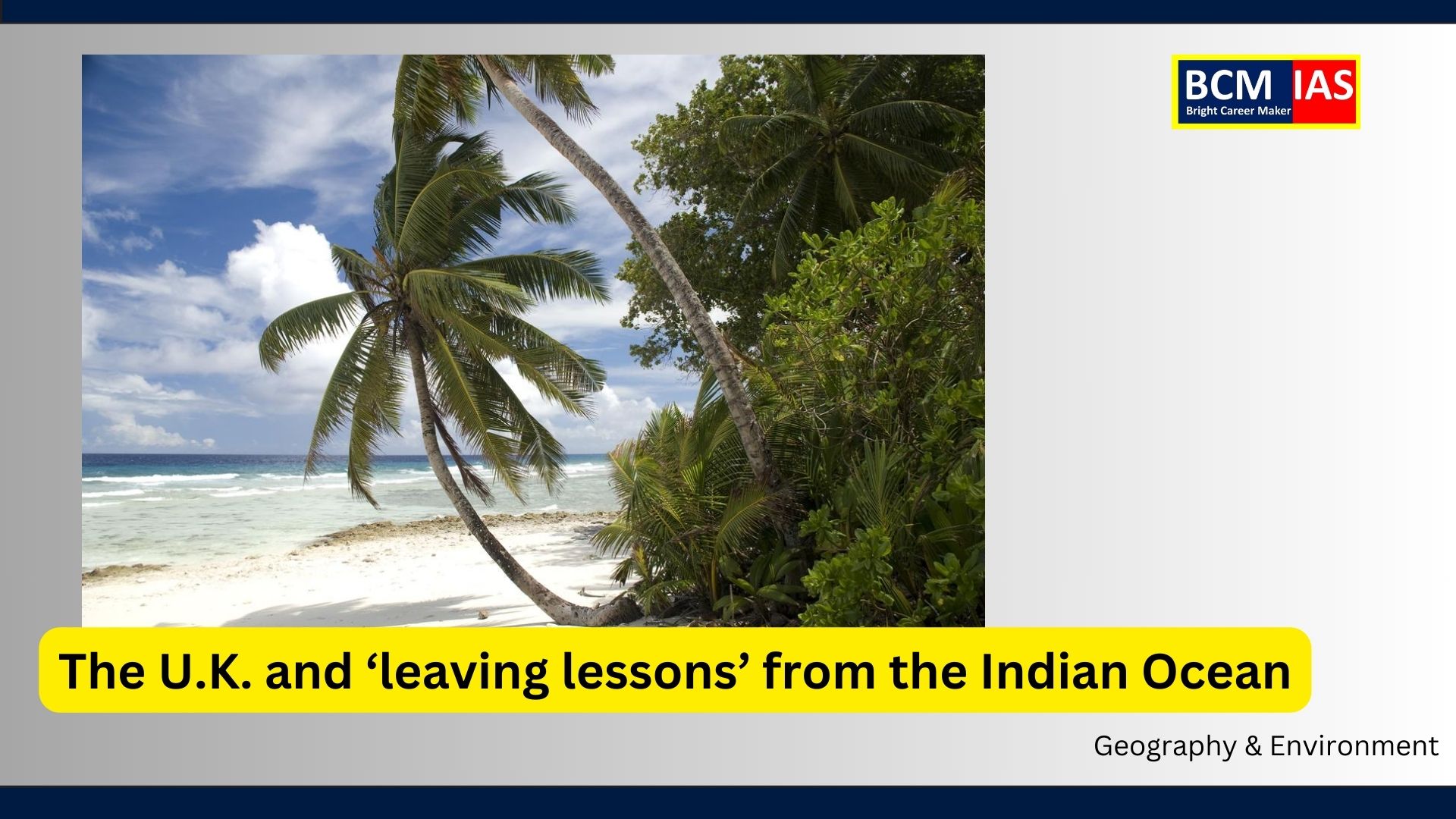
The U.K. and ‘leaving lessons’
from the Indian Ocean
News
Analysis
The article by Mohamed Nasheed on the Chagos Islands is a
multi-faceted discussion encompassing history, sovereignty, international
relations, and environmental conservation.
It addresses the geopolitical complexities surrounding the
Chagos Islands, their historical connection with the Maldives, and the
environmental imperatives of protecting the Indian Ocean’s marine resources.
Below is an analysis and explanation in the context of the UPSC
Civil Services Examination (CSE) syllabus:
Relevant
UPSC Syllabus Sections:
1. General
Studies Paper I: History of the World and Indian History
o Colonialism
and Decolonisation
o World History
o Post-colonial
Indian Ocean Region
2. General
Studies Paper II: International Relations
o India and its
neighborhood - relations
o Bilateral,
regional and global groupings and agreements involving India and/or affecting
India's interests
o Effect of
policies and politics of developed and developing countries on India’s
interests
o International
Institutions, treaties, and conventions related to conservation
3. General
Studies Paper III: Environment and Biodiversity
o Conservation,
Environmental Pollution, and Degradation
o Sustainable
Development
o Indian Ocean
as a critical geopolitical region
1.
Historical Context (General Studies Paper I)
Colonialism and Decolonisation:
- The
Chagos Islands are a product of European colonisation, their sovereignty
shifting between France and Britain through colonial wars. The islands
were retained by the United Kingdom after World War II, even after the decolonisation
of Mauritius in 1968.
- The Maldivian
historical connection to the Chagos Islands is well documented. The
article mentions that the Chagos Atolls were part of the Maldivian
Sultanate, supported by historical records like a 1560 letter from a
Maldivian Sultan. The British-French wars determined the
sovereignty over these islands, but the Maldives' historical claim
adds complexity to the issue of rightful ownership.
- Decolonisation
of the Indian Ocean territories remains incomplete. The editorial draws a parallel
between Britain's withdrawal from India in 1947, where the human cost of
Partition was severe, and the importance of avoiding similar disruptions
while addressing the status of Chagos and other island nations.
2.
International Relations and Geopolitical Dimensions (General Studies Paper II)
Geopolitics of the Indian Ocean Region:
- The
Chagos Archipelago, being geographically located in the Indian Ocean,
is geopolitically significant for countries like the Maldives,
Mauritius, Seychelles, and Sri Lanka. The editorial emphasizes the
need for a joint agreement among Indian Ocean island nations to
maintain the protected environmental status of Chagos.
- The U.K.'s
role in the region, as a former colonial power, continues to be of
importance. The editorial calls for the U.K. to learn its "leaving
lessons," ensuring that the decolonisation of Chagos does not result
in chaos, similar to what occurred during India's partition.
India's
Regional Interests:
- While
India is not directly mentioned in the editorial, the Indian Ocean's
geopolitics are crucial for India's maritime strategy and regional
influence. Any changes in sovereignty or control over the Chagos
Islands could impact India's strategic interests, particularly
concerning maritime security, trade routes, and environmental diplomacy.
- International Relations: The editorial suggests that decolonisation should
involve collaboration between multiple countries, including the Maldives
and Mauritius. Such multi-national agreements fall under the theme of bilateral
and regional groupings, a crucial area for India's foreign policy in
the Indian Ocean region.
Environmental
Diplomacy and Protected Status:
- The
article praises the U.K. for maintaining the Chagos Islands as a marine
protected area. However, it suggests that as the U.K. decolonises and
moves away from the region, a framework should be established involving
regional nations like the Maldives to ensure the protection of the marine
ecosystem.
3.
Environmental Conservation (General Studies Paper III)
Marine
Conservation and Sustainable Development:
- The
article highlights that the Chagos Islands, along with the Maldives, are
some of the only areas in the Indian Ocean with fully protected fishing
zones, free from industrial exploitation. This makes it an essential
location for marine biodiversity and sustainable fishing practices.
- The
editorial underlines the rapid depletion of fish stocks due to unsustainable
fishing practices (trawlers and seiners) by external countries. This
highlights a broader issue of global environmental governance in
the oceans, which aligns with sustainable development goals.
- Environmental protection as an international responsibility: The Maldives and other Indian
Ocean nations must work together to ensure the long-term conservation
of marine resources, which ties into international conventions on marine
biodiversity and sustainable use of natural resources.
Climate
Change and Vulnerability:
- As
the author is also the Secretary General of the Climate Vulnerable
Forum (CVF), he links the conservation of the Chagos Islands to
broader concerns about climate vulnerability, particularly for
island nations like the Maldives. Rising sea levels and changing oceanic
conditions make the protection of these islands crucial for regional
environmental stability.
Key
Themes in UPSC Syllabus:
1.
Colonial History and Decolonisation:
o Understanding
the British decolonisation process in the Indian Ocean territories,
particularly the Chagos Islands and its implications for countries like the
Maldives and Mauritius, offers insights into post-colonial geopolitics.
2.
India's Role in
Indian Ocean Region:
o The editorial
touches on themes relevant to India’s maritime strategy and its
influence in the Indian Ocean. While the issue directly concerns the U.K.,
Maldives, and Mauritius, the geopolitical shifts would have implications for
India's strategic positioning in the region.
3.
International
Environmental Diplomacy:
o Conservation and
protection of marine resources in the Indian Ocean fall under global
environmental governance. The need for multi-nation cooperation to sustain
biodiversity ties into broader issues of international treaties and
conventions on sustainable development.
4.
Environmental
Conservation and Sustainable Fishing Practices:
o The fishing
practices of countries around the Indian Ocean and the need for
sustainable, non-destructive techniques (e.g., pole-and-line fishing) highlight
issues of sustainable exploitation of marine resources, relevant for GS
Paper III.
Conclusion:
The editorial on the Chagos Islands touches upon crucial UPSC
themes such as colonial history, international relations in the Indian Ocean
region, and environmental conservation. It underscores the
importance of multi-national cooperation in preserving the marine ecosystem,
drawing historical connections to the Maldives while emphasizing the U.K.’s
role in the decolonisation of the islands. These themes are highly relevant for
aspirants preparing for topics on international relations, history,
and environmental conservation.
Probable Mains Question &
Answer
Discuss the historical and geopolitical significance of the
Chagos Islands in the context of colonialism and decolonisation. How can
environmental conservation be balanced with the decolonisation process in the
Indian Ocean region?
Answer:
Introduction:
The Chagos Islands, located in the Indian Ocean, have been a
site of strategic geopolitical importance since the colonial era. The islands
are historically linked with the Maldives and have been under British control
since the 19th century. The issue of decolonisation has resurfaced in recent
years, with Mauritius asserting claims over the islands, while the UK continues
to retain control. This situation presents a complex intersection of colonial
history, international law, and environmental conservation, particularly given
the protected status of the Chagos Archipelago.
Historical
Context and Geopolitical Significance:
1. Colonial
Control and Strategic Importance:
o The Chagos
Islands were part of the British Indian Ocean Territory (BIOT) and have been
strategically important for both the British and American military. The Diego
Garcia Atoll, part of the Chagos Archipelago, has been used as a major U.S.
military base.
o The sovereignty
of the Chagos Islands has shifted due to British-French colonial conflicts,
and by 1965, the islands remained under British control. The British kept the
islands even after the decolonisation of Mauritius and the Maldives.
2. Historical
Connection with the Maldives:
o Historically,
the Chagos Islands were part of the Maldivian Sultanate, as documented
in letters from the 16th century. The proximity of the islands to the Maldives
also meant that they were used by Maldivians for fishing and trade.
o The Chagos
Islands were uninhabited for centuries until slaves brought from Zanzibar
populated the islands in the late 1700s. The shared African heritage of
slaves in both the Maldives and Chagos points to the interconnectedness of the
region during the colonial period.
3. Decolonisation
and Sovereignty Disputes:
o The issue of decolonisation
of the Chagos Islands has remained contentious, with Mauritius seeking control
over the territory. The International Court of Justice (ICJ) in 2019
ruled in favor of Mauritius, stating that the UK’s continued control of the
Chagos Islands was illegal under international law.
o However, the UK
has retained its control over the islands, citing security reasons linked to
the military base on Diego Garcia. The Chagos issue highlights the
complexities of post-colonial sovereignty disputes, particularly in the
Indian Ocean region.
Environmental
Conservation and the Indian Ocean:
1. Marine
Conservation in the Chagos Islands:
o The Chagos
Archipelago is one of the few zones in the Indian Ocean that is fully protected
from industrial fishing. The UK declared it a Marine Protected Area (MPA),
ensuring that the rich biodiversity and fish stocks in the region are
preserved.
o Given the rapid
depletion of fish stocks in the Indian Ocean due to unsustainable fishing
practices, the conservation of the Chagos Islands becomes crucial. Countries
like the Maldives have maintained sustainable fishing techniques, such as pole-and-line
fishing, that avoid bycatch and maintain ecological balance.
2. Balancing
Decolonisation with Conservation:
o As the UK
prepares to potentially cede control over the Chagos Islands in line with the
ICJ ruling, it is important to ensure that the environmental protections are
not compromised. A coordinated approach involving all island nations in the
Indian Ocean (e.g., Maldives, Mauritius, Seychelles, and Sri Lanka)
could help maintain the protected status of the Chagos Archipelago.
o The UK must
learn from past mistakes, such as the human cost of India's Partition during
decolonisation, and ensure a peaceful, cooperative process that involves multilateral
agreements on both sovereignty and environmental protection.
Challenges
and Way Forward:
1. Legal
and Diplomatic Challenges:
o The legal
complexities of the Chagos dispute involve not just the UK and Mauritius, but
also the U.S. military interests in Diego Garcia. Any future settlement
must address these concerns while ensuring that the sovereignty claims of
Mauritius and historical ties with the Maldives are respected.
2. Environmental
Governance:
o The Indian Ocean
is a vital global commons, and the Chagos Islands are a biodiversity
hotspot. Any future governance structure for the islands should involve the
United Nations Environment Programme (UNEP) and other international
bodies to ensure that the environmental protections are maintained
regardless of which nation gains sovereignty.
3. Regional
Cooperation for Conservation:
o A regional body
involving Indian Ocean island nations could be established to jointly
manage the Chagos Archipelago’s marine resources. This would ensure that environmental
concerns are not overshadowed by political disputes and that the island
nations share responsibility for sustainable development.
Conclusion:
The Chagos Islands are a unique case of historical
significance, colonial legacy, and environmental conservation. As the
decolonisation process unfolds, it is essential to ensure that the geopolitical
and environmental interests of all Indian Ocean nations are balanced. By
adopting a cooperative approach that maintains the protected status of the
Chagos Archipelago, both decolonisation and sustainable development goals
can be achieved.
MCQs for Practice
1. Consider the following statements regarding the historical
significance of the Chagos Islands:
1.
The Chagos Islands were part of the Maldivian
Sultanate historically, as evidenced by letters from the 16th century.
2.
The sovereignty of the Chagos Islands has shifted
between France and the United Kingdom during various colonial conflicts.
3.
The Chagos Islands were uninhabited until the British
populated them in the early 1900s as part of their colonial expansion.
Which of the above statements are correct?
- A) 1
and 2 only
- B) 1
and 3 only
- C) 2
and 3 only
- D) 1,
2, and 3
Answer: A) 1 and 2 only
2. With reference to the geopolitical significance of the
Chagos Islands, consider the following statements:
1.
The Chagos Archipelago is of strategic importance to
the U.S. military, which operates a base on Diego Garcia.
2.
The International Court of Justice (ICJ) ruled that
the Chagos Islands should remain under British sovereignty due to military
interests.
3.
The Chagos Islands are a point of contention between
the United Kingdom and Mauritius regarding sovereignty and decolonisation.
Which of the above statements are correct?
- A) 1
and 2 only
- B) 2
and 3 only
- C) 1
and 3 only
- D) 1,
2, and 3
Answer: C) 1 and 3 only
3. Consider the following statements regarding the
environmental conservation of the Chagos Islands:
1.
The Chagos Archipelago is one of the few zones in the
Indian Ocean with full protection from industrial fishing.
2.
The fishing techniques used in the Maldives, such as
pole-and-line fishing, are more sustainable than industrial trawling.
3.
Environmental conservation of the Chagos Islands is
only the responsibility of the United Kingdom, as it currently holds
sovereignty over the territory.
Which of the above statements are correct?
- A) 1
and 2 only
- B) 2
and 3 only
- C) 1
and 3 only
- D) 1,
2, and 3
Answer: A) 1 and 2 only
4. With reference to decolonisation and international law
concerning the Chagos Islands, consider the following statements:
1.
The International Court of Justice (ICJ) ruled that
the United Kingdom's control over the Chagos Islands is illegal under
international law.
2.
Mauritius has been recognized as having a legitimate
claim over the Chagos Archipelago in international forums.
3.
The United Nations has remained neutral in the dispute
over the Chagos Islands and has not made any recommendations for its
decolonisation.
Which of the above statements are correct?
- A) 1
and 2 only
- B) 2
and 3 only
- C) 1
and 3 only
- D) 1,
2, and 3
Answer: A) 1 and 2 only
5. Consider the following statements about the sustainable
development and future governance of the Chagos Islands:
1.
The decolonisation of the Chagos Islands could affect
marine conservation efforts in the Indian Ocean if the protected status is not
maintained.
2.
Regional cooperation between Indian Ocean nations like
the Maldives, Mauritius, and Seychelles is crucial for ensuring sustainable
management of the Chagos Archipelago's marine resources.
3.
The United Kingdom has refused any international
cooperation on the governance of the Chagos Islands and is solely responsible
for maintaining its marine conservation efforts.
Which of the above statements are correct?
- A) 1
and 2 only
- B) 2
and 3 only
- C) 1
and 3 only
- D) 1,
2, and 3
Answer: A) 1 and 2 only


Comments on “The U.K. and ‘leaving lessons’ from the Indian Ocean”