


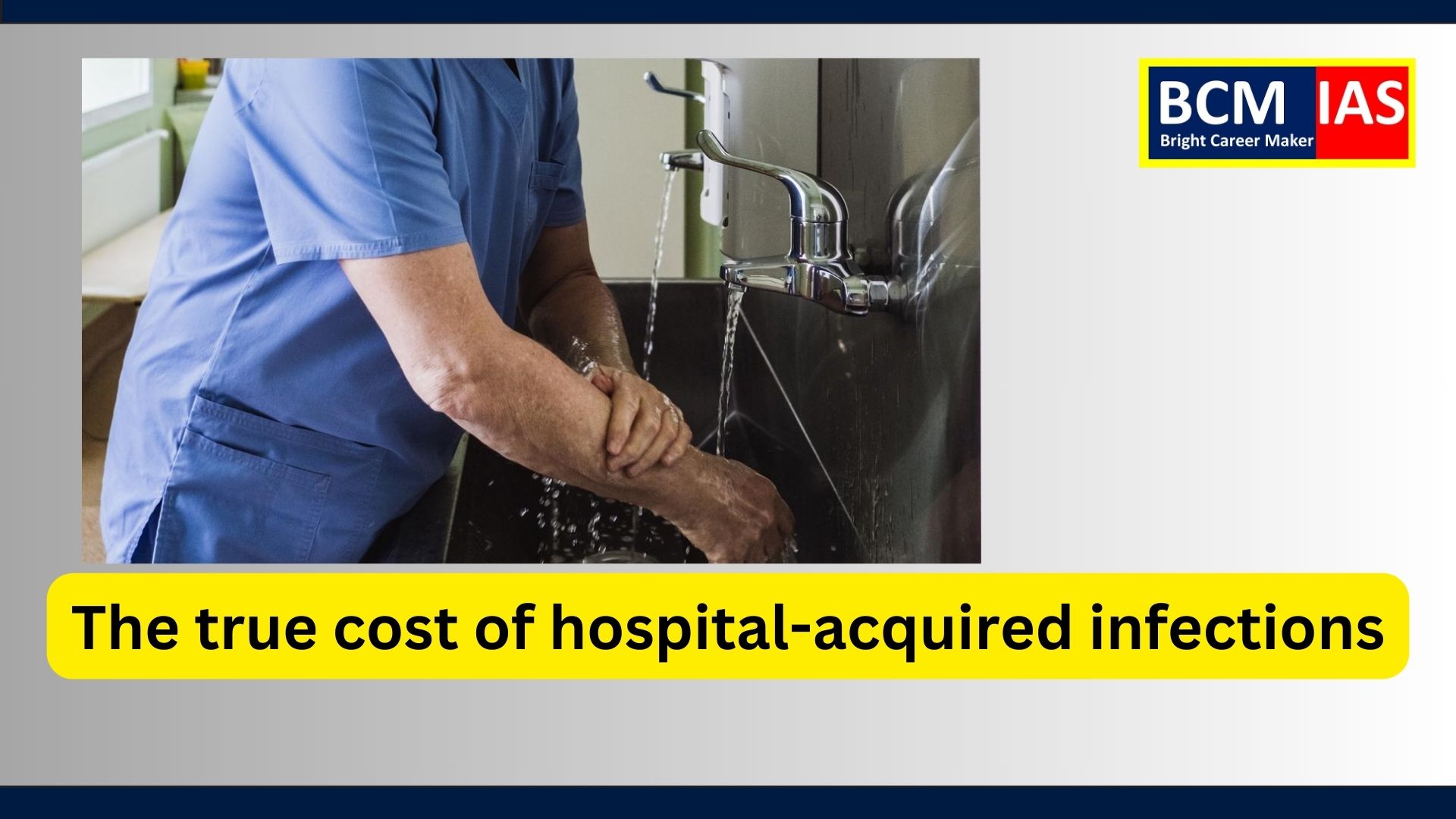
The true cost of
hospital-acquired infections
·
The article titled "The true cost of
hospital-acquired infections" in The Hindu newspaper discusses the
financial, ethical, and systemic challenges that arise from Hospital-Acquired
Infections (HAIs) and offers potential solutions to address them.
·
The analysis touches upon two contrasting cases in
India that highlight how HAIs impact both patients and healthcare providers.
Key
Issues and Challenges
1. Hospital-Acquired Infections (HAIs)
Hospital-acquired infections are infections patients develop
while receiving medical care in hospitals, such as ventilator-associated
pneumonia or surgical site infections. HAIs significantly increase patient
morbidity, mortality, and healthcare costs. This creates a dilemma for both
patients and hospitals: patients bear the physical and financial burden of
prolonged treatment, while hospitals face ethical scrutiny for failing to
prevent such infections.
2. Case Studies
Two cases illustrate the complexity of dealing with HAIs:
- Mumbai
Case: A patient
developed a post-operative infection after a knee replacement surgery. The
patient is seeking legal recourse for financial losses due to the
infection, claiming that the hospital should be responsible for managing
the complication.
- Bangalore
Case: A family
challenged the hospital’s responsibility for a ventilator-associated
infection, arguing that they should not be charged for treating an
infection acquired in the ICU. Here, the issue is not compensation but the
waiver of treatment costs for a hospital-acquired infection.
These cases underscore a common
theme: the lack of clarity on hospital accountability in managing and
preventing HAIs, especially in accredited healthcare settings.
The
Global and Indian Context
1. International Perspective (U.S.)
In the United States, there are strict policies to handle
HAIs. The Medicare and Medicaid insurance system does not reimburse hospitals
for the cost of managing certain HAIs. This system incentivizes hospitals to
prioritize infection prevention. Additionally, the U.S. has platforms like the Hospital
Compare website, which publicly displays HAI rates, allowing patients to
make informed choices. This level of transparency increases hospital
accountability.
2. Indian Healthcare Challenges
India’s healthcare system faces significant challenges in
handling HAIs:
- Despite
many hospitals obtaining prestigious accreditations like the Joint
Commission International (JCI) and National Accreditation Board for
Hospitals (NABH), they are not mandated to publicly disclose their HAI
rates. This limits transparency and accountability.
- Indian
hospitals also deal with a higher incidence of HAIs due to factors like
antibiotic resistance (AMR) and resource constraints. These limitations
make it difficult to implement the same infection control standards as in
developed nations.
Proposed
Solutions
The article proposes several strategies to improve the
management of HAIs in India:
1. Transparency and Public Reporting
NABH and JCI-accredited hospitals in India should be required
to disclose their HAI rates on a public platform. Institutions like the NABH,
Indian Council of Medical Research (ICMR), or the National Centre for Disease
Control (NCDC) could oversee this process. This would allow patients to make
informed decisions about hospital care, just as in the U.S. system.
2. Reimbursement and Cost-Sharing Models
The article suggests adopting a reimbursement model that
aligns with global practices:
- Hospitals
with international accreditation (JCI) could follow global standards by
absorbing the cost of HAI-related treatments instead of passing them on to
patients.
- NABH-accredited
hospitals could follow a "no loss-no profit" model for treating
HAIs. This approach would balance patient protection with hospital
sustainability.
- Insurance
companies could play a role by requiring that a portion of their payouts
be directed toward improving infection control standards.
3. Public Education and Litigation Awareness
The author emphasizes the need for public education to inform
patients and their families about the nature of HAIs. Not all infections
acquired in hospitals are due to negligence, as some may be unrelated to
hospital procedures (e.g., fungal infections in immunocompromised patients).
Patients should also understand that hospitals can only reduce but not
completely eliminate the risk of HAIs. This would help reduce unnecessary
litigation and foster a more balanced approach to addressing HAIs.
Ethical
and Financial Dilemmas
The article raises an important ethical question: should
hospitals bear the financial burden of HAIs, or should the responsibility be
shared between patients and the healthcare system? On one hand, hospitals must
strive to prevent infections through stringent infection control practices. On
the other hand, not all HAIs are avoidable, and holding hospitals solely
accountable for every infection could lead to financial strain and defensive
medicine practices.
Conclusion
Hospital-acquired infections are a growing concern in
healthcare systems globally. The article highlights how India's healthcare
system, with its diverse standards and challenges, needs to implement a
combination of transparency, patient protection, and education to better manage
the financial and ethical implications of HAIs. Solutions like public
disclosure of HAI rates, reimbursement models that do not pass on costs to
patients, and improved public understanding of HAIs can collectively help
reduce the burden of these infections while ensuring accountability in the
healthcare sector.
Mains Question:
Q: Discuss the challenges associated with
hospital-acquired infections (HAIs) in India and suggest measures to enhance
accountability and patient protection in the healthcare system.
Introduction:
Hospital-acquired infections (HAIs) are infections that occur
in patients during their hospital stay, unrelated to their initial condition.
HAIs are a major cause of increased morbidity, mortality, and financial burden
in healthcare systems worldwide. In India, these infections pose a significant
challenge due to diverse healthcare standards, a high prevalence of
antimicrobial resistance (AMR), and resource constraints. This issue raises
ethical, financial, and policy dilemmas about the accountability of healthcare
providers and the protection of patients.
Body:
1. Challenges of
Hospital-Acquired Infections in India:
a. Lack of Transparency and Data Disclosure:
- Although
many hospitals in India are accredited by NABH and JCI, there is no
requirement to publicly disclose their HAI rates.
- Without
publicly available data, patients cannot make informed decisions, and
hospitals are not held accountable for high infection rates.
b. Diverse Healthcare Standards:
- India’s
healthcare system includes both world-class hospitals and under-resourced
facilities, making it difficult to implement uniform infection control
standards.
- Accredited
hospitals may have better infection control measures in place, but many
smaller hospitals lack the resources to effectively prevent HAIs.
c. High Antimicrobial Resistance (AMR):
- India
faces a significant challenge of AMR, which increases the complexity of
treating HAIs.
- Resistance
to antibiotics, including last-resort drugs, limits the options available
to treat infections effectively.
d. Ethical and Financial Dilemmas:
- Patients
often face a financial burden when they contract HAIs, particularly in
private hospitals where the cost of extended care and treatments can be
high.
- Ethical
issues arise when hospitals benefit financially from the prolonged care
required to treat infections that occur under their watch.
2. Consequences of HAIs:
- Increased
Patient Morbidity and Mortality: HAIs lead to extended hospital stays, additional
surgeries or treatments, and higher chances of complications.
- Financial
Burden: The
cost of treating HAIs falls on patients, increasing their out-of-pocket
expenses. This is particularly significant in India, where a large portion
of healthcare is paid out-of-pocket.
- Impact
on Healthcare System: HAIs strain hospital resources, leading to higher costs and
inefficiencies in the healthcare system.
3. Proposed Solutions to Enhance Accountability and Patient
Protection:
a. Mandatory Public Disclosure of HAI Rates:
- NABH
and JCI-accredited hospitals should be required to publish their HAI data
on a common platform monitored by institutions like NABH, ICMR, or NCDC.
- This
would promote transparency, enabling patients to choose hospitals based on
infection control performance.
b. Incentivizing Infection Control:
- The
U.S. model, where Medicare and Medicaid do not reimburse for certain HAIs,
could be adapted in India. Insurers could require hospitals to improve infection
control standards in return for reimbursements.
- A
reimbursement model based on infection control performance should be
considered, where hospitals that demonstrate lower HAI rates are
incentivized.
c. No-Cost or Low-Cost HAI Treatment:
- JCI-accredited
hospitals could adopt international standards by not charging patients for
the treatment of HAIs. For NABH-accredited hospitals, a “no loss-no
profit” model can be implemented.
- This
would ensure that patients do not bear the financial burden for infections
acquired in hospitals.
d. Public Education and Litigation Awareness:
- Educating
patients and families about the nature of HAIs, including the
understanding that not all infections are due to hospital negligence, can
help reduce unnecessary litigation.
- Hospitals
should focus on patient education regarding infection prevention practices
and the limitations of infection control.
Conclusion:
HAIs present a complex challenge to healthcare systems in
India, involving issues of transparency, accountability, and financial burden.
To address these challenges, a multifaceted approach is required. Hospitals
must be transparent in disclosing their infection rates, align with global
standards of infection control, and ensure that patients are not financially
penalized for acquiring infections during their hospital stay. Public education
is essential to create awareness among patients and families about HAIs, and
insurance models should incentivize infection control improvements. By
implementing these measures, India can strengthen its healthcare system and
protect patients from the negative consequences of hospital-acquired
infections.


Comments on “The true cost of hospital-acquired infections”