


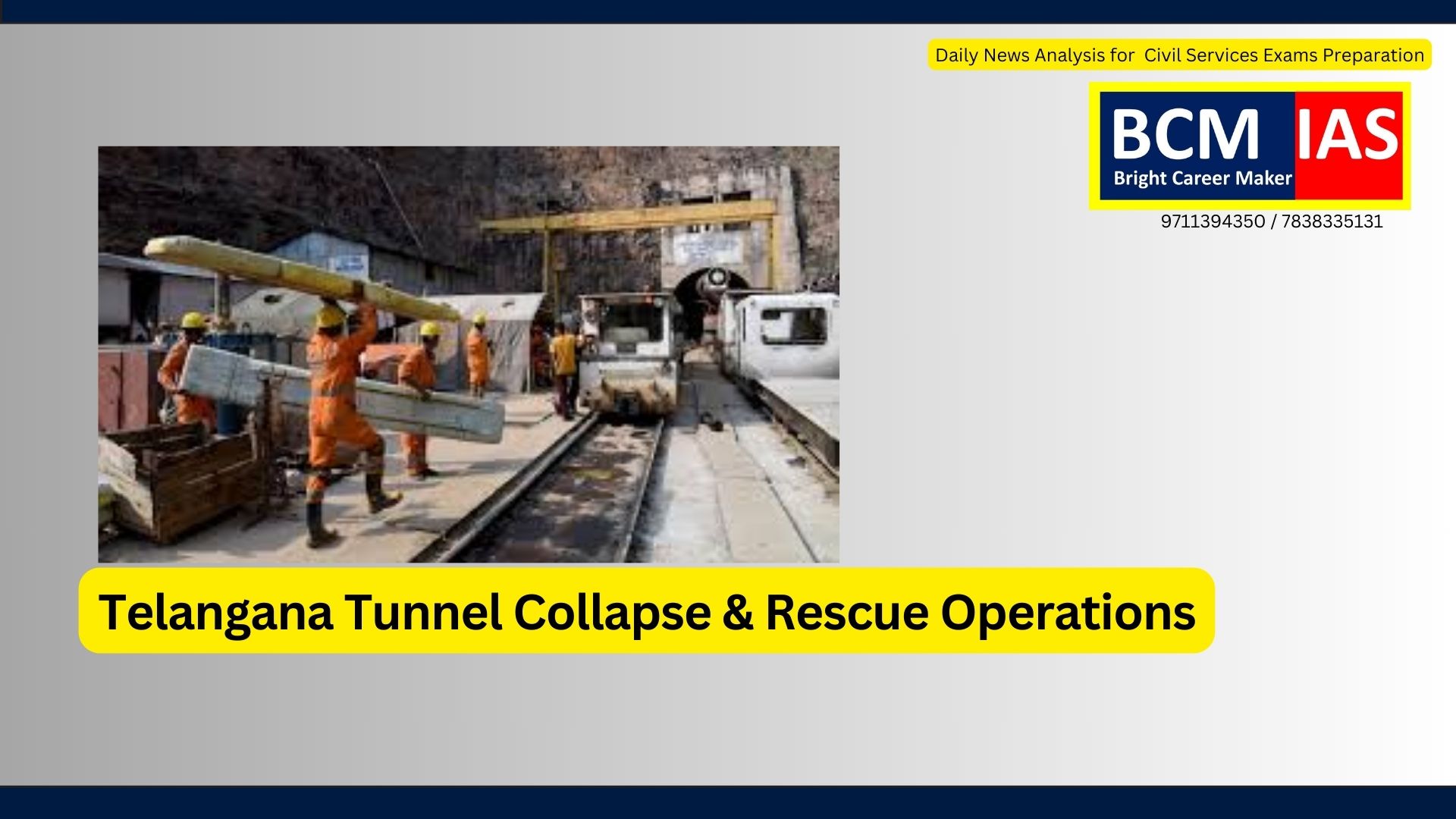
Telangana Tunnel Collapse & Rescue Operations
1. Syllabus Mapping
for UPSC CSE
The given news article on Telangana
Tunnel Collapse & Rescue Operations falls under the
following parts of the UPSC Civil Services Exam (CSE) Syllabus:
|
Exam
Component |
Relevant
Topics |
|
Prelims (GS Paper
I) |
- Current Affairs
(Disaster Management, Infrastructure) |
|
Mains (GS Paper II
- Governance & Polity) |
- Disaster Response
Mechanisms in India - Role of State and Central Governments in Crisis
Management |
|
Mains (GS Paper III
- Disaster Management) |
- Role of NDRF, SDRF in
Rescue Operations - Infrastructure Failures (Tunnels, Dams, Bridges) - Safety
Regulations & Accountability |
|
Mains (GS Paper IV
- Ethics & Integrity) |
- Ethical Responsibility
of Government in Crisis Management |
|
Interview
(Personality Test) |
- Disaster Preparedness in
India - Role of Leadership in Crisis Management - Coordination Between Centre
& State |
2. Analysis of the
News
Social, Economic, and Political Analysis
Social Analysis:
- Loss
of Lives & Psychological Impact: The collapse
of the Srisailam Left Bank Canal (SLBC) tunnel has left eight workers trapped,
creating a state of panic and distress.
- Impact
on Families & Workers' Safety: Tunnel
workers, who are often low-income laborers, face poor working conditions
and inadequate
safety measures.
- Public
Sentiment & Support: The tragedy has
sparked widespread public
concern, with people demanding strict safety protocols in future
construction projects.
Economic Analysis:
- Project
Delays & Financial Loss: This incident may delay the SLBC project,
leading to increased costs for the government.
- Impact
on Infrastructure Development: Repeated tunnel
collapses, including the Silkyara
tunnel collapse in Uttarakhand, raise questions about the quality of engineering and
adherence to safety standards.
- Financial
Burden on Government: The government may
have to spend additional
resources on rescue and reconstruction efforts, impacting
the state’s budget
allocation.
Political & Constitutional Analysis:
- Government
Accountability & Responsibility:
- The
Telangana State
Government is leading the rescue efforts, with support from the Central
Government.
- The
role of the NDRF,
SDRF, and NHIDCL (National Highways & Infrastructure Development
Corporation Limited) in managing disasters comes under
scrutiny.
- Opposition’s
Role:
- Rahul
Gandhi (Opposition Leader) has extended support,
signaling the issue's political importance.
- The
Centre’s role in
aiding states during disasters under the Disaster Management Act, 2005
is also relevant.
- The
Telangana State
Government is leading the rescue efforts, with support from the Central
Government.
- The
role of the NDRF,
SDRF, and NHIDCL (National Highways & Infrastructure Development
Corporation Limited) in managing disasters comes under
scrutiny.
- Rahul
Gandhi (Opposition Leader) has extended support,
signaling the issue's political importance.
- The
Centre’s role in
aiding states during disasters under the Disaster Management Act, 2005
is also relevant.
3. Views from Different Stakeholders
Legal Perspective:
- Labour
& Safety Laws:
- The
Building and Other
Construction Workers Act, 1996 mandates safety measures for construction
workers.
- The
Mines Act, 1952
applies to tunnel projects, ensuring worker safety in underground operations.
- The
Disaster
Management Act, 2005 outlines the responsibilities of state &
national agencies in disaster response.
- The
Building and Other
Construction Workers Act, 1996 mandates safety measures for construction
workers.
- The
Mines Act, 1952
applies to tunnel projects, ensuring worker safety in underground operations.
- The
Disaster
Management Act, 2005 outlines the responsibilities of state &
national agencies in disaster response.
Opposition’s Opinion:
- Rahul
Gandhi’s Statement: Supports the government’s efforts
but may later
question safety lapses and infrastructure failures.
- Political
Blame Game Expected: Opposition parties may demand accountability
from Telangana CM
and Central Government agencies like NHIDCL.
4. Impact of the Incident
Social Impact:
✔
Families of trapped workers facing mental trauma.
✔
Increased demand for better safety measures in
tunnels and other construction projects.
✔ Public
trust in government infrastructure projects is
shaken.
Economic Impact:
✔
Financial burden on state and central governments due
to rescue and reconstruction costs.
✔
Delayed completion of the Srisailam Left Bank Canal (SLBC) Project,
affecting irrigation and water supply.
✔
Investors and contractors( Impact on Investors) may hesitate
in taking up infrastructure projects due to safety
concerns.
Political Impact:
✔ Political
debates on safety lapses and accountability
of NHIDCL, the State, and Centre.
✔ Telangana
government under pressure to review
infrastructure projects.
✔ Opposition
may demand judicial inquiry into safety violations.
Legal Impact:
✔
Calls for stronger enforcement of safety
regulations under the Labour
& Mines Acts.
✔
Possible compensation claims by affected workers
under labour laws.
✔ Accountability
of contractors and state agencies for
negligence.
5. Key Takeaways from
the News
🔹 Disaster
Management Agencies: Role of NDRF,
SDRF, NHIDCL, State Govt. & Army in rescue
operations.
🔹 Lack
of Safety Measures: Need for stronger
compliance with construction safety laws.
🔹 Political
Coordination: Telangana CM Revanth
Reddy & PM Modi's discussion shows Centre-State
cooperation in crisis.
🔹 Infrastructure
Challenges: Tunnel collapses raise
concerns over construction quality in mega
projects.
🔹 Economic
Consequences: Financial burden & delayed
development of the SLBC project.
6. Extracted Facts in
a Simple Table
|
Key
Aspect |
Details |
|
Incident |
Srisailam Left Bank Canal
(SLBC) tunnel collapse |
|
Location |
Nagarkurnool district,
Telangana |
|
Number of Workers
Trapped |
8 workers |
|
Rescue Agencies
Involved |
Army, NDRF, SDRF, NHIDCL,
Singareni Collieries |
|
Methods Used for Rescue |
Dewatering Dewatering
Technology , oxygen pumping, alternative debris removal methods |
|
Political Response |
CM Revanth Reddy, PM
Modi’s assurance of support, Rahul Gandhi’s statement |
|
Infrastructure
Concern |
Poor safety standards in
tunnel construction |
|
Legal Framework |
Disaster Management Act,
2005; Mines Act, 1952; Labour Laws |
|
Economic Impact |
Increased financial burden
& project delays |
7. Exam Preparation
Guide
|
Exam
Stage |
What
to Keep in Mind |
|
Prelims (GS Paper
I) |
- Role of NDRF, SDRF,
Disaster Management Act, 2005 - Labour & Safety Laws (Mines Act, 1952;
Construction Workers Act, 1996) - Telangana’s SLBC Project & Irrigation
Importance |
|
Mains (GS Paper II
- Governance) |
- Centre-State Coordination
in Disaster Response - Role of NDRF, SDRF, NHIDCL in crisis management -
Labour Rights & Tunnel Safety Standards |
|
Mains (GS Paper III
- Disaster Management & Infrastructure) |
- Importance of Disaster Preparedness
in India - Role of engineering
& construction safety in large projects - Economic impact
of delayed
infrastructure projects |
|
Ethics (GS Paper
IV) |
- Ethical responsibilities
of the government towards workers’ safety - Accountability in governance & public service
delivery |
|
Interview
(Personality Test) |
- Handling infrastructure crises
- Centre-State
relations in disaster response - Government's role in industrial
safety |
Conclusion
The Telangana tunnel
collapse has highlighted critical
gaps in infrastructure safety, labour protection, and disaster response
mechanisms. While rescue
efforts are ongoing, the incident
underscores the need for stricter regulatory compliance and political
accountability.
This topic is important
for UPSC as it covers disaster
management, governance, Centre-State relations, labour rights, and economic
development.
Mains
Question & Ans
The
impact of tunnel collapses extends beyond economic losses to social
displacement and public trust. Discuss the socio-economic impact of such
failures."
Answer:
Introduction
Tunnel collapses,
whether in infrastructure projects, mining, or urban developments, cause severe socio-economic consequences beyond
immediate financial losses. These failures disrupt communities, displace people, erode
public trust in governance, and impact economic activities
linked to the infrastructure.
Socio-Economic Impact of Tunnel Collapses
1. Social Impact
✅ Loss of Lives & Injuries
- Tunnel collapses often lead to casualties,
injuries, and long-term disabilities, affecting families
and local communities.
- Example: The Uttarkashi
Tunnel Collapse (2023) trapped workers for days,
highlighting safety concerns.
✅ Displacement & Livelihood Disruptions
- Communities near collapsed tunnels
may face forced displacement, losing homes
and access to basic services.
- Example: Himalayan region tunnel
collapses have displaced local tribes and residents,
affecting their traditional way of life.
✅ Psychological Trauma & Public Trust
Erosion
- Victims and their families suffer psychological
distress, leading to mental health
crises.
- Repeated tunnel collapses reduce
public trust in infrastructure projects and governance,
sparking protests and legal actions.
✅ Environmental Degradation
- Collapses can lead to landslides,
water contamination, and ecological damage, affecting
local agriculture
and biodiversity.
2. Economic Impact
✅ Financial Losses & Project Delays
- Governments and private entities
face huge
cost overruns due to reconstruction, lawsuits, and
compensation claims.
- Example: The Siliguri
Tunnel Collapse (2022) delayed strategic railway projects,
increasing overall expenditure.
✅ Impact on Trade & Connectivity
- Tunnels play a key role in transportation
and trade routes; their failure disrupts
supply chains and regional economies.
- Example: Zojila Tunnel
disruptions affect military logistics and trade
in border areas.
✅ Loss of Employment & Investment
Confidence
- Workers in construction, mining,
and transportation lose jobs,
leading to economic hardship.
- Foreign
investors hesitate to invest in projects
with weak safety regulations, impacting economic growth.
✅ Burden on Public Finances
- Governments must compensate
victims, fund rescue operations, and rebuild infrastructure,
straining public resources.
- The NATM (New
Austrian Tunneling Method) failure in India led to a ₹500
crore loss, forcing budget reallocations.
Way Forward
✅ Stronger
Safety Regulations & Monitoring – Strict enforcement of construction
safety norms and real-time monitoring of tunnel projects.
✅ Advanced
Engineering & Geotechnical Studies – Use of seismic-resistant
designs, AI-based risk prediction, and better geological assessments.
✅ Community Engagement & Transparency – Involving local communities in decision-making and
ensuring accountability in project execution.
✅ Quick Compensation & Rehabilitation – Government-backed
insurance schemes and relocation support for displaced
communities.
Conclusion
Tunnel collapses go
beyond financial setbacks, leading to human suffering, displacement,
environmental damage, and economic instability. A proactive approach—combining
engineering excellence, policy reforms,
and public engagement—is necessary to ensure safe and sustainable infrastructure
development.


Comments on “Telangana Tunnel Collapse & Rescue Operations”