


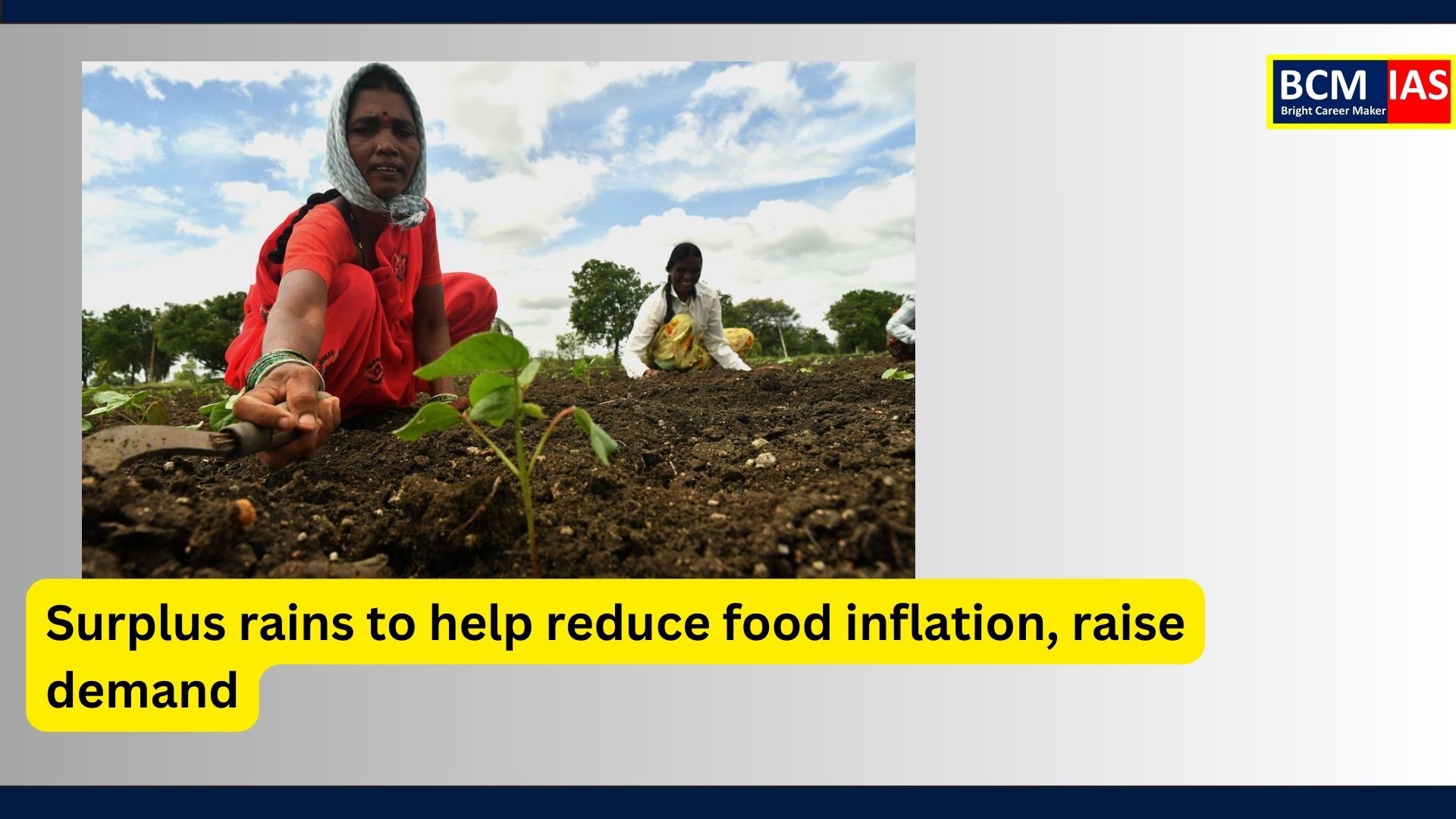
Surplus rains to help reduce food inflation, raise demand
News Analysis
The news article titled “Surplus rains to help reduce food
inflation, raise demand” discusses the positive impact of surplus rainfall
on India's agricultural sector and its potential effects on reducing food
inflation. The article emphasizes the influence of a good Kharif crop, healthy
reservoir levels, and expectations of a good Rabi season on food inflation and
rural demand.
Key Highlights from the Article:
1. Kharif
Crop Sowing:
o By late
September 2023, Kharif crop sowing increased by 1.5% compared to the
same time last year. This growth was driven by favorable monsoon rains
and good reservoir levels.
o Despite a few
exceptions (like urad dal, bajra, and cotton), Kharif sowing levels were
generally higher, which is a positive sign for the agricultural economy.
2. Impact
of Monsoon:
o The Southwest
monsoon has boosted reservoir levels across most parts of India. The
article notes that, as of September 30, 2023, the monsoon resulted in 8%
surplus rains above the long-term average.
o This surplus
water is expected to benefit both Kharif and Rabi crops, particularly in
regions where reservoir levels are high (except in the North, which experienced
some deficits).
o Reservoirs in
India were filled to 87% capacity by late September, which is above last
year’s levels and is considered a good sign for the upcoming Rabi crop
season.
3. Crop-wise
Sowing Growth and Decline:
o The article
provides a breakdown of crop performance for the Kharif season:
§ Pulses saw the highest increase in sowing,
with a 7.3% year-on-year growth.
§ Paddy and coarse cereals also
registered moderate increases in sowing, at 3.8% and 3.7%,
respectively.
§ However, some
crops faced a decline: cotton sowing dropped by 9.2%, and sugarcane
saw a 13.1% decrease.
4. Economic
and Inflationary Effects:
o Food
inflation is
expected to decline in the second half of the financial year 2024-2025 (H2
FY25), as more crops are harvested due to better rains and increased sowing
levels.
o The surplus
rainfall not only aided crop sowing but also diversified the crops grown
this Kharif season, improving gross value addition (GVA) in the
agricultural sector.
o The article
notes that the combination of a good Kharif crop and the Rabi
prospects will help alleviate the inflationary pressures on food items.
This is important given recent concerns over rising food prices in India.
5. Impact
on Rural Demand:
o The higher
sowing levels and favorable weather are also expected to boost rural
demand in India, as better agricultural output leads to higher incomes for
farmers and related economic activities.
o The article
notes that this rise in rural demand will contribute to overall economic
growth, as rural areas benefit from improved agricultural output.
Conclusion:
The article highlights the critical role of the monsoon
season in India’s agricultural economy. Favorable monsoon rains have
increased Kharif crop sowing, improved reservoir levels, and
created optimistic Rabi crop prospects, which together are expected to
reduce food inflation and boost rural demand. Despite some
challenges in the sowing of specific crops like cotton and sugarcane,
the overall outlook for the agricultural sector appears positive, which could
help alleviate inflationary pressures in the broader economy.
MCQs for Practice-
1. Consider the following statements regarding Kharif crops
in India:
1.
Kharif crops are sown at the beginning of the monsoon
season.
2.
Kharif crops are harvested before the monsoon ends.
3.
Paddy, pulses, and coarse cereals are examples of
Kharif crops.
Which of the statements given above is/are correct? a) 1 and
3 only
b) 1 and 2 only
c) 1, 2, and 3
d) 2 and 3 only
Answer: a) 1 and 3 only
Explanation:
Kharif crops are sown at the onset of the monsoon (June-July) and harvested at
the end of the monsoon (October-November), so statement 2 is incorrect. Paddy,
pulses, and coarse cereals are common Kharif crops.
2. Consider the following statements about the impact of
surplus monsoon rains on agriculture:
1.
Surplus rains lead to higher reservoir levels, which
are beneficial for both Kharif and Rabi crops.
2.
Excessive rains can increase food inflation by
damaging crops and disrupting supply chains.
Which of the statements given above is/are correct? a) 1 only
b) 2 only
c) Both 1 and 2
d) Neither 1 nor 2
Answer: c) Both 1 and 2
Explanation:
While surplus rains can boost reservoir levels and benefit both Kharif and Rabi
crops (statement 1), excessive rains can sometimes cause crop damage, leading
to supply disruptions and increased food inflation (statement 2).
3. Which of the following statements is correct regarding
food inflation in India?
a) Higher crop sowing always leads to higher food inflation.
b) Increased crop production typically helps in reducing food inflation.
c) Food inflation rises due to increased agricultural output.
d) Monsoon rains have no direct effect on food inflation.
Answer: b) Increased crop production typically helps in reducing food inflation.
Explanation:
Increased crop production leads to higher supply, which generally helps in
reducing food inflation by stabilizing the prices of food items.
4. Consider the following crops mentioned in the context of
Kharif sowing:
1.
Cotton
2.
Sugarcane
3.
Pulses
Which of the above experienced a decrease in sowing in
the 2023 Kharif season compared to the previous year? a) 1 and 2 only
b) 1 and 3 only
c) 2 and 3 only
d) 1, 2, and 3
Answer: a) 1 and 2 only
Explanation:
Cotton and sugarcane saw a decline in sowing, with cotton down by 9.2% and
sugarcane by 13.1%. Pulses, on the other hand, experienced an increase in
sowing by 7.3%.
5. Which of the following statements best describes the role
of the Southwest monsoon in the Indian agricultural sector as mentioned in the
article?
a) The Southwest monsoon primarily benefits industrial
sectors and has minimal impact on agriculture.
b) The Southwest monsoon’s surplus rains improve reservoir levels, which is
crucial for both Kharif and Rabi crops.
c) Only Rabi crops are dependent on the Southwest monsoon for water supply.
d) Monsoon rains negatively impact the Kharif crop sowing process.
Answer: b) The Southwest monsoon’s surplus rains improve reservoir levels, which
is crucial for both Kharif and Rabi crops.
Explanation:
The article emphasizes that surplus rains from the Southwest monsoon have
helped boost reservoir levels, which are beneficial for both Kharif
crops (grown during the monsoon season) and Rabi crops (grown after
the monsoon).


Comments on “Surplus rains to help reduce food inflation, raise demand”