

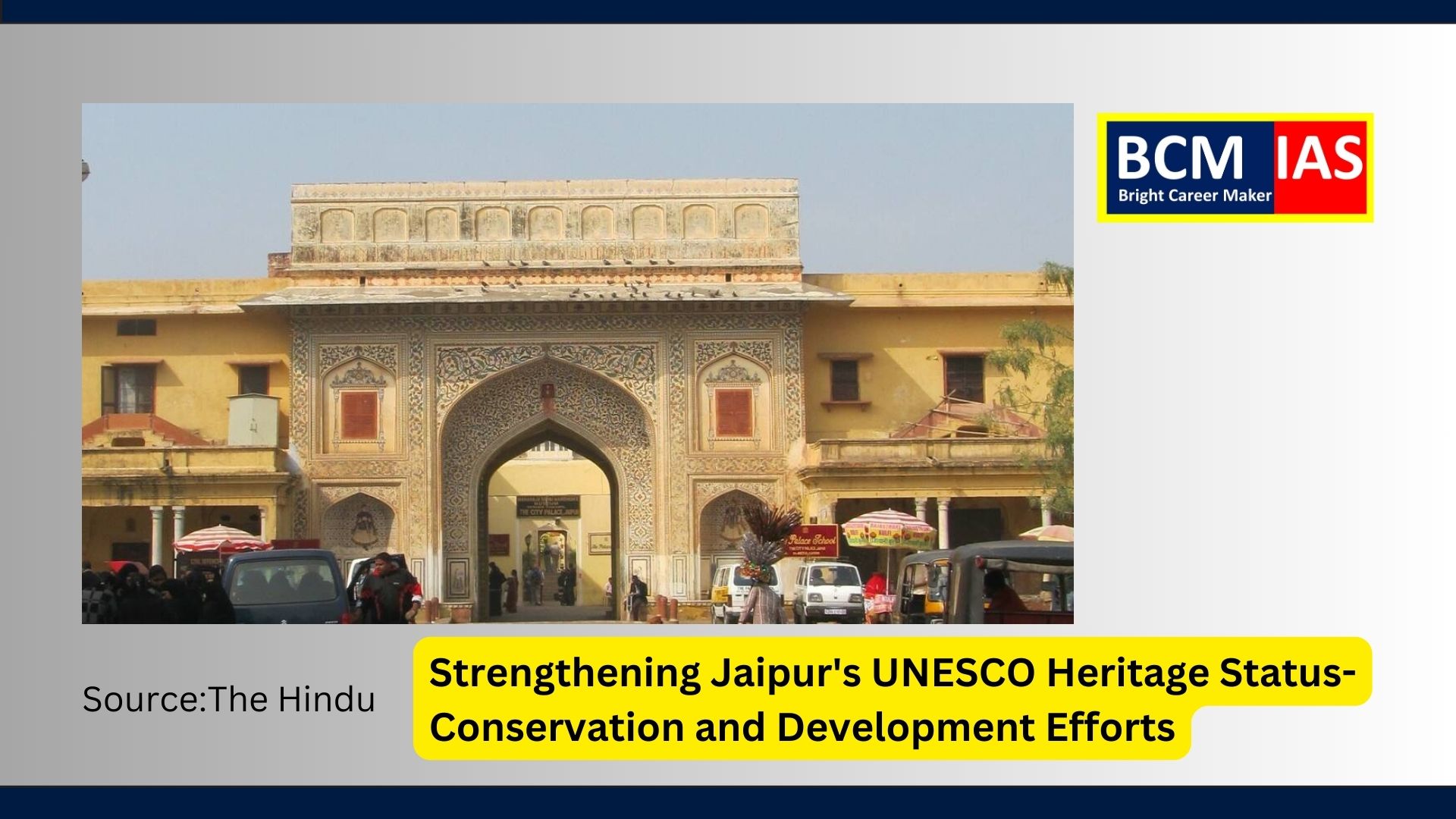
Strengthening Jaipur's UNESCO
Heritage Status: Conservation and Development Efforts
News Analysis
Introduction:
Jaipur, famously known as the "Pink City" and
recognized as a UNESCO World Heritage Site in 2019, is set to witness a
major conservation and infrastructure enhancement initiative. The Government
of Rajasthan has allocated ₹100 crore towards the preservation of its rich
architectural and cultural legacy. These efforts aim to not only conserve the
city's heritage but also boost tourism and economic growth.
Recent Conservation Efforts:
1. Budgetary Allocation for Conservation:
A significant budget of ₹100 crore has been allocated
for the conservation and development of the Walled City of Jaipur. This
fund will address critical heritage conservation needs, improve infrastructure,
and enhance the city's historical character.
2. Redevelopment of Man Sagar Lake:
- 400-year-old
Man Sagar Lake
will undergo redevelopment, with a focus on restoring its natural beauty
and improving its tourism potential.
- Boating
facilities will
be introduced to attract tourists and locals alike.
- The
lake's embankment will be beautified, creating a new scenic spot,
enhancing Jaipur’s aesthetic appeal and providing a distinctive landmark
for visitors.
3. Renovation of the Museum of Legacies:
- The Maharaja
School of Arts & Crafts in Kishanpole Bazar, now known as the Museum
of Legacies, will be renovated.
- This
will involve restoring its rich collection of art and crafts to
make it more accessible to the public, showcasing the region’s cultural
heritage in a more engaging manner.
Significance of Conservation Efforts:
1. Boosting Tourism and Economic Development:
- The
planned conservation measures are expected to have a positive impact on tourism.
As one of India’s major tourist destinations, Jaipur's improved
infrastructure and beautification projects will attract more visitors.
- Tourism
growth will, in
turn, benefit the local economy, particularly businesses dependent
on tourist inflow, such as hotels, restaurants, and handicraft markets.
2. Preservation of Architectural Legacy:
- Jaipur’s
architectural legacy, characterized by its grid layout and iconic
monuments such as Hawa Mahal, City Palace, and Jantar
Mantar, is a key feature of its UNESCO World Heritage status.
- The
city's conservation projects will ensure that these historical
structures are protected from deterioration, thus preserving the
cultural and historical identity of Jaipur for future generations.
3. Revitalization of Local Culture:
- The Museum
of Legacies renovation project will provide a platform for showcasing
the traditional arts and crafts of Rajasthan, helping to preserve
and promote the local artisanal traditions.
- This
will contribute to cultural continuity, offering a connection
between Jaipur’s heritage and its modern identity as a bustling commercial
and tourist hub.
4. Distinctive Landmarks and Urban Beautification:
- The
development of a photography point in front of Hawa Mahal,
Jaipur’s most recognizable landmark, will enhance tourist experiences and
create more opportunities for engaging with the city’s architectural
wonders.
- The embankment
beautification around Man Sagar Lake will create a new focal
point for both residents and tourists, improving the city's scenic
offerings and emphasizing its status as a heritage site.
Overview of Jaipur's UNESCO World Heritage
Status:
1. Historical and Architectural Significance:
- Jaipur
was founded in 1727 AD by Sawai Jai Singh II, the Kachwaha
Rajput ruler of Amber. The city’s urban layout reflects a unique blend of Vedic
architecture, Hindu traditions, and influences from Mughal
and Western cultures.
- Its grid-based
urban planning stands as a testament to a synthesis of ancient and
modern architectural practices, making it an exemplary model of
urbanization in India’s history.
2. Iconic Monuments:
- Hawa
Mahal, City
Palace, Jantar Mantar, and Govind Dev Temple are some of
Jaipur’s most iconic monuments. These structures not only showcase the
architectural brilliance of the time but also symbolize the cultural and
religious significance of the city.
3. Maintenance of Local Traditions:
- As
the capital of Rajasthan, Jaipur has maintained its commercial,
artisanal, and cooperative traditions in their original form. This
continuation of local traditions, alongside modern development, is a major
factor in Jaipur’s global recognition.
UNESCO World Heritage Sites: An Overview
1. World Heritage Programme:
- The UNESCO
World Heritage Programme recognizes sites of exceptional cultural
or physical significance worldwide. These sites are preserved under an
international treaty, the 1972 UNESCO Convention, aimed at
protecting cultural and natural heritage globally.
2. India's UNESCO Sites:
- As of
2024, India has 43 UNESCO World Heritage Sites, including 34
cultural sites, 8 natural sites, and 1 mixed site.
Jaipur’s inclusion in this prestigious list highlights its global
importance in terms of heritage and culture.
Conclusion:
Jaipur’s ₹100 crore heritage conservation initiative
represents a crucial step in preserving its UNESCO World Heritage status. By
focusing on the conservation of historic sites, enhancing infrastructure, and
promoting local culture, Jaipur is positioning itself as a model city that
blends tradition with modern development. The future prospects for tourism,
economic growth, and cultural preservation are promising, and these efforts
will ensure that the "Pink City" continues to thrive as a vibrant
center of heritage and culture on the global stage.
MCQs for Practice
1. What is the primary focus of the ₹100 crore budget
allocation for Jaipur?
A) Industrial development
B) Conservation of Jaipur’s heritage and infrastructure
C) Construction of new monuments
D) Expansion of Jaipur’s urban boundaries
Answer: B) Conservation of Jaipur’s heritage and
infrastructure
2. What will be redeveloped as part of Jaipur’s conservation
efforts to boost tourism?
A) City Palace
B) Jantar Mantar
C) Man Sagar Lake
D) Nahargarh Fort
Answer: C) Man Sagar Lake
3. What is the expected outcome of the heritage conservation
efforts in the Walled City of Jaipur?
A) Creation of new industries
B) Enhanced political relations
C) Boost to tourism and improvement in local economy
D) Construction of modern skyscrapers
Answer: C) Boost to tourism and improvement in local economy
4. When was Jaipur declared a UNESCO World Heritage Site?
A) 2010
B) 2019
C) 2020
D) 2021
Answer: B) 2019
5. What is the Museum of Legacies in Jaipur formerly known
as?
A) Maharaja School of Arts & Crafts
B) City Museum
C) Hawa Mahal Museum
D) Rajput Heritage School
Answer: A) Maharaja School of Arts & Crafts


Comments on “Strengthening Jaipur's UNESCO Heritage Status: Conservation and Development Efforts”