


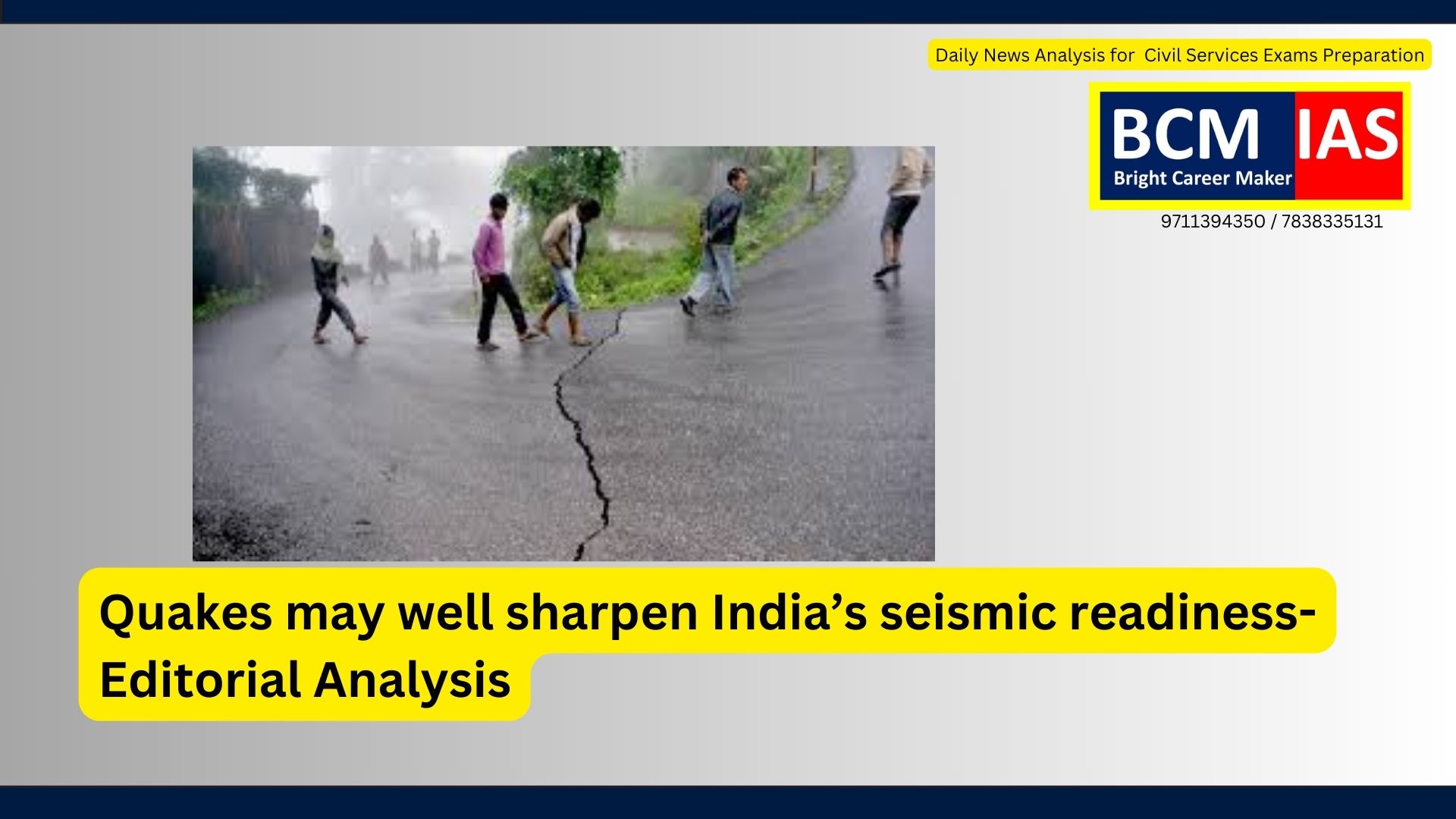
Strengthening India’s Seismic
Readiness-Editorial Analysis
The article by Gopalkrishna
Gandhi underscores India's
vulnerability to earthquakes, particularly in the Himalayan region and Indo-Gangetic plains,
and the urgent need for preparedness and policy
reforms. The recent earthquakes
in Delhi and Bihar (February 2025), coupled with the 7.1 magnitude quake in Tibet (January
2025), serve as reminders that seismic
risks are increasing, and India cannot afford to remain complacent.
1. Understanding
the Seismic Threat to India
A) Fault Lines
& Tectonic Activity in India
- India
sits on the Indian Plate, which is continuously pushing against the
Eurasian Plate, creating the Himalayas
and a major fault line from Kashmir to
Arunachal Pradesh.
- Tectonic
pressure has been building for centuries,
making the Himalayan region prone to high-magnitude earthquakes.
- The
Indo-Gangetic plains are also at risk due to sedimentary deposits,
which can amplify seismic waves.
B) Recent
Earthquakes Indicate Growing Risk
- The January 7,
2025 earthquake (Mw 7.1) in Tibet affected Nepal
and North India, highlighting that quakes do
not respect national borders.
- The February 17,
2025 tremors in Delhi and Siwan (Bihar) caused panic,
proving that seismic risks extend beyond the Himalayan region.
- Seismologists warn
that major quakes in the Himalayan region are overdue,
meaning that India’s urban and rural infrastructure is at high
risk.
2. Are India’s
Disaster Preparedness Measures Sufficient?
A) Existing
Seismic Building Codes & Their Enforcement
- The
National Building Code (NBC) and Bureau of Indian Standards (BIS) provide
seismic safety guidelines, especially for zones II,
III, IV, and V.
- However, enforcement
is weak, and many buildings in high-risk zones
do not adhere to earthquake-resistant designs.
- Illegal
construction and unregulated urban expansion
further increase vulnerability in cities like Delhi,
Kolkata, and Guwahati.
B) Infrastructure
Development & Its Risks
- The Himalayan
region is witnessing rapid infrastructure growth,
including hydropower dams, tunnels, and expressways.
- Unplanned
construction weakens the earth’s crust,
making landslides and earthquakes more destructive.
- Past disasters like the 2021
Uttarakhand flood (triggered by a glacial lake outburst)
and 2015
Nepal earthquake highlight the dangers
of inadequate planning in seismic regions.
C) Emergency
Response & Institutional Preparedness
- India has disaster
management institutions, including:
- National
Disaster Management Authority (NDMA)
- Ministry
of Earth Sciences (MoES)
- State
Disaster Response Forces (SDRF)
- However, there is no
nationwide earthquake insurance mechanism or structured
evacuation planning for high-risk cities.
3. Steps India
Must Take for Seismic Preparedness
A) Strengthening
Engineering & Infrastructure Safety
✔ Immediate halt to infrastructure projects
that destabilize the Himalayan terrain.
✔ Retrofitting old and vulnerable
buildings, including historical sites, hospitals, and schools.
✔ Stricter enforcement of seismic building
codes, particularly in Delhi,
Bihar, Uttarakhand, Himachal Pradesh, and the Northeast.
B) Updating
Seismic Zonation Maps & Risk Assessments
✔ Seismic hazard maps need to be revised
with GIS-based planning to
identify high-risk areas.
✔ Special assessments for critical
structures like nuclear plants (e.g., Narora in UP) and hydropower projects.
C) Introducing
Earthquake Insurance & Financial Planning
✔ A national seismic insurance scheme to
protect citizens from financial losses.
✔ Investment in early warning systems and
earthquake sensors in collaboration with global experts.
D) Strengthening
Community Preparedness & Awareness
✔ Regular earthquake drills in schools,
offices, and residential societies.
✔ Public awareness campaigns on emergency
response, safe evacuation, and first aid.
E) Advancing
International Collaborations & Technology Adoption
✔ Collaboration with Japan, the U.S., and
China to adopt AI-based
earthquake prediction models.
✔ Sensor-based monitoring systems in
high-risk zones for real-time data collection.
4. Conclusion:
India Must Prioritize Seismic Readiness Now
India cannot
prevent earthquakes, but it can prepare for them.
The recent tremors are warnings
that stronger policies, better infrastructure,
and public awareness are needed immediately.
The cost of inaction will be far greater than
the investment required for seismic preparedness. Now is the time to act—before a
catastrophic earthquake strikes. ✅🌍


Comments on “Strengthening India’s Seismic Readiness-Editorial Analysis”