

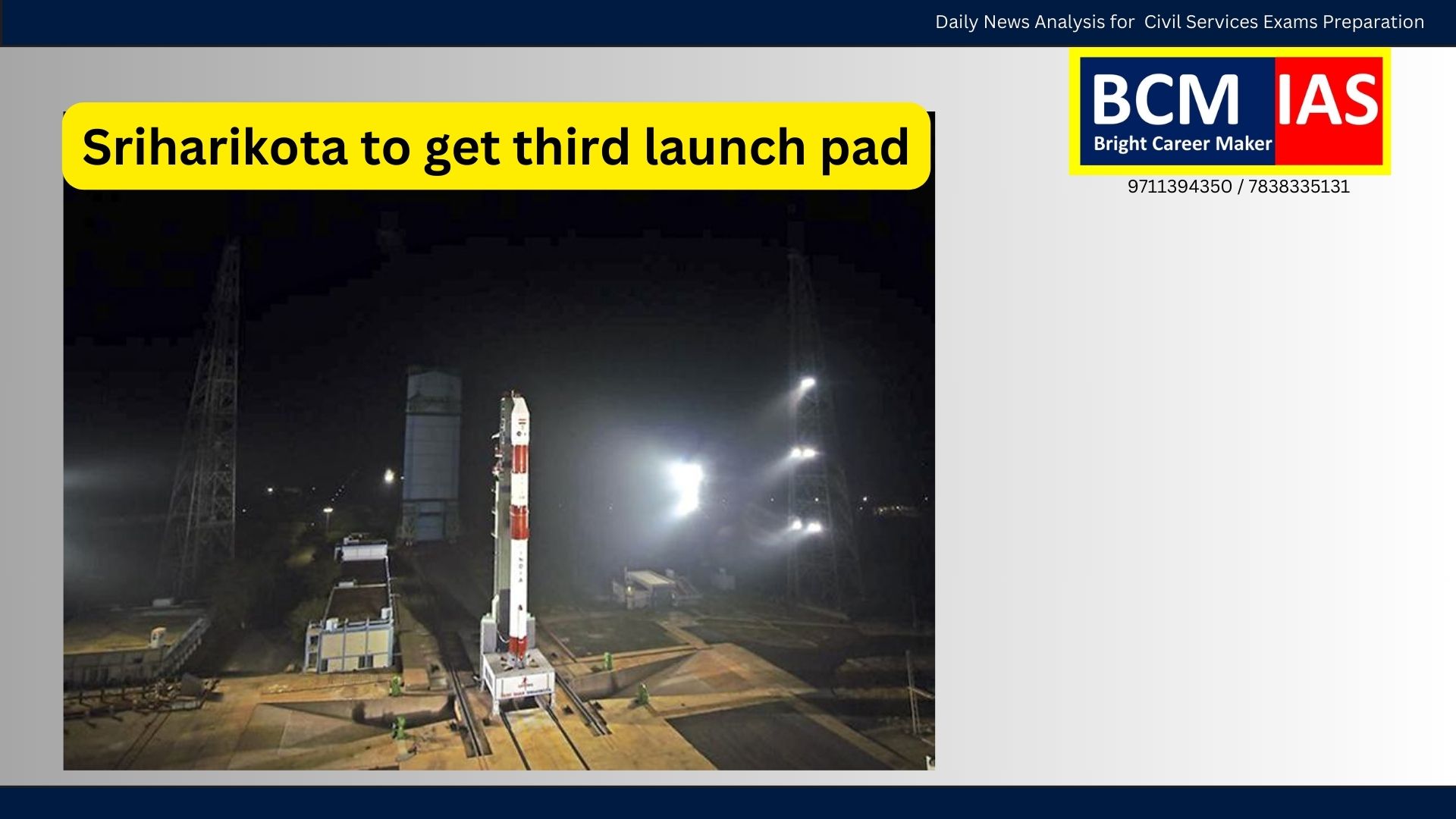
Sriharikota to get third launch pad
Overview
The Union Cabinet has approved the
construction of a third launch pad at
the Satish Dhawan Space Centre (SDSC) in
Sriharikota with a financial outlay of ₹3,984.86 crore. This development aims
to bolster India's space launch capabilities in line with the evolving
requirements of ISRO’s ambitious space programs.
Key Features of the
Third Launch Pad
1. Timeline
and Cost:
o The
project is set to be completed by early
2029, with a planned cost of ₹3,984.86 crore.
2. Purpose:
o Acts
as a standby
for the two existing launch pads, ensuring operational redundancy.
o Supports
newer launch vehicles such as the Next
Generation Launch Vehicles (NGLVs), slated for operation by
2031.
o Facilitates
Indian-manned
spaceflight missions, targeted for 2026.
3. Universal
Design:
o The
pad will be adaptable to handle:
§ Launch
Vehicle Mark-3 (LVM-3) with semi-cryogenic stages.
§ Scaled-up
configurations of NGLVs for heavier payloads.
4. Operational
Importance:
o Enhances
capacity and flexibility
to meet space transportation demands for the next 25-30 years.
o Designed
to accommodate heavier and advanced launch vehicles, enabling a wider range of
missions.
Significance of the
Development
1. Increased
Launch Capacity:
o The
addition of a third pad will reduce scheduling bottlenecks and allow for more
frequent launches.
o It
supports ISRO’s growing portfolio of satellite launches, including commercial
missions and international collaborations.
2. Support
for Future Missions:
o Critical
for manned spaceflight missions under the Gaganyaan program.
o Ensures
the infrastructure required for NGLVs, which are being developed for greater
payload capacity and efficiency.
3. Boost
to Space Infrastructure:
o Positions
Sriharikota as a major global spaceport with enhanced operational capabilities.
o Strengthens
India’s ability to undertake diverse and simultaneous missions, including
interplanetary exploration.
4. Long-Term
Vision:
o With
evolving requirements in the global space industry, the new launch pad ensures
India's relevance in the space economy for decades.
o Addresses
the demand for heavier payloads and advanced launch vehicles, making India more
competitive globally.
Challenges and
Considerations
1. Timely
Execution:
o Meeting
the four-year timeline requires efficient project management to avoid delays
that could affect ISRO’s planned missions.
2. Technological
Adaptation:
o The
universal design must effectively cater to diverse launch vehicle
configurations, requiring precision in engineering.
3. Budget
Allocation:
o Ensuring
the project stays within the allocated budget while meeting advanced
technological requirements.
4. Environmental
Impact:
o Construction
activities at Sriharikota must address environmental concerns, given its
proximity to sensitive ecosystems.
Conclusion
The construction of the third launch pad at
Sriharikota is a strategic step in strengthening India’s space capabilities. It
not only ensures operational redundancy but also supports the upcoming
generation of advanced launch vehicles and manned space missions. This initiative
aligns with ISRO’s long-term vision of becoming a leader in the global space
economy while meeting India’s growing domestic and commercial space demands. It
reflects the government’s commitment to advancing India’s position as a
significant player in space exploration and technology.
MCQs
1. What is the total outlay approved by the Union
Cabinet for the construction of the third launch pad at Sriharikota?
A. ₹2,500 crore
B. ₹3,000 crore
C. ₹3,984.86 crore
D. ₹4,500 crore
Answer: C.
₹3,984.86 crore
2. What is the primary purpose of the third launch
pad at the Satish Dhawan Space Centre (SDSC)?
A. To replace the existing launch pads.
B. To act as a standby for the existing launch pads and support newer launch
vehicles.
C. To focus exclusively on commercial satellite launches.
D. To facilitate interplanetary missions only.
Answer: B. To
act as a standby for the existing launch pads and support newer launch
vehicles.
3. Which of the following launch vehicles will the
third launch pad at Sriharikota be designed to support?
1.
Launch Vehicle Mark-3 (LVM-3)
2.
Next Generation Launch Vehicles
(NGLVs)
3.
Reusable Launch Vehicles (RLVs)
Select the correct option:
A. 1 and 2 only
B. 2 and 3 only
C. 1 and 3 only
D. 1, 2, and 3
Answer: A. 1 and
2 only
4. By when is the third launch pad at Sriharikota
expected to be operational?
A. Early 2026
B. Early 2029
C. Late 2027
D. Mid-2030
Answer: B. Early
2029
5. What long-term objective is the third launch pad
at Sriharikota intended to serve?
A. To accommodate launches for the next 10 years.
B. To meet evolving space transportation requirements for the next 25-30 years.
C. To ensure exclusive focus on manned space missions.
D. To privatize ISRO’s launch facilities.
Answer: B. To
meet evolving space transportation requirements for the next 25-30 years.


Comments on “Sriharikota to get third launch pad”