


Solar Paraboloid Technology
Overview
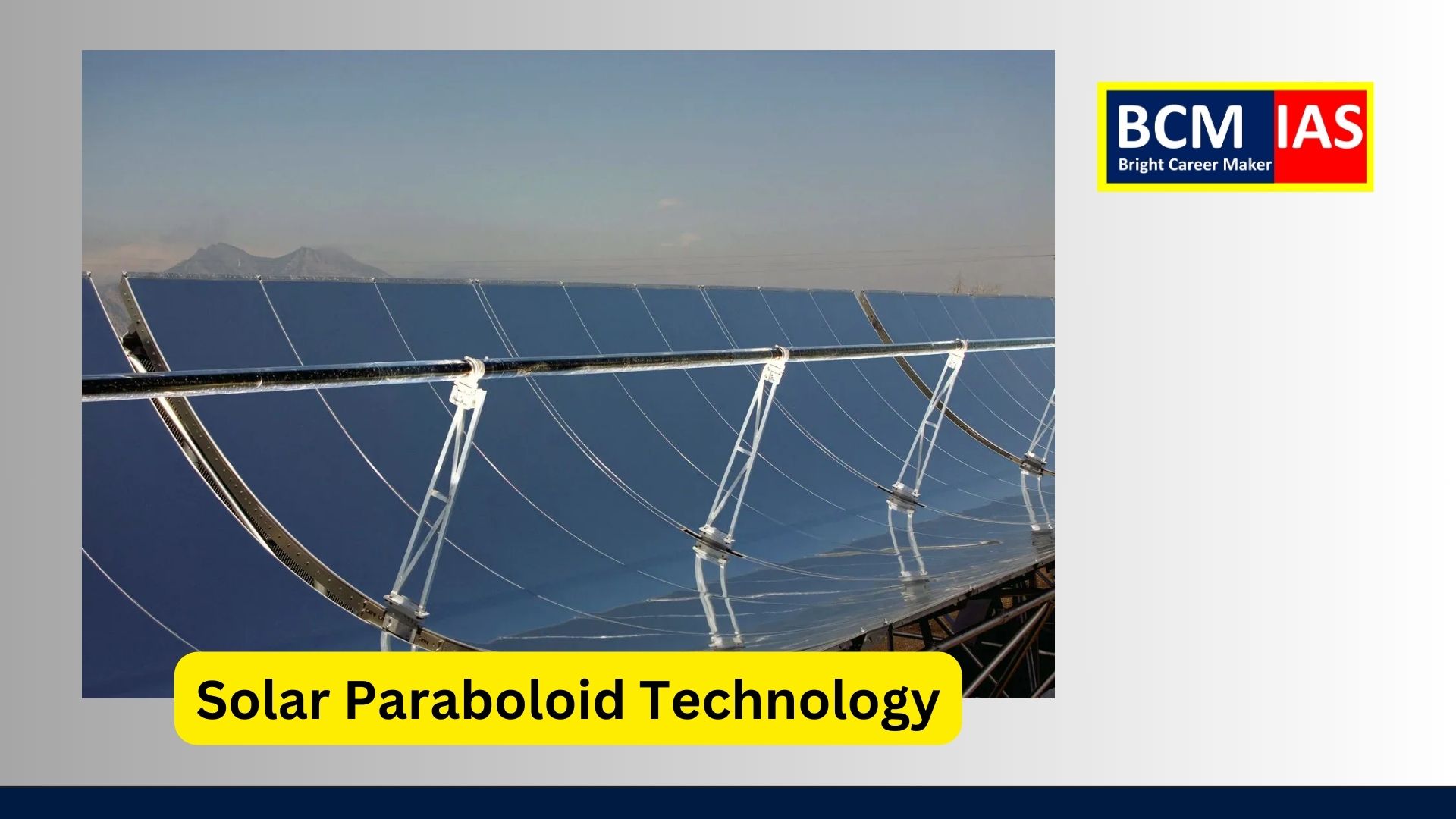
Solar Paraboloid Technology is a frontier technology designed
to harness solar energy more efficiently. It uses a parabolic-shaped reflector
to concentrate sunlight, which significantly improves the thermal efficiency of
solar energy systems.
Working Mechanism
- Parabolic
Trough Collector (PTC) System: Solar paraboloids utilize a PTC system that includes
long, curved mirrors to concentrate sunlight onto a receiver tube located
at the mirror’s focal line.
- Heat
Generation: The
concentrated sunlight heats a fluid inside the receiver tube. This thermal
energy can be converted into electricity or used directly for industrial
heating.
- Higher
Operating Temperatures: These systems can operate at temperatures up to 300°C, which
enhances thermal efficiency due to reduced heat losses.
Significance
- Enhanced
Efficiency:
Solar paraboloids achieve higher thermal efficiencies compared to
traditional photovoltaic (PV) systems by operating at higher temperatures,
which reduces convective and conductive heat losses.
- Lower
Cost Per Unit of Electricity: The high efficiency of these systems can potentially
lower the cost per unit of electricity, making it competitive with fossil
fuels.
- Versatile
Applications:
Apart from electricity generation, solar paraboloid technology can provide
direct heat for various industrial processes.
- Renewable
Energy Contribution: Solar paraboloids offer a sustainable alternative to fossil fuels,
aiding in carbon emission reduction and net-zero targets.
- Scalability
and Flexibility:
The systems can be scaled according to energy needs and space
availability, making them suitable for both large-scale and small-scale
applications.
- Improved
Land Use Efficiency: Solar paraboloids achieve higher energy yields per unit of land
area compared to flat-panel PV installations.
Challenges
- High
Upfront Costs:
The technology requires precise construction, specialized materials, and
advanced tracking systems, contributing to significant initial investment
costs.
- Infrastructure
Requirements:
Large-scale adoption necessitates considerable infrastructure support,
including land availability and maintenance capabilities.
- Need
for Policy Support and Incentives: Government initiatives are crucial for promoting the
adoption of solar paraboloid technology, including investment in R&D,
financial incentives, and support for local manufacturing.
Way Forward
- Investment
in Research and Development: Ongoing R&D is needed to improve efficiency,
reduce costs, and enhance material quality and system design.
- Government
and Industry Collaboration: Partnerships between governments and private sectors
can drive innovation, offer financial incentives, and integrate solar
paraboloid technology into existing energy frameworks.
- Public
Awareness and Incentives: Educating the public and providing incentives for
early adopters can accelerate the transition to renewable energy sources.
- Promotion
of Local Manufacturing: Encouraging local production can reduce costs and dependency on
imported technology, fostering a sustainable market for solar paraboloids.
Frontier Technologies Overview
- Digital
Technologies:
Includes The Metaverse, IoT, blockchain, AI, big data, and quantum
computing.
- Physical
Technologies:
Includes autonomous driving, 3D-printing, and hardware innovations.
- Biological
Technologies:
Includes bioprinting, organoids, genetic engineering, and the
brain-computer-interface.
MCQs for Practice
1.
What is the primary component of Solar Paraboloid
Technology that concentrates sunlight?
o A) Flat solar
panels
o B) Parabolic
Trough Collector (PTC) system
o C) Photovoltaic
cells
o D) Wind turbines
Answer: B) Parabolic Trough Collector (PTC) system
2.
What is one of the key advantages of Solar Paraboloid
Technology over traditional photovoltaic systems?
o A) Lower
operating temperatures
o B) Higher
thermal efficiency due to reduced heat losses
o C) Higher cost
per unit of electricity
o D) Limited
applications to electricity generation only
Answer: B) Higher thermal efficiency due to reduced heat losses
3.
Which of the following is NOT considered a frontier
technology?
o A) Artificial
Intelligence (AI)
o B) 3D-printing
o C) Bioprinting
o D) Wind energy
Answer: D) Wind energy
4.
What is a significant challenge faced by Solar
Paraboloid Technology?
o A) Low upfront
costs
o B) Lack of
scalability
o C) High upfront
costs due to precise construction and advanced tracking systems
o D) Limited
applicability to industrial processes
Answer: C) High upfront costs due to precise construction and advanced tracking
systems
5.
Why is government support crucial for the adoption of
Solar Paraboloid Technology?
o A) To provide
land for installations
o B) To ensure
consistent sunlight exposure
o C) To promote
research, provide financial incentives, and support local manufacturing
o D) To regulate
the prices of fossil fuels
Answer: C) To promote research, provide financial incentives, and support local
manufacturing


Comments on “Solar Paraboloid Technology”