

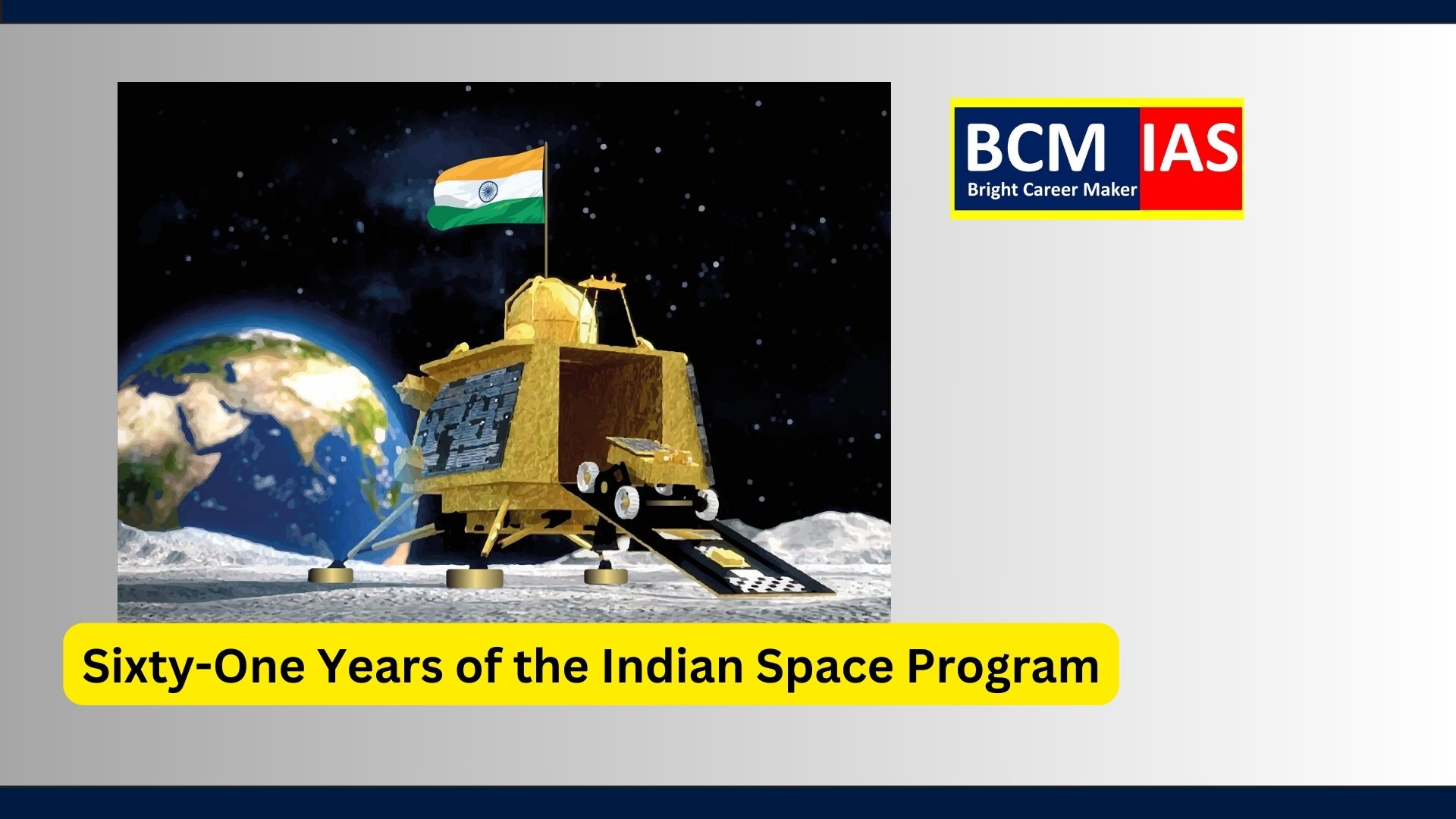
Sixty-One Years of the Indian Space
Program
- The Indian space program began on November 21,
1963, with the launch of a Nike-Apache sounding rocket from Thumba,
Kerala.
- This milestone marked India's entry into space
exploration and helped ISRO develop solid propellant technology,
forming the backbone of its current launch vehicle systems.
- Over six decades, ISRO has evolved into a
globally recognized space agency, pioneering projects like the Chandrayaan
and Mars Orbiter missions while also fostering private sector
collaboration.
1. GSAT-N2 Satellite Launch
- ISRO’s GSAT-N2/GSAT-20, a 4,700-kg Ka-band
high-throughput communication satellite, was launched aboard a SpaceX
Falcon 9 rocket from Florida.
- It provides broadband connectivity to
underserved regions, including the Northeast, Andaman & Nicobar
Islands, and Lakshadweep, supporting initiatives like Smart Cities
and in-flight internet.
- The launch from SpaceX was necessitated by
payload limitations of India’s LVM-3 rocket, which can carry a maximum of
4 tonnes to the geostationary transfer orbit (GTO).
2. Upcoming PSLV-C59
Mission
- ISRO’s PSLV-C59 will launch the European Proba-3
mission to study the Sun. This mission employs the PSLV-XL variant,
which was last used for the Aditya-L1 mission in September 2023.
- Liftoff is scheduled for December 4, 2024,
continuing ISRO’s record of hosting international satellite launches.
3. Private Sector
Participation
- Four private companies are gearing up for
satellite launches:
1. Pixxel unveiled Fireflies,
a constellation of hyperspectral satellites to monitor crop health,
deforestation, and water stress.
2. GalaxEye
Space and PierSight Space are leveraging the PSLV’s Orbital
Experimental Module (POEM) for testing advanced systems like synthetic
aperture radar (SAR).
3. HEX20 plans to
launch a 5-kg cubesat (Nila) in 2025 aboard SpaceX’s Transporter 13
mission.
4. Catalyx
Space successfully launched and decommissioned a satellite on
ISRO’s Small Satellite Launch Vehicle (SSLV), marking significant
progress in small satellite capabilities.
4. Advances in Space
Science
- India celebrated its full membership in the
Square Kilometre Array Observatory (SKAO), a project to build the
world’s largest radio telescope in South Africa and Australia.
- ISRO’s Aditya-L1 mission achieved its
first scientific breakthrough by predicting the time of a coronal mass
ejection, demonstrating India’s growing contribution to solar physics.
5. Bharatiya Antariksh
Station
- The Departments of Space and Biotechnology
signed agreements for conducting biological experiments aboard
India’s planned space station, the Bharatiya Antariksh Station.
- This collaboration underscores India’s focus on
leveraging space for advancements in life sciences and biotechnology.
6. Space Analog Mission
in Ladakh
- AAKA Space Studio
launched India’s first Space Analog Mission in Leh, Ladakh,
simulating conditions on the Moon and Mars.
- This initiative tests habitat sustainability,
life-support systems, and the psychological effects of isolation,
preparing for future human spaceflight missions.
Conclusion
The news underscores the maturity
of India’s space program, which has diversified into advanced research, private
sector involvement, and international collaborations. From broadband
satellites to analog missions, India is positioning itself as a leader in both
scientific and commercial space activities, setting the stage for ambitious
projects like the Bharatiya Antariksh Station and Gaganyaan.
MCQs
1. Origin of Indian Space
Program
The Indian space program began with
the launch of which rocket from Thumba, Kerala, in 1963?
a) Rohini
b) SLV-3
c) Nike-Apache
d) Agni-I
Answer: c)
Nike-Apache
2. GSAT-N2 Satellite
Purpose
What is the primary purpose of the
recently launched GSAT-N2/GSAT-20 satellite?
a) Navigation services for ships
and aircraft
b) Enhancing broadband connectivity in underserved regions
c) Monitoring weather patterns over the Indian Ocean
d) Mapping agricultural land use across India
Answer: b)
Enhancing broadband connectivity in underserved regions
3. PSLV-C59 Mission
The PSLV-C59 mission, scheduled for
December 4, 2024, will launch which of the following payloads?
a) Aditya-L1 Solar Observatory
b) Bharatiya Antariksh Station prototype
c) European Proba-3 Sun-study mission
d) Nila satellite from HEX20
Answer: c)
European Proba-3 Sun-study mission
4. Private Sector
Contribution
What is the primary purpose of
Pixxel’s Fireflies constellation of hyperspectral satellites?
a) Military reconnaissance
b) Studying exoplanets
c) Monitoring crop health, deforestation, and water stress
d) Providing internet connectivity in remote areas
Answer: c)
Monitoring crop health, deforestation, and water stress
5. Space Analog Mission
India’s first Space Analog Mission
in Ladakh is designed to simulate conditions on:
a) The Sun’s surface
b) Venus and Jupiter
c) The Moon and Mars
d) Asteroid belts
Answer: c) The Moon and Mars


Comments on “Sixty-One Years of the Indian Space Program”