


Daily Current Affairs Analysis
14 June 2024
-------------------------------------------------------------------------------------------------------------
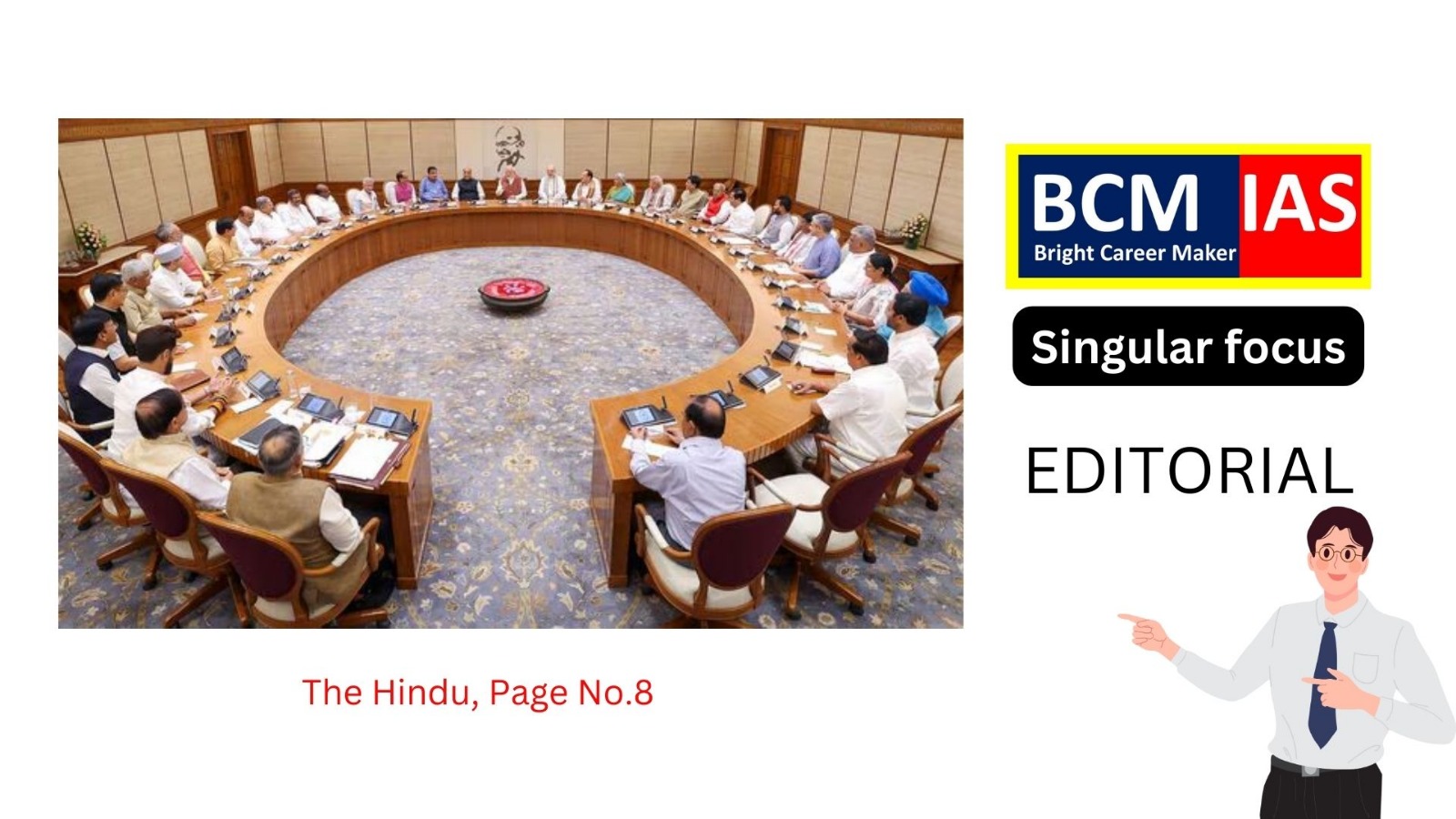
Singular Focus: Science is now too vast to be
administered by one Minister
Meaning of Headline-
·
The headline suggests that the domain of science has become too
extensive and complex to be managed effectively by a single minister.
·
It implies the need for multiple ministers or a specialized
minister to handle the various scientific fields adequately.
Related Topic (as per UPSC
Syllabus)
Prelims:
- General Studies
Paper 1:
o
Current Events of National and
International Importance:
§
Understanding changes in ministerial portfolios and
their implications on governance.
Mains:
- General Studies
Paper 2:
o
Governance, Constitution, Polity, Social
Justice and International Relations:
§
Role of different ministries and departments in
governance.
§
Issues related to the allocation of ministerial
responsibilities.
- General Studies
Paper 3:
o
Technology, Economic Development,
Bio-diversity, Environment, Security and Disaster Management:
§
Science and Technology developments and their
administration.
§
Role of different departments in advancing scientific
research.
§
Issues related to research and development in India.
§
Allocation and management of resources for scientific
advancements.
Interview:
- Current Affairs
and General Awareness:
o
Questions on recent changes in ministerial portfolios.
o
Discussions on the effectiveness of having a single
minister for multiple scientific departments.
o
Analysis of the challenges faced by scientific
departments in India and potential solutions.
News
Analysis
Introduction:
The article, titled "Singular Focus:
Science is Now Too Vast to be Administered by One Minister," examines the
portfolios of ministers in India's 18th Lok Sabha, with a particular focus on
the responsibilities assigned to Jitendra Singh. It highlights the complexities
and challenges in managing the diverse and rapidly evolving fields of science
and technology.
Body:
Key Points:
1. Ministerial
Portfolios:
o
The portfolios of the newly sworn-in ministers in the
18th Lok Sabha show little change from the previous regime.
o
The Bharatiya Janata Party (BJP) has retained major
portfolios like Home and Telecommunications, while other portfolios are
distributed among its coalition allies.
2. Jitendra
Singh's Responsibilities:
o
Jitendra Singh's portfolio includes the Departments of
Space (DoS) and Atomic Energy (DAE), Ministries of Earth Sciences (MoES),
Science and Technology (MST), and Personnel, Public Grievances, and Pensions.
o
Each of these departments is highly complex and
requires dedicated attention.
3. Challenges
in Science and Technology:
o
The DoS is managing the entry of private sector
players into the national space program, developing human spaceflight missions,
and new launch vehicles.
o
The MoES is involved in seabed exploration for
minerals and climate adaptation and mitigation.
o
The MST oversees key research areas, including
artificial intelligence, quantum computing, multi-omics approaches, and
advanced energy storage solutions.
o
The DAE is advancing nuclear power, starting new
reactor programs, and commissioning new facilities annually.
4. Need for
Specialized Leadership:
o
The vast and divergent fields overseen by these
departments require more than a shared Minister of State.
o
Persistent problems include delays in fellowship and
grant disbursements, inadequate facilities for interdisciplinary research,
restrictive regulations, poor intellectual property rights protection, and
declining gross domestic expenditure on research and development (R&D).
5. Recommendations
for Improvement:
o
The article argues for separate ministers for major
research bodies to address long-standing issues effectively.
o
Emphasis is placed on the need for capacity building
to absorb increased funding for R&D and to drive meaningful progress.
Conclusion:
The article underscores the need for a more
focused and specialized approach to managing India's science and technology
sectors. Given the rapid advancements and the critical role these fields play
in national development, the appointment of dedicated ministers with specific
mandates is essential. This approach would help address persistent challenges,
foster innovation, and ensure that India's scientific and technological
pursuits are effectively managed and supported.
Mains Probable Question
Evaluate
the effectiveness of allocating multiple scientific departments under a single
ministerial portfolio in India. Discuss challenges and suggest improvements.
Model Suggested Answer:
1. Introduction
In the ever-evolving landscape of
science and technology, the effective governance and management of scientific
endeavors are crucial for national progress. The allocation of multiple
scientific departments, such as the Departments of Space (DoS), Atomic Energy
(DAE), Earth Sciences (MoES), and Science and Technology (MST) under a single
ministerial portfolio, has sparked a debate on its efficacy. This approach,
though intended to streamline administration and policy-making, presents
significant challenges and complexities that need to be addressed to foster
innovation, research, and development effectively.
2. Demand of the Question
Challenges of Allocating
Multiple Scientific Departments Under a Single Ministerial
Portfolio:
1. Complexity and Overload:
o
The vast and varied nature of
scientific disciplines demands specialized knowledge and focused attention. A
single minister may struggle to grasp and address the intricacies of each
field, leading to potential oversight and inefficiency.
o
Departments like DoS, DAE,
MoES, and MST have distinct mandates and operational methodologies. Managing
these diverse portfolios effectively requires a deep understanding of their
unique needs and challenges.
2. Coordination and Collaboration:
o
Inter-departmental
coordination is crucial for holistic scientific advancement. Under a single
minister, the potential for bureaucratic delays and miscommunication increases,
hindering collaborative efforts.
o
Effective collaboration with
private sector players, international organizations, and academic institutions
may be compromised due to the administrative burden on one minister.
3. Resource Allocation and Focus:
o
Equitable allocation of
resources, both financial and human, becomes challenging. Departments may
compete for limited resources, leading to neglect of critical areas.
o
The minister's attention might
be disproportionately divided, causing some departments to receive less focus
and support than they require.
4. Policy and Regulatory Framework:
o
Diverse scientific fields have
distinct regulatory and policy requirements. A single minister might face
difficulties in formulating and implementing specialized policies that cater to
the specific needs of each department.
o
Cutting-edge research and
innovation demand agile and responsive regulatory frameworks, which might be
hampered under a consolidated ministerial structure.
Impact on Research and
Development:
1. Stagnation and Bureaucratic Hurdles:
o
The slow disbursement of
fellowships and grants can demotivate young researchers, stifling innovation
and research output.
o
Inflexible and outdated
regulations can impede the progress of interdisciplinary research and
collaboration.
2. Intellectual Property Rights and Translational
Research:
o
Weak intellectual property
protection can discourage innovation and the commercialization of research
outcomes.
o
Translational research, which
bridges the gap between laboratory discoveries and practical applications,
requires robust support and infrastructure, often lacking under a strained
ministerial system.
3. Declining Investment in R&D:
o
The gross domestic expenditure
on research and development (R&D) as a fraction of GDP has been declining
since 2008-09. Insufficient funding and investment can severely hamper
scientific progress and technological advancements.
o
Capacity building to absorb
additional funds effectively remains a challenge, highlighting the need for
strategic planning and implementation.
3. Way Forward
Recommendations for
Effective Management and Governance:
1. Dedicated Ministers for Specific Scientific Fields:
o
Appointing dedicated ministers
for each major scientific field (e.g., space, atomic energy, earth sciences,
and general science and technology) would ensure focused attention and
specialized governance.
o
These ministers should ideally
hold Cabinet rank to facilitate effective decision-making and resource
allocation.
2. Strengthening Inter-departmental Coordination:
o
Establishing a robust
framework for inter-departmental collaboration can enhance synergies and
streamline efforts across different scientific domains.
o
Creating a central
coordinating body, possibly under the Prime Minister's Office, to oversee and
facilitate interactions between various scientific departments.
3. Enhancing Resource Allocation and Infrastructure:
o
Ensuring equitable and
adequate allocation of financial and human resources to each scientific
department based on their specific needs and priorities.
o
Investing in state-of-the-art
research facilities and infrastructure to support interdisciplinary research
and innovation.
4. Policy and Regulatory Reforms:
o
Formulating flexible and
adaptive regulatory frameworks that cater to the evolving needs of different
scientific fields.
o
Strengthening intellectual
property rights protection to encourage innovation and facilitate the
commercialization of research outcomes.
5. Promoting Capacity Building and Investment in R&D:
o
Focusing on capacity building
through training, education, and skill development programs to create a robust
pipeline of scientific talent.
o
Increasing public and private
investment in R&D to ensure sustainable growth and development in the
scientific sector.
Conclusion:
Allocating multiple scientific
departments under a single ministerial portfolio, while aimed at streamlining
governance, presents significant challenges that can impede scientific
progress. To address these challenges, it is imperative to appoint dedicated
ministers for specific scientific fields, strengthen inter-departmental
coordination, enhance resource allocation, and implement policy and regulatory
reforms. By promoting capacity building and increasing investment in R&D,
India can effectively harness the potential of its scientific community and
drive innovation, research, and development forward. Ensuring focused attention
and specialized governance will enable the country to navigate the complexities
of modern science and technology, fostering a thriving and dynamic scientific
ecosystem.
MCQs for Prelims Practice
1-
Which of the following departments is NOT mentioned in
the article as being under the portfolio of the Minister of State with
independent charge?
- A) Department of Space (DoS)
- B) Ministry of Earth Sciences (MoES)
- C) Department of Biotechnology (DBT)
- D) Ministry of Science and Technology (MST)
Answer: C) Department of
Biotechnology (DBT)
2- What is the
primary issue discussed in the article regarding the allocation of scientific
departments?
- A) Lack of funding for scientific research
- B) The complexity of managing multiple scientific
fields under a single ministerial portfolio
- C) Corruption in scientific departments
- D) Privatization of scientific research
Answer: B) The complexity of managing
multiple scientific fields under a single ministerial portfolio
3- Which of the
following challenges is mentioned in the article as affecting young researchers
in India?
- A) Lack of job opportunities
- B) Timeliness of fellowship and grant disbursals
- C) Inadequate laboratory facilities
- D) Poor mentorship programs
Answer: B) Timeliness of fellowship
and grant disbursals
4- According to the
article, what is one of the missions of the Ministry of Earth Sciences (MoES)?
- A) Exploring the seabed for mineral resources
- B) Developing artificial intelligence
technologies
- C) Advancing nuclear power
- D) Managing the national space program
Answer: A) Exploring the seabed for
mineral resources
5- What has been the
trend in India's gross domestic expenditure on research and development
(R&D) as a fraction of GDP since 2008-09?
- A) Increasing
- B) Decreasing
- C) Remaining stable
- D) Fluctuating
Answer: B) Decreasing
Other Important Links
|
|
Follow us
on-
|
|
ADMISSIONS
OPEN For
Details, Contact us- 9711394350 / 9717724350 |
|


Comments on “Singular Focus: Science is now too vast to be administered by one Minister”