


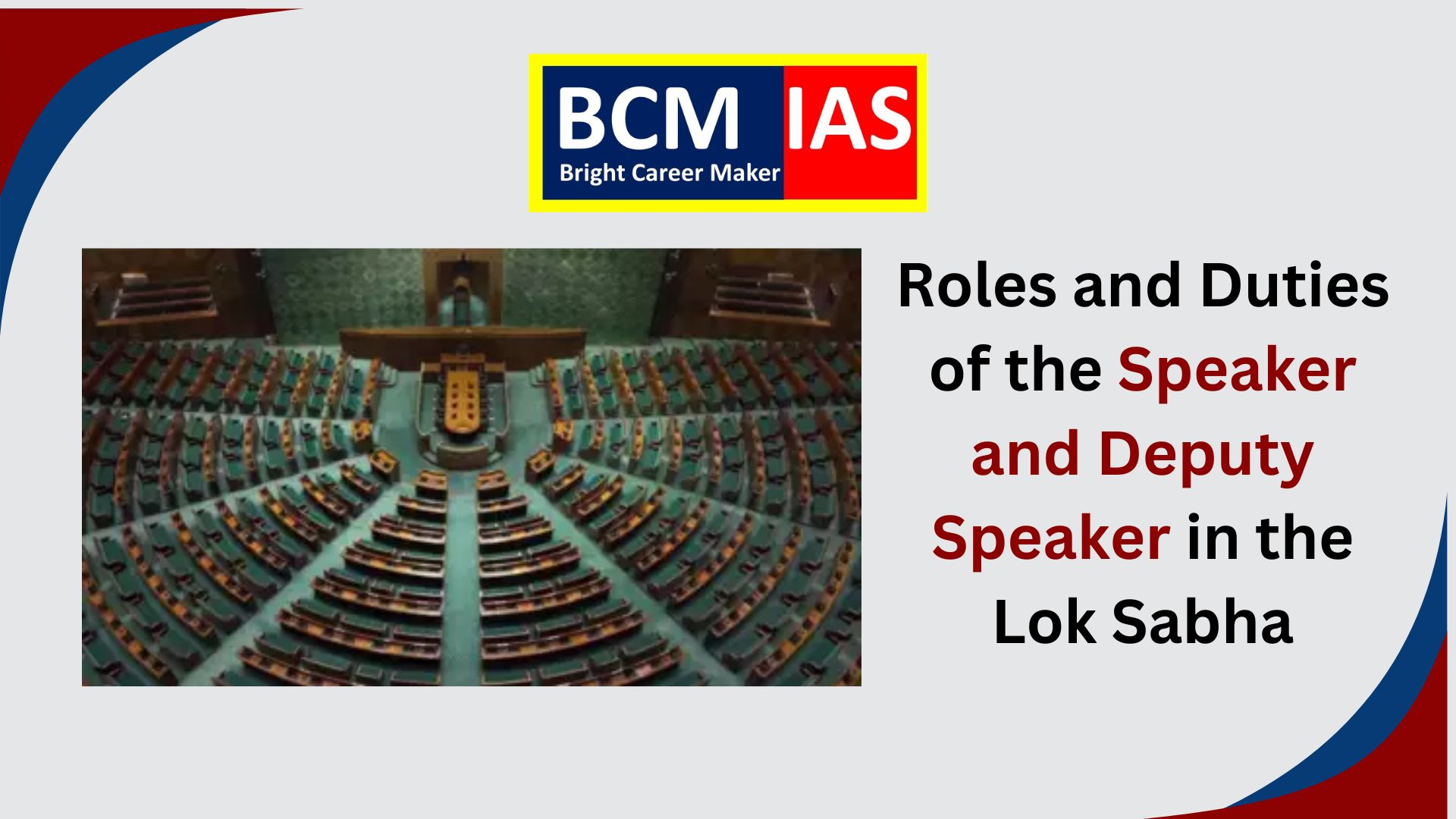
Roles and Duties of the Speaker
and Deputy Speaker in the Lok Sabha
Introduction
The recent appointment of Bhartruhari Mahtab as the 'Speaker
pro tem' of the 18th Lok Sabha by the President of India highlights the
importance of understanding the roles and duties associated with the Speaker
and Deputy Speaker in the Lok Sabha. This analysis delves into the
constitutional provisions, the election process, and the significance of these
roles, emphasizing the need for impartiality and effective parliamentary
functioning.
Speaker pro tem
- Definition
and Purpose:
The term 'Speaker pro tem' is not found in the Constitution but is a
conventional term meaning 'for the time being' or 'temporary'. It is used
to describe the senior-most member of the Lok Sabha appointed by the
President to preside over the first meeting of the new Lok Sabha until a
full-time Speaker is elected.
- Appointment
and Duties: The
President appoints the Speaker pro tem to ensure that the office of the
Speaker is never left vacant. The Speaker pro tem administers the oath of
office to other MPs and oversees the election of the full-time Speaker.
Constitutional Provisions
- Article
94: Ensures
that the Speaker does not vacate office until immediately before the first
meeting of the Lok Sabha after its dissolution.
- Article
95(1): Provides
for the President to appoint a member of the Lok Sabha to perform the
duties of the Speaker if both the Speaker and Deputy Speaker positions are
vacant.
- Article
93: Mandates
the Lok Sabha to elect two members as the Speaker and Deputy Speaker.
Election of Speaker and Deputy Speaker
- Speaker: Elected on a date fixed by the
President. Historically, all Speakers in independent India have been
elected unopposed.
- Deputy
Speaker:
Elected on a date fixed by the Speaker. The Deputy Speaker steps in during
the vacancy or absence of the Speaker and plays a crucial role in
maintaining parliamentary operations.
Role and Responsibilities of the Speaker
1.
Conduct of Business: The Speaker oversees the conduct of business in the
Lok Sabha, ensuring orderly proceedings.
2.
Certifying Money Bills: The Speaker certifies bills as
Money Bills, which limits the role of the Rajya Sabha in these matters.
3.
Deciding on Disqualification: Under the Tenth Schedule, the
Speaker decides on the disqualification of MPs for defection.
4.
Referral of Bills: The Speaker has the power to refer bills to Standing
Committees for scrutiny, though this practice has declined in recent years.
5.
Suspension of Members: The Speaker can suspend members for
grave disorder in the House, although this power should be exercised with
restraint to maintain robust parliamentary functioning.
Importance of Impartiality
- British
Convention: In
the UK, the Speaker resigns from their political party upon election to
reflect impartiality. They seek re-election as 'The Speaker seeking
re-election' without party affiliation.
- Indian
Practice:
Indian Speakers have not resigned from their political parties upon
election. Resigning from the party could demonstrate independence and
impartiality, enhancing the credibility of the office.
Deputy Speaker
- Role
and Convention:
Traditionally, the Deputy Speaker position has been offered to the
Opposition since 1991, fostering a bipartisan approach. This practice was
not followed in the 17th Lok Sabha but should ideally return to strengthen
parliamentary democracy.
Conclusion
The roles of the Speaker and Deputy Speaker are pivotal in
ensuring the effective functioning of the Lok Sabha. Adherence to
constitutional provisions, maintaining impartiality, and upholding healthy
parliamentary conventions are essential for a vibrant democracy. The
appointment of a Speaker pro tem and the subsequent election of the full-time
Speaker are critical steps in this process, ensuring continuity and stability
in the legislative framework.
MCQs
Question 1
Consider the following statements regarding the 'Speaker pro
tem':
1.
The term 'Speaker pro tem' is found in the
Constitution of India.
2.
The 'Speaker pro tem' administers the oath of office
to other MPs.
3.
The 'Speaker pro tem' is appointed by the President of
India.
Which of the statements given above is/are correct?
A. 1 only
B. 2 and 3 only
C. 1 and 3 only
D. 2 only
Answer: B. 2 and 3 only
Question 2
Which Article of the Indian Constitution ensures that the
Speaker of the Lok Sabha shall not vacate his/her office until immediately
before the first meeting of the Lok Sabha after its dissolution?
A. Article 93
B. Article 94
C. Article 95
D. Article 96
Answer: B. Article 94
Question 3
With reference to the role of the Speaker of the Lok Sabha,
consider the following statements:
1.
The Speaker certifies a Bill to be a Money Bill.
2.
The Speaker decides on the disqualification of members
under the Tenth Schedule.
3.
The Speaker is responsible for nominating the Deputy
Speaker of the Lok Sabha.
Which of the statements given above is/are correct?
A. 1 and 2 only
B. 1 and 3 only
C. 2 and 3 only
D. 1, 2 and 3
Answer: A. 1 and 2 only
Question 4
Consider the following conventions regarding the Speaker of
the Lok Sabha:
1.
Once elected, the Speaker resigns from his/her
political party.
2.
The Speaker seeks re-election as an independent
candidate.
Which of the statements given above is/are correct?
A. 1 only
B. 2 only
C. Both 1 and 2
D. Neither 1 nor 2
Answer: D. Neither 1 nor 2
Question 5
According to the conventions in the Indian Parliament, who
usually holds the position of the Deputy Speaker of the Lok Sabha?
A. A member of the ruling party
B. A member of the Opposition
C. A senior-most member of the Lok Sabha
D. A member nominated by the President
Answer: B. A member of the Opposition
Mains Question for Practice
Discuss the constitutional provisions and
conventions related to the roles and duties of the Speaker and Deputy Speaker
of the Lok Sabha. How can the impartiality of these offices be ensured?
Answer
Introduction
The roles of the Speaker and Deputy Speaker of the Lok Sabha
are pivotal in the smooth functioning of the Indian Parliament. These positions
are entrusted with maintaining order during debates, ensuring the legislative
process is conducted fairly, and upholding the Constitution. This answer delves
into the constitutional provisions, the election process, the duties associated
with these roles, and the conventions that ensure their impartiality.
Constitutional Provisions
1.
Article 93: Mandates the election of the Speaker and Deputy Speaker by
the members of the Lok Sabha. This ensures that both positions are filled
through a democratic process within the House.
2.
Article 94: States that the Speaker shall not vacate office until
immediately before the first meeting of the Lok Sabha after its dissolution,
ensuring continuity in parliamentary proceedings.
3.
Article 95(1): Provides that when the positions of both Speaker and Deputy
Speaker are vacant, the President shall appoint a member of the Lok Sabha to
perform the duties of the Speaker. This member is referred to as the 'Speaker
pro tem' and presides over the election of the full-time Speaker.
4.
Tenth Schedule: Empowers the Speaker to decide on the disqualification of
members on grounds of defection, reflecting the Speaker's role in maintaining
the integrity of the House.
Election Process
- Speaker: Elected on a date fixed by the
President. Historically, the election of the Speaker has been a unanimous
process with candidates being elected unopposed.
- Deputy
Speaker:
Elected on a date fixed by the Speaker. Traditionally, the Deputy
Speaker's position has been offered to a member of the Opposition,
fostering a bipartisan approach within the Lok Sabha.
Roles and Duties
1.
Conduct of Business: The Speaker presides over the sessions of the Lok
Sabha, maintaining order and decorum during debates. The Speaker ensures that
the proceedings are conducted in accordance with parliamentary rules and
practices.
2.
Certification of Money Bills: The Speaker certifies bills as
Money Bills, which limits the Rajya Sabha's role in these financial matters.
This certification is crucial as it determines the legislative process for
financial legislation.
3.
Disqualification of Members: Under the Tenth Schedule, the
Speaker decides on matters of disqualification related to defection. This role
is critical in maintaining the stability and discipline of political parties
within the House.
4.
Referral of Bills: The Speaker has the authority to refer bills to
Standing Committees for detailed examination and scrutiny. This practice
enhances the legislative process by allowing for in-depth analysis and
discussion.
5.
Suspension of Members: The Speaker can suspend members for
grave disorder in the House. This power is essential for maintaining order but
should be exercised judiciously to ensure fair representation and debate.
Conventions and Impartiality
1.
Impartiality: The Speaker is expected to be impartial and fair, upholding
the dignity of the House. To ensure impartiality, the Speaker should ideally
resign from their political party upon election, as practiced in the UK
Parliament. This step can help in demonstrating the Speaker's neutrality.
2.
British Convention: In the UK, once elected, the Speaker resigns from
their political party and seeks re-election as an independent candidate. This
practice reflects the Speaker's commitment to impartiality and neutrality.
3.
Indian Practice: While Indian Speakers have not traditionally resigned from
their political parties, adopting this practice could enhance the credibility
and impartiality of the office. Former Speaker Somnath Chatterjee demonstrated
independence by refusing to resign from his post despite his party's direction,
setting a notable precedent.
4.
Deputy Speaker's Role: Traditionally, the Deputy Speaker's
position has been offered to a member of the Opposition. This practice, which
began in 1991, ensures a balanced representation of interests within the House.
The absence of a Deputy Speaker in the 17th Lok Sabha was a deviation from this
healthy convention, and its restoration would be beneficial.
Conclusion
The roles of the Speaker and Deputy Speaker are fundamental
to the functioning of the Lok Sabha. Adherence to constitutional provisions and
conventions ensures that these positions are filled democratically and function
impartially. The adoption of practices that emphasize neutrality, such as
resigning from political parties upon election, can further enhance the
impartiality of these offices. Ensuring the Speaker and Deputy Speaker's
independence is essential for maintaining the integrity and effectiveness of
parliamentary proceedings, ultimately strengthening India's democratic
framework.


Comments on “Roles and Duties of the Speaker and Deputy Speaker in the Lok Sabha”