

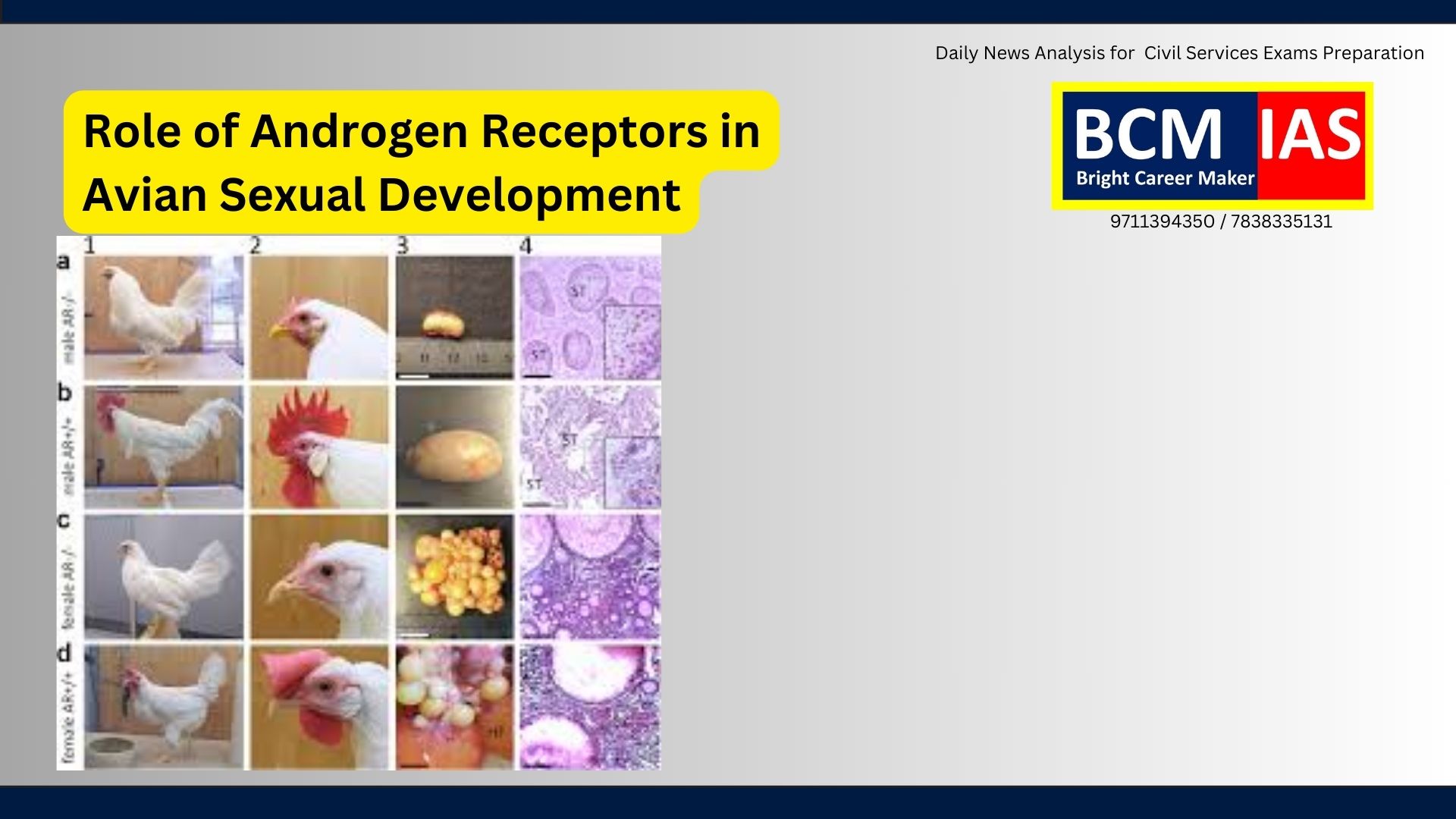
Role of Androgen Receptors in Avian Sexual Development
Introduction:
The study conducted by the Max
Planck Institute of Biological Intelligence and
the Technical University of Munich has
revealed a groundbreaking finding: androgen receptors are
not only crucial for male chickens but also play a vital role in female
chickens' sexual development and fertility.
This challenges the traditional notion that androgen hormones are predominantly
male-specific.
Key Findings of the
Study:
1. Role of Androgen
Receptors:
·
In Male Chickens:
- Male
chickens devoid of androgen receptors developed smaller testicles
but were unable to crow or develop sexual characteristics like combs,
even when exposed to testosterone.
- The
neural circuits
for crowing behavior failed to develop in the absence of androgen
receptors.
- Traits
like tail feather length and spurs remained unaffected, indicating these
may be governed by hormone-independent
mechanisms.
·
In Female Chickens:
- Female
chickens lacking androgen receptors were infertile and failed to develop or lay eggs.
- Ovaries
were present but smaller, and essential sexual behaviors and physical
traits like pigmented
eye rings and comb
development did not manifest.
- This
highlights the crucial role of androgens
in ovarian follicle development and head ornamentation.
2. Hormone-Dependent
vs. Hormone-Independent Traits:
·
Hormone-Dependent Traits:
- Traits
like comb development, crowing behavior, and ovarian follicle development
are directly regulated by androgen
receptors.
- Without
the receptors, these traits did not develop, even when testosterone was
introduced.
·
Hormone-Independent Traits:
- Certain
characteristics, like tail
feather length and spurs, remained unaffected by the
absence of androgen receptors.
- This
indicates these traits may be governed by genetic factors or other hormonal systems.
3. Role of the Bursa
of Fabricius:
- The
bursa of Fabricius
(a lymphoid organ) plays a key role in sexual development.
- Normal
chickens experience shrinkage
of the bursa during puberty, signaling sexual maturation.
- In
chickens lacking androgen receptors, this involution was either delayed
or did not occur, further implicating androgen receptors in sexual
development.
Implications of the
Study:
A. Scientific
Implications:
1.
Revisiting Gender-Specific
Hormones:
o Traditionally,
testosterone
has been viewed as a male hormone. This study demonstrates its importance in female fertility and development
as well.
2.
Complex Hormonal
Interactions:
o The
study underscores the interplay between testosterone
and estrogen receptors in brain functions and sexual
characteristics, complicating the understanding of hormone-mediated effects.
3.
Avian vs. Mammalian
Development:
o Unlike
mammals, birds exhibit some sexual traits that are independent of hormones,
revealing unique evolutionary adaptations.
B. Practical
Implications:
1.
Poultry Industry:
o Understanding
how androgen signaling affects traits like body weight and fertility can inform
breeding practices. For example, male chickens are castrated in commercial
settings to increase
body weight by reducing androgen secretion.
2.
Genetic Engineering:
o The
use of CRISPR/Cas9
in the study highlights its potential to explore genetic mechanisms and develop
solutions for fertility and developmental issues in birds.
Challenges
Identified:
1.
Incomplete Understanding of
Mechanisms:
o Traits
like tail feather length remain unaffected by androgen receptor modifications,
indicating the need for further research into hormone-independent mechanisms.
2.
Hormonal Interactions:
o The
conversion of testosterone into estrogen complicates the study of testosterone-mediated effects,
requiring more detailed exploration.
Way Forward:
1.
Further Research:
o Investigating
the hormone-independent
mechanisms regulating certain traits will provide a deeper
understanding of avian sexual development.
2.
Broader Application:
o The
findings can be extended to other avian species and even mammals to uncover
universal principles of sexual development.
3.
Industry Applications:
o Using
these insights to optimize poultry farming practices and improve fertility
outcomes in birds.
Conclusion:
This study highlights the critical
role of androgen receptors in regulating sexual
development, fertility, and behaviors in both male and female chickens. It
challenges traditional notions of gender-specific hormones and uncovers a
complex interaction between hormone-dependent and independent
mechanisms in birds. The findings have broad
implications for biology, genetics, and the poultry industry, paving the way
for further research into avian and mammalian sexual development.
MCQs
Question 1:
What is the primary role of androgen
receptors in female chickens, as highlighted in the study?
1.
Promoting tail feather growth.
2.
Facilitating ovarian development and
egg-laying.
3.
Regulating body weight reduction.
4.
Controlling pigmentation of skin.
Correct Answer: 2.
Facilitating ovarian development and egg-laying.
Explanation: The
study revealed that female chickens without androgen receptors failed to
develop ovaries fully and lay eggs, indicating the crucial role of androgen
signaling in their reproductive development.
Question 2:
Which of the following traits in chickens was
found to be hormone-independent in the study?
1.
Comb development.
2.
Crowing behavior in males.
3.
Tail feather length and spurs.
4.
Ovarian follicle development.
Correct Answer: 3.
Tail feather length and spurs.
Explanation:
Despite the lack of androgen receptors, certain male traits like tail feather
length and spurs remained unaffected, suggesting hormone-independent
mechanisms.
Question 3:
What is the function of the bursa of
Fabricius in birds?
1.
Regulates body temperature.
2.
Develops antibodies and B lymphocytes.
3.
Enhances egg-laying capacity.
4.
Controls sexual differentiation.
Correct Answer: 2.
Develops antibodies and B lymphocytes.
Explanation: The
bursa of Fabricius is a lymphoid organ that helps in antibody production and
plays a role in sexual growth and maturation.
Question 4:
What experimental tool was used in the study
to block androgen receptor functions in chickens?
1.
Gene silencing via RNA interference.
2.
CRISPR/Cas9 genetic modification.
3.
Hormone replacement therapy.
4.
Artificial insemination.
Correct Answer: 2.
CRISPR/Cas9 genetic modification.
Explanation: The
researchers used CRISPR/Cas9 technology to knock out genes responsible for
androgen receptor development in chickens.
Question 5:
Why did male chickens without androgen
receptors fail to crow, even when exposed to testosterone?
1.
Testosterone was not absorbed in their
bloodstream.
2.
Neural circuits governing crowing behavior
did not fully develop.
3.
Testosterone levels were too low for
effective signaling.
4.
The syrinx, the vocal organ, was damaged.
Correct Answer: 2.
Neural circuits governing crowing behavior did not fully develop.
Explanation: The
study found that androgen receptors were crucial for the development of neural
circuits associated with crowing behavior in male chickens.


Comments on “Role of Androgen Receptors in Avian Sexual Development”