


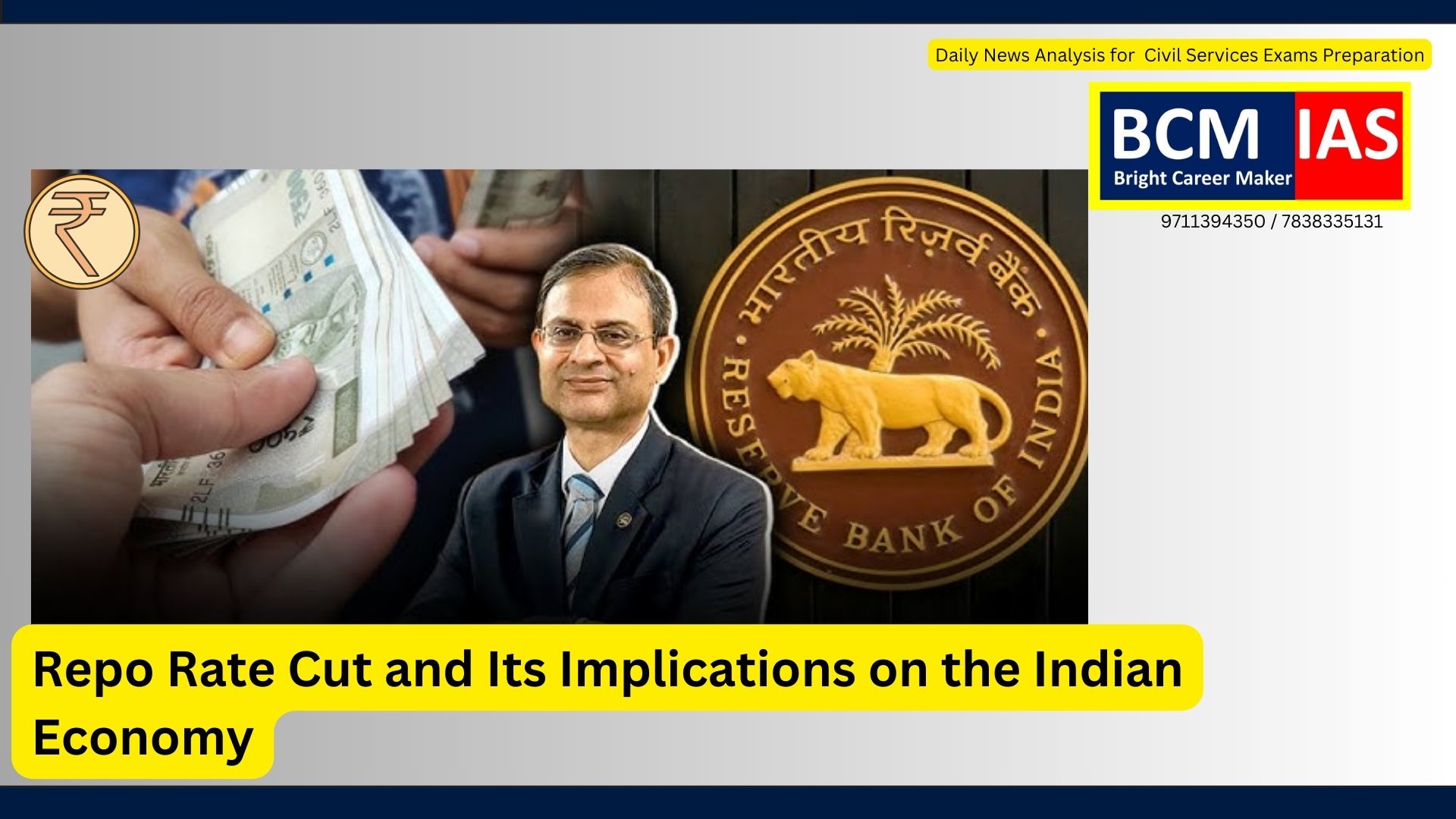
Repo Rate Cut and Its Implications on the
Indian Economy
1. Introduction
The Monetary Policy Committee (MPC) of the Reserve Bank of
India (RBI) recently reduced the repo rate from 6.5% to 6.25% (a 25
basis points cut) for the first time since 2020. This decision aligns with
the Union Budget 2025-26, which introduced personal income tax
reductions to spur consumption and economic growth. The repo rate cut is
expected to lower borrowing costs, improve liquidity, and stimulate
investment, but it also carries potential inflationary risks.
2. Understanding the
Repo Rate
(A) What is the Repo Rate?
- The repo
rate (Repurchase Agreement Rate) is the interest rate at which
commercial banks borrow money from the RBI to meet short-term
liquidity needs.
- Banks
pledge government securities as collateral and agree to repurchase
them later at a slightly higher price (including interest).
(B) How Does the Repo Rate Impact the Economy?
|
Scenario |
Impact on Banks |
Impact on Borrowers
& Economy |
|
High Repo Rate |
Costlier borrowing for banks |
Higher interest rates for consumers & businesses →
Reduced borrowing & spending |
|
Low Repo Rate |
Cheaper loans for banks |
Lower interest rates for businesses & consumers →
Increased borrowing & economic activity |
- Monetary
Policy Tool:
The RBI adjusts the repo rate to regulate inflation, money supply, and
overall economic growth.
3. Reasons Behind the
Repo Rate Cut by RBI
(A) Growth-Stimulating Budget Measures
- Union
Budget 2025-26
announced personal income tax cuts and revised TDS limits,
increasing disposable income and consumer spending.
- Lower
repo rates complement fiscal stimulus by ensuring affordable
loans, boosting consumption and investment.
(B) Declining Inflation Trends
- Consumer
Price Index (CPI) inflation declined to 5.22% in December 2024, the lowest
in four months.
- Falling
inflation
provides the RBI with room for monetary easing without major
inflationary risks.
(C) Enhancing Market Liquidity
- The
RBI recently injected ₹1.5 trillion into the banking system to ease
liquidity constraints.
- A repo
rate cut ensures banks have access to cheaper funds, improving credit
flow to businesses.
(D) Global Economic Uncertainty & External Risks
- U.S.
tariffs on Canada, Mexico, and China raised concerns over global trade instability.
- The
rupee weakened to ₹87.29 per dollar, increasing import costs and
inflation risks.
- A
repo rate cut aims to cushion the Indian economy from external shocks
and support domestic growth.
4. Implications of the
Repo Rate Cut
(A) Economic Growth and Investment Boost
- Lower
interest rates reduce borrowing costs for businesses and consumers,
encouraging:
- Business
expansion →
More investments in infrastructure, manufacturing, and services.
- Higher
employment →
Increased demand leads to job creation.
- Greater
consumer spending → Low-cost loans for housing, automobiles, and retail consumption.
(B) Financial Market Reactions
- Banks
lower lending rates, making loans cheaper but also reducing deposit interest
rates.
- Declining
fixed deposit (FD) rates push investors toward equities, mutual funds, and
real estate, increasing stock market activity.
(C) Export Competitiveness & Rupee Depreciation
- A lower
repo rate reduces investment returns, leading to capital outflows
from India to higher-yield economies.
- A weaker
rupee makes Indian exports more competitive in global markets.
- However,
import costs rise, increasing prices of oil, electronics, and
essential goods.
(D) Potential Inflationary Pressures
- Increased
demand and spending may push prices higher, impacting essential
commodities.
- If
inflation exceeds RBI’s 4% target, the central bank may need to reverse the rate cut
to control price rises.
5. Balancing Inflation
and Growth: RBI’s Role
(A) Inflation Targeting Framework
- RBI
follows an inflation-targeting policy under the Monetary Policy Framework Agreement
(2016).
- Inflation
Target: 4%
±2% band (set by the Urjit Patel Committee in 2014).
- Historical
Context:
- Chakravarty
Committee (1982-85) proposed a 4% inflation target in Wholesale Price Index
(WPI).
- Urjit
Patel Committee (2014) institutionalized CPI-based inflation targeting,
aligning India with global best practices.
(B) M3 Money Supply and Monetary Policy
- M3
(Broad Money) = M1 (Currency + Demand Deposits) + Net Time Deposits.
- RBI
controls M3 money supply growth through repo rate adjustments,
affecting liquidity and inflation.
6. Challenges and Risks
|
Potential Issue |
Impact |
|
Inflationary Pressures |
Rising consumer demand may push prices higher. |
|
Rupee Depreciation |
Weak rupee raises import costs, worsening trade balance. |
|
Low Deposit Rates |
FD investors and pensioners receive lower returns,
impacting savings. |
|
Global Uncertainties |
Trade wars, commodity price fluctuations, and geopolitical
risks affect stability. |
7. Way Forward: RBI’s
Monetary Strategy
(A) Monitoring Inflation Trends
- If
inflation rises beyond 6%, the RBI may have to pause or reverse
rate cuts.
(B) Managing Liquidity Carefully
- The
RBI should balance liquidity injection while ensuring excessive
money supply does not fuel inflation.
(C) Encouraging Targeted Lending
- Encouraging
low-cost loans for MSMEs, infrastructure, and rural sectors to
maximize economic gains from the rate cut.
(D) Enhancing Rupee Stability
- RBI
may use Open Market Operations (OMO) and forex reserves to
stabilize the rupee amid global volatility.
8. Conclusion
The RBI’s repo rate cut aims to stimulate economic growth,
complementing the pro-growth fiscal measures in the Union Budget 2025-26.
However, it poses inflationary risks, which must be carefully managed to
maintain price stability within the 4% target. Given global
uncertainties, India’s monetary policy must remain dynamic, balancing
growth and inflation control effectively.
UPSC Mains Practice Question
Q:
"The repo rate is a
critical tool in monetary policy that influences economic growth and inflation.
Analyze the impact of the recent repo rate cut by the RBI on the Indian
economy, highlighting both the benefits and risks involved."
(250 words)
Answer
Introduction
The repo rate, set by the Reserve Bank of India
(RBI), is the interest rate at which commercial banks borrow short-term
funds. In February 2025, the RBI cut the repo rate from 6.5% to 6.25%,
the first reduction in five years. This move follows the Union Budget
2025-26, which reduced personal income tax to stimulate consumption and
economic growth. While a lower repo rate promotes investment and credit
growth, it also raises inflationary and fiscal risks.
1. Positive Impacts of
the Repo Rate Cut
(A) Economic Growth & Investment Expansion
- Lower
borrowing costs
→ Cheaper loans for businesses and individuals → Higher investments and
economic expansion.
- Encourages
infrastructure development, leading to job creation and
improved productivity.
(B) Increased Consumer Spending
- Lower
EMIs on home, car, and business loans → Higher disposable income → Boosts demand
for goods and services.
(C) Financial Market & Credit Liquidity
- Higher
stock market participation as deposit rates decline, pushing investments into equities
and mutual funds.
- ₹1.5
trillion liquidity injection ensures adequate funds for banks to lend more freely.
(D) Improved Export Competitiveness
- Weaker
rupee (due to
lower interest rates) makes Indian exports more competitive in
global markets.
2. Risks and Challenges
of the Rate Cut
(A) Inflationary Pressures
- Increased
borrowing and spending could push inflation above the RBI’s 4% target.
- Imported
inflation risk
due to higher import costs (e.g., crude oil, essential
commodities).
(B) Impact on Savings & Fixed Deposits
- Lower
interest rates on savings and FDs reduce returns for pensioners and conservative
investors.
- May push
people toward riskier investments, increasing market volatility.
(C) External Economic Uncertainty
- Global
trade tensions (U.S.-China tariffs) and a weak rupee (₹87.29/$) could destabilize
financial markets.
(D) Banking Sector Profitability
- Lower
lending rates reduce net interest margins for banks, affecting
profitability.
3. Balancing Growth and
Inflation: RBI’s Role
- Inflation
Targeting: RBI
follows a 4% ±2% inflation target, ensuring price stability
while promoting growth.
- Liquidity
Management:
Open Market Operations (OMO) and forex reserves can stabilize rupee
depreciation risks.
- Sector-Specific
Lending:
Directing funds toward productive sectors (MSMEs, infrastructure, green
energy) rather than speculative consumption.
Conclusion
The repo rate cut aligns with India’s pro-growth fiscal
policy, aiming to boost investments, demand, and exports. However, inflationary
risks, rupee depreciation, and external economic uncertainties require a
cautious and flexible monetary approach. The RBI must closely monitor
inflation trends and adjust policies accordingly to sustain long-term
economic stability.
MCQs
Q1. With reference to the recent repo rate cut by the RBI,
consider the following statements:
1.
A reduction in the repo rate makes borrowing cheaper
for commercial banks.
2.
Lower repo rates encourage higher consumer spending
and investment in the economy.
3.
An increase in the repo rate leads to higher inflation
in the long run.
Which of the statements given above is/are correct?
(a) 1 and 2 only
(b) 2 and 3 only
(c) 1 and 3 only
(d) 1, 2, and 3
Answer: (a) 1
and 2 only
Explanation: An increase in the
repo rate reduces inflation by discouraging borrowing and reducing money
supply, not increasing it.
Q2. How does a repo rate cut affect different economic
sectors?
(a)
It increases the interest rate on fixed deposits, encouraging more savings.
(b) It reduces borrowing costs for businesses, leading to higher
investments and job creation.
(c) It strengthens the domestic currency by attracting foreign capital
inflows.
(d) It directly controls inflation by reducing money supply.
Answer: (b) It
reduces borrowing costs for businesses, leading to higher investments and job
creation.
Explanation: Lower repo rates
make credit cheaper, encouraging businesses to borrow more for expansion,
leading to higher employment and economic growth.
Q3. Consider the following effects of a reduction in the repo
rate:
1.
Lowered loan interest rates for individuals and
businesses.
2.
Increased liquidity in the banking system.
3.
Strengthening of the rupee against foreign currencies.
4.
Higher stock market activity due to lower fixed
deposit rates.
Which of the above are correct consequences of a repo rate
cut?
(a) 1, 2, and 4 only
(b) 2 and 3 only
(c) 1 and 3 only
(d) 1, 2, 3, and 4
Answer: (a) 1,
2, and 4 only
Explanation: A repo rate cut
weakens the rupee as lower interest rates reduce foreign capital inflows,
not strengthen it.
Q4. The Reserve Bank of India (RBI) uses the repo rate to:
(a)
Control inflation and regulate money supply in the economy.
(b) Increase foreign direct investment (FDI) in India.
(c) Manage fiscal deficit by controlling government borrowing.
(d) Directly influence stock market prices.
Answer: (a) Control
inflation and regulate money supply in the economy.
Explanation: The repo rate is
a key monetary policy tool that helps the RBI manage inflation and
liquidity, but it does not directly control FDI or fiscal deficit.
Q5. The 4% inflation target in India, set by the RBI, is
based on recommendations of which committee?
(a)
Chakravarty Committee (1982)
(b) Narasimham Committee (1991)
(c) Urjit Patel Committee (2014)
(d) Kelkar Committee (2002)
Answer: (c) Urjit
Patel Committee (2014)
Explanation: The Urjit Patel
Committee institutionalized inflation targeting, setting a 4% CPI
inflation target with a ±2% band, later formalized in 2016 under the
Monetary Policy Framework Agreement.


Comments on “Repo Rate Cut and Its Implications on the Indian Economy”