


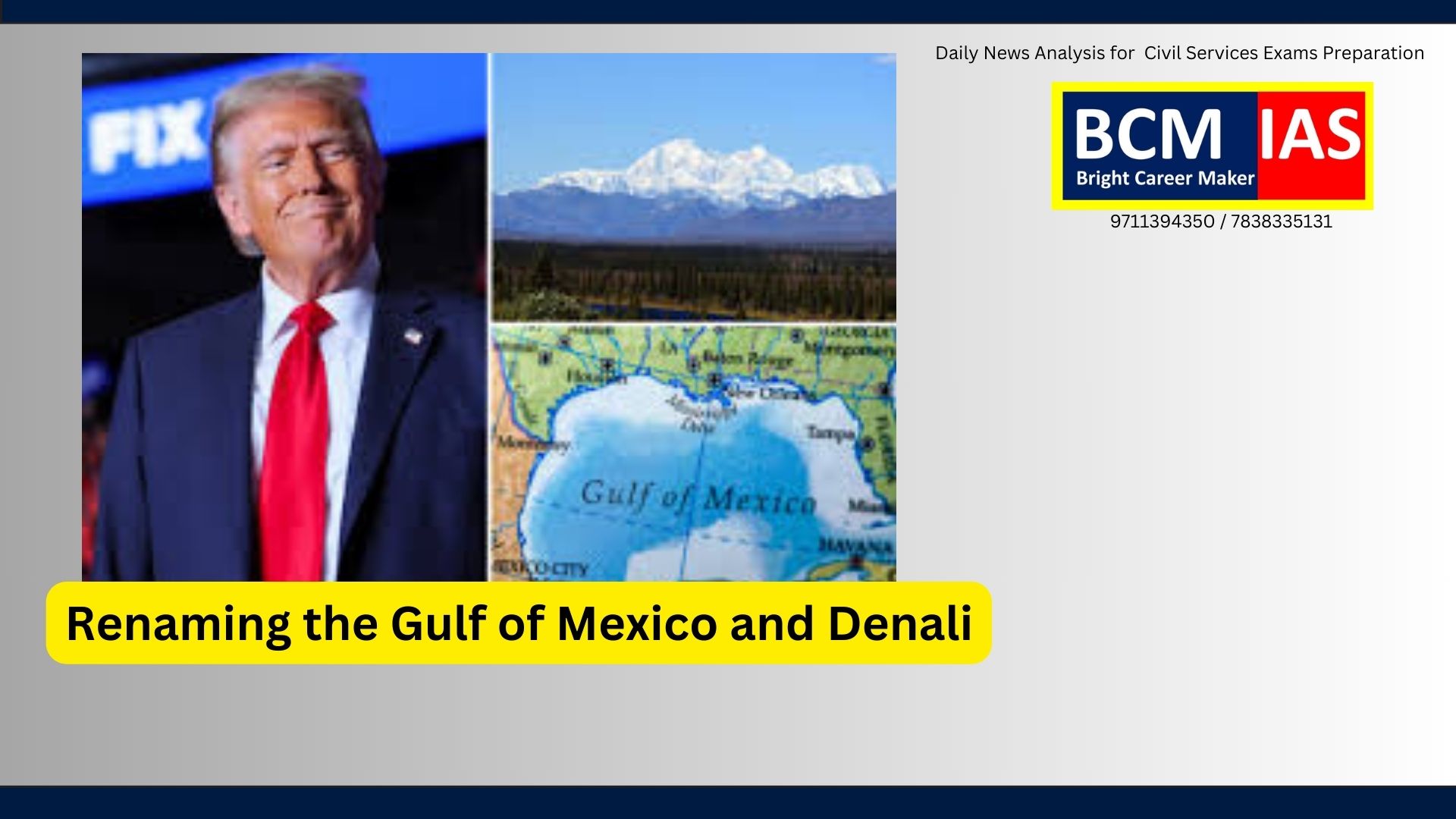
Renaming the Gulf of Mexico and Denali
The executive order signed by the US
President to rename the Gulf of Mexico as
the Gulf of America and revert Denali to Mount
McKinley reflects the interplay of governance,
geopolitics, and cultural identity in naming practices. The move raises
questions about historical narratives, international norms, and domestic
priorities.
Key Aspects:
1. Governance and
International Norms on Naming:
- The
International
Hydrographic Organization (IHO) ensures standardization of
water body names globally.
- Member
states, including the US and Mexico, can adopt domestic alternative names,
but international treaties and agreements remain bound to recognized names
(e.g., Gulf of Mexico).
- In
this case, Mexico
and Cuba are not obligated to use the new name,
maintaining the international status quo.
2. Gulf of Mexico:
Strategic and Economic Importance
- Geography:
The Gulf of Mexico, the largest gulf in the world, borders the US, Mexico,
and Cuba. It connects to:
- The
Atlantic Ocean via the Straits
of Florida.
- The
Caribbean Sea via the Yucatán
Channel.
- Economic
Contributions:
- Supplies
14% of US crude
oil and 5%
of natural gas.
- Hosts
48% of US
petroleum refining capacity and 51% of natural gas processing
capacity.
- Impact
of Renaming:
- Symbolically
asserts American ownership and dominance, but it does not affect
international economic or legal arrangements.
3. Denali (Mount
McKinley):
- Historical
Renaming: The highest peak in North America,
located in Alaska, was renamed Denali
in 2015 to honor the indigenous Koyukon
people, who have traditionally referred to it by this
name.
- Reverting
to Mount McKinley: Honors President William McKinley
(1897-1901), who led during the Spanish-American War and oversaw US
economic growth.
- Cultural
Implications:
- The
change signals a shift from recognizing indigenous heritage to
emphasizing historical American leadership.
- It
may draw criticism for erasing native cultural significance.
4. Comparative Global
Disputes on Naming:
- "Persian
Gulf" vs. "Arabian Gulf":
Iran and Saudi Arabia dispute the naming of this key water body,
reflecting broader geopolitical tensions.
- "Sea
of Japan" vs. "East Sea":
Japan and South Korea differ on the name, tied to historical grievances
and territorial disputes.
- South
China Sea: Various countries claim overlapping
territories, leading to conflicting naming conventions.
- These
disputes illustrate how naming reflects broader issues of sovereignty,
history, and regional dominance.
Implications:
1. Domestic
Impact:
o Renaming
reinforces nationalist narratives and prioritizes American-centric historical
and economic contributions.
o May
polarize opinions, particularly among indigenous groups and environmental activists.
2. International
Reactions:
o The
Gulf of America name is unlikely to gain traction internationally, as Mexico
and Cuba continue to use Gulf
of Mexico.
o The
move might be perceived as symbolic and politically motivated, with limited
practical implications.
3. Geopolitical
Symbolism:
o Similar
to other naming disputes, this action reflects an assertion of identity and
influence over strategic resources and landmarks.
Conclusion:
The renaming of the Gulf of Mexico and Denali
(Mount McKinley) highlights the complex interplay of nationalism, cultural
identity, and geopolitical assertion. While the changes carry symbolic
significance domestically, their international impact remains limited due to
established norms and agreements. This underscores how naming practices often
reflect broader political and cultural narratives rather than altering
geopolitical realities.
MCQs
1. With reference to the Gulf of Mexico, consider the following
statements:
1. It is the
largest gulf in the world, bordered by the United States, Mexico, and Cuba.
2. It
connects to the Atlantic Ocean through the Yucatán Channel and to the Caribbean
Sea via the Straits of Florida.
3. It
contributes significantly to the United States' petroleum refining capacity.
Which of the statements given above is/are correct?
(a) 1 and 2 only
(b) 2 and 3 only
(c) 1 and 3 only
(d) 1, 2, and 3
Ans: (c)
2. The renaming of Denali back to Mount McKinley is associated with
which of the following?
(a) Honoring indigenous Koyukon heritage in Alaska.
(b) Recognizing President William McKinley’s leadership.
(c) Celebrating the geological history of North America.
(d) Highlighting Alaska’s economic contribution to the United States.
Ans: (b)
3. Consider the following pairs of naming disputes and their associated
regions:
1. Persian
Gulf vs. Arabian
Gulf – Iran and Saudi Arabia
2. Sea of
Japan vs. East Sea – Japan and South Korea
3. South
China Sea vs. West Philippine Sea – China and the Philippines
Which of the pairs given above is/are correctly matched?
(a) 1 only
(b) 1 and 2 only
(c) 2 and 3 only
(d) 1, 2, and 3
Ans: (d)
4. With reference to the governance of international naming conventions
for geographical features, consider the following statements:
1. The
International Hydrographic Organization (IHO) standardizes names for water bodies
globally.
2. Member
states must adopt IHO-standardized names for all domestic and international
use.
3. The IHO
allows domestic alternative names alongside internationally recognized names.
Which of the statements given above is/are correct?
(a) 1 and 2 only
(b) 2 only
(c) 1 and 3 only
(d) 1, 2, and 3
Ans: (c)
5. What makes the Gulf of Mexico strategically significant for the
United States?
1. It
provides access to both the Pacific and Atlantic Oceans.
2. It hosts
over 50% of the United States’ petroleum refining capacity.
3. It serves
as a key route for international shipping and trade.
Select the correct answer using the codes below:
(a) 1 and 2 only
(b) 2 and 3 only
(c) 1 and 3 only
(d) 1, 2, and 3
Ans: (b)


Comments on “Renaming the Gulf of Mexico and Denali”