


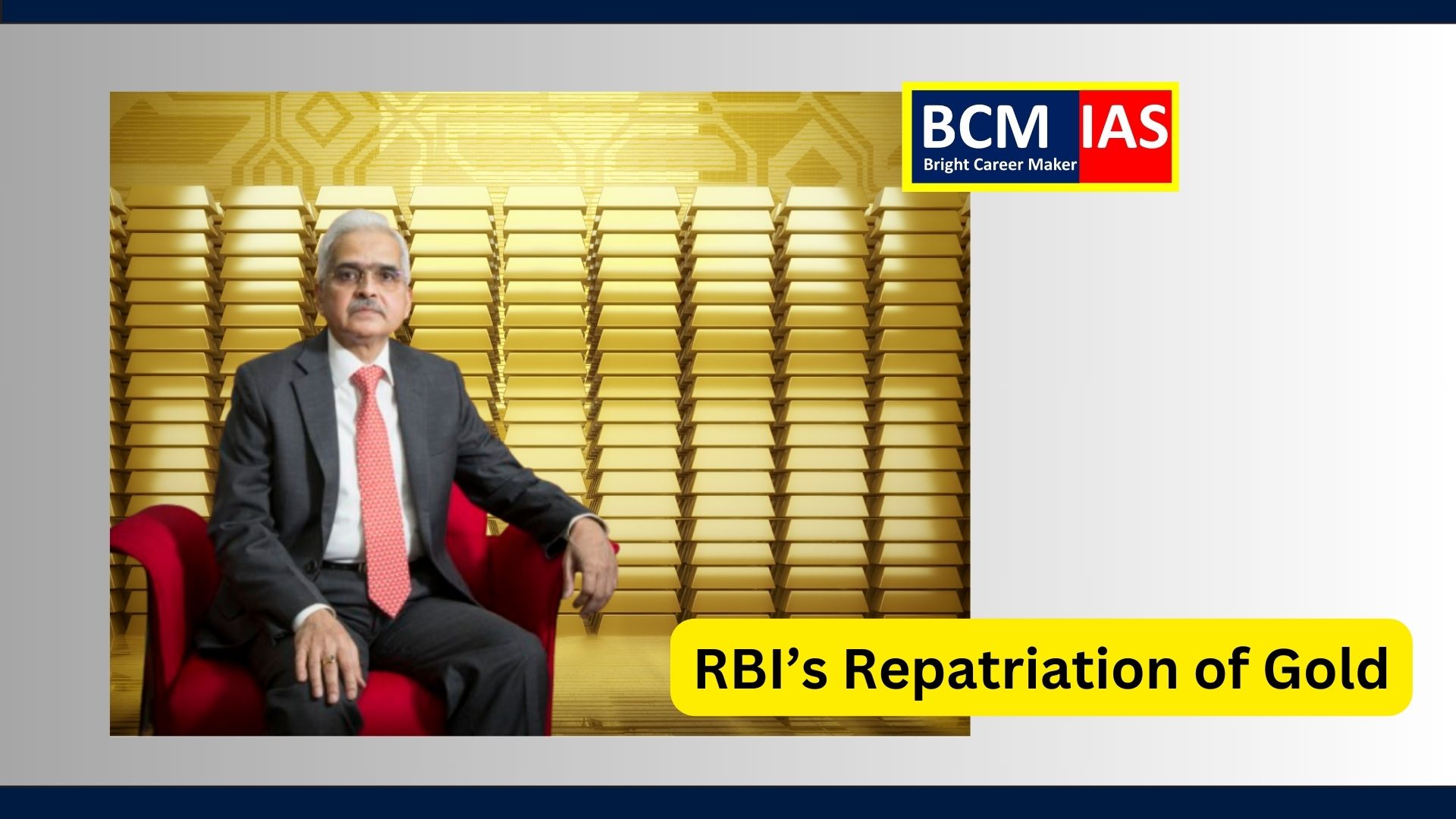
RBI’s
Repatriation of Gold
The Reserve Bank of India (RBI) recently repatriated
102 tonnes of gold from international custodians, specifically the Bank of
England (BoE) and the Bank for International Settlements (BIS). This move
signifies a shift in India’s approach toward managing its gold reserves,
prioritizing domestic control and reducing reliance on foreign vaults. Here’s
an analysis of this development and its broader implications:
Key Details
of RBI’s Gold Repatriation
1.
India’s Gold Reserves: According
to RBI’s recent report, India’s gold reserves now stand at 854.73 metric
tonnes, of which 510.46 tonnes are held domestically. India is ranked 8th
globally in sovereign gold holdings, with gold comprising 9.57% of its foreign
exchange reserves.
2.
Foreign Exchange Reserves: India’s
total foreign exchange reserves in October 2024 were USD 688.27 billion,
consisting of:
o Foreign
Currency Assets (FCA) – USD 598.24 billion
o Gold – USD
67.44 billion
o Special
Drawing Rights (SDRs) – USD 18.27 billion
o Reserve Tranche
Position (RTP) – USD 4.32 billion
3.
Global Trend of Repatriation: India’s
move reflects a broader trend among central banks repatriating gold to mitigate
geopolitical risks. For example, Venezuela, Austria, and Germany have
repatriated their gold reserves in the past decade.
Reasons for
Gold Repatriation
1.
Reducing Geopolitical Risks: Holding
gold domestically reduces the risk of foreign sanctions or restrictions that
could freeze access to gold stored abroad. For instance, Russia faced sanctions
that froze USD 300 billion in its foreign reserves, prompting other countries
to reconsider where their assets are stored.
2.
Market Confidence and Economic
Sovereignty: Gold is considered a “safe haven” asset, and holding
it domestically can enhance public confidence in financial stability.
Additionally, India’s gold reserves now exceed its external debt, strengthening
its debt repayment capacity and reinforcing economic sovereignty.
3.
Supporting Domestic Financial Markets: With more
gold stored within India, the RBI can support domestic financial products like
Sovereign Gold Bonds (SGBs), which are part of the government’s initiative to
reduce dependence on physical gold imports.
4.
Cost Savings: The RBI
incurs custodial fees, transportation costs, and insurance charges for holding
gold abroad. By repatriating a portion of its reserves, the RBI can reduce
these recurring costs.
5.
Strengthening Import Cover: India’s
foreign reserves, with the addition of domestic gold holdings, are now
sufficient to cover 11.8 months of imports, enhancing the nation’s trade
resilience.
Role of
Gold in Foreign Exchange Reserves
Gold is a vital component of India’s foreign exchange
reserves, providing stability and liquidity. Historically, gold reserves have
served as collateral for loans and financial instruments, offering a buffer in
economic crises. Holding gold in global financial centers like London and New
York has allowed India easy access to convert gold into cash during
emergencies. However, the trend of gold repatriation emphasizes the importance
of reducing reliance on foreign custodians to maintain economic resilience.
Conclusion
The RBI’s decision to repatriate gold represents
India’s commitment to economic resilience and risk management. Bringing gold
back to domestic vaults aligns with a global trend of central banks
prioritizing national control over valuable assets, reducing exposure to
international political and financial risks.
Way Forward
1.
Increase in Domestic Gold-Based Financial
Products: The RBI can leverage its domestic gold reserves to support
financial products, like gold-backed loans, that reduce the public’s reliance
on physical gold holdings.
2.
Further Diversification of Foreign
Exchange Reserves: Maintaining a balance between foreign assets and
gold holdings will ensure stability and liquidity for India’s economy,
particularly during global economic shifts.
3.
Continued Focus on Import Cover: Enhancing
foreign reserves to cover higher import months will improve India’s resilience
against trade imbalances and volatile global markets.
In summary, India’s gold repatriation is a strategic
move toward self-reliance, aiming to safeguard national assets, promote
financial stability, and reduce costs while strengthening the country's
economic foundation in uncertain global conditions.
Mains Probable Question
Mains
Question
Q. Analyze the reasons behind the Reserve Bank of
India’s recent repatriation of gold reserves from foreign custodians. Discuss
the significance of this decision for India’s economic resilience and foreign
exchange management.
Answer
Introduction
The Reserve Bank of India (RBI) recently repatriated
102 tonnes of gold from the Bank of England (BoE) and the Bank for
International Settlements (BIS). This move reflects a shift in India's approach
to managing its foreign exchange reserves, aiming to strengthen economic
sovereignty, reduce geopolitical risks, and enhance the flexibility of domestic
financial markets. India’s total gold reserves now stand at 854.73 metric
tonnes, with a significant portion held domestically.
Body
Reasons for
RBI’s Gold Repatriation
1.
Mitigating Geopolitical Risks: Holding
gold domestically minimizes exposure to foreign sanctions or restrictions,
which could potentially freeze assets held abroad. The case of Russia’s frozen
assets amid sanctions after the Ukraine crisis has underscored the need for
central banks to hold reserves within national borders.
2.
Economic Sovereignty and Confidence: Gold is
viewed as a “safe haven” asset, especially during financial instability.
Holding it domestically boosts public confidence and underscores India’s debt
repayment capacity, as India’s gold reserves now exceed 101% of its external
debt.
3.
Reducing Custodial and Transportation
Costs: Gold storage abroad incurs substantial custodial fees,
insurance costs, and transportation charges. By repatriating gold, the RBI can
cut these recurring expenses, which is a cost-effective strategy for long-term
financial management.
4.
Supporting Domestic Financial Markets: With more
gold held domestically, the RBI gains flexibility to support gold-backed
financial products like Sovereign Gold Bonds (SGBs). These products aim to
reduce the demand for physical gold imports, addressing India’s reliance on
gold imports and managing its trade deficit more effectively.
5.
Strengthening Import Cover: India’s
foreign reserves, bolstered by its domestic gold holdings, are now sufficient
to cover 11.8 months of imports. This increased import cover enhances India’s
resilience against external trade and currency shocks.
Significance
of Gold Repatriation for India’s Economic Resilience
1.
Enhanced Financial Stability: Gold
repatriation strengthens India’s financial stability by securing critical
assets within the country. This move aligns with a broader global trend where
central banks prioritize national control over reserves in response to
international uncertainties.
2.
Increased Flexibility in Forex Management: By
holding gold domestically, the RBI can deploy these reserves to manage currency
fluctuations and respond to liquidity needs more swiftly, contributing to
robust foreign exchange management.
3.
Alignment with Global Trends: Many
countries, including Venezuela, Austria, and Germany, have repatriated their
gold reserves over the past decade. India’s decision reflects a strategic
alignment with global practices to maintain control over valuable assets amidst
growing geopolitical tensions.
4.
Strengthened Debt Repayment Capacity: With gold
reserves exceeding the level of external debt, India demonstrates a strong debt
position, which may improve the country’s credit rating and reduce borrowing
costs in the global market.
Conclusion
India’s decision to repatriate gold reserves
represents a proactive approach toward securing economic sovereignty, reducing
geopolitical risks, and enhancing financial flexibility. By bringing gold back
to domestic vaults, the RBI strengthens India’s economic resilience and
positions the nation to respond effectively to global uncertainties.
Way Forward
1.
Leverage Domestic Gold Holdings for
Financial Products: RBI can utilize domestic gold reserves to support
financial instruments such as gold-backed loans and bonds, which could reduce
the public’s demand for physical gold.
2.
Further Diversification of Forex Reserves: Ensuring
a balanced mix of assets—foreign currency, gold, and SDRs—will provide India
with financial stability and sufficient liquidity to weather global market
volatility.
3.
Enhance Import Cover: Expanding
foreign exchange reserves to cover a higher number of import months would
further strengthen India’s resilience against potential external shocks and
currency fluctuations.
In conclusion, the RBI’s
repatriation of gold is a strategic step to fortify India’s economic
foundation, manage geopolitical risks, and support sustainable foreign exchange
management. This decision reinforces India’s commitment to self-reliance and
prepares the nation to better withstand global financial challenges.
MCQs for Practice
1. The Reserve
Bank of India recently repatriated 102 tonnes of gold from which of the
following institutions?
(a) Bank of America and the Federal Reserve
(b) Bank of England and Bank for International Settlements
(c) Bank of Japan and Swiss National Bank
(d) European Central Bank and Bank of Canada
Answer: (b) Bank
of England and Bank for International Settlements
2. Which of
the following is a primary reason for India’s repatriation of gold reserves?
(a) To increase public access to physical gold
(b) To reduce geopolitical and custodial risks associated with foreign holdings
(c) To promote foreign investment in gold mines abroad
(d) To increase gold export capacity
Answer: (b) To
reduce geopolitical and custodial risks associated with foreign holdings
3. In India’s
foreign exchange reserves, which of the following assets has the largest share?
(a) Gold reserves
(b) Special Drawing Rights (SDRs)
(c) Foreign Currency Assets (FCA)
(d) Reserve Tranche Position with IMF
Answer: (c)
Foreign Currency Assets (FCA)
4. India’s
total gold reserves now exceed 101% of which of the following?
(a) India’s GDP
(b) India’s external debt
(c) India’s foreign direct investment (FDI) inflows
(d) India’s forex reserves
Answer: (b)
India’s external debt
5. The recent
trend of central banks repatriating gold reserves can be seen as a response to
which of the following?
(a) Decreasing global demand for gold
(b) Lowered insurance costs for holding gold domestically
(c) Rising geopolitical tensions and risk of asset freezes abroad
(d) Declining value of gold in global markets
Answer: (c) Rising
geopolitical tensions and risk of asset freezes abroad


Comments on “RBI’s Repatriation of Gold”