


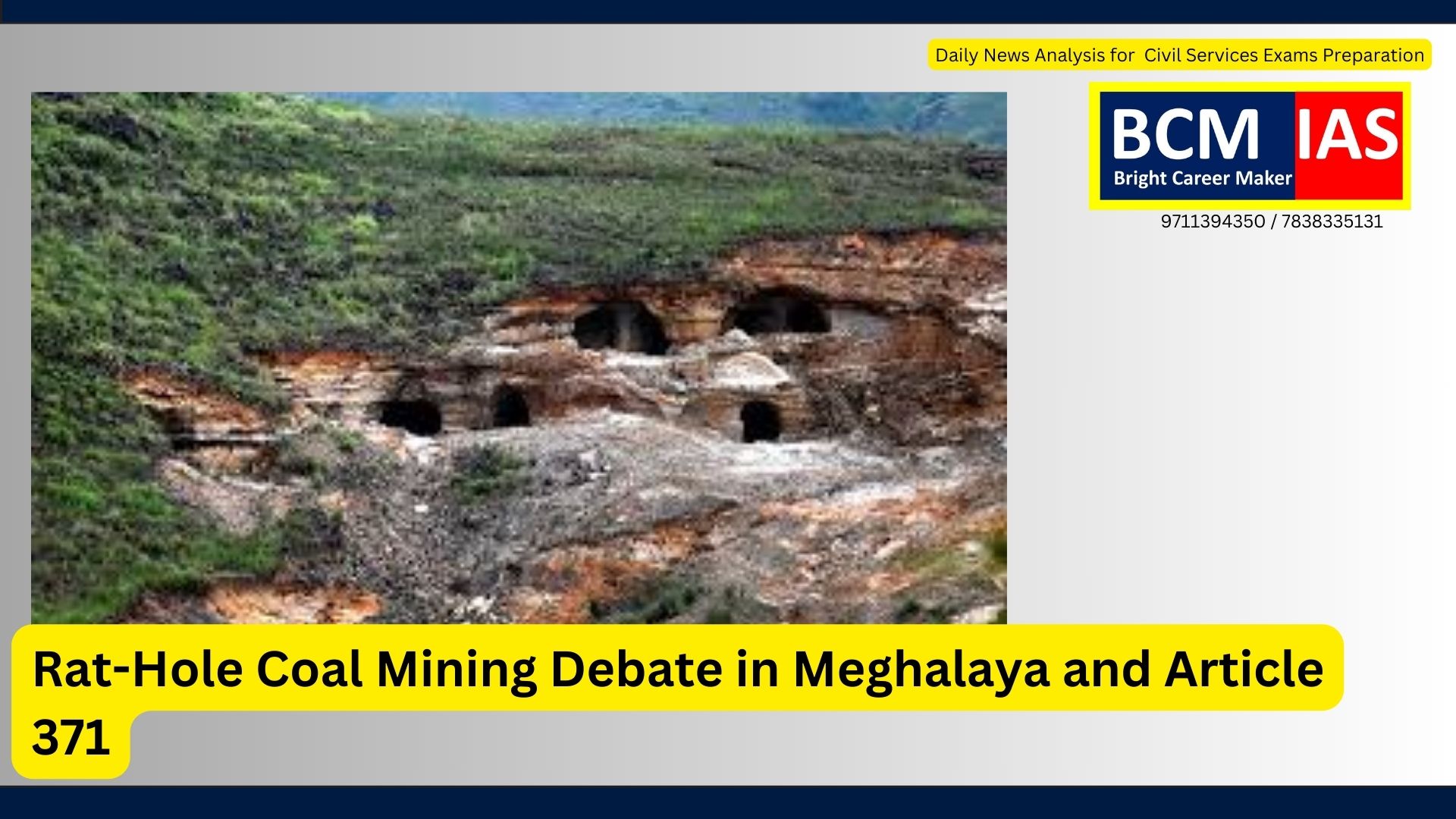
Rat-Hole Coal Mining Debate in Meghalaya
and Article 371
Introduction
Meghalaya, a northeastern state of India, has been at the
center of a controversial debate on rat-hole coal mining, an
environmentally hazardous but economically significant practice. The issue has
gained political prominence in the upcoming elections for the Khasi Hills
Autonomous District Council (KHADC) and Jaintia Hills Autonomous District
Council (JHADC), with regional parties advocating for special constitutional
provisions under Article 371 to bypass the National Green Tribunal
(NGT) ban on rat-hole mining.
This analysis delves into:
1.
What is rat-hole coal mining?
2.
Why was it banned?
3.
The relevance of Article 371 in the Meghalaya coal mining issue.
4.
The constitutional and political debate around this demand.
5.
Environmental and legal challenges.
1.
What is Rat-Hole Coal Mining?
Rat-hole mining is a method of extracting coal where narrow tunnels are dug,
often just big enough for one worker to enter and extract the coal manually. It
is widely practiced in Meghalaya, especially in the Jaintia Hills, Khasi
Hills, and West Khasi Hills districts.
Types
of Rat-Hole Mining:
- Side-cutting: Miners dig narrow horizontal
tunnels into the slopes of hills.
- Box-cutting: A vertical shaft is dug and
then tunnels are made horizontally from it.
Why
is it Preferred in Meghalaya?
- Meghalaya
has thin coal seams that are not economically viable for
large-scale open-cast mining.
- The
terrain makes mechanized mining difficult, so locals depend on this
small-scale traditional practice.
- It is
cheaper and less capital-intensive, allowing small miners to
operate.
- The
local population, particularly tribal communities, depends on coal
mining for livelihood.
2.
Why was Rat-Hole Mining Banned?
The National Green Tribunal (NGT) banned rat-hole
mining in Meghalaya in April 2014, citing:
(A)
Environmental Damage:
- Water
Contamination:
Acid mine drainage from coal mines pollutes rivers, especially the Lukha
and Kopili rivers, turning them blue and acidic.
- Deforestation
& Land Degradation: Widespread coal mining has destroyed forest cover
and agricultural land, leading to severe soil erosion.
- Loss
of Biodiversity:
Mining has disrupted ecosystems in the East Khasi Hills and Jaintia
Hills.
(B)
Human Rights & Safety Issues:
- Frequent
Accidents:
- Many
miners die due to cave-ins and flooding, with no safety measures
in place.
- The
2018 Ksan mine disaster, where 15 miners were trapped and died,
highlighted the dangers.
- Child Labor & Exploitation:
- Reports
have found that many underage laborers, including migrants from
Assam and Nepal, work in hazardous conditions.
(C)
Violation of National Mining Laws:
- Meghalaya's
coal mining was being conducted without proper environmental clearances
under the Mines and Minerals (Development and Regulation) Act, 1957
and Environmental Protection Act, 1986.
- The NGT
argued that the state government failed to regulate coal mining
properly.
3.
The Demand for Article 371 in Meghalaya
With elections approaching, the Voice of the People Party
(VPP) has raised the demand to bring Meghalaya under Article 371,
similar to Nagaland (Article 371A), to bypass the NGT ban and revive
coal mining.
What
is Article 371?
- Article
371 grants special provisions to various states for governance,
land rights, and resource control.
- Article
371A (Nagaland)
provides exclusive rights to Nagas over land and its resources,
meaning national laws like the Mines Act do not automatically apply.
Why
is VPP Citing Article 371?
- They
argue that if Nagaland can mine coal despite the NGT ban, Meghalaya
should get similar powers.
- They
claim that the Sixth Schedule (which governs Meghalaya's tribal areas) does not
offer the same level of autonomy as Article 371A.
4.
The Constitutional and Political Debate
Other political parties oppose the idea, arguing that:
1.
Article 371A and the Sixth Schedule serve different
purposes.
2.
The Sixth Schedule already empowers Meghalaya’s
Autonomous District Councils (ADCs) to regulate land and forests, but Paragraph 12A allows
state laws to override ADC laws, limiting their power.
3.
Nagaland’s Article 371A has created governance
challenges, with its
own Chief Minister acknowledging that it has made regulating illegal mining
difficult.
Thus, while the VPP and Congress want some elements of
Article 371 to be incorporated into the Sixth Schedule, other
parties argue the two provisions are not compatible.
5.
Environmental and Legal Challenges
Even if Meghalaya were granted special provisions under
Article 371:
- Rat-hole
mining would still violate national environmental laws.
- India
is bound by international climate agreements (Paris Agreement) to reduce
coal dependency.
- State-level
autonomy cannot override fundamental rights (e.g., right to a clean
environment under Article 21).
- Meghalaya
needs a scientific and regulated mining approach rather than legal
loopholes to revive mining.
6.
The Way Forward: Balancing Economy & Environment
Given the legal and ecological concerns, Meghalaya should
consider alternative approaches:
(A)
Regulated Mining Instead of Rat-Hole Mining
- Adopt
modern and scientific coal mining techniques that reduce
environmental damage.
- Implement
strict environmental safeguards and rehabilitation policies.
(B)
Diversification of Economy
- Invest
in tourism, eco-friendly industries, and skill development to reduce dependency on coal.
- Promote
alternative livelihood options for mining-dependent communities.
(C)
Strengthening Legal and Administrative Framework
- Set
up a state-level coal mining regulatory body to monitor mining
activities.
- Improve
coordination between state and central environmental agencies.
7.
Conclusion
The demand for Article 371 in Meghalaya reflects the
economic distress of coal miners and the political stakes in the elections.
However, using constitutional amendments to bypass environmental laws may
not be a sustainable solution. Instead, Meghalaya must adopt a scientific,
regulated mining policy that ensures economic growth without harming the
environment and public health. The challenge is to balance economic
aspirations with legal and ecological responsibilities.
Mains Question and
Answer
"The demand for Article 371 in
Meghalaya is seen as a strategy to bypass environmental laws and revive coal
mining. Critically analyze the constitutional, environmental, and
socio-economic implications of this demand."
Answer
Introduction
Meghalaya has witnessed a political push to bring the state under Article
371 of the Constitution to bypass the National Green
Tribunal (NGT) ban on rat-hole coal mining. The Voice of
the People Party (VPP) argues that special constitutional
provisions, similar to Article 371A of Nagaland, would
allow Meghalaya greater control over its land and mineral resources. However,
such a move raises constitutional, environmental, and
socio-economic concerns, making it a contentious issue in
governance.
1. Constitutional Aspects of the Demand for Article 371 in
Meghalaya
(A) Understanding Article 371 and Its
Variants
- Article 371 provides special provisions for certain states to
protect their social,
cultural, and economic interests.
- Article 371A
(Nagaland)
grants exclusive rights to Nagas over land
and natural resources, preventing Union laws from applying
automatically.
- Meghalaya is already protected under the Sixth Schedule, which
grants autonomy to its tribal councils.
(B) Conflict Between Article 371 and the
Sixth Schedule
- Meghalaya has Autonomous District Councils (ADCs) under the Sixth Schedule, with powers over land, forests, and minerals.
- However, Paragraph 12A of the Sixth Schedule allows state laws to
override district council laws, limiting their autonomy.
- If Meghalaya gets Article 371-like powers, it could undermine the existing Sixth Schedule framework
and create legal inconsistencies.
(C) Legal Challenges to Article 371 in
the Context of Mining
- Even if Meghalaya gets Article 371A-like status, it cannot override national environmental laws
like:
- Mines and
Minerals (Development and Regulation) Act, 1957
- Environmental
Protection Act, 1986
- Forest
Conservation Act, 1980
- The NGT and
Supreme Court’s rulings
- Thus, Article 371 will not legally permit rat-hole mining unless new
state-level laws are framed in compliance with national policies.
2. Environmental Implications of Resuming Rat-Hole Mining
(A) Severe Ecological Degradation
- Water
Pollution:
Acid mine drainage from rat-hole mines contaminates rivers like Lukha and Kopili, making them toxic and turning them blue.
- Deforestation: Large-scale mining has led to loss of forest cover, affecting biodiversity and climate regulation.
- Soil Erosion: Mining destabilizes land,
leading to landslides and loss of agricultural
productivity.
(B) Violation of Climate Commitments
- India has pledged to reduce its reliance on fossil fuels under
the Paris Agreement.
- Allowing rat-hole mining goes against India’s commitment to a low-carbon future.
- Meghalaya’s coal is highly polluting due to high sulfur
content, worsening air quality.
(C) Risk to Human Health and Safety
- Cave-in
accidents
are common in rat-hole mines, often trapping and killing miners.
- 2018 Ksan Mine
Disaster:
15 miners died due to flooding in an illegal mine.
- Toxic exposure causes lung diseases, skin ailments, and other respiratory issues
among miners.
3. Socio-Economic Implications of the Article 371 Demand
(A) Economic Benefits of Coal Mining
- Coal mining directly supports thousands of families in Meghalaya,
particularly in Khasi and
Jaintia Hills.
- Small-scale
coal mining is a major income source for the tribal population.
- Mining contributes to state revenue, helping fund development projects.
(B) Challenges in Regulating Mining
- The NGT ban was imposed because Meghalaya failed
to implement environmental safeguards.
- Illegal mining
networks
continue despite the ban, leading to
loss of state revenue and exploitation
of laborers.
(C) Lack of Alternative Livelihoods
- Without mining, many former miners struggle for employment,
increasing economic distress in rural areas.
- The state needs policies to transition workers to other industries,
such as eco-tourism, agriculture, and skill-based
employment.
4. Way Forward: Balancing Economic Growth and Environmental
Protection
(A) Scientific and Regulated Mining
Instead of Rat-Hole Mining
- Meghalaya must develop a sustainable coal policy, ensuring:
- Scientific
extraction techniques to minimize ecological damage.
- Environmental
impact assessments before granting mining licenses.
- Mine safety
measures to prevent accidents.
(B) Strengthening Governance and
Monitoring
- Strict
enforcement of mining regulations to prevent illegal operations.
- Set up a state-level coal mining regulatory body for
monitoring and compliance.
- Use of
technology
like satellite imaging and drones to track illegal mining activities.
(C) Diversification of Economy and
Alternative Livelihoods
- Promote
eco-tourism and sustainable agriculture in tribal areas.
- Invest in skill training programs to help former miners
transition to other jobs.
- Encourage industries like bamboo processing, handicrafts, and food
processing to reduce coal dependency.
5. Conclusion
The demand for Article 371 in Meghalaya reflects economic
concerns over the NGT mining ban. However, bypassing environmental laws
through constitutional amendments is neither legally nor environmentally
sustainable. Instead, Meghalaya should adopt scientific and regulated
mining, strengthen governance, and diversify economic
opportunities to ensure both economic growth and environmental
conservation. The challenge lies in finding a sustainable balance
between livelihood security and ecological responsibility.
MCQs for Practice-
1. Consider the following statements regarding Rat-Hole Mining:
1.
It is a mining technique in which narrow tunnels are
dug manually to extract coal.
2.
It is predominantly practiced in Meghalaya due to its
unique geological conditions.
3.
Rat-hole mining is considered an environmentally
sustainable method of coal extraction.
Which of the statements given above is/are correct?
(a) 1 and 2 only
(b) 1 and 3 only
(c) 2 and 3 only
(d) 1, 2, and 3
Answer:
(a) 1 and 2 only
Explanation: Rat-hole
mining involves manually digging narrow tunnels to extract coal and is prevalent
in Meghalaya due to its thin coal seams and hilly terrain. However, it is
not an environmentally sustainable method as it
causes severe water and soil pollution.
2. With reference to the Sixth Schedule of the Indian Constitution,
consider the following statements:
1.
It provides for the creation of Autonomous District
Councils (ADCs) in certain northeastern states.
2.
ADCs have the power to legislate on matters related to
land, forests, and customary practices.
3.
The laws made by the ADCs cannot be overridden by
state laws under any circumstances.
Which of the statements given above is/are correct?
(a) 1 and 2 only
(b) 2 and 3 only
(c) 1 and 3 only
(d) 1, 2, and 3
Answer:
(a) 1 and 2 only
Explanation: The Sixth
Schedule provides for Autonomous District Councils (ADCs) in Assam,
Meghalaya, Tripura, and Mizoram with the power to legislate on land,
forests, and customary laws. However, Paragraph
12A of the Sixth Schedule allows state laws to override ADC laws, making
Statement 3 incorrect.
3. Which of the following statements regarding Article 371 and its
special provisions is correct?
(a) Article 371 provides uniform special provisions to all
northeastern states.
(b) Article 371A grants Nagaland exclusive rights over its land and natural
resources.
(c) Article 371C grants Arunachal Pradesh the power to regulate its land use
and customary laws.
(d) Article 371D provides special protections for the economic interests of
tribal communities in Meghalaya.
Answer:
(b) Article 371A grants Nagaland exclusive rights over its land and natural
resources.
Explanation: Article
371A grants Nagaland special rights over its land,
resources, and customary practices. Article 371C
applies to Manipur, and 371D applies to Andhra Pradesh
and Telangana. Meghalaya is not covered under Article 371 but under
the Sixth Schedule.
4. Consider the following environmental concerns related to
Rat-Hole Mining in Meghalaya:
1.
Acid mine drainage pollutes local rivers and
groundwater sources.
2.
Deforestation and land degradation lead to soil
erosion and loss of biodiversity.
3.
The method ensures minimal waste generation, making it
a sustainable mining practice.
Which of the statements given above is/are correct?
(a) 1 and 2 only
(b) 2 and 3 only
(c) 1 and 3 only
(d) 1, 2, and 3
Answer:
(a) 1 and 2 only
Explanation: Rat-hole
mining leads to acid mine drainage, soil erosion, deforestation, and loss of
biodiversity, but it does not ensure minimal waste generation or
sustainability. Statement 3 is incorrect.
5. Which of the following organizations is responsible for
regulating environmental impact assessments (EIA) in India?
(a) National Biodiversity Authority (NBA)
(b) Ministry of Environment, Forest and Climate Change (MoEFCC)
(c) Central Ground Water Board (CGWB)
(d) Geological Survey of India (GSI)
Answer:
(b) Ministry of Environment, Forest and Climate Change (MoEFCC)
Explanation: The MoEFCC is
responsible for implementing the Environmental Impact Assessment (EIA)
regulations under the Environment Protection Act, 1986, which also
applies to coal mining activities in Meghalaya.


Comments on “Rat-Hole Coal Mining Debate in Meghalaya and Article 371”