


Daily Current Affairs Analysis
14 June 2024
-------------------------------------------------------------------------------------------------------------
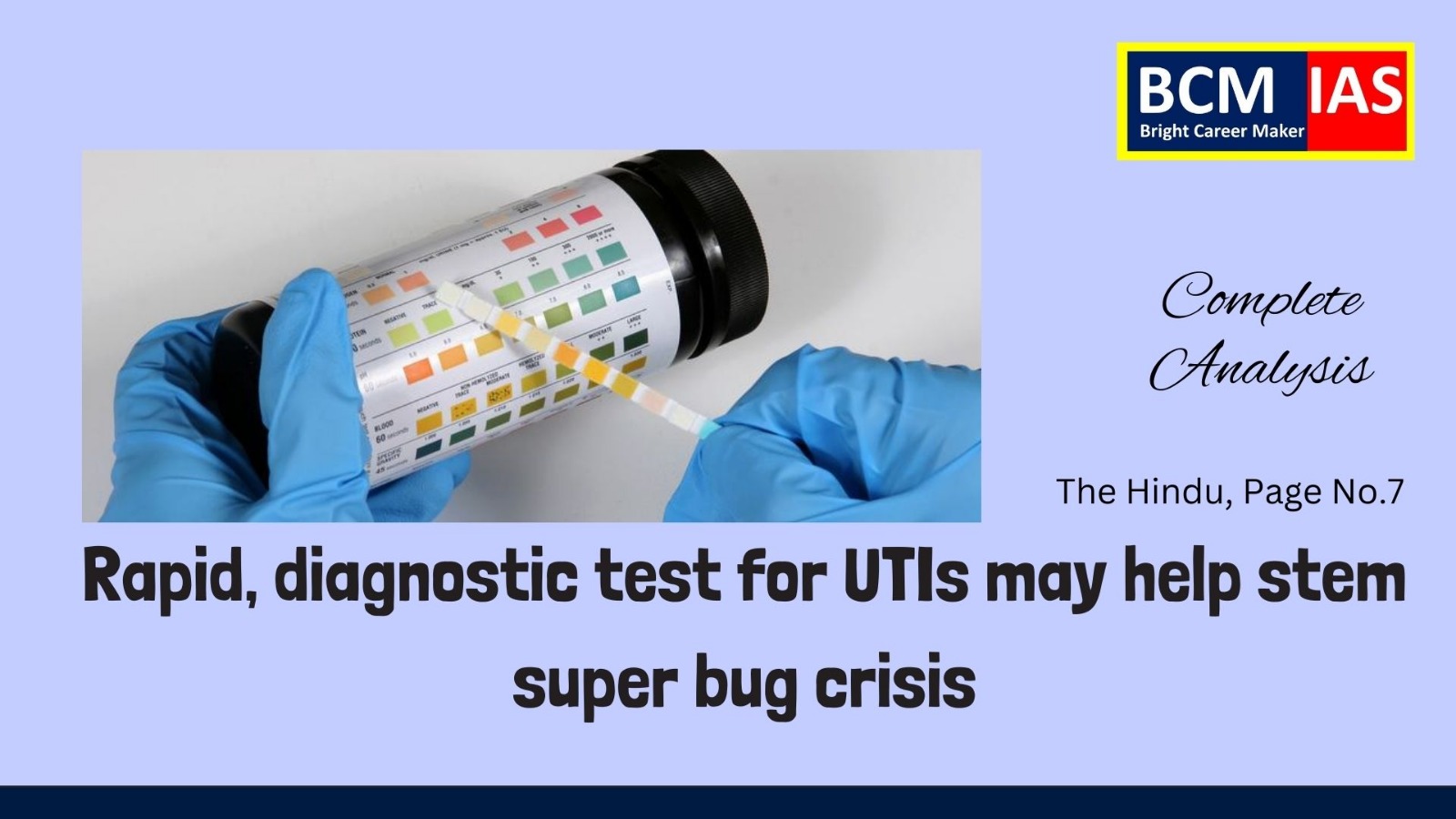
Rapid, diagnostic test for UTIs may help stem super
bug crisis
Meaning of Headline-
·
The headline refers to the development of a new diagnostic test for
urinary tract infections (UTIs) that is both rapid and accurate.
·
This test is significant because it can help in identifying the
appropriate antibiotics quickly, thereby reducing the misuse or overuse of
antibiotics.
·
This is crucial in combating the rise of antibiotic-resistant
bacteria, often referred to as "superbugs."
Related Topic (as per UPSC
Syllabus)
Prelims:
- Science and
Technology:
o
Recent developments and their applications and effects
in everyday life.
o
Awareness in the fields of IT, Space, Computers,
robotics, nano-technology, bio-technology, and issues relating to intellectual
property rights.
Mains:
- General Studies
Paper II:
o
Government policies and interventions
for development in various sectors and issues arising out of their design and
implementation.
§
This includes public health policies and initiatives
to combat antimicrobial resistance.
- General Studies
Paper III:
o
Science and Technology:
§
Developments and their applications and effects in
everyday life.
§
Achievements of Indians in science & technology;
indigenization of technology and developing new technology.
§
Awareness in the fields of biotechnology, issues
relating to intellectual property rights.
o
Health:
§
Issues relating to development and management of
Social Sector/Services relating to Health, Education, Human Resources.
§
Awareness in the fields of Biotechnology.
Interview:
- Current Affairs
and Issues of National and International Importance:
o
The candidate should be aware of recent technological
advancements, especially those with significant implications for public health
and policy.
o
Discussion on strategies to combat antimicrobial
resistance and the role of innovative diagnostic tools in public health.
News
Analysis
Introduction:
The article discusses the development of a
rapid diagnostic test for urinary tract infections (UTIs), which has won the
Longitude Prize. This innovation promises to revolutionize the management of
infections and address the global crisis of antimicrobial resistance (AMR).
Body:
Key Points:
1. Longitude
Prize and the PA-100 AST System:
o
The PA-100 AST System by Sysmex Astrego won the
Longitude Prize, an award aimed at tackling AMR.
o
This system is designed to quickly identify the
bacteria causing UTIs and determine the most effective antibiotic for
treatment.
2. Significance
of Rapid Diagnostics:
o
The accurate and rapid diagnosis of bacterial
infections is critical for prescribing the right antibiotics.
o
Traditional methods of diagnosing UTIs can take up to
2-3 days, but the PA-100 AST System can provide results within 45 minutes.
3. Impact on
Antimicrobial Resistance:
o
Misuse and overuse of antibiotics are primary
contributors to the development of AMR.
o
Rapid and accurate diagnostics help reduce unnecessary
antibiotic prescriptions, slowing down the spread of resistant bacteria.
4. Global
Health Implications:
o
Antibiotic-resistant infections killed nearly 1.3
million people globally in 2019, with projections suggesting this could rise to
10 million deaths per year by 2050.
o
The economic impact of AMR could reach up to $100
trillion by 2050.
5. Advantages
of the PA-100 AST System:
o
The test is quick, affordable, and can be performed at
the point of care, reducing the need for laboratory analysis.
o
It is especially beneficial in countries with limited
access to advanced medical facilities.
6. The
Longitude Prize's Role:
o
The Longitude Prize, inspired by a historical
competition to solve navigational problems at sea, was launched to find
innovative solutions to major global challenges.
o
The prize incentivizes the creation of a rapid
diagnostic test for bacterial infections to combat AMR.
7. Potential
Benefits for Patients and Healthcare Systems:
o
Millions of people suffer from UTIs annually, leading
to significant health care costs and patient suffering.
o
Rapid testing allows for appropriate treatment,
reducing the risk of complications and the spread of resistance.
Conclusion:
The development of the PA-100 AST System
and its recognition by the Longitude Prize mark a significant milestone in the
fight against antimicrobial resistance. By providing a quick, accurate, and
affordable diagnostic tool, this innovation has the potential to save millions
of lives and reduce the global economic burden of AMR. The focus now shifts to
the widespread implementation and use of this technology to achieve its full
impact.

Mains Probable Question
"Discuss the significance of rapid
diagnostic tests in combating antimicrobial resistance and improving public
health outcomes."
Answer
1.
Introduction
Antimicrobial resistance (AMR) is a growing global health concern,
threatening the effective treatment of an ever-increasing range of infections
caused by bacteria, parasites, viruses, and fungi. The misuse and overuse of
antibiotics are major factors contributing to the rise of drug-resistant
pathogens. Rapid diagnostic tests (RDTs) for infections, such as urinary tract
infections (UTIs), represent a transformative approach in the fight against
AMR. These tests promise to revolutionize infection management by ensuring the
appropriate use of antibiotics, thus preserving their efficacy for future
generations. The recent development of the PA-100 AST System, a rapid
point-of-care test for UTIs, exemplifies the potential impact of such
innovations.
2. Demand of
the Question
a. Significance of Rapid Diagnostic Tests
Rapid diagnostic tests are crucial in identifying infections quickly and
accurately. Traditional methods of diagnosing bacterial infections often
involve culturing samples in a laboratory, which can take several days. In
contrast, RDTs can provide results within minutes to hours. This speed is
critical for timely and appropriate medical interventions. For instance, the
PA-100 AST System can deliver results in 45 minutes, compared to the 2-3 days
required by conventional methods. Early and accurate diagnosis helps
healthcare providers prescribe the correct antibiotics, reducing unnecessary
usage and the risk of developing resistant strains.
b. Impact on Antimicrobial Resistance
By ensuring that antibiotics are only prescribed when necessary and that
the right antibiotics are chosen, RDTs help in slowing the spread of
antibiotic resistance. Antibiotic resistance occurs when bacteria evolve
mechanisms to resist the effects of drugs designed to kill them. This
resistance can spread rapidly, rendering common treatments ineffective. The
precision of RDTs in identifying the causative agent of infections and
determining its susceptibility to specific antibiotics is a significant
advantage in this regard. The PA-100 AST System's ability to provide accurate
susceptibility testing directly addresses this challenge, making it a valuable
tool in public health.
c. Benefits for Public Health Outcomes
The implementation of rapid diagnostic tests has far-reaching
implications for public health. First, they enhance the effectiveness of
infection management by enabling prompt and appropriate treatment. Second,
by reducing the misuse of antibiotics, RDTs contribute to the sustainability
of antimicrobial agents, ensuring they remain effective for longer periods.
Third, widespread use of RDTs can lead to better health outcomes by decreasing
the incidence of severe complications from infections due to timely treatment.
Moreover, these tests can help in lowering healthcare costs by
minimizing unnecessary treatments and reducing the length of hospital stays.
d. Technological and Logistical
Considerations
The development and deployment of RDTs like the PA-100 AST System
require addressing several technological and logistical challenges. These
include ensuring the accuracy and reliability of tests, making them affordable
and accessible, especially in low-resource settings, and integrating them
into existing healthcare systems. Training healthcare professionals in the use
of these new technologies is also crucial for their successful implementation.
3. Way
Forward
a. Strengthening Research and Development
Investing in the research and development of new and improved
rapid diagnostic tests is essential. This includes not only advancing the
technology behind these tests but also understanding the pathogens they are
designed to detect. Governments, academic institutions, and private sector
players should collaborate to foster innovation in this field.
b. Enhancing Accessibility and Affordability
For RDTs to make a significant impact, they must be accessible and
affordable to a wide range of populations, especially in low- and
middle-income countries where the burden of infectious diseases and antibiotic
resistance is often higher. Policies and subsidies that lower the cost of these
tests can play a crucial role.
c. Integrating RDTs into Healthcare Systems
Effective integration of RDTs into healthcare systems requires
coordinated efforts. Training healthcare providers to use these tests
accurately, establishing protocols for their use, and ensuring that healthcare
facilities are equipped with the necessary infrastructure are key steps. This
integration should be accompanied by public health campaigns to raise awareness
about the importance of appropriate antibiotic use.
d. Promoting Stewardship Programs
Antibiotic stewardship programs are
essential to ensure that antibiotics are used responsibly. These programs
should promote the use of RDTs as a standard practice in diagnosing infections.
By doing so, they can help maintain the effectiveness of existing antibiotics
and delay the emergence of resistance.
e. Global Cooperation and Policy Making
Addressing AMR is a global challenge that requires international
cooperation. Countries should work together to share data, research findings,
and best practices related to the use of RDTs and the management of antibiotic
resistance. Global health organizations such as the World Health
Organization (WHO) can play a pivotal role in coordinating these efforts and
setting international standards.
f. Continuous Monitoring and Evaluation
The impact of RDTs on AMR and public health should be continuously monitored
and evaluated. This includes tracking their usage, effectiveness, and any
changes in patterns of antibiotic resistance. Data gathered from these
evaluations can inform policy decisions and guide future research and
development efforts.
g. Encouraging Innovation through Incentives
To stimulate the development of new RDTs and other technologies that
combat AMR, incentives and funding opportunities should be provided to
researchers and companies. Prizes, grants, and other forms of support can
encourage innovation and bring new solutions to the market faster.
In conclusion, rapid diagnostic tests like the PA-100 AST System hold
great promise in the fight against antimicrobial resistance and the improvement
of public health outcomes. By ensuring accurate and timely diagnosis, they
enable appropriate antibiotic use, reduce the spread of resistant strains, and
enhance the overall effectiveness of infection management. Continued
investment, global cooperation, and strategic policy implementation are
crucial to fully realize the potential of these technologies and safeguard
public health for future generations.
MCQs for Prelims Practice
1- What is
the primary benefit of the PA-100 AST System in combating antimicrobial
resistance?
- a) It
can diagnose viral infections.
- b) It
can identify the specific bacteria causing the infection and the
appropriate antibiotic within 45 minutes.
- c) It is
cheaper than traditional diagnostic tests.
- d) It
can be used without any medical training.
Answer: b) It can identify the specific
bacteria causing the infection and the appropriate antibiotic within 45
minutes.
2- The
Longitude Prize mentioned in the article is awarded for:
- a)
Innovations in space technology.
- b)
Discoveries in quantum physics.
- c)
Advances in antimicrobial resistance solutions.
- d)
Achievements in environmental conservation.
Answer: c) Advances in antimicrobial
resistance solutions.
3- How does
the PA-100 AST System help in reducing the misuse of antibiotics?
- a) By
increasing the cost of antibiotics.
- b) By
providing rapid and accurate diagnosis, allowing for the correct
antibiotic to be prescribed.
- c) By
promoting the use of herbal medicines.
- d) By
banning the use of broad-spectrum antibiotics.
Answer: b) By providing rapid and accurate
diagnosis, allowing for the correct antibiotic to be prescribed.
4- According
to the article, what is the estimated global economic loss due to
antibiotic-resistant infections by 2050?
- a) $1
trillion
- b) $10
trillion
- c) $100
trillion
- d) $4
trillion
Answer: c) $100 trillion
5- What is a
major limitation of traditional dipstick tests for urinary tract infections
(UTIs) as mentioned in the article?
- a) They
are very expensive.
- b) They
take too long to provide results.
- c) They
have an accuracy of only 50-60%.
- d) They
require sophisticated laboratory equipment.
Answer: c) They have an accuracy of only 50-60%.

Other Important Links
|
|
Follow us on-
|
|
ADMISSIONS OPEN For Details, Contact
us- 9711394350 / 9717724350 |
|


Comments on “Rapid, diagnostic test for UTIs may help stem super bug crisis”