


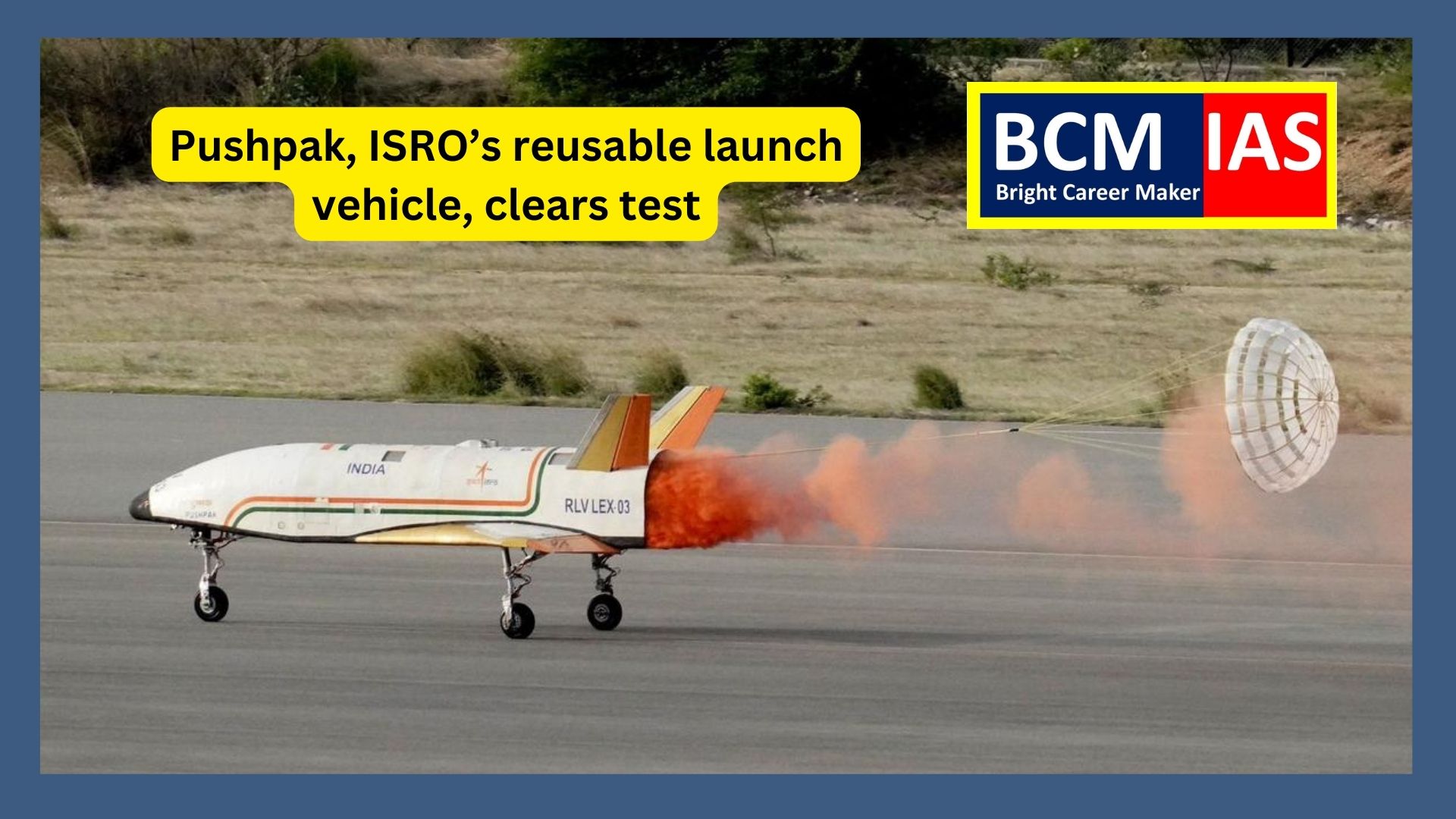
Pushpak, ISRO’s reusable launch
vehicle, clears test
Science
& Technology
Analysis and Explanation of the News
Introduction
The Indian Space Research Organisation (ISRO) has achieved a
significant milestone with the successful completion of the third reusable
launch vehicle landing experiment (RLV LEX). This experiment was conducted at
the Aeronautical Test Range in Chitradurga, Karnataka, and marks a critical
advancement in ISRO’s efforts to develop reusable launch vehicle (RLV)
technology. The experiment demonstrated the autonomous landing capability of
the vehicle under challenging conditions, showcasing the robustness and precision
of the technology developed by ISRO.
Key Highlights of the Experiment
1.
Successful Completion of RLV LEX-03:
o The experiment
was conducted at 7.10 a.m. on a Sunday morning.
o This was the
third and final test in a series aimed at validating the autonomous landing
capabilities of the RLV.
o The vehicle,
named Pushpak, was released from an Indian Air Force Chinook helicopter at an
altitude of 4.5 km.
2.
Autonomous Landing and Performance:
o Pushpak
autonomously executed cross-range correction manoeuvres, approached the runway,
and performed a precise horizontal landing at the runway centerline.
o The landing was
achieved under more challenging release and severe wind conditions compared to
previous tests.
3.
Technical Specifications and Performance:
o The vehicle’s
aerodynamic configuration, characterized by a low lift-to-drag ratio, resulted
in a landing velocity exceeding 320 kmph.
o For comparison,
commercial aircraft typically land at around 260 kmph, and fighter aircraft at
around 280 kmph.
o After touchdown,
the vehicle's velocity was reduced to nearly 100 kmph using a brake parachute,
followed by the application of landing gear brakes for further deceleration.
o Pushpak utilized
its rudder and nose-wheel steering system to maintain stability and precision
during the ground roll phase.
4.
Technological Validation and Reusability:
o The mission
simulated the high-speed landing conditions and approach interface for a
vehicle returning from space.
o This reaffirmed
ISRO’s expertise in critical technologies required for developing an RLV.
o An advanced
guidance algorithm for correcting longitudinal and lateral plane errors,
essential for future orbital re-entry missions, was validated.
o The LEX-03
mission reused the winged body and flight systems from the previous LEX-02
mission without any modifications, demonstrating the robustness and reusability
of ISRO’s design.
5.
Technological Tools and Sensors:
o The experiment
employed various sensors, including an inertial sensor, radar altimeter, flush
air data system, and NavIC (Navigation with Indian Constellation).
o These sensors
were crucial for ensuring the precision and autonomy of the landing process.
Significance and Future Implications
1.
Advancement in Reusable Launch Vehicle Technology:
o The successful
completion of RLV LEX-03 is a major step forward in developing reusable launch
vehicles.
o Reusable launch
technology can significantly reduce the cost of access to space by allowing the
same vehicle to be used multiple times.
2.
Validation of Critical Technologies:
o The experiment
validated advanced guidance algorithms and high-speed landing techniques, which
are essential for future missions involving orbital re-entry.
o The reuse of
flight systems from previous missions without modifications demonstrates the
reliability and efficiency of the technology.
3.
ISRO’s Growing Expertise and Confidence:
o Consistent
success in these experiments boosts ISRO’s confidence in handling critical
technologies for future space missions.
o ISRO’s ability
to autonomously land reusable vehicles paves the way for more complex and
cost-effective space missions in the future.
Conclusion
The successful completion of the RLV LEX-03 experiment by
ISRO marks a significant milestone in the development of reusable launch
vehicle technology. This achievement not only showcases ISRO’s technological
prowess but also lays the foundation for more cost-effective and sustainable
space missions. The advancements validated in this experiment are crucial for
future orbital re-entry missions, positioning ISRO as a formidable player in
the global space arena.
MCQs
Question 1
What was the altitude at which Pushpak was released during
the RLV LEX-03 experiment?
A. 2.5 km
B. 3.5 km
C. 4.5 km
D. 5.5 km
Answer: C. 4.5 km
Question 2
Which aircraft was used to release Pushpak for the RLV LEX-03
experiment?
A. Boeing 747
B. Indian Air Force Chinook helicopter
C. HAL Tejas
D. ISRO's PSLV
Answer: B. Indian Air Force Chinook helicopter
Question 3
What was the landing velocity of Pushpak during the RLV
LEX-03 experiment?
A. 220 kmph
B. 260 kmph
C. 280 kmph
D. 320 kmph
Answer: D. 320 kmph
Question 4
Which system was used to reduce the velocity of Pushpak after
touchdown?
A. Reverse thrust
B. Brake parachute
C. Rocket boosters
D. Air brakes
Answer: B. Brake parachute
Question 5
What type of guidance algorithm was validated during the RLV
LEX-03 mission?
A. Vertical plane error correction
B. Longitudinal and lateral plane error corrections
C. Horizontal plane error correction
D. Circular plane error correction
Answer: B. Longitudinal and lateral plane error corrections
Mains Practice Qn
Discuss the significance of ISRO’s successful
completion of the third reusable launch vehicle landing experiment (RLV
LEX-03). How does this achievement contribute to the future of space
exploration and technology?
Answer
Introduction
The Indian Space Research Organisation (ISRO) recently marked
a significant milestone by successfully completing the third reusable launch
vehicle landing experiment (RLV LEX-03) at the Aeronautical Test Range in
Chitradurga, Karnataka. This experiment demonstrated the autonomous landing
capability of the reusable launch vehicle, Pushpak, under challenging
conditions. This accomplishment is a pivotal step toward advancing reusable
space technology, which promises to revolutionize space exploration by making
it more cost-effective and sustainable.
Significance of RLV LEX-03
1.
Validation of Autonomous Landing Technology:
o The RLV LEX-03
experiment validated the autonomous landing capabilities of Pushpak. This
includes the ability to perform cross-range correction maneuvers, approach the
runway accurately, and execute a precise horizontal landing.
o This technology
is crucial for future missions involving reusable vehicles, as it ensures safe
and reliable landings without manual intervention.
2.
Technological Advancements:
o The successful
landing under more challenging release conditions and severe wind conditions
demonstrates the robustness of ISRO's technology.
o The advanced
guidance algorithm for correcting longitudinal and lateral plane errors was
validated, which is essential for future orbital re-entry missions.
3.
Cost-Effectiveness and Sustainability:
o Reusable launch
vehicles significantly reduce the cost of space missions by allowing the same
vehicle to be used multiple times. This is a departure from the traditional
single-use rockets, which are more expensive and less sustainable.
o The reuse of the
winged body and flight systems from the previous LEX-02 mission without
modifications highlights the durability and reliability of ISRO’s design,
further enhancing cost savings.
4.
Enhanced Capabilities for Future Missions:
o The success of
RLV LEX-03 boosts ISRO’s confidence in handling critical technologies essential
for more complex space missions. This includes future missions involving
orbital re-entry and the development of more advanced reusable launch systems.
o The ability to
autonomously land vehicles returning from space is a significant step toward
the goal of developing fully reusable launch vehicles, which can support a wide
range of space missions, including satellite deployment, space tourism, and
interplanetary exploration.
Contributions to the Future of Space
Exploration
1.
Paving the Way for Advanced Space Missions:
o The development
of reusable launch vehicles like Pushpak is essential for the future of space
exploration. These vehicles can undertake multiple missions, reducing the
turnaround time between launches and increasing the frequency of missions.
o This capability
is critical for ambitious projects such as establishing permanent human
presence on the Moon or Mars, where repeated and reliable access to space is
required.
2.
Global Competitiveness:
o With the
successful demonstration of reusable launch technology, ISRO joins the ranks of
a few elite space agencies globally, such as NASA and SpaceX, that are
developing similar technologies.
o This enhances
India's position in the global space industry, attracting international
collaborations and commercial opportunities.
3.
Stimulating Technological Innovation:
o The success of
RLV LEX-03 encourages further research and development in related technologies,
including advanced materials, propulsion systems, and autonomous navigation.
o It stimulates
innovation within the Indian scientific community and fosters the development
of a robust ecosystem supporting space technology advancements.
4.
Environmental and Economic Benefits:
o Reusable launch
vehicles offer environmental benefits by reducing space debris and minimizing
the environmental impact of manufacturing and launching new rockets for each
mission.
o Economically,
the reduced cost of access to space opens up opportunities for smaller
companies and startups to enter the space sector, fostering economic growth and
technological advancement.
Conclusion
The successful completion of the RLV LEX-03 experiment by
ISRO is a landmark achievement in the field of space technology. It validates
critical autonomous landing capabilities and paves the way for more
cost-effective and sustainable space missions. This milestone not only enhances
ISRO’s technological prowess but also contributes significantly to the future
of space exploration, positioning India as a key player in the global space
industry. The advancements achieved through this experiment promise to revolutionize
space exploration, making it more accessible, sustainable, and economically
viable.


Comments on “Pushpak, ISRO’s reusable launch vehicle, clears test”