


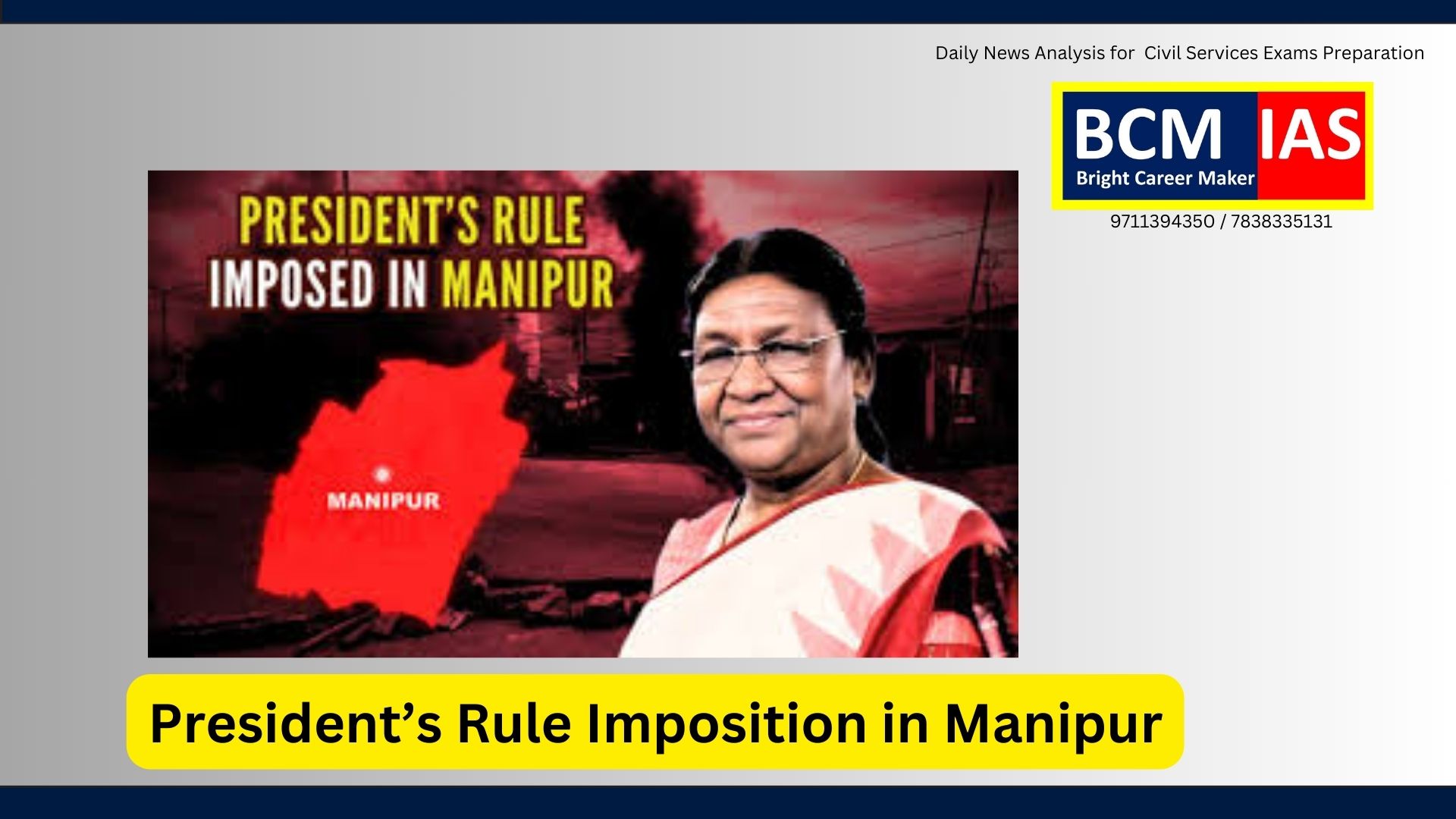
President’s
Rule Imposition in Manipur
The recent imposition of President’s
Rule (PR) in Manipur is a significant political and
constitutional event. This decision was taken following the resignation of
Chief Minister N. Biren Singh
amidst the ongoing ethnic conflict in the state. Below is a structured
breakdown of the situation, covering the constitutional, political, and
security aspects.
1. Constitutional Basis of President’s
Rule in Manipur
1.1. Article 356 of the Indian Constitution
President’s Rule has been imposed under Article
356, which allows the President of India to
take over the governance of a state if the constitutional machinery fails.
1.1.1. Conditions for Invoking Article
356
- If
the Governor reports to the President
that governance in the state cannot
be carried on in accordance with the Constitution.
- If
there is a failure
of the constitutional machinery in the state.
- If
the state fails to
comply with Union government directives.
1.2. Governor’s Report and Presidential
Proclamation
- Manipur
Governor Ajay Kumar Bhalla submitted a report
recommending PR.
- President
Droupadi Murmu acted on this report and issued
the proclamation.
- As
per Article 356(3),
this proclamation must be approved
by both Houses of Parliament within two months, or it will
cease to operate.
2. Political Background: Why Was PR
Imposed?
2.1. Resignation of CM N. Biren Singh
- The
political crisis
in Manipur worsened after Biren
Singh resigned on February
9, 2024.
- The
BJP leadership in
the state failed to reach a consensus on a new CM.
- Due
to the inability to form an alternative government, the Governor
recommended President’s Rule.
2.2. Failure of State Administration
- Manipur
has been in a state of ethnic
violence and unrest since May 3, 2023.
- The
state
administration failed to control the situation, leading to
massive internal displacement and loss of life.
2.3. BJP’s Internal Struggle
- The
BJP high command
was unable to decide on a replacement
for Biren Singh.
- With
no alternative leader emerging, governance became ineffective.
- The
central government had to step
in and impose PR to restore order.
3. The Ethnic Conflict and Security
Crisis
3.1. Timeline of Violence
- On
May 3, 2023,
large-scale violence broke out between the Kuki-Zo tribes (tribal communities)
and Meitei people
(dominant group in Imphal Valley).
- The
violence was ethnic
in nature and led to:
- Over
250 deaths.
- Displacement
of around 60,000 people.
- Massive
damage to property, villages, and state infrastructure.
3.2. Role of Illegal Immigration &
Border Issues
- Former
CM Biren Singh
highlighted the issue of illegal immigration.
- He
blamed the
unregulated Indo-Myanmar border (398 km long) and the Free Movement Regime (FMR).
- According
to Singh, illegal immigration was changing
the demographic balance of Manipur.
3.3. Law and Order Breakdown
- The
violence was exacerbated by the failure
of security forces to control the situation.
- The
state government
struggled to maintain order, which justified the
imposition of PR.
4. Immediate Effects of President’s Rule
4.1. Suspension of the State Assembly
- The
Manipur Legislative
Assembly is under suspended animation, meaning:
- The
assembly is not
dissolved, but its powers are frozen.
- It
can be revived if
normalcy is restored.
- No
new laws can be passed at the state level.
- Executive
power is now with the President, acting through the Governor.
4.2. Administration by the Union
Government
- Governor
becomes the de facto executive head.
- Union
Home Ministry (MHA) directly governs the state.
- IAS
and IPS officers report to the Centre.
- Any
new policies or governance measures will be taken by the central government.
5. Political Reactions &
Implications
5.1. BJP’s Dilemma
- The
BJP-led government
in Manipur collapsed due to infighting.
- The
central BJP
was unable to find
a leader to replace Biren Singh.
- This
raises questions
about BJP’s governance in Northeast India.
5.2. Congress Reaction
- Congress
leader Jairam
Ramesh stated that the party had been demanding PR for 20 months.
- Congress
sees this as a failure
of BJP governance.
5.3. Tribal Leaders' Response
- The
Indigenous Tribal
Leaders Forum (ITLF), representing Kuki-Zo groups, supported PR over a mere change
of CM.
- They
believe this prevents
Meitei dominance in governance.
6. The Road Ahead
6.1. Parliamentary Approval
- PR
will last two
months unless both Houses of Parliament approve it.
- If
approved, it can continue for
six months and be extended up to three years.
6.2. Restoration of Normalcy
- The
Centre must address
ethnic tensions before elections can be held.
- The
government may attempt
reconciliation between Kuki-Zo and Meitei groups.
6.3. Future of BJP in Manipur
- BJP
faces a leadership
crisis in the state.
- If
law and order
improves, BJP might call
for fresh elections.
- If
unrest continues, PR
could be extended.
7. Conclusion: What Does This Mean for
Manipur?
The imposition of President’s Rule in Manipur
marks a critical phase in the state’s political
and security landscape. The state government collapsed due to ethnic
violence, internal BJP conflicts, and governance failure. PR
was necessary to stabilize the situation,
but its long-term success will depend on how effectively the central
government addresses the root causes of the crisis,
including ethnic tensions, illegal immigration, and
law enforcement failures.
UPSC Mains Question
and Model Answer
Discuss
the constitutional provisions and the political circumstances that led to the
imposition of President’s Rule in Manipur in February 2024. Critically analyze
its impact on governance and ethnic conflicts in the state. (250 words, 15
marks)
Answer:
1. Introduction: Constitutional
Provisions for President’s Rule
President’s Rule in Manipur was imposed under
Article
356 of the Indian Constitution, which allows the President
to assume direct control of a state’s administration if
the constitutional machinery fails. The Governor of Manipur, Ajay
Kumar Bhalla, recommended PR, citing the inability of the
state government to function effectively.
2. Political Circumstances Leading to PR
- Resignation
of CM N. Biren Singh (February 9, 2024):
After prolonged ethnic unrest and governance failure, Singh stepped down.
- BJP’s
failure to elect a new leader: The state BJP
leadership could not reach a consensus on an alternative Chief Minister.
- Breakdown
of law and order: Since May 3, 2023,
violent ethnic clashes between the Kuki-Zo
tribes and Meitei people resulted in over 250 deaths and 60,000 displacements.
- Illegal
immigration concerns: The unregulated 398 km Indo-Myanmar border
and the Free
Movement Regime (FMR) were seen as exacerbating
demographic tensions.
- Governor’s
recommendation: The failure of the state machinery
and ethnic
polarization made PR necessary.
3. Impact of President’s Rule
3.1. Positive Impacts
- Restoration
of central control: Brings stability by
placing governance under the Union
Government.
- Opportunity
for conflict resolution: Enables neutral administration
to mediate between ethnic groups.
- Ensuring
law and order: Central security forces can act
decisively without political interference.
3.2. Negative Impacts
- Democratic
setback: The elected state government is removed,
leading to concerns over federalism.
- Continued
ethnic tensions: PR does not automatically resolve ethnic
conflicts unless active reconciliation efforts are made.
- Potential
delay in elections: Prolonged PR may weaken political institutions
in the state.
4. Conclusion
The imposition of President’s
Rule in Manipur is a constitutional necessity but not a long-term solution.
The central government must use this period to address ethnic
grievances, improve law enforcement, and ensure fair governance.
Ultimately, restoration of democracy and peaceful
coexistence should be the priority.
MCQs
Q1. With reference to President’s Rule
in a state under Article 356 of the Indian Constitution, consider the following
statements:
1.
It can be imposed only after receiving a
report from the Governor of the state.
2.
It must be approved by both Houses of
Parliament within two months.
3.
It leads to the automatic dissolution of the
State Legislative Assembly.
Which of the statements given above
is/are correct?
(a) 1 and 2 only
(b) 2 and 3 only
(c) 1 and 3 only
(d) 1, 2, and 3
Answer: (a)
1 and 2 only
Explanation:
- Statement
1 is correct: Although a Governor’s report is
usually the basis for PR, the President can impose it even without a
report.
- Statement
2 is correct: As per Article 356(3),
PR must be approved
within two months by both Houses of Parliament.
- Statement
3 is incorrect: The State Assembly is kept under suspended animation
and is not automatically dissolved.
Q2. Consider the following situations:
1.
A state fails to comply with the directions
given by the Union Government.
2.
There is a financial emergency in the state
due to an economic crisis.
3.
Elections in the state lead to a hung
assembly with no party able to form a government.
4.
The state government is unable to control law
and order due to ethnic violence.
Under which of the above circumstances
can President’s Rule be imposed under Article 356?
(a) 1 and 2 only
(b) 2 and 3 only
(c) 1, 3, and 4 only
(d) 1, 2, 3, and 4
Answer: (c)
1, 3, and 4 only
Explanation:
- Statement
1 is correct: Failure to comply with Union Government directives
can lead to PR.
- Statement
2 is incorrect: A financial emergency is declared under Article 360,
not Article 356.
- Statement
3 is correct: A hung assembly where no party can
form a government can justify PR.
- Statement
4 is correct: Breakdown of law and order, as seen
in Manipur, can lead to PR.
Q3. In the context of the imposition of
President’s Rule in Manipur, consider the following statements:
1.
The Union Government directly assumes all
executive and legislative functions of the state.
2.
The Governor exercises executive power on
behalf of the President.
3.
The maximum duration of President’s Rule in a
state is two years.
Which of the statements given above
is/are correct?
(a) 1 and 2 only
(b) 2 only
(c) 1 and 3 only
(d) 1, 2, and 3
Answer: (a)
1 and 2 only
Explanation:
- Statement
1 is correct: Under President’s Rule, the Union
Government administers the state through the Governor.
- Statement
2 is correct: The Governor acts as the President’s
representative in the state.
- Statement
3 is incorrect: The maximum duration is three years,
subject to Parliamentary
approval every six months.
Q4. Which of the following are possible
consequences of President’s Rule in a state?
1.
The state legislature is automatically
dissolved.
2.
The Governor administers the state on behalf
of the President.
3.
The Parliament can legislate on subjects in
the State List.
4.
The state’s financial matters are directly
controlled by the Union Government.
Select the correct answer using the codes
given below:
(a) 1 and 2 only
(b) 2 and 3 only
(c) 2, 3, and 4 only
(d) 1, 3, and 4 only
Answer: (c)
2, 3, and 4 only
Explanation:
- Statement
1 is incorrect: The State Assembly is kept under
suspended animation, not dissolved.
- Statement
2 is correct: The Governor acts as the executive
head.
- Statement
3 is correct: Parliament can make laws on State List subjects
under PR.
- Statement
4 is correct: State budget and financial decisions are controlled
by the Union Government.
Q5. With reference to Article 356,
consider the following statements:
1.
The Supreme Court has held that President’s
Rule is subject to judicial review.
2.
If a state remains under President’s Rule for
more than one year, it must be extended by a Constitutional Amendment.
3.
President’s Rule can be revoked at any time
by the President without parliamentary approval.
Which of the statements given above
is/are correct?
(a) 1 and 2 only
(b) 1 and 3 only
(c) 2 and 3 only
(d) 1, 2, and 3
Answer: (b)
1 and 3 only
Explanation:
- Statement
1 is correct: In S.R. Bommai v. Union of India (1994),
the Supreme Court ruled that PR is subject
to judicial review.
- Statement
2 is incorrect: PR can be extended beyond one year
only with
Parliamentary approval, not by a constitutional amendment.
- Statement
3 is correct: The President can revoke PR at any
time without requiring Parliament’s approval.


Comments on “President’s Rule Imposition in Manipur”