


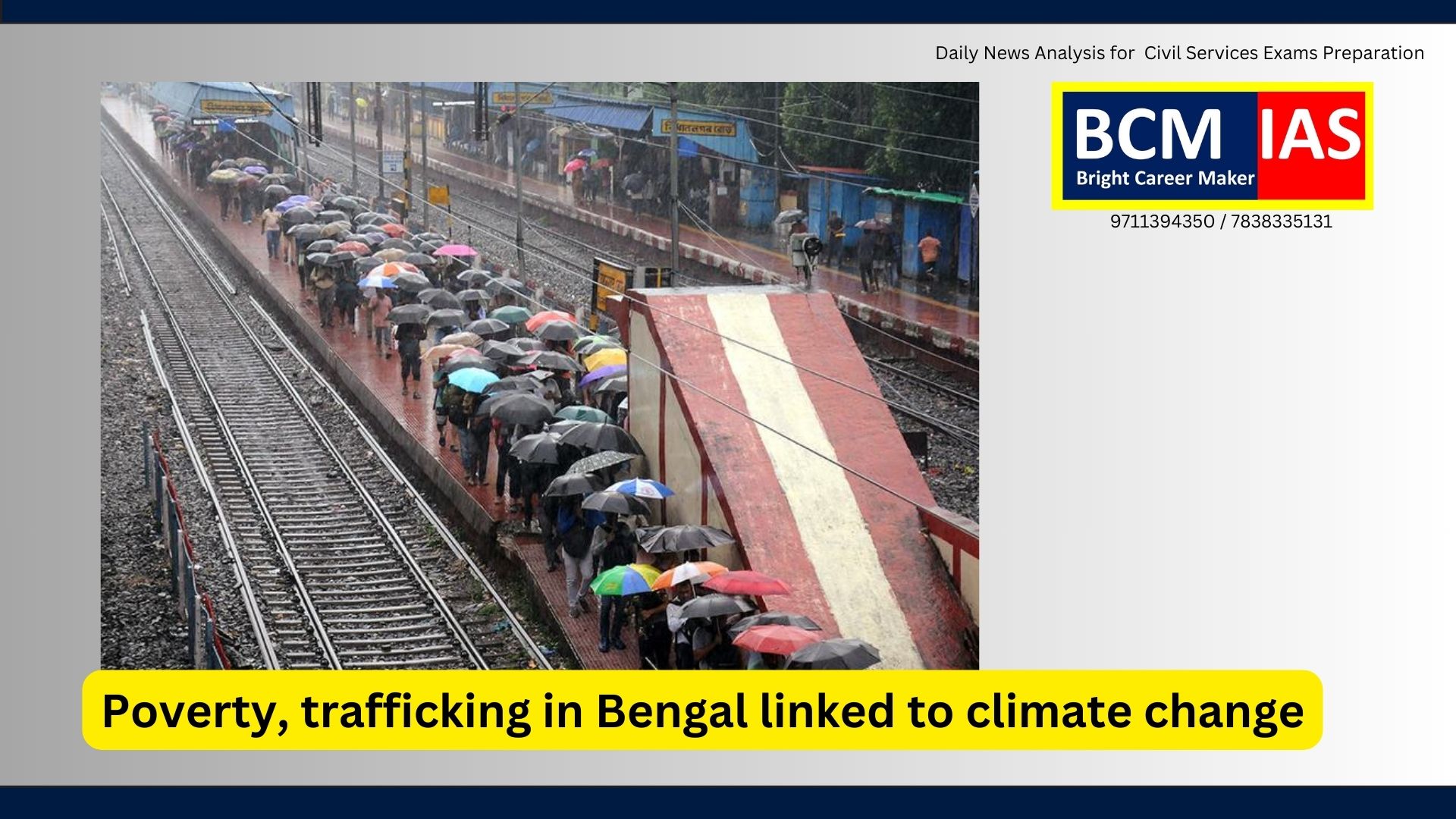
Poverty, trafficking in Bengal linked to climate change
The article highlights a critical
intersection between climate change, poverty,
and human trafficking in West Bengal,
particularly in the vulnerable Sundarbans region. It presents a grim picture of
how climate-induced disasters exacerbate socio-economic vulnerabilities,
leading to increased human trafficking. Key insights from the article are
structured below:
1. Link Between Climate Change and
Trafficking:
·
Natural Disasters as Catalysts:
- Repeated
tropical cyclones (e.g., Cyclones Amphan, Yaas, and Dana) have devastated
livelihoods in coastal West Bengal.
- The
destruction of resources forces migration, creating opportunities for
traffickers to exploit displaced individuals, especially women and
children.
·
Socio-Environmental Vulnerabilities:
- A
lack of access to essential services and livelihood opportunities pushes
impoverished communities into dire situations.
- Traffickers
exploit these vulnerabilities under the guise of offering better economic
prospects.
2. Statistical Evidence:
·
Increase in Trafficking Cases:
- Data
from the National Crime Records Bureau (NCRB) and ILFAT shows a rising
trend in trafficking cases: 59 in 2020, 61 in 2021, and 67 in 2022.
- Women
and children constitute the majority of trafficking victims, highlighting
their disproportionate risk.
·
Missing Persons:
- In
2022, 58,871 people were reported missing in West Bengal, with women and
children forming the bulk of this group.
·
Conviction Rates:
- The
conviction rate for trafficking cases in 2022 stood at 55%, indicating a
moderate level of judicial success but also reflecting challenges in
enforcement.
3. Testimonies and Stakeholder Views:
·
Voices from NGOs and Survivors:
- NGOs
like Goranbose Gram Bikash Kendra and ILFAT highlight the interplay of
poverty and climate disasters in driving trafficking.
- Survivors
such as Neha recount personal stories of displacement and exploitation
triggered by climate-induced destruction.
·
Call for Integrative Action:
- Stakeholders
emphasize the need to integrate climate change as a factor in
anti-trafficking policies.
- Community-level
support systems and livelihood generation programs are crucial to prevent
exploitation.
4. Broader Implications:
·
Climate Justice and Migration:
- The
issue reflects the broader challenge of climate justice, where
marginalized communities bear the brunt of climate change impacts without
adequate safety nets.
·
Women and Children as Vulnerable Groups:
- The
disproportionate impact on women and children underscores the
intersectionality of climate change with gender and age vulnerabilities.
Conclusion:
This article sheds light on the cascading
effects of climate change, linking environmental disasters to socio-economic
crises and exploitation. The Sundarbans region serves as a case study of how
natural disasters can amplify risks of trafficking. Effective interventions
must address both immediate vulnerabilities (e.g., rescue operations and legal
action) and systemic issues like poverty alleviation, livelihood support, and
climate resilience to mitigate the root causes of trafficking.
Question:
“Climate change is emerging as a
major driver of human trafficking, particularly in vulnerable regions like the
Sundarbans. Critically analyze the statement and suggest measures to mitigate
this challenge.”
Answer:
Introduction:
Climate change is a growing concern not only
for its environmental impacts but also for its socio-economic consequences. In
regions like the Sundarbans, repeated cyclones and rising sea levels are
displacing communities, forcing migration, and increasing vulnerabilities to
human trafficking. This linkage exemplifies the interplay of environmental and
human security challenges.
Body:
1. Linkage Between Climate Change and
Human Trafficking:
·
Destruction of Livelihoods:
- Cyclones
like Amphan, Yaas, and Dana have destroyed agricultural lands, fisheries,
and basic infrastructure, leaving people jobless and impoverished.
- Migration
in search of alternative livelihoods exposes individuals, especially
women and children, to traffickers.
·
Socio-Environmental Vulnerabilities:
- Lack
of access to education, healthcare, and social support systems makes
marginalized communities easy targets.
- Traffickers
exploit desperation with false promises of employment or marriage.
·
Gendered Impact:
- Women
and girls face disproportionate risks due to gender inequalities and
social norms, leading to exploitation in labor or sex trafficking.
2. Statistical Evidence:
- NCRB
data (2022): 58,871 missing persons in West Bengal, including 53,655 women
and 12,455 children.
- Trafficking
cases in West Bengal rose from 59 in 2020 to 67 in 2022, with minors
forming a significant proportion of victims.
3. Challenges in Tackling the Issue:
·
Policy Gaps:
- Existing
anti-trafficking interventions do not adequately consider climate change
as a factor.
- Limited
coordination between climate adaptation and trafficking prevention
policies.
·
Weak Enforcement:
- Despite
a 55% conviction rate in trafficking cases, enforcement remains
inconsistent.
- Lack
of community-level reporting and rescue mechanisms.
·
Poverty and Migration:
- Economic
insecurity remains a root cause, exacerbated by inadequate livelihood
opportunities and rehabilitation measures.
4. Measures to Mitigate the Challenge:
A. Climate Resilience and Adaptation:
1. Strengthening
Livelihoods:
o Introduce
alternative livelihoods like eco-tourism, crab farming, or mangrove-based
industries in the Sundarbans.
o Promote
microfinance and self-help groups to empower women economically.
2. Disaster
Management:
o Establish
robust early warning systems and post-disaster relief programs.
o Ensure
climate-resilient infrastructure to prevent displacement.
B. Anti-Trafficking Interventions:
1. Integration
of Climate and Trafficking Policies:
o Acknowledge
climate change as a factor in anti-trafficking frameworks.
o Train
law enforcement to recognize climate-induced vulnerabilities.
2. Community
Awareness and Engagement:
o NGOs
like ILFAT can strengthen local awareness campaigns against trafficking.
o Survivors
can act as community leaders to educate others.
3. Child
and Women Protection:
o Provide
education and vocational training to reduce susceptibility to exploitation.
o Create
safe migration pathways for those forced to relocate.
C. Strengthening Governance:
1.
Data-Driven Policy Making:
o Use
real-time data to monitor climate-related migration and trafficking hotspots.
2.
International Cooperation:
o Collaborate
with global organizations addressing climate change and human trafficking.
Conclusion:
The nexus between climate change and human
trafficking in regions like the Sundarbans is a wake-up call for policymakers.
A multi-pronged approach involving climate resilience, socio-economic
empowerment, and robust anti-trafficking frameworks is essential. Addressing
root causes like poverty and displacement will not only combat trafficking but
also build a sustainable and equitable future for vulnerable communities.
MCQs
Question 1:
Which of the following
best explains the link between climate change and human trafficking in
vulnerable regions like the Sundarbans?
a) Loss of biodiversity caused by rising temperatures.
b) Destruction of livelihoods due to repeated cyclones.
c) Increased access to global markets for traffickers.
d) Reduced migration from urban to rural areas.
Correct Answer: b. Destruction of livelihoods due to repeated cyclones.
Explanation: Climate change-induced cyclones destroy livelihoods,
forcing migration, and increasing vulnerability to trafficking.
Question 2:
Which of the following
is the most vulnerable group to human trafficking in the context of climate
change-induced migration?
a) Elderly men in urban areas.
b) Middle-income households in rural areas.
c) Women and children from disaster-affected regions.
d) Government employees in coastal regions.
Correct Answer: c. Women and children from disaster-affected regions.
Explanation: Women and children are disproportionately affected due
to socio-economic vulnerabilities and lack of safety nets.
Question 3:
Which of the following
is an effective measure to reduce human trafficking exacerbated by climate
change?
a) Establishing rapid-response units for trafficking rescue
missions.
b) Promoting community-level vocational training and
livelihood options.
c) Increasing the frequency of cyclone preparedness drills.
d) Enhancing penalties for traffickers without community
awareness programs.
Correct Answer: b. Promoting community-level vocational training and
livelihood options.
Explanation: Providing sustainable livelihoods reduces the need for
migration and decreases trafficking vulnerabilities.
Question 4:
The National Crime
Records Bureau (NCRB) reported a significant number of missing persons in West
Bengal in 2022. Which of the following is the likely underlying cause in
regions like the Sundarbans?
a) Organized labor protests against poor wages.
b) Increased deforestation leading to habitat loss.
c) Migration triggered by loss of livelihoods due to
cyclones.
d) Urbanization reducing rural opportunities.
Correct Answer: c. Migration triggered by loss of livelihoods due to cyclones.
Explanation: Climate change-driven cyclones lead to forced migration,
increasing risks of trafficking.
Question 5:
Which international
principle best supports policies aimed at addressing climate change-induced
trafficking?
a) Polluter Pays Principle.
b) Common but Differentiated Responsibilities.
c) Principle of Non-Interference.
d) Doctrine of State Responsibility.
Correct Answer: b. Common but Differentiated Responsibilities.
Explanation: Climate change disproportionately affects vulnerable
regions, and this principle underscores the need for equitable global
responsibility in mitigation efforts.


Comments on “Poverty, trafficking in Bengal linked to climate change”