


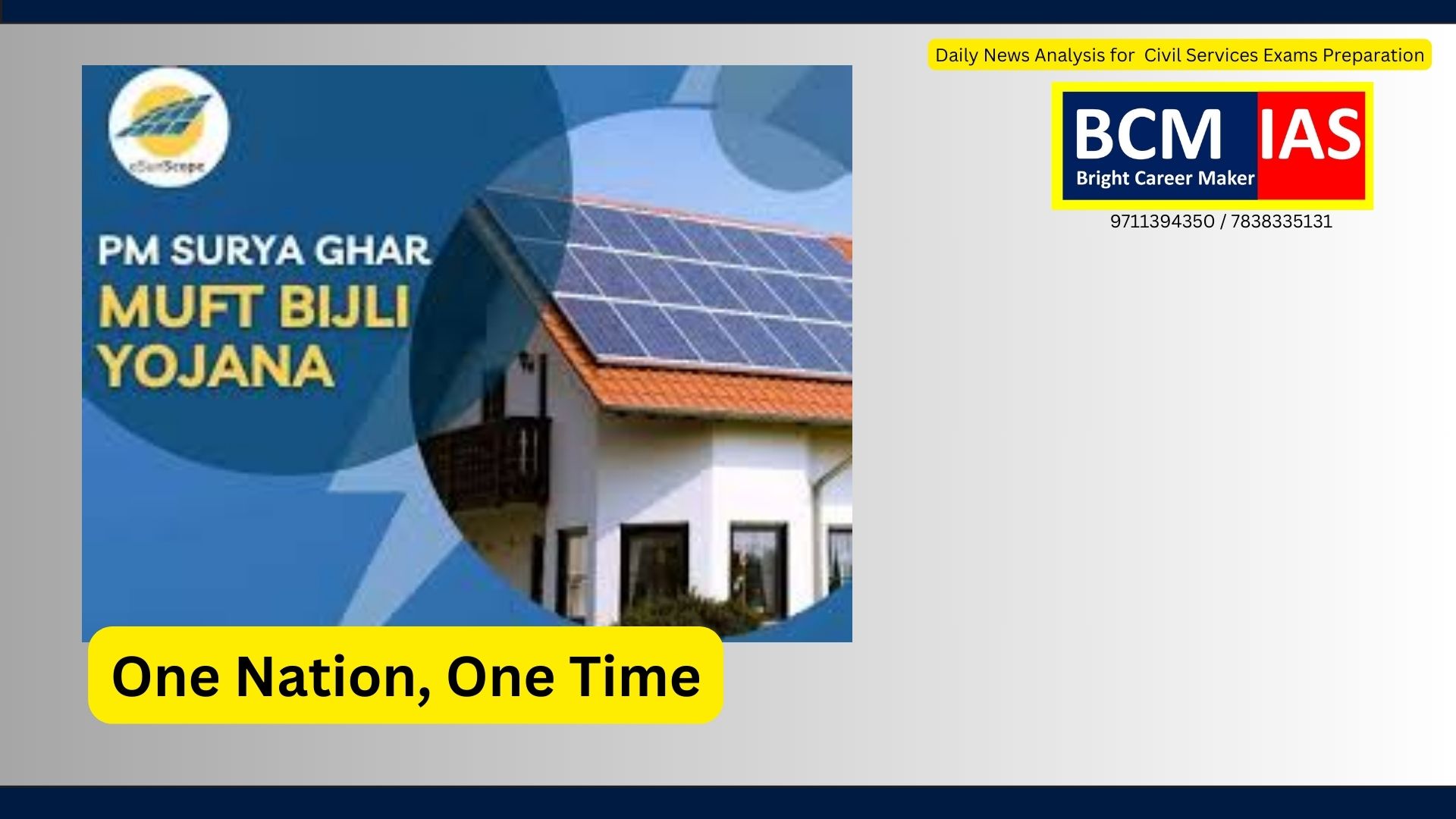
PM Surya Ghar Rooftop Solar Installation Scheme
·
The PM Surya
Ghar scheme is a ₹75,000 crore initiative aimed at accelerating rooftop solar installations across one
crore households in India.
·
The scheme aligns with India’s
renewable energy targets and the government’s vision
of achieving energy self-sufficiency, reducing carbon
emissions, and lowering household electricity costs.
1. Understanding the PM Surya Ghar
Scheme
A. Objectives and Launch Details
- Announced
in January 2024, following the inauguration of the Ram Temple in
Ayodhya.
- Officially
launched on February 15, 2024.
- Target:
Install rooftop
solar systems in one crore households across India.
- Implementation
Timeline: Expected to be achieved within 2-3 years,
according to the government.
B. Subsidy Structure and Financial
Assistance
- 60%
subsidy for systems up to 2 kW capacity.
- 40%
subsidy for systems between 2 kW and 3 kW.
- Subsidy
capped at 3 kW.
- Subsidy
amount:
- ₹30,000
for 1 kW system.
- ₹60,000
for 2 kW system.
- ₹78,000
for 3 kW or higher
systems.
C. Progress and Challenges in
Implementation
- As
of January 2025, only 8.5 lakh households (8.5%) have
installed rooftop solar systems.
- Initial
slow progress noted by the Parliamentary Standing Committee on Energy,
citing:
- Rain-related
delays.
- Slow
processing of applications (Only 5 lakh
installations out of 20 lakh applications completed as of October 2024).
- Recent
improvements: Daily installations increased from 3,000 to 9,000.
2. Significance and Benefits of the
Scheme
A. Advancing Renewable Energy Goals
- India’s
renewable energy capacity has grown 200% in the past decade,
from 75.52 GW in
2014 to 220 GW today.
- Annual
target of 50 GW of new renewable energy capacity in the coming years.
B. Reduction in Electricity Costs and
Energy Security
- Rooftop
solar installations help households
save on electricity bills and reduce dependency on grid power.
- Grid-connected
solar power tariff reduced by 80% (from ₹10.95
per unit in 2010-11 to ₹2.15
per unit today).
C. Environmental Benefits
- Contributes
to India’s net-zero emissions target by 2070.
- Reduces
dependency on fossil
fuels, thereby lowering
carbon footprint.
D. Economic and Employment Growth
- Boosts
domestic solar panel manufacturing and strengthens
India’s renewable
energy industry.
- Creates
jobs in
installation, maintenance, and production of solar panels.
3. Challenges in Implementation
A. Slow Progress in Reaching Target
- Only
8.5% of the one crore target has been achieved
within the first year.
- Bureaucratic
delays and procedural bottlenecks have slowed
implementation.
B. Financial and Technical Barriers
- Upfront
cost of solar installations is still high for low-income households,
even with subsidies.
- Lack
of awareness and technical knowledge
about rooftop solar systems.
C. Grid Integration and Storage Issues
- Challenges
in integrating solar power with existing electricity grids,
especially in rural areas.
- Limited
storage solutions for excess solar power generation.
4. Way Forward for Effective
Implementation
A. Accelerating Installation Process
- Simplify
application and approval process to ensure
faster installations.
- Better
coordination between the Centre, states, and local distribution companies
(DISCOMs).
B. Expanding Financial Support
- Introduce
easy financing options like low-interest solar loans
for households.
- Increase
subsidy for lower-income households to encourage
wider adoption.
C. Strengthening Awareness and Capacity
Building
- Mass
awareness campaigns to educate consumers
on the benefits of
rooftop solar systems.
- Training
programs for local technicians to improve solar panel
maintenance and efficiency.
D. Improving Grid Infrastructure and
Battery Storage
- Strengthen
grid connectivity to accommodate higher rooftop solar energy input.
- Invest
in energy storage solutions (e.g., solar
batteries) to maximize
energy utilization.
5. Conclusion
The PM Surya Ghar scheme is
a transformative step in India’s renewable energy journey,
aiming to make solar energy more accessible and
affordable for households. While progress has been slow
due to administrative and logistical challenges,
the increase in daily installations and government push
indicate strong potential for success. By
addressing financial, technical, and infrastructure
barriers, the scheme can help
India achieve its clean energy goals, reduce electricity costs for citizens,
and establish itself as a leader in renewable energy adoption.
Mains Question (GS
Paper 3 – Energy, Environment & Infrastructure Development)
Q1. "The PM Surya Ghar scheme aims
to accelerate India's transition to renewable energy while making solar power
accessible to households. However, challenges in implementation hinder its
success." Discuss. (250 words)
Answer
Introduction
The PM Surya Ghar: Muft
Bijli Yojana, launched in February
2024, is a ₹75,000 crore initiative aimed at
installing rooftop solar systems in one crore households across India. It
aligns with India's renewable energy goals and
reduces
dependence on fossil fuels by making solar power more
accessible and affordable for citizens.
Objectives and Significance of the
Scheme
1. Promoting Renewable Energy
- Supports
India's goal of
achieving 500 GW of non-fossil fuel energy capacity by 2030.
- Encourages
distributed solar
energy adoption to enhance energy security.
2. Reducing Household Electricity Costs
- 60%
subsidy for up to 2 kW systems and 40% for systems up to 3 kW
reduces upfront costs.
- Enables
households to generate
and store electricity, lowering grid dependency.
3. Economic Growth and Job Creation
- Boosts
the domestic solar panel industry and creates employment opportunities
in manufacturing, installation, and maintenance.
4. Climate Change Mitigation
- Supports
India’s net-zero
carbon emissions target by 2070.
- Reduces
grid demand,
helping decrease reliance on coal-based power generation.
Challenges in Implementation
1. Slow Installation Progress
- As
of January 2025, only
8.5 lakh households (8.5%) have installed rooftop solar systems,
far below the one crore target.
2. Financial and Affordability Barriers
- Despite
subsidies, high
upfront costs deter low-income households from adoption.
- Limited
financing options and lack of easy loan schemes.
3. Bureaucratic and Administrative
Delays
- Slow
processing of applications on the Surya Ghar portal.
- Coordination
challenges between central, state, and local authorities
impact implementation.
4. Technical Challenges and Grid
Integration Issues
- Poor
infrastructure for integrating rooftop solar power into the electricity
grid.
- Limited
energy storage solutions, affecting solar
energy usage during non-sunny hours.
Measures for Effective Implementation
1. Accelerating Installation and
Approvals
- Streamline
the approval and subsidy disbursal process
to ensure faster installations.
- Strengthen
coordination between DISCOMs (distribution companies) and government
agencies.
2. Expanding Financial Support
- Introduce
low-interest solar
loans and EMI-based
financing options to make adoption easier.
- Higher
subsidies for economically weaker households
to ensure inclusivity.
3. Enhancing Awareness and Capacity
Building
- Conduct
nationwide
awareness campaigns on solar power benefits and application process.
- Training
programs for local technicians to improve solar panel
installation and maintenance.
4. Improving Infrastructure and Grid
Readiness
- Upgrade
grid infrastructure to integrate rooftop solar power
efficiently.
- Invest
in energy storage solutions, such as solar batteries,
to improve energy utilization.
Conclusion
The PM Surya Ghar scheme
has the potential to revolutionize India's renewable energy sector,
but implementation challenges must be addressed for
its success. By simplifying bureaucracy, expanding
financial incentives, improving infrastructure, and raising public awareness,
the government can ensure effective deployment of rooftop
solar systems. Achieving this target will not only reduce
household energy costs but also help India
lead in sustainable energy development.
MCQs
1. With reference to the PM Surya Ghar:
Muft Bijli Yojana, consider the following statements:
1.
The scheme provides subsidies for rooftop
solar installations only for commercial and industrial sectors.
2.
The subsidy covers up to 60% of the cost for
solar systems of up to 2 kW capacity.
3.
The target of the scheme is to install
rooftop solar systems in one crore households across India.
Which of the statements given above
is/are correct?
A. 1
and 2 only
B. 2
and 3 only
C. 3
only
D. 1,
2, and 3
Answer: B.
2 and 3 only
Explanation:
- The
PM Surya Ghar
scheme is for residential households, not for commercial
and industrial sectors.
- The
subsidy structure provides 60%
for up to 2 kW and 40%
for 2-3 kW systems.
- The
scheme aims to install
rooftop solar in one crore households across India.
2. Consider the following benefits of
rooftop solar installations under the PM Surya Ghar scheme:
1.
Reduction in electricity costs for
households.
2.
Lower dependence on coal-based power
generation.
3.
Contribution to India's target of 500 GW
non-fossil fuel energy capacity by 2030.
4.
Increase in the import of solar panels from
foreign manufacturers.
Which of the above statements are
correct?
A. 1,
2, and 3 only
B. 1
and 4 only
C. 2
and 3 only
D. 1,
2, 3, and 4
Answer: A.
1, 2, and 3 only
Explanation:
- Rooftop
solar reduces
electricity costs as households generate their own power.
- It
helps reduce
reliance on coal-based energy by increasing solar power
generation.
- It
contributes to India’s
500 GW non-fossil fuel energy target.
- Statement
4 is incorrect because the government is
promoting domestic
solar panel manufacturing under schemes like the PLI scheme.
3. Which of the following challenges
affect the implementation of rooftop solar projects in India?
1.
High upfront installation costs.
2.
Limited awareness and technical knowledge
among consumers.
3.
Grid integration and energy storage issues.
4.
Excessive dependence on hydropower for energy
needs.
Select the correct answer using the code
below:
A. 1,
2, and 3 only
B. 2
and 4 only
C. 1,
3, and 4 only
D. 1,
2, 3, and 4
Answer: A.
1, 2, and 3 only
Explanation:
- High
upfront costs remain a barrier despite
subsidies.
- Limited
consumer awareness about the benefits and
application process delays adoption.
- Grid
integration challenges exist due to
fluctuations in solar power generation.
- Statement
4 is incorrect as India still primarily depends
on thermal
(coal-based) power, not hydropower.
4. Consider the following statements
about India's solar power sector:
1.
India’s installed renewable energy capacity
has increased by over 200% in the last decade.
2.
The tariff for grid-connected solar power
plants in India has significantly reduced over time.
3.
India aims to achieve net-zero carbon
emissions by 2050 through solar energy expansion.
Which of the statements given above
is/are correct?
A. 1
and 2 only
B. 2
and 3 only
C. 1
and 3 only
D. 1,
2, and 3
Answer: A.
1 and 2 only
Explanation:
- India's
renewable energy
capacity has increased by over 200% in the last decade
(from 75.52 GW in
2014 to 220 GW in 2024).
- The
tariff for
grid-connected solar energy has decreased significantly
(from ₹10.95 per unit in 2010-11 to ₹2.15 per unit in 2024).
- Statement
3 is incorrect as India has set its net-zero emissions target for
2070, not 2050.
5. Consider the following government
initiatives related to solar energy in India:
1.
PM-KUSUM Scheme –
Supports solar energy adoption in the agriculture sector.
2.
Faster Adoption and
Manufacturing of Hybrid and Electric Vehicles (FAME) –
Promotes rooftop solar adoption in residential areas.
3.
Production Linked Incentive
(PLI) Scheme for Solar PV Manufacturing – Encourages
domestic production of solar panels.
4.
International Solar Alliance
(ISA) – Aims to promote solar energy adoption among member
countries.
Which of the above initiatives directly
promote solar energy in India?
A. 1,
2, and 3 only
B. 1,
3, and 4 only
C. 2,
3, and 4 only
D. 1,
2, 3, and 4
Answer: B.
1, 3, and 4 only
Explanation:
- PM-KUSUM
Scheme promotes solar energy adoption for
agricultural irrigation pumps.
- The
PLI Scheme encourages domestic solar PV manufacturing
to reduce dependence on imports.
- International
Solar Alliance (ISA) fosters global cooperation for solar
energy development.
- FAME
is unrelated to rooftop solar—it supports electric vehicle adoption, not
residential solar installations.


Comments on “PM Surya Ghar Rooftop Solar Installation Scheme”