


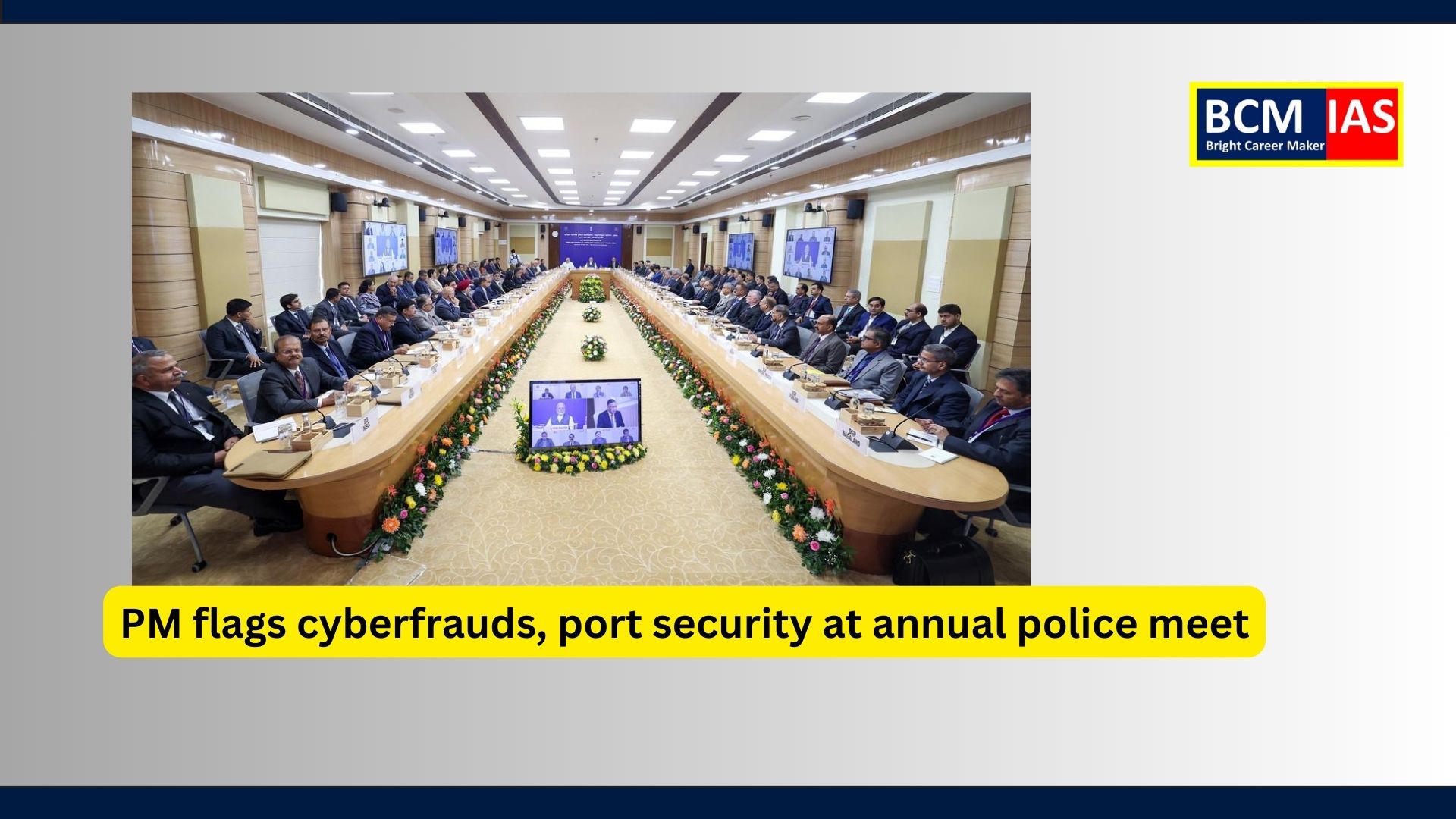
PM
flags cyber frauds, port security at annual police meet Narendra Modi
Context
Prime Minister Narendra Modi
addressed the 59th All India Conference of Directors-General of Police and
Inspectors-General of Police in Bhubaneswar, emphasizing critical issues in
national security, policing, and technology adoption. The conference brought
together senior police officers to deliberate on existing and emerging security
challenges.
Key Issues Highlighted by
the PM
1. Cybercrime
and Digital Fraud:
o Concerns
over cybersecurity threats, particularly AI-driven crimes like deepfakes,
which can harm social and familial relations.
o Emphasis on
addressing the risks posed by digital frauds, given India's rapid
digitization and expanding use of technology.
2. Port
Security:
o The PM
highlighted the need to enhance port security, recognizing the
vulnerabilities of coastal infrastructure to smuggling, narco-trafficking, and
other criminal activities.
o A plan
of action was proposed to address these concerns comprehensively.
3. Urban
Policing Initiatives:
o PM Modi
acknowledged innovative urban policing strategies and suggested their standardization
and implementation in 100 cities across India.
4. Police
Station as Focal Point:
o Emphasis on
the police station as the epicenter of resource allocation and
operational effectiveness.
o Advocated
for leveraging technology to reduce the workload of constabulary staff,
improving efficiency and morale.
5. Homage to
Sardar Vallabhbhai Patel:
o In honor of
Patel’s 150th birth anniversary, the PM urged the police establishment
to adopt initiatives that enhance the image, professionalism, and
capabilities of the police force.
Deliberations at the
Conference
1. Security
Challenges:
o Topics
discussed included counter-terrorism, left-wing extremism, coastal
security, and cybercrime.
o Emerging
security concerns, such as the rise in narco-trafficking and malicious
online narratives, were key areas of focus.
2. Border
Security:
o Specific
attention was given to emerging threats along the Bangladesh and Myanmar
borders, highlighting cross-border smuggling and infiltration issues.
3. Urban
Policing:
o Strategies
for managing growing urban populations and associated challenges, such as crime
control and public safety, were explored.
Analysis
1. Technology-Driven
Challenges:
o The
emphasis on cybercrime and deepfakes reflects the evolving nature of threats,
where technology misuse poses significant risks to national and
individual security.
2. Strengthening
Coastal and Port Security:
o Given
India’s extensive coastline and reliance on ports for trade, enhancing port
security is critical for preventing illegal activities such as smuggling
and trafficking.
3. Urban
Policing:
o Urban areas
are hubs of economic and social activity but are also prone to unique security
challenges. Standardizing effective urban policing practices can enhance safety
in these regions.
4. Focus on
Police Modernization:
o The call to
use technology to reduce constabulary workload and enhance police stations as
resource centers aligns with the goal of modernizing India’s police force.
5. Nationwide
Implementation:
o Collating
successful policing initiatives and implementing them in key cities showcases
an intent to replicate best practices at scale.
Conclusion
PM Modi’s address underscores the
importance of proactive policing, technological integration, and
capacity building in addressing modern security challenges. His focus on
cybercrime, port security, and urban policing reflects a comprehensive approach
to strengthening India’s internal security apparatus. The conference’s
deliberations on emerging threats and innovative strategies lay the
foundation for more responsive and effective policing across the country.
Mains Question
Q. The evolving nature of security
threats, including cybercrimes, coastal vulnerabilities, and urban challenges,
demands a proactive and technology-driven approach to policing. Discuss the key
recommendations made by the Prime Minister at the 59th All India Police
Conference and their relevance in addressing these challenges.
Answer
Introduction
India faces a wide range of
security threats, from cybercrimes and deepfakes to
vulnerabilities in coastal infrastructure and urban policing. At the 59th
All India Conference of Directors-General and Inspectors-General of Police,
Prime Minister Narendra Modi outlined a roadmap for addressing these challenges
through innovation, technology, and institutional reform.
Key Recommendations by
the Prime Minister
1. Addressing
Cybercrime and AI Threats:
o Recognized
the risks posed by digital frauds and AI-powered tools like
deepfakes, which can disrupt social and familial relations.
o Advocated
for a cybercrime-focused strategy, integrating advanced technology and
training for law enforcement.
2. Enhancing
Port Security:
o Highlighted
the need to secure India’s extensive coastal infrastructure, given its
susceptibility to smuggling, narco-trafficking, and other criminal
activities.
o Proposed a comprehensive
plan of action to mitigate risks.
3. Urban
Policing Innovations:
o Acknowledged
successful urban policing initiatives and suggested their standardization in
100 cities for broader implementation.
o Focused on
addressing challenges unique to urban areas, such as organized crime and crowd
management.
4. Technology
to Reduce Constabulary Workload:
o Stressed
the importance of leveraging technology to streamline administrative tasks,
allowing the police to focus on core duties.
5. Strengthening
Police Stations:
o Proposed
making police stations the focal point of resource allocation, improving
their effectiveness as hubs of law enforcement.
6. Homage to
Sardar Vallabhbhai Patel:
o Urged the
police establishment to honor Patel’s legacy by adopting measures to enhance
their image, professionalism, and capabilities in time for his 150th
birth anniversary.
Relevance of These
Recommendations
1. Adapting to
Emerging Threats:
o Cybercrimes,
especially AI-driven ones like deepfakes, require specialized knowledge
and tools, making technological upgrades and training imperative.
2. Coastal
Security as a Strategic Priority:
o India’s 7,500-km
coastline and reliance on maritime trade make port security critical for
preventing illegal activities and ensuring economic stability.
3. Urban
Policing for Growing Cities:
o With rapid
urbanization, crime in cities is becoming more complex. Standardizing effective
strategies can bolster public safety.
4. Modernizing
the Police Force:
o Reducing
the workload of constables through technology and empowering police stations
ensures efficient functioning and boosts morale.
5. Fostering
Public Trust:
o Enhancing
police professionalism and capabilities will help build a positive image
of law enforcement, fostering trust among citizens.
Way Forward
1. Institutional
and Technological Investment:
o Allocate
resources for AI-driven tools, cybersecurity frameworks, and capacity
building for law enforcement.
2. Policy
Integration:
o Implement a
national policy on coastal and urban security, integrating technology
and best practices.
3. Training
and Awareness:
o Organize
training programs for police personnel on cybersecurity and urban crime
management.
4. Collaborative
Efforts:
o Foster
collaboration between state and central agencies, ensuring a unified
approach to national security.
Conclusion
The Prime Minister’s
recommendations at the police conference reflect a forward-looking approach to
addressing modern security challenges. By integrating technology,
innovation, and institutional reform, India’s law enforcement agencies can
strengthen their capabilities, ensuring a safer and more secure environment for
all.
MCQs
1. Which emerging technology did PM
Modi flag as a potential threat due to its ability to disrupt social and
familial relations?
A. Blockchain
B. Artificial Intelligence and Deepfakes
C. Quantum Computing
D. Internet of Things
Answer: B.
Artificial Intelligence and Deepfakes
2. What specific aspect of security
did PM Modi propose as needing a comprehensive plan of action?
A. Counter-terrorism
B. Cybersecurity
C. Port and Coastal Security
D. Border Security with Pakistan
Answer: C.
Port and Coastal Security
3. What did PM Modi suggest should
be made the focal point of resource allocation in the police system?
A. Headquarters of the Directors-General of Police
B. Police Academy Training Centers
C. Police Stations
D. Specialized Cybercrime Units
Answer: C.
Police Stations
4. In which context did PM Modi
urge the police establishment to honor Sardar Vallabhbhai Patel?
A. By focusing on cybersecurity initiatives
B. By modernizing urban policing strategies
C. By enhancing police image, professionalism, and capabilities on his 150th
birth anniversary
D. By developing coastal security plans
Answer: C. By
enhancing police image, professionalism, and capabilities on his 150th birth
anniversary
5. Which of the following was NOT a
topic of discussion during the 59th All India Police Conference?
A. Counter-terrorism and left-wing extremism
B. Economic security and narco-trafficking
C. Urban policing and coastal security
D. Development of a national defense strategy
Answer: D.
Development of a national defense strategy


Comments on “PM flags cyberfrauds, port security at annual police meet Narendra Modi”