


Daily Current Affairs Analysis
13 June 2024
-------------------------------------------------------------------------------------------------------------
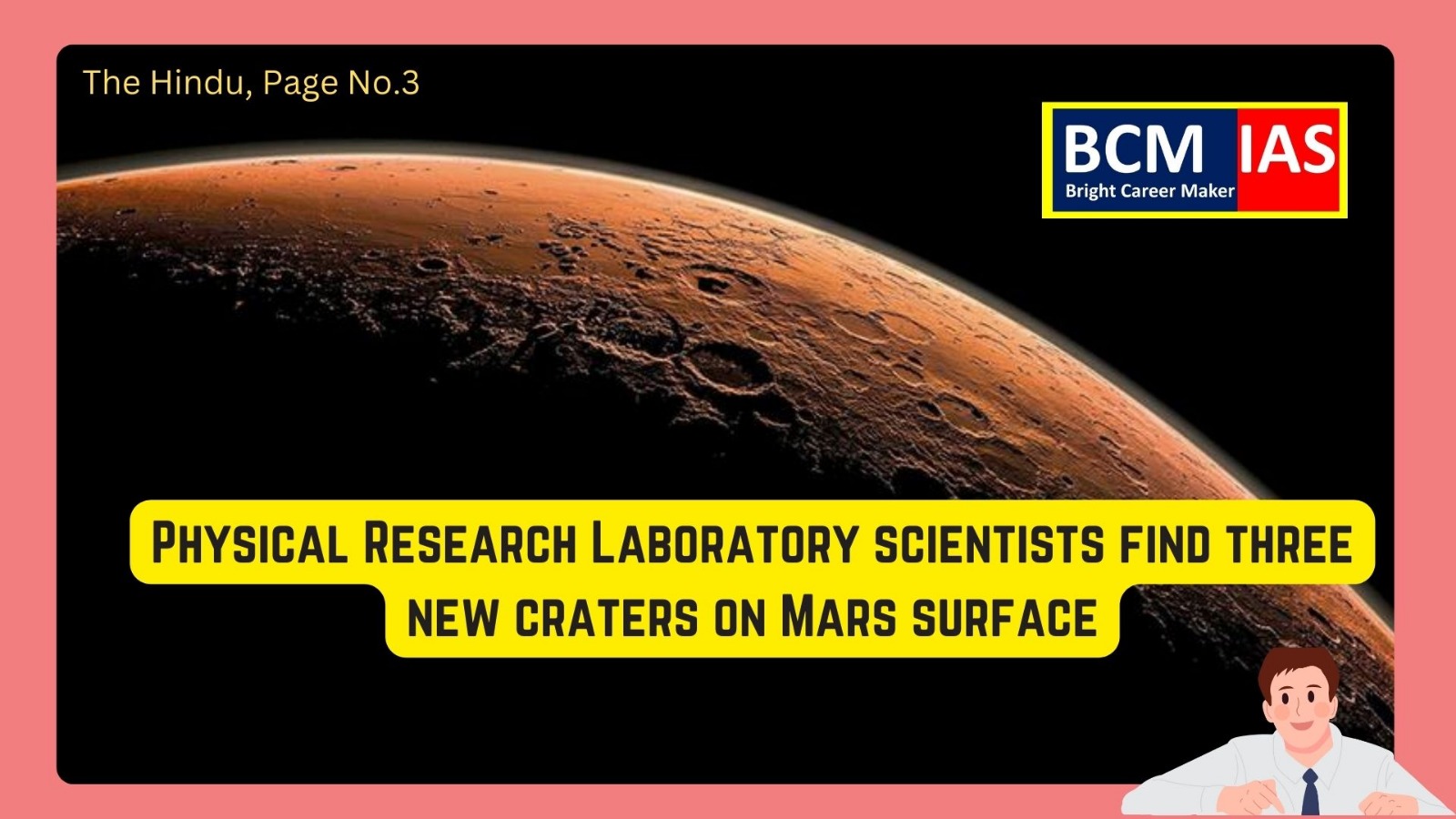
Physical Research Laboratory scientists find three
new craters on Mars surface
Meaning of Headline-
·
means that scientists from the Physical Research Laboratory (PRL)
in Ahmedabad have discovered three new craters on the surface of Mars.
·
These craters have been found in the Tharsis volcanic region of
Mars and have been named based on the recommendation of the PRL.
Related Topic (as per UPSC Syllabus)
Prelims:
- General Studies
Paper I:
o
Current events of national
and international importance.
o
General Science:
§
Discoveries and advancements in space research.
Mains:
- General Studies
Paper III:
o
Science and Technology:
§
Developments and their applications and effects in
everyday life.
§
Achievements of Indians in science & technology;
indigenization of technology and developing new technology.
§
Awareness in the fields of space.
Interview:
- Space Research and
Achievements:
o
Questions may focus on the role of Indian institutions
in space research, the significance of discoveries on Mars, and the
contributions of Indian scientists to international space missions.
This news highlights the advancements in
space exploration and the contributions of Indian scientists, which are
significant for the UPSC syllabus under science and technology, especially in
the context of space research and exploration.
News
Analysis
Introduction
The article discusses a significant
discovery made by scientists at the Physical Research Laboratory (PRL) in
Ahmedabad. They have identified three new craters on the surface of Mars in the
Tharsis volcanic region. These craters have been officially named and their
characteristics studied, providing new insights into Martian geology and its
historical climate conditions.
Discovery of New Craters
The discovery was made by the PRL
scientists and has been recognized by the International Astronomical Union
(IAU) Working Group for Planetary System Nomenclature. The three craters have
been named as follows:
1. Lal Crater
2. Mursan Crater
3. Hilsa Crater
Details of the Craters
- Lal Crater: Named after Devendra Lal, a renowned Indian geophysicist and former
PRL director. This crater is 65 kilometers wide and is located at the
coordinates -20.98 and 209.34°.
- Mursan Crater: Named after a town in Uttar Pradesh, it is a 10-kilometer wide
crater situated on the eastern side of Lal Crater.
- Hilsa Crater: Named after a
town in Bihar, this crater is also 10 kilometers wide and is positioned on
the western side of Lal Crater.
Scientific Importance of Lal
Crater
The PRL emphasizes the significance of Lal
Crater due to its unique geological features:
- The
entire area of Lal Crater within the Tharsis volcanic region is covered
with lava, indicating volcanic activity.
- Thick Sedimentary Deposits: There is geophysical evidence of a 45-meter
thick sedimentary deposit beneath the lava layer in the Lal Crater. This
is crucial as it suggests the presence of materials other than lava.
Implications of the Discovery
- The
sedimentary deposits provide compelling evidence that water once existed
on Mars. This sediment suggests that water had flowed, moving large
volumes of sediment into the crater.
- This
discovery supports the theory that Mars was once a wet planet with
significant amounts of water, which has important implications for
understanding the planet's climate history and potential for past life.
Conclusion
The identification of these three craters,
particularly the detailed study of the Lal Crater, marks a significant
contribution to Martian geological research. The findings highlight the dynamic
geological past of Mars and reinforce the possibility of water having been
present on the planet, offering new avenues for exploration and study.
Mains Probable Question
Question - Discuss the
significance of the discovery of new craters on Mars by Indian scientists for
planetary science and space exploration.
Model Suggested Answer
1.
Introduction:
The recent
discovery of three new craters on Mars by the Ahmedabad-based Physical Research
Laboratory (PRL) has brought significant attention to India's contributions to
planetary science and space exploration. The craters, named Lal, Mursan, and
Hilsa, were found in the Tharsis volcanic region of Mars, an area known for its
extensive volcanic activity. This discovery not only highlights the scientific
capabilities of Indian institutions but also provides valuable insights into
the geological and climatic history of Mars. This essay explores the
implications of these findings, the challenges and opportunities they present
for planetary science, and potential future directions in space exploration.
2.
Demand of the Question:
The significance of the discovery of
new craters on Mars extends across various domains of planetary science and
space exploration:
A. Advancements in
Planetary Science:
- Geological Insights: The discovery of craters in the Tharsis region offers new data on
Mars' geological history. The presence of thick sedimentary deposits in
the Lal crater, for instance, suggests that water once played a
significant role in shaping Mars' surface. This finding aligns with other
evidence indicating that Mars had a wetter and possibly habitable past.
- Volcanic Activity: The
Tharsis volcanic region is one of the most geologically active areas on
Mars. Studying these craters can provide deeper insights into the planet's
volcanic history and its impact on Mars' climate and atmosphere.
Understanding the timing and extent of volcanic eruptions can help
scientists reconstruct the planet's climatic evolution.
- Impact Cratering Process: Craters
on planetary surfaces are crucial for understanding the impact cratering
process, which is fundamental to planetary science. These new craters can
serve as natural laboratories for studying the mechanics of crater
formation and the subsequent geological processes that modify them over
time.
B. Implications for
Space Exploration:
- Site Selection for Future Missions:
Discoveries like these play a critical role in selecting sites for future
missions. The presence of sedimentary deposits and indications of past
water flow make the Tharsis region a compelling target for future
exploration missions aimed at uncovering signs of past life on Mars.
- Technological Validation: The
successful identification and analysis of these craters demonstrate the
effectiveness of current remote sensing technologies and methodologies
used by Indian scientists. This validation is essential for planning and
executing future space missions with more advanced technology.
- International Collaboration: These
discoveries underscore the importance of international collaboration in
space exploration. The naming of the craters by the International
Astronomical Union (IAU) following PRL's recommendations highlights the
collaborative nature of planetary science, fostering a global scientific
community.
C. Contributions to
Astrobiology:
- Habitability Potential: The
discovery of sedimentary deposits in the craters provides potential
habitats where microbial life could have existed. Analyzing these deposits
can yield critical information about the ancient environments of Mars,
contributing to the broader search for extraterrestrial life.
- Climate Reconstruction: The
sedimentary layers can help reconstruct the climatic history of Mars. By
studying these layers, scientists can infer the environmental conditions
that prevailed when the sediments were deposited, offering clues about
Mars' habitability over geological timescales.
3.
Way Forward:
To maximize the scientific and
exploratory potential of these discoveries, a multi-faceted approach is
essential:
A. Enhanced Research
and Analysis:
- In-depth Geological Studies:
Detailed geological and mineralogical studies of the newly discovered
craters should be prioritized. Using advanced spectrometers and
high-resolution imaging, scientists can analyze the composition of
sedimentary deposits and volcanic materials to better understand the
geological history of Mars.
- Simulated Experiments: Conducting laboratory experiments that simulate Martian conditions
can help validate hypotheses about the formation and evolution of these
craters. Such experiments can provide valuable data on the interaction
between volcanic and sedimentary processes on Mars.
B. Future Mars
Missions:
- Robotic Exploration: Future missions to Mars should include landers and rovers
specifically designed to study the Tharsis region. These missions can
collect and analyze samples directly from the craters, providing
ground-truth data to complement remote sensing observations.
- Sample Return Missions:
Planning sample return missions to these craters can bring back Martian
rocks and sediments for detailed analysis on Earth. This would enable
scientists to use sophisticated laboratory instruments that are not
feasible to send to Mars.
C. International
Collaboration and Data Sharing:
- Global Partnerships: Strengthening international collaboration in Mars exploration can
pool resources and expertise, leading to more comprehensive and
cost-effective missions. Sharing data and findings with the global
scientific community will enhance the collective understanding of Mars.
- Open Data Platforms:
Developing open data platforms where scientists from around the world can
access and analyze data from Mars missions will foster collaborative
research and accelerate scientific discoveries.
D. Educational and
Public Engagement:
- Raising Awareness:
Publicizing the achievements of Indian scientists in discovering new
Martian craters can inspire the next generation of scientists and
engineers. Educational programs and outreach activities can highlight the
importance of space exploration and its benefits to society.
- Incorporating Discoveries into
Curriculum: Integrating the latest findings
from Mars into educational curricula can provide students with up-to-date
knowledge and stimulate interest in planetary science and space
technology.
Conclusion:
The discovery of new craters on Mars
by PRL scientists is a significant milestone for India's space research
community. It enhances our understanding of Mars' geological and climatic
history and underscores the potential for future exploration and international
collaboration. By pursuing detailed research, planning ambitious missions,
fostering global partnerships, and engaging the public, we can build on these
discoveries to unlock the secrets of Mars and advance the frontiers of
planetary science. This integrated approach will not only elevate India's
standing in the global scientific community but also contribute to the broader
quest for knowledge and exploration in our solar system.
MCQs for Prelims Practice
1. Which Indian organization discovered three new craters
on Mars?
o
a) ISRO
o
b) DRDO
o
c) Physical Research
Laboratory (PRL)
o
d) Tata Institute of
Fundamental Research (TIFR)
Answer: c) Physical
Research Laboratory (PRL)
Explanation: The Physical
Research Laboratory (PRL) in Ahmedabad is credited with the discovery of three
new craters on Mars.
2. In which region on Mars were the new craters
discovered by PRL scientists?
o
a) Valles Marineris
o
b) Olympus Mons
o
c) Tharsis volcanic region
o
d) Gale Crater
Answer: c) Tharsis
volcanic region
Explanation: The three
new craters were discovered in the Tharsis volcanic region on Mars.
3. What is the significance of the sedimentary deposit
found in the Lal crater?
o
a) It indicates the presence
of lava flow.
o
b) It provides evidence of
volcanic activity.
o
c) It suggests that water once
moved large volumes of sediment into the crater.
o
d) It confirms the presence of
life on Mars.
Answer: c) It
suggests that water once moved large volumes of sediment into the crater.
Explanation: The 45-meter
thick sedimentary deposit in the Lal crater suggests that water had once moved
large volumes of sediment into the crater, indicating past water flow on Mars.
4. Which crater is named after a renowned Indian
geophysicist and former director of PRL?
o
a) Mursan crater
o
b) Hilsa crater
o
c) Lal crater
o
d) Gale crater
Answer: c) Lal
crater
Explanation: The Lal
crater is named after Devendra Lal, a renowned Indian geophysicist and former
director of PRL.
5. What does the discovery of these craters indicate
about the history of Mars?
o
a) Mars has always been dry
and devoid of water.
o
b) Mars experienced
significant volcanic activity.
o
c) Mars had water flow on its
surface at some point in the past.
o
d) Mars has a thick atmosphere
like Earth.
Answer: c) Mars had
water flow on its surface at some point in the past.
Explanation: The
discovery of sedimentary deposits in the craters, particularly the Lal crater,
indicates that water once flowed on the surface of Mars.Top of Form


Comments on “Physical Research Laboratory scientists find three new craters on Mars surface”