


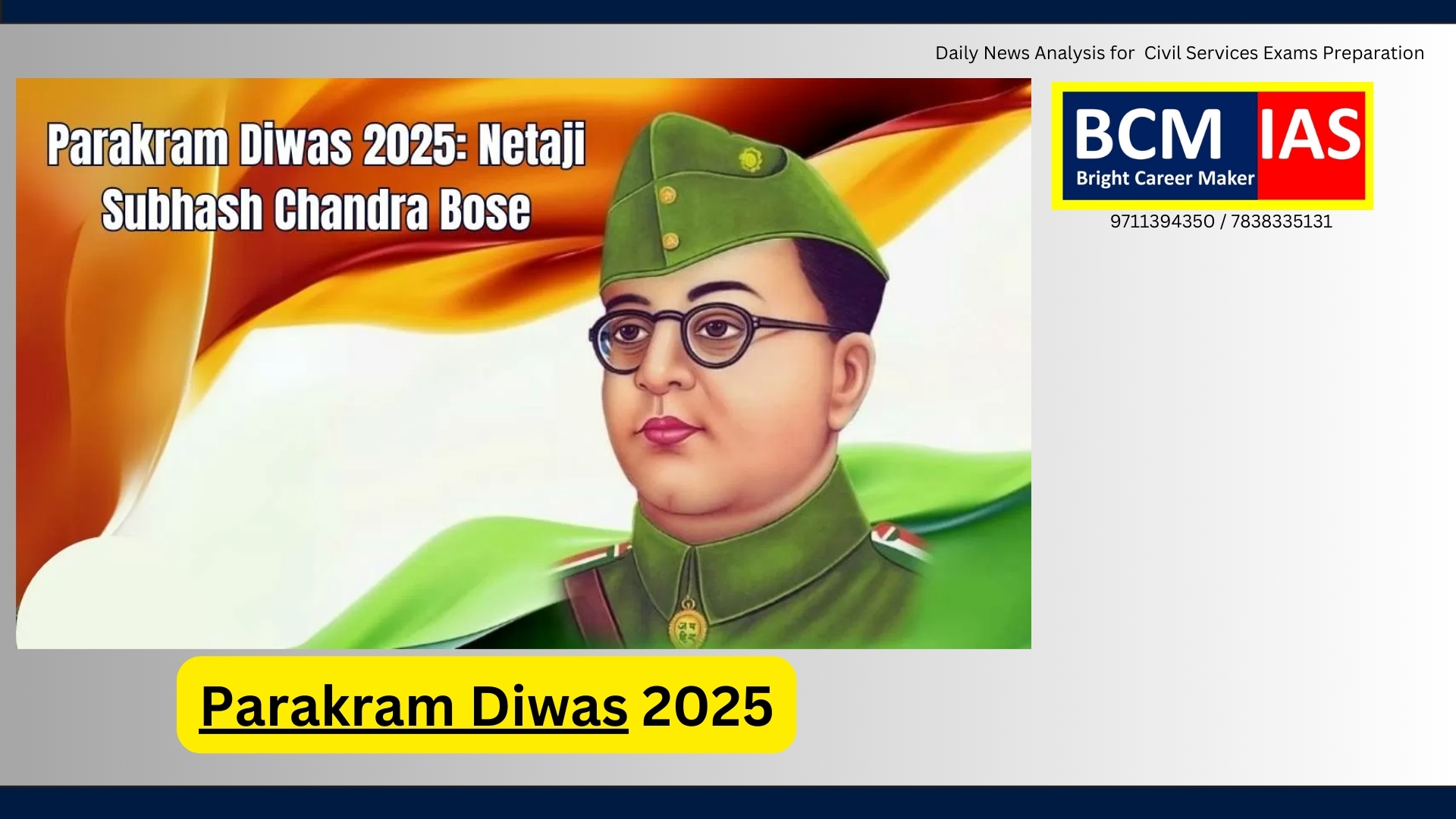
Parakram Diwas 2025
1.
Significance of the Occasion
·
Parakram
Diwas (Day of Valor):
- Celebrated
annually on 23rd
January, it marks Netaji
Subhas Chandra Bose's birth anniversary.
- The
occasion is a reminder of Bose’s revolutionary leadership and his call
for complete independence.
- The
2025 celebrations
at Barabati Fort, Cuttack, underscore Netaji’s birthplace and his
association with Odisha.
·
Rash
Behari Bose’s 80th Death Anniversary (21st January 2025):
- Recognizes
Rash Behari Bose as the founder
of the Indian National Army (INA), paving the way for
Subhas Chandra Bose’s leadership.
- Highlights
his contribution to revolutionary activities and international alliances.
2.
Contributions of Subhas Chandra Bose
Early Life
and Inspiration:
- Influenced
by spiritual leaders like Ramakrishna
Paramhansa and Swami
Vivekananda, and literary works like Bankim Chandra Chatterjee’s
"Ananda Math", Bose’s ideological foundation
blended Indian traditions and modern thought.
- Resigned
from the Indian Civil
Services (ICS) in 1921 to join the freedom movement,
showcasing his commitment.
Leadership
and Strategy:
·
Indian
National Congress:
- Elected
Congress President
in 1938 (Haripura)
and 1939 (Tripuri)
but resigned due to ideological differences with Gandhi, particularly
over his militant approach.
- Formed
the Forward Bloc
in 1939, advocating radical-left
policies and socialism for post-independence India.
·
International
Alliances:
- Sought
support from Germany,
Japan,
and other Axis powers during World War II, leveraging their conflict with
Britain to advance India’s independence.
- Established
Azad Hind Radio
to communicate with Indians worldwide.
·
Indian
National Army (INA):
- Took
over leadership from Rash Behari Bose in 1943 and restructured the INA to
include a women’s
regiment (Rani of Jhansi Regiment), emphasizing gender
equality.
- INA’s
"Chalo
Delhi" campaign aimed to liberate India but was
halted at Imphal
in 1944 due to logistical challenges and Japan’s defeat.
·
Azad
Hind Government:
- Proclaimed
a Provisional
Government in Singapore in 1943, recognized by several
countries, showcasing his international stature.
Death and
Legacy:
- His
disappearance
following a plane crash in 1945 remains a mystery, adding a mythical aura
to his legacy.
- Known
for his famous slogan: “Give
me blood, and I will give you freedom”, inspiring
countless Indians to join the struggle.
3.
Contributions of Rash Behari Bose
Revolutionary
Beginnings:
- Involved
in the Alipore Bomb
Case (1908) and the assassination
attempt on Viceroy Hardinge in 1912.
- Played
a key role in the Ghadar
Movement, mobilizing Indian expatriates against British
rule.
Formation
of the Indian Independence League (IIL):
- After
escaping to Japan
in 1915, he founded the IIL,
laying the groundwork for organizing Indians abroad.
Role in INA:
- Formed
the Azad Hind Fauj
(INA) in 1942, later handing over leadership to Subhas
Chandra Bose, recognizing his ability to lead a mass movement.
Legacy:
- Rash
Behari Bose was instrumental in uniting revolutionaries globally and
securing Japanese support for India’s struggle.
4.
Ideological Differences Between Gandhi and Bose
The table comparing Gandhi and
Bose highlights their contrasting visions:
|
Aspect |
Mahatma Gandhi |
Subhas Chandra Bose |
|
Ideology |
Non-violence
(Ahimsa) and truth (Satyagraha). |
Militant
resistance and socialism. |
|
Means
and Ends |
Ethical
means for freedom. |
Focused
on achieving results, even using violence. |
|
Form
of Government |
Decentralized
village republics. |
Strong
central government with socialist planning. |
|
Economic
Vision |
Self-reliant,
village-based economy. |
Modernization
and industrialization. |
|
Militarism |
Opposed
militarism. |
Admired
military discipline and established the INA. |
|
British
Rule |
Opposed
collaboration with British or Axis powers. |
Allied
with Axis powers to weaken British rule. |
5. Broader
Implications
Cultural
and Political Relevance:
- Events
like Parakram Diwas
reinforce the importance of revolutionary figures in shaping India’s
independence movement.
- The
celebration of Rash
Behari Bose’s contributions ensures recognition of
often-overlooked revolutionaries.
Historical
Lessons:
- Bose’s
advocacy for international
alliances and military
action shows the need for a multi-dimensional approach in
political struggles.
- His
vision of a socialist,
industrialized India reflects ideas relevant to modern
governance and economic planning.
Symbolism
of INA Trials:
- The
INA trials of 1945-46 galvanized nationalist sentiment, demonstrating
Bose’s enduring influence even after his death.
6.
Conclusion
The legacies of Subhas Chandra
Bose and Rash Behari Bose represent the diverse strategies employed during
India’s freedom struggle. While Gandhi’s non-violent movement dominated the
mainstream narrative, the Bose duo showcased the importance of revolutionary
action, international alliances, and military strategies. Their contributions
remain a testament to India’s resilience and determination for independence.
Question:
"Critically examine the contributions of Subhas Chandra
Bose and Rash Behari Bose to India's freedom struggle. How did their approach
differ from that of Mahatma Gandhi, and what relevance do their ideologies hold
in contemporary India?" (GS Paper 1: Modern Indian
History)
Answer:
Introduction:
Subhas Chandra Bose and Rash
Behari Bose were pivotal leaders of India’s freedom struggle who adopted
revolutionary methods to challenge British colonial rule. Unlike Mahatma
Gandhi’s non-violent approach, they believed in militarism and international
alliances to achieve complete independence.
Contributions
of Subhas Chandra Bose:
1.
Formation
of the Indian National Army (INA):
o Took leadership of the INA in 1943,
restructuring it into a disciplined force.
o Organized the Rani of Jhansi Regiment, reflecting his
progressive views on women’s participation.
o Led the Chalo
Delhi campaign, symbolizing his determination to overthrow
British rule militarily.
2.
Provisional
Government of Azad Hind:
o Established in Singapore (1943) and recognized
by several Axis-aligned nations.
o Mobilized resources and created an alternative
political structure to challenge British authority.
3.
Role
in Nationalist Sentiments:
o His famous slogan, “Give me blood, and I will give you
freedom,” inspired millions.
o INA trials (1945-46) ignited nationalist fervor
and exposed British vulnerabilities.
4.
Strategic
Alliances:
o Negotiated support from Axis powers, including
Germany and Japan, to fight British imperialism.
o Established Azad Hind Radio to communicate with Indians
globally.
Contributions
of Rash Behari Bose:
1.
Revolutionary
Beginnings:
o Played a key role in the Alipore Bomb Case (1908)
and the assassination attempt on Viceroy Hardinge.
o Led the Ghadar
Movement, mobilizing expatriate Indians to overthrow British
rule.
2.
Formation
of the Indian Independence League (IIL):
o Founded the IIL in Japan in 1924, uniting
Indians abroad for the freedom struggle.
o Laid the groundwork for the INA and handed over
its leadership to Subhas Chandra Bose.
3.
Global
Outreach:
o Secured support from Japan and other nations
for India’s independence.
o Emphasized the importance of international
collaboration for revolutionary causes.
Comparison
with Mahatma Gandhi:
|
Aspect |
Mahatma
Gandhi |
Subhas
& Rash Behari Bose |
|
Ideology |
Non-violence
and civil disobedience. |
Militant
resistance and revolutionary action. |
|
Means
and Ends |
Ethical
means (Ahimsa and Satyagraha). |
Focused
on results, even with violent methods. |
|
International
Alliances |
Opposed
alliances with Axis powers. |
Allied
with Axis powers to weaken Britain. |
|
Government
Vision |
Decentralized
village economy. |
Centralized,
industrialized, and socialist. |
|
Role
of Women |
Supported
inclusion in social reforms. |
Actively
mobilized women in military roles (Rani of Jhansi Regiment). |
Relevance
of Their Ideologies in Contemporary India:
1.
Subhas
Chandra Bose:
o His call for a strong central government and industrialization
aligns with modern India’s focus on development and self-reliance (Atmanirbhar Bharat).
o His advocacy for gender equality
continues to inspire women’s empowerment movements.
2.
Rash
Behari Bose:
o His emphasis on global partnerships remains significant in
India’s current foreign policy and diaspora outreach.
3.
Militarism
and Defense:
o The importance of military strength, as
highlighted by both leaders, reflects in India’s modern defense policies
and initiatives like Make
in India (Defense).
4.
Patriotism
and Unity:
o Their vision of uniting Indians beyond caste,
religion, and region resonates with efforts to maintain national integrity.
Conclusion:
Subhas Chandra Bose and Rash
Behari Bose showcased the importance of revolutionary action and international
alliances in the freedom struggle, offering an alternative path to Gandhi’s
non-violent approach. Their legacy of patriotism, military discipline, and
progressive ideologies continues to inspire modern India’s development and
global standing. While non-violence remains central to India’s identity, the
Boses’ vision underscores the value of assertiveness in achieving national
goals.
MCQs
Q1.
Which of the following statements about the Indian National Army (INA) is/are
correct?
1.
The
INA was initially formed under the leadership of Captain Mohan Singh.
2.
Subhas
Chandra Bose later took over its leadership and renamed it Azad Hind Fauj.
3.
The
INA included a women’s regiment named Rani of Jhansi Regiment.
4.
The
INA succeeded in liberating Delhi from British control.
Select the correct answer using the code
given below:
a) 1 and 2 only
b) 1, 2, and 3 only
c) 2, 3, and 4 only
d) 1, 2, 3, and 4
Answer: b) 1,
2, and 3 only
Q2.
The Provisional
Government of Azad Hind was formed by Subhas Chandra Bose in
which of the following locations?
a) Rangoon
b) Singapore
c) Tokyo
d) Bangkok
Answer: b) Singapore
Q3.
Which of the following organizations was founded by Rash Behari Bose to
mobilize Indians in Japan for the freedom struggle?
a) Indian National Army
b) Indian Independence League
c) Ghadar Party
d) Forward Bloc
Answer: b) Indian
Independence League
Q4.
Subhas Chandra Bose’s ideology differed from that of Mahatma Gandhi in which of
the following aspects?
1.
Bose
believed in militant resistance, while Gandhi followed non-violence.
2.
Bose
supported alliances with Axis powers, while Gandhi opposed them.
3.
Bose
focused on a centralized, industrialized economy, while Gandhi advocated for a
decentralized village economy.
Select the correct answer using the code
given below:
a) 1 and 2 only
b) 2 and 3 only
c) 1 and 3 only
d) 1, 2, and 3
Answer: d) 1,
2, and 3
Q5.
Which of the following slogans is attributed to Subhas Chandra Bose?
a) “Do or Die”
b) “Inquilab Zindabad”
c) “Give me blood, and I will give you freedom”
d) “Jai Hind”
Answer: c) “Give
me blood, and I will give you freedom”


Comments on “Parakram Diwas 2025”