


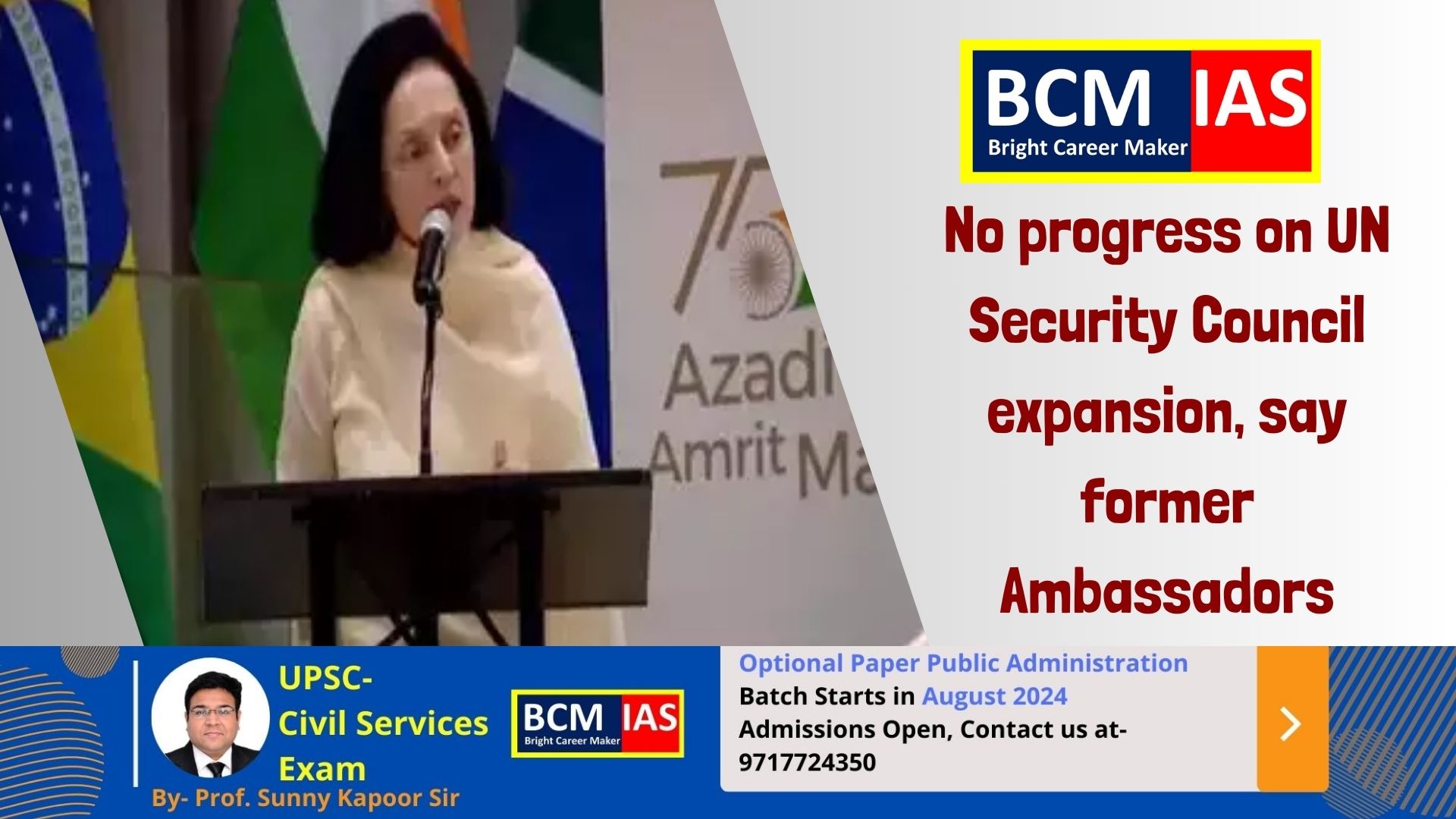
No progress on UN Security Council expansion, say former
Ambassadors
News Analysis
1.
Stagnation in UNSC Reform:
o Despite efforts
by India and other countries, there has been no significant progress in the
United Nations Security Council (UNSC) reform and expansion.
o This statement
comes from two former Indian Ambassadors to the United Nations.
2.
India's Efforts and Frustrations:
o India, along
with Brazil, Germany, and Japan (collectively known as the G-4), has been
actively pushing for a permanent seat at the UNSC.
o The lack of
progress has led to considerable frustration, especially ahead of the Summit of
the Future at the UN scheduled for September 22-23.
3.
Statements by Former Ambassadors:
o Ruchira Kamboj,
India’s former Permanent Representative to the UN (2022-2024), highlighted the
absence of concrete progress in her statements at a seminar in Delhi.
o She mentioned
that since 2023, the only advancement has been in making the Inter-Governmental
Negotiations (IGN) process more transparent.
4.
Inter-Governmental Negotiations (IGN):
o The IGN process
has seen some movement towards transparency, including live broadcasts and a
digital repository for proposals.
o However, these
steps are seen as insufficient without substantial reform.
5.
Recent Address by India’s Acting Permanent
Representative:
o R. Ravindra
criticized the outdated composition of the UNSC, referring to it as a
"1945-vintage binary outlook," highlighting that the current
permanent members (P5) are remnants of post-World War II power structures.
o He pointed out
the disillusionment with the multilateral system, urging member states to
consider alternative approaches.
Conclusion:
The article underscores the ongoing struggle and frustration
surrounding the efforts to reform and expand the UNSC. Despite transparency
improvements in the negotiation process, tangible progress remains elusive.
India and its allies continue to advocate for their inclusion in this critical
global decision-making body, highlighting the need for a more representative
and updated UN Security Council.
UPSC Mains Question:
"Discuss the reasons behind the lack of
progress in the United Nations Security Council (UNSC) reform and expansion.
What are the implications of this stagnation for global governance? Suggest
measures that can be taken to overcome these challenges."
Answer:
Introduction
The United Nations Security Council (UNSC) reform and
expansion have been long-debated topics, with countries like India, Brazil,
Germany, and Japan (the G-4) pushing for permanent seats. Despite these
efforts, there has been little progress, leading to frustration among nations
advocating for a more representative and effective global governance structure.
This essay explores the reasons for the stagnation in UNSC reform, its
implications, and potential measures to address these challenges.
Reasons for Lack of Progress in UNSC Reform
1.
Vested Interests of P5 Members:
o The five
permanent members (P5) of the UNSC – the United States, Russia, China, the
United Kingdom, and France – hold significant power, including the veto right.
o Any reform
proposal requires their consensus, and they are often reluctant to dilute their
influence by expanding permanent membership.
2.
Geopolitical Rivalries:
o Geopolitical
tensions and rivalries among nations complicate the reform process.
o Countries with
regional conflicts or competing interests may oppose each other's bids for
permanent seats, further stalling progress.
3.
Complexity of Reform Process:
o The reform
process is inherently complex, requiring amendments to the UN Charter.
o This
necessitates a two-thirds majority in the General Assembly and ratification by
at least two-thirds of the member states, including all P5 members.
4.
Diverse Views on Reform:
o There are varied
perspectives on how the UNSC should be reformed, including the number of new
permanent and non-permanent members, regional representation, and the veto
power.
o Reaching a
consensus on these aspects among the 193 UN member states is a formidable
challenge.
Implications of Stagnation for Global
Governance
1.
Erosion of Legitimacy:
o The lack of
progress undermines the legitimacy and credibility of the UNSC as a
representative body.
o It reflects
poorly on the UN's ability to adapt to contemporary global realities.
2.
Ineffective Conflict Resolution:
o An
unrepresentative UNSC may struggle to address global conflicts and crises effectively,
as it may not reflect the current geopolitical dynamics and power structures.
o This can lead to
gridlocks and inaction in critical situations.
3.
Disillusionment with Multilateralism:
o The perceived
ineffectiveness of the UNSC can foster disillusionment with the broader
multilateral system.
o Countries may
seek alternative mechanisms outside the UN framework, weakening the global
governance structure.
Measures to Overcome Challenges
1.
Building Broad-Based Coalitions:
o Proponents of
UNSC reform should build broad-based coalitions to garner wider support and
create momentum for change.
o Engaging with
diverse groups of countries and regions can help build a more inclusive reform
agenda.
2.
Incremental Reforms:
o While
comprehensive reform may be challenging, incremental changes, such as enhancing
the role of elected members and improving transparency, can be pursued.
o These steps can
build trust and pave the way for more substantial reforms.
3.
Addressing Regional Concerns:
o Efforts should
be made to address regional concerns and rivalries by fostering dialogue and
cooperation among competing countries.
o Creating a
framework for regional representation can help mitigate opposition and build
consensus.
4.
Veto Power Reforms:
o Revisiting the
veto power and considering proposals such as limiting its use in cases of mass
atrocities or requiring multiple P5 members to exercise a veto can enhance the
UNSC's effectiveness.
o These reforms
can reduce the instances of deadlock and promote a more responsible use of
veto.
Conclusion
The lack of progress in UNSC reform and expansion highlights
the challenges of transforming global governance structures to reflect
contemporary realities. Addressing these challenges requires sustained
diplomatic efforts, coalition-building, and incremental reforms that can create
a conducive environment for more comprehensive changes. Ensuring a more
representative and effective UNSC is crucial for maintaining the legitimacy and
credibility of the United Nations in addressing global peace and security issues.
MCQs for UPSC Prelims 2024
1.
Which group of countries is collectively known as the
G-4, which actively pushes for permanent seats at the UNSC?
o A) India,
Brazil, Germany, and Japan
o B) India, China,
Russia, and South Africa
o C) Brazil, Argentina,
Mexico, and Chile
o D) Germany,
France, Italy, and Spain
Answer: A) India, Brazil, Germany, and Japan
2.
According to the article, what has been the primary
focus of movement since 2023 regarding the UNSC reform process?
o A) Increasing
the number of non-permanent members
o B) Making the
Inter-Governmental Negotiations (IGN) process more transparent
o C) Eliminating
the veto power of P5 members
o D) Establishing
a new international coalition for reform
Answer: B) Making the Inter-Governmental Negotiations (IGN)
process more transparent
3.
What term did India’s Acting Permanent Representative
R. Ravindra use to describe the UNSC's current composition?
o A)
"21st-century multilateral outlook"
o B)
"1945-vintage binary outlook"
o C) "Global
democratic council"
o D)
"Evolving international structure"
Answer: B) "1945-vintage binary outlook"
4.
What is one major reason for the lack of progress in
UNSC reform as highlighted in the article?
o A) Financial
constraints of the United Nations
o B) Vested
interests of the current permanent members (P5)
o C) Lack of
interest from developing countries
o D) Insufficient
proposals from member states
Answer: B) Vested interests of the current permanent members
(P5)
5.
Which of the following measures is suggested to
overcome the challenges of UNSC reform?
o A) Strengthening
the power of non-permanent members
o B) Revisiting
the veto power of P5 members
o C) Increasing
the budget of the United Nations
o D) Establishing
a parallel international organization
Answer: B) Revisiting the veto power of P5 members


Comments on “No progress on UN Security Council expansion, say former Ambassadors”