

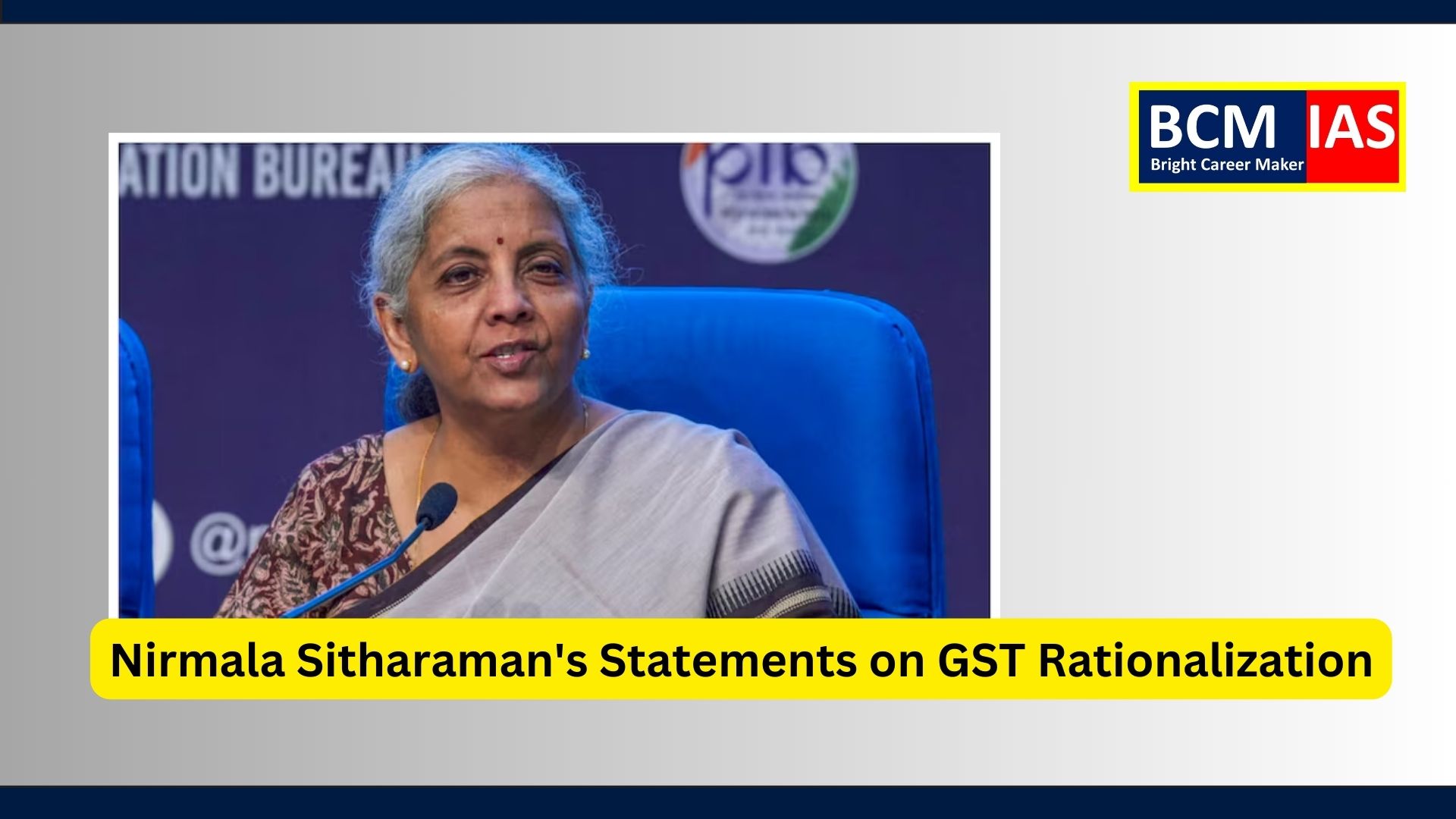
Nirmala Sitharaman's Statements
on GST Rationalization
Introduction
In a recent interaction, Union Finance Minister Nirmala
Sitharaman addressed the ongoing discussions regarding the rationalization of
Goods and Services Tax (GST) rates. Her remarks highlight the complexities and
delays involved in the process, as well as the implications of the GST
compensation mechanism for states.
Key
Points from the Interaction
1. Rationalization
of GST Rates
o Item-by-Item
Review: The GST
Council is engaged in a detailed examination of tax rates on a case-by-case
basis. This approach aims to streamline the GST framework and make it more
effective.
o Delays Due to
Various Factors:
Sitharaman pointed out that the rationalization process has been stalled due to
several factors, notably the impact of COVID-19 and upcoming state elections.
This indicates that external events significantly influence fiscal policies.
2. GST
Compensation and Cess
o End of
Compensation Payments:
Sitharaman reaffirmed that GST compensation payments were set to conclude on
June 30, 2022, as mandated by law. This cessation implies that states can no
longer expect guaranteed financial support from the central government based on
pre-GST revenue levels.
o Discussion on
Cess Continuation:
While the compensation payments have ended, the GST compensation cess continues
to be collected. The council is deliberating whether this cess should persist
and on which items it should be applied.
3. States'
Concerns
o Requests for
Continued Compensation: Some states are advocating for the continuation of GST compensation.
However, Sitharaman emphasized that such continuity contradicts the
foundational principles of GST, which were designed to alleviate fears of
revenue loss among states.
o State Revenue
Growth: Sitharaman
presented data to counter claims that states are worse off post-GST. She
highlighted Tamil Nadu's revenue growth as an example, asserting that states
have benefitted from the GST and compensation scheme, even though some
criticism persists regarding the GST framework.
4. Political
Context and Criticism
o Countering
Allegations:
Sitharaman addressed allegations against the GST, particularly from state
governments that are politically motivated. She suggested that such claims lack
logic and are often made for political gain, especially when they come from
representatives within the GST Council.
Conclusion
Nirmala Sitharaman's statements reflect the government's
commitment to reviewing and rationalizing GST rates systematically while
acknowledging the complexities introduced by recent global and political
events. The transition to a stable GST framework is crucial for both the
central government and states, as it affects revenue generation and economic
stability. Furthermore, the discourse around GST compensation reveals
underlying tensions between state demands and central government policies. This
ongoing dialogue is vital for ensuring the GST framework meets its intended
goals while addressing the economic realities faced by individual states.
MCQs for Practice
MCQ 1: GST Rationalization Process
Question: What is the current focus of the GST Council regarding tax rates?
A) Reducing the overall tax revenue
B) Increasing tax rates across all goods and services
C) Rationalizing tax rates item by item
D) Eliminating GST altogether
Answer: C) Rationalizing tax rates item by item
Explanation: The GST Council is engaged in an item-by-item review of tax
rates for rationalization purposes.
MCQ 2: Factors Delaying GST Rationalization
Question: Which of the following factors has contributed to the delays in the
rationalization of GST rates?
A) Economic growth in states
B) Impact of COVID-19 and state elections
C) Increase in state revenues
D) Public demand for lower taxes
Answer: B) Impact of COVID-19 and state elections
Explanation: The Finance Minister noted that COVID-19 and elections in
some states have been significant factors in delaying the rationalization
process.
MCQ 3: GST Compensation Payments
Question: As of June 30, 2022, what change occurred regarding GST compensation
payments to states?
A) They were increased to support states further.
B) They were ended as mandated by law.
C) They were extended indefinitely.
D) They were made available only to certain states.
Answer: B) They were ended as mandated by law.
Explanation: The Finance Minister confirmed that compensation payments
ceased after June 30, 2022, as outlined in the GST legislation.
MCQ 4: GST Compensation Cess
Question: What is the ongoing discussion in the GST Council concerning the GST
compensation cess?
A) Whether to abolish the cess completely
B) The items on which the cess should be levied and its continuation
C) Increasing the cess rate
D) Distributing the cess among all states equally
Answer: B) The items on which the cess should be levied and its continuation
Explanation: The GST Council is deliberating on whether the cess should
continue and the specific items it should apply to.
MCQ 5: Economic Growth and GST Impact
Question: What argument did Nirmala Sitharaman present regarding the impact of the
GST on state revenues, particularly using Tamil Nadu as an example?
A) States have suffered revenue losses post-GST.
B) States have seen no change in their revenues.
C) States, including Tamil Nadu, have benefited from higher revenues due to the
GST compensation scheme.
D) Tamil Nadu's revenue has decreased since the implementation of GST.
Answer: C) States, including Tamil Nadu, have benefited from higher revenues due
to the GST compensation scheme.
Explanation: Sitharaman highlighted that Tamil Nadu's revenues increased
significantly post-GST implementation compared to before.


Comments on “Nirmala Sitharaman's Statements on GST Rationalization”