


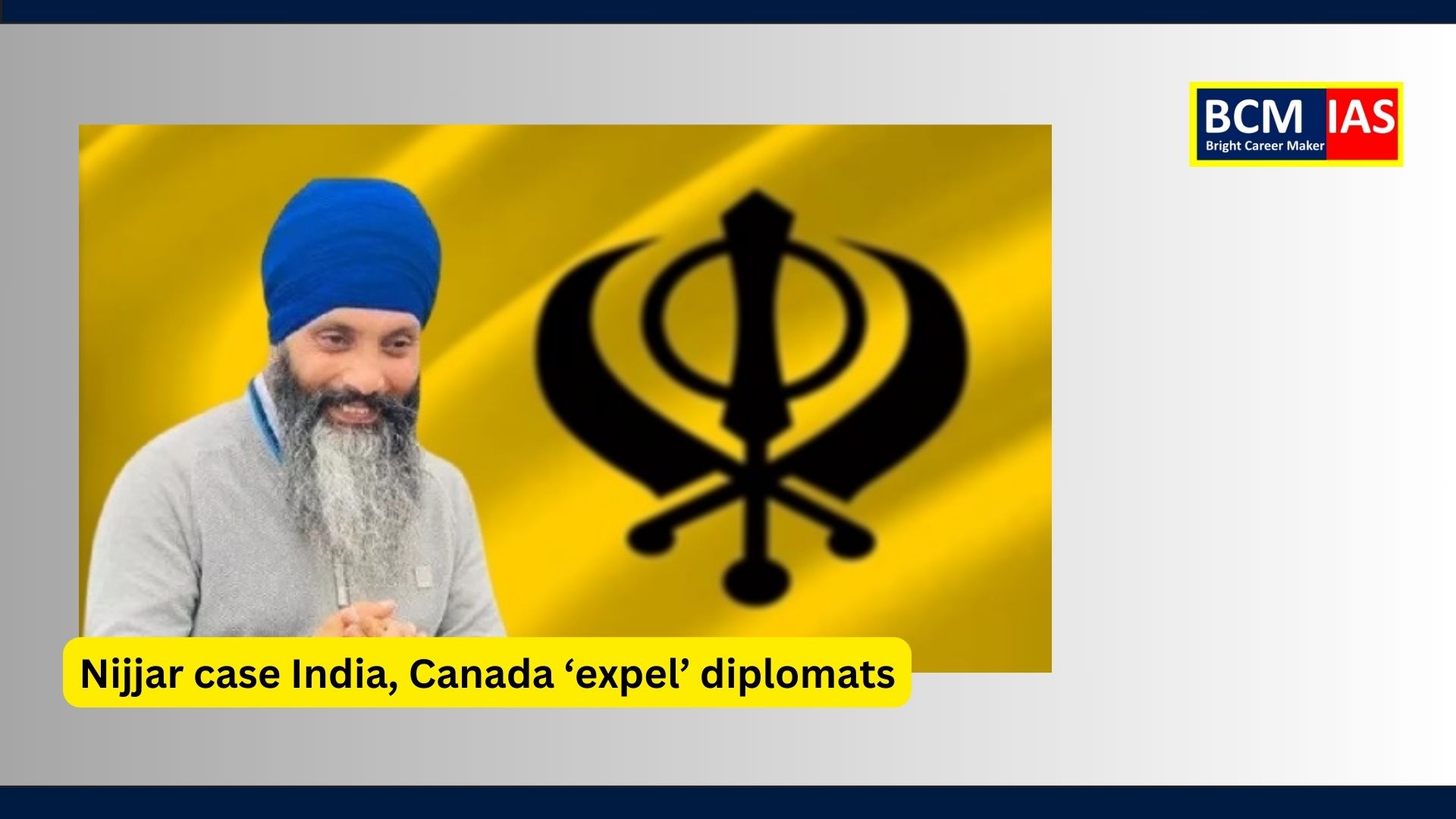
Nijjar case: India, Canada
‘expel’ diplomats
News Analysis
The situation involving India and Canada has escalated
following the diplomatic conflict over the killing of Hardeep Singh Nijjar, a
pro-Khalistan activist, in British Columbia, Canada, in June 2023. Here’s a
detailed analysis of the key developments and implications:
Background
of the Conflict
- Hardeep Singh Nijjar was a prominent figure associated with the pro-Khalistan
movement, which advocates for the creation of an independent Sikh state,
separate from India. On June 18, 2023, Nijjar was assassinated by
unidentified attackers outside the Guru Nanak Gurdwara in Surrey, British
Columbia.
- Canadian
Prime Minister Justin Trudeau made a significant statement in the
House of Commons, alleging that agents of the Indian government
were involved in Nijjar's killing. This accusation marked a major turning
point in diplomatic relations between India and Canada, resulting in
heightened tensions and retaliatory actions.
Recent
Diplomatic Developments
1. Expulsion
of Diplomats:
o The Canadian
government declared six Indian officials as “persons of interest” concerning
the investigation into Nijjar’s murder. In response, India withdrew its High
Commissioner, Sanjay Kumar Verma, and other senior diplomats stationed
in Canada.
o India further expelled
six Canadian diplomats, including the Acting High Commissioner Stewart
Ross Wheeler. The diplomats were ordered to leave India by October 19,
2024.
o Canada also
announced the expulsion of six Indian diplomats, including the High
Commissioner, signaling a sharp escalation in the diplomatic standoff.
2. India’s
Response:
o The Indian
Ministry of External Affairs (MEA) reacted strongly to the allegations,
describing them as “preposterous imputations” aimed at serving a
political agenda in Canada.
o India accused
the Trudeau government of engaging in vote bank politics, suggesting
that the allegations were intended to garner support from particular segments
of the Canadian population.
o The MEA also
condemned Canada for providing a platform for “violent extremists and
terrorists”, accusing Canadian authorities of justifying these actions
under the pretext of freedom of speech.
o The statement
mentioned that India reserves the right to take further action in safeguarding
its interests if the situation deteriorates further.
3. Impact
on Bilateral Relations:
o The diplomatic
fallout has led to a serious deterioration in India-Canada relations.
Prior to these developments, India had already frozen visa services for
Canadian citizens and requested the withdrawal of 41 Canadian diplomats
from their missions in India.
o The MEA’s
statement emphasized that Prime Minister Trudeau’s actions have “endangered
the safety” of Indian diplomats and community leaders in Canada, hinting at
the growing concern over the security of Indian interests in Canada.
Broader
Issues and Political Context
1. Political
Motivations and Domestic Issues in Canada:
o The timing and
nature of the accusations indicate that domestic political pressures may
be influencing the actions of the Canadian government. With elections on the
horizon, Trudeau’s government is likely seeking to address concerns of specific
communities, including those who support the pro-Khalistan movement.
o India has
claimed that certain individuals, including those involved in violent
extremism, have been “fast-tracked for citizenship” in Canada, ignoring
India’s requests for their extradition.
2. India’s
Accusation of Extremism Support:
o India has
consistently raised concerns about the presence of Khalistani extremists
in Canada. Indian authorities have accused Canada of providing a safe haven
to individuals who promote separatist activities and threaten India’s
sovereignty.
o The MEA has
stated that Trudeau’s government is providing “space to terrorists”,
which reflects long-standing concerns that Canada is not taking sufficient
action against groups that threaten India's national security.
Implications
and Conclusion
The expulsion of diplomats from both sides marks a serious
escalation in an already strained bilateral relationship. India’s decision
to pull back its senior diplomats and expel Canadian officials highlights its
strong opposition to the accusations made by Canada. Meanwhile, Canada's move
to label Indian diplomats as “persons of interest” underscores the gravity of
the situation from their perspective.
This diplomatic row can have significant
repercussions on various aspects
of India-Canada ties, including:
- Trade negotiations: Both countries were in the process of strengthening
trade relations, which may now face delays or even stagnation.
- Diaspora issues: There is a large Indian community in Canada, and ongoing tensions
could affect their sense of security and bilateral community engagements.
- Geopolitical positioning: The involvement of a major
Western nation in directly accusing another sovereign state of targeted
killings can create ripples across international diplomatic networks.
In conclusion, the current standoff represents one of the
most severe diplomatic crises between India and Canada in recent history. The
steps taken by both nations reflect a deepening mistrust and hardening
of stances, and unless there is diplomatic mediation, these actions could lead
to a prolonged period of strained ties affecting multiple aspects of
bilateral cooperation.
MCQs
MCQ 1:
What was the primary reason behind the recent diplomatic
tension between India and Canada?
- A)
Trade disputes between the two countries
- B)
Allegations by Canada regarding the involvement of Indian agents in the
killing of a pro-Khalistan activist
- C)
Visa restrictions imposed by India on Canadian citizens
- D)
Differences over environmental agreements
Answer: B
MCQ 2:
How did India respond after Canada declared six Indian
officials as “persons of interest”?
- A) Imposed
trade sanctions on Canada
- B)
Expelled six Canadian diplomats and withdrew its High Commissioner from
Canada
- C)
Signed a new trade deal with another country
- D)
Filed a case in the International Court of Justice
Answer: B
MCQ 3:
What accusation did India make against the Canadian
government in their official statement?
- A)
Suppressing free speech
- B)
Violating trade agreements
- C)
Supporting violent extremists and separatists under the guise of freedom
of speech
- D)
Ignoring international diplomatic protocols
Answer: C
MCQ 4:
Which Canadian official was among those expelled by India
during the diplomatic fallout?
- A)
Justin Trudeau
- B)
Sanjay Kumar Verma
- C)
Stewart Ross Wheeler
- D)
Marie Catherine Joly
Answer: C
MCQ 5:
What broader implication might arise from the ongoing
India-Canada diplomatic row?
- A)
Improved bilateral trade relations
- B)
Strengthened cultural ties between the two nations
- C)
Potential delay or stagnation in trade negotiations and bilateral
cooperation
- D)
Increased military cooperation between India and Canada
Answer: C


Comments on “Nijjar case: India, Canada ‘expel’ diplomats”