


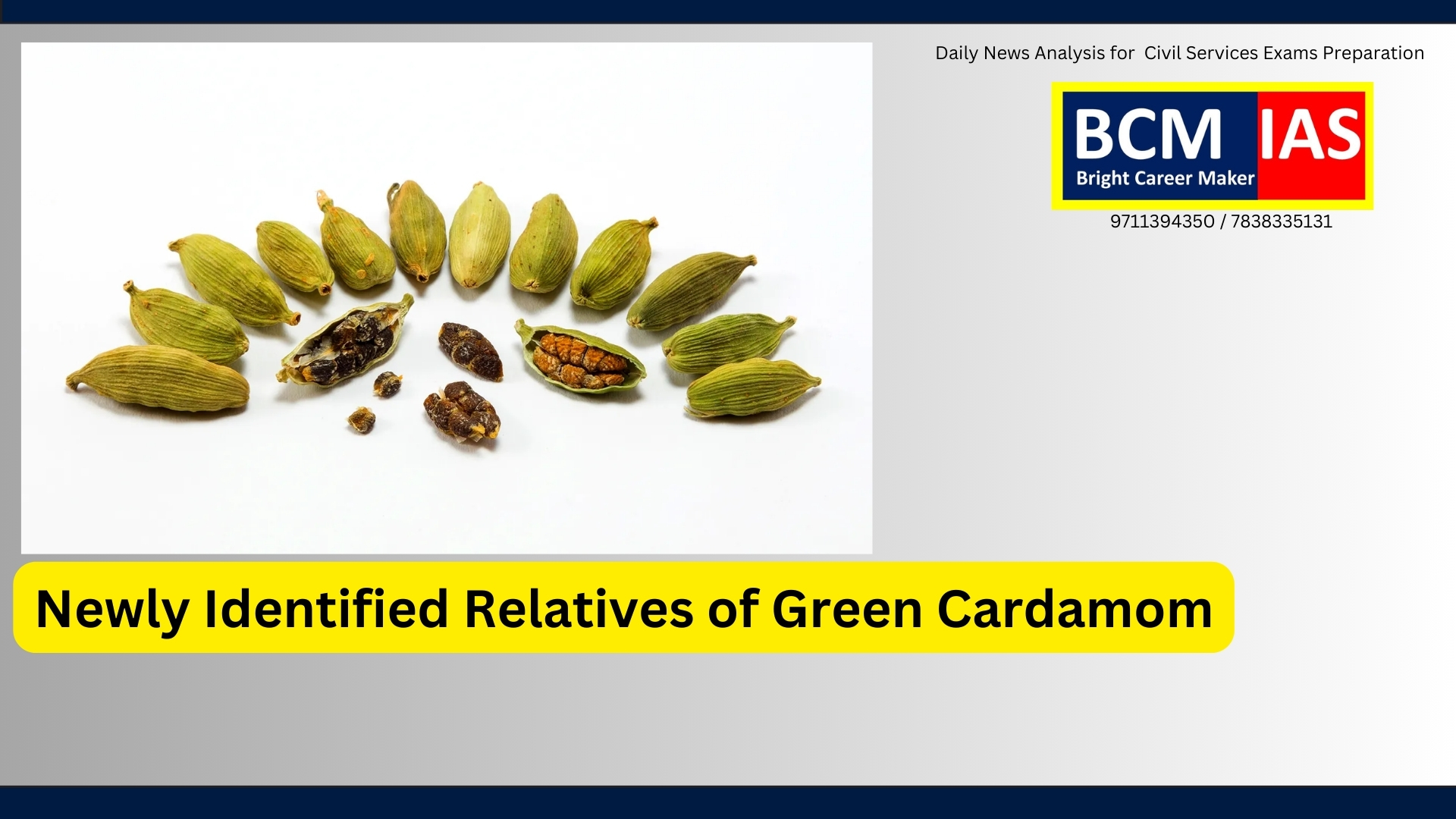
Newly Identified Relatives of Green Cardamom
Introduction
Cardamom, often referred to as the "Queen
of Spices," has long been recognized as a single species under the
genus Elettaria cardamomum. However, a recent study by an international
team of researchers has identified six additional species closely
related to green cardamom, bringing the total species in the Elettaria genus
to seven.
The study, published in the journal Taxon,
involved researchers from Denmark, India, Colombia, Czech Republic,
Singapore, Sri Lanka, and the U.K. Among them, Mamiyil Sabu from
KSCSTE-Malabar Botanical Garden, Kozhikode, India, played a key role in the
discovery.
Key Findings of the
Study
1. Reclassification of the Elettaria Genus
- Previously,
Elettaria cardamomum was the only species in the Elettaria genus.
- Now,
the genus includes seven species, including:
- Four
species reclassified from the Alpinia genus:
- Elettaria
ensal
- Elettaria
floribunda
- Elettaria
involucrata
- Elettaria
rufescens
- Two
newly identified species from Kerala’s Western Ghats:
- Elettaria
facifera (from Periyar Tiger Reserve, Idukki)
- Elettaria
tulipifera (from Agasthyamalai hills
and Munnar, Idukki)
2. Significance of the Discovery
- Biodiversity
and Conservation:
- This
discovery highlights previously overlooked genetic diversity
within the genus Elettaria, which may have important ecological
and agricultural implications.
- The
Western Ghats is a biodiversity hotspot, and the new species
discovery further emphasizes its ecological importance.
- Potential
for Spice Industry:
- Since
green cardamom (Elettaria cardamomum) is commercially cultivated,
the newly identified relatives may hold untapped potential for spice
production, genetic improvement, and disease resistance.
- Future
research could explore how these new species contribute to flavor
profiles and adaptability in spice cultivation.
3. Historical and Linguistic Significance
- The genus
name "Elettaria" originates from the old Malayalam term
"elletari," used by Dutch botanist Hendrik van Rheede
in his 17th-century botanical treatise Hortus Malabaricus.
- This
highlights India’s historical role in spice trade and botanical
documentation.
Challenges and
Conservation Needs
1. Habitat Protection
o
The newly
discovered species are found in ecologically sensitive areas such as the
Periyar Tiger Reserve and Agasthyamalai Hills.
o
Conservation
efforts are needed to protect these species from deforestation and climate
change.
2. Further Genetic Research
o
Understanding
how these species differ from commercially cultivated green cardamom can
help in crop improvement and sustainable agriculture.
3. Sustainable Cultivation Practices
o
If some
of these species have desirable traits for spice production, their
cultivation should be carefully regulated to prevent habitat
destruction.
Conclusion
The discovery of six new relatives of green
cardamom significantly expands the scientific understanding of the
Elettaria genus. It has implications for conservation, agriculture, and
genetic research. Given the commercial importance of cardamom, this
research may open new avenues for spice production and biodiversity
conservation in the Western Ghats.
MCQs
1. What is the primary
significance of the recent reclassification of the Elettaria genus?
(a) It confirms that Elettaria cardamomum is the
only species in its genus.
(b) It expands the Elettaria genus from one species to seven, including four
reclassified species.
(c) It removes Elettaria cardamomum from the commercial spice industry.
(d) It proves that cardamom is not native to India.
Answer: (b) It
expands the Elettaria genus from one species to seven, including four
reclassified species.
Explanation: The
discovery added six more species to the genus Elettaria,
including four species previously classified under Alpinia and two
newly identified species from Kerala’s Western Ghats.
2. Where were the two newly
identified Elettaria species discovered?
(a) Andaman and Nicobar Islands
(b) Periyar Tiger Reserve and Agasthyamalai Hills in Kerala
(c) Sundarbans Biosphere Reserve
(d) Nilgiri Hills and Western Maharashtra
Answer: (b)
Periyar Tiger Reserve and Agasthyamalai Hills in Kerala
Explanation: Elettaria
facifera was discovered in Periyar Tiger Reserve, Idukki, while Elettaria
tulipifera was found in Agasthyamalai Hills, Thiruvananthapuram, and
Munnar, Idukki.
3. What was the old Malayalam
name for Elettaria cardamomum, as used in the 17th-century treatise Hortus
Malabaricus?
(a) Tulsi
(b) Elletari
(c) Kurumulaku
(d) Kariveppila
Answer: (b)
Elletari
Explanation: The name
"Elettaria" originates from the Malayalam term
"elletari", documented by Hendrik van Rheede in Hortus
Malabaricus.
4. What is a potential benefit of
identifying new species related to green cardamom?
(a) It confirms that cardamom can only be grown in
Kerala.
(b) It may help improve commercial spice production through genetic research.
(c) It proves that Elettaria cardamomum is not useful for agriculture.
(d) It eliminates the need for conservation of wild species.
Answer: (b) It
may help improve commercial spice production through genetic research.
Explanation: Genetic
diversity in wild relatives of cardamom could contribute to improving
flavor, disease resistance, and adaptability in cultivated varieties.
5. Why is the discovery of new
Elettaria species significant for biodiversity conservation?
(a) It highlights the ecological importance of the
Western Ghats as a biodiversity hotspot.
(b) It suggests that Kerala is the only region in India where spices can grow.
(c) It proves that Alpinia species are unrelated to cardamom.
(d) It shows that commercial cardamom farming is unnecessary.
Answer: (a) It
highlights the ecological importance of the Western Ghats as a biodiversity
hotspot.
Explanation: The Western
Ghats is a globally recognized biodiversity hotspot, and the discovery of
new Elettaria species emphasizes the need for conservation efforts
to protect these newly identified species.


Comments on “Newly Identified Relatives of Green Cardamom”