


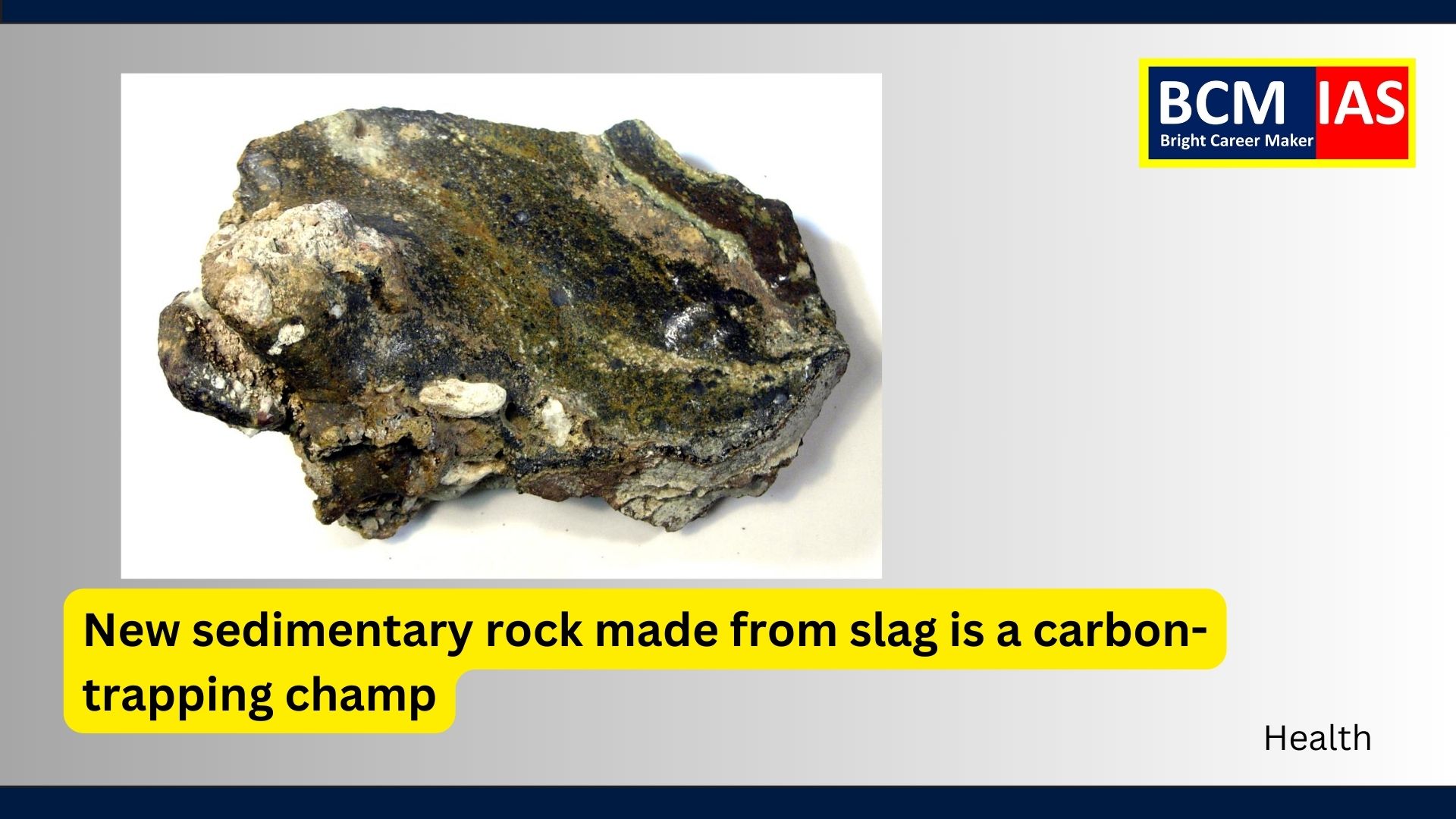
New sedimentary rock made from
slag is a carbon-trapping champ
News Analysis
The news delves into the discovery and analysis of a new
sedimentary rock formed from slag, a by-product of steelmaking. This rock has
shown potential for carbon sequestration through mineral carbonation, which
mimics natural weathering processes. Below is an analysis and explanation of
the key concepts:
1. Human Impact and the Anthropocene Era
- The
article begins by situating the discovery of lithified slag within the
broader context of human activity’s impact on the Earth, particularly the
Anthropocene, a geological era characterized by significant alterations to
the Earth's systems due to human actions.
- Slag,
a composite material containing metal oxides and silicon dioxide, is one
of many by-products of industrial processes that have reshaped landscapes
and contributed to environmental changes. In 2015, human-made materials
like slag contributed more than 316 million tonnes of sedimentary material
to the oceans, exceeding natural sediment deposits.
2. Formation of Sedimentary Rocks from Slag
- The
article highlights a unique formation of sedimentary rock made from
coastal slag deposits in the U.K. These rocks form through a process
called lithification, where industrial waste like slag hardens into
rock.
- What
makes this formation significant is the ability of lithified slag to store
greenhouse gases, specifically carbon dioxide, through a process called mineral
carbonation, which mimics natural weathering processes.
3. Mineral Carbonation and Carbon Sequestration
- Mineral
carbonation occurs when the minerals in slag break down and react with
carbon dioxide in the atmosphere, forming carbonates. One of the key
carbonates identified in the slag sample is calcite (CaCO3), a form
of calcium carbonate commonly found in natural rock formations like chalk.
- The
potential to capture and store carbon dioxide through mineral carbonation
is significant, especially given that global slag production is projected
to increase by 10.5% by 2031. Reusing slag for carbon capture could help
reduce the steel industry's carbon footprint, turning a waste product into
a climate change solution.
4. Understanding Lithification in Slag
- Researchers
have been studying slag deposits in Warton, England, to understand how
slag undergoes lithification and how it can maximize carbon capture
potential. They used multiple analytical techniques, including X-ray
diffraction and thermogravimetric analysis (TGA), to study the minerals in
the slag samples.
- X-ray
diffraction identified various minerals, including larnite (a form
of calcium silicate), and revealed how these minerals react under
different environmental conditions. TGA helped quantify the amount of
calcite in the samples by heating them and measuring weight loss.
5. Lithification Mechanisms
- The
study identified two key lithification mechanisms:
- Calcite
Cement Precipitation: This process dominates on the top surface of the slag and the
sea-facing side of the deposit. Calcium in the slag dissolves and reacts
with atmospheric carbon dioxide to form calcite, trapping carbon in the
rock.
- Calcium-Silicate-Hydrate
(CSH) Precipitation: In the intertidal zone, saltwater prevents calcium from
dissolving, leading to the formation of CSH minerals, which have varying
textures and elemental compositions.
6. Environmental and Practical Applications
- By
understanding these processes, scientists can explore how to repurpose
slag deposits to maximize carbon sequestration. The calcite cement
mechanism is particularly promising because it captures carbon dioxide
directly from the atmosphere without the need for additional processing
facilities.
- Moreover,
the precipitation of CSH minerals can help limit the release of toxic
metals, such as vanadium and chromium, into the environment, making slag a
more environmentally friendly material.
- Hardened
slag can also be repurposed for coastal protection, where it could serve
as a barrier to prevent coastal erosion while simultaneously capturing
carbon.
Conclusion:
This news highlights the dual potential of slag as both a
waste management solution and a tool for environmental protection. By capturing
carbon dioxide and limiting the release of harmful metals, lithified slag
offers a promising approach to mitigating climate change and protecting
ecosystems from industrial by-products. The research conducted on the
lithification of slag provides a foundation for future strategies to harness
its carbon capture potential and repurpose it for environmental applications
like coastal defense.
MCQs
1. What
is slag primarily composed of?
- A) Organic compounds and
minerals
- B) Metal oxides and silicon
dioxide
- C) Sulfates and phosphates
- D) Plastic and steel fibers
Answer: B) Metal oxides and silicon dioxide
2. What
process allows lithified slag to store greenhouse gases like carbon dioxide?
- A) Sublimation
- B) Combustion
- C) Mineral carbonation
- D) Oxidation
Answer: C) Mineral carbonation
3. What
key mineral was identified in slag samples that contributes to carbon capture?
- A) Gypsum
- B) Hematite
- C) Calcite (Calcium Carbonate)
- D) Quartz
Answer: C) Calcite (Calcium Carbonate)
4. Which
lithification mechanism dominates on the sea-facing side of the slag deposit
above the water level?
- A) Calcite cement precipitation
- B) Calcium-Silicate-Hydrate
(CSH) cement precipitation
- C) Oxidative cement formation
- D) Phosphate mineralization
Answer: A) Calcite cement precipitation
5. What
is one environmental benefit of slag's calcium-silicate-hydrate (CSH)
precipitation?
- A) It accelerates the breakdown
of calcium.
- B) It limits the release of
toxic metals like vanadium and chromium.
- C) It increases the acidity of
the soil.
- D) It prevents the formation of
carbonates.
Answer: B) It limits the release of toxic
metals like vanadium and chromium.


Comments on “New sedimentary rock made from slag is a carbon-trapping champ”