


Daily
Current Affairs Analysis
10 June
2024
-------------------------------------------------------------------------------------------------------------
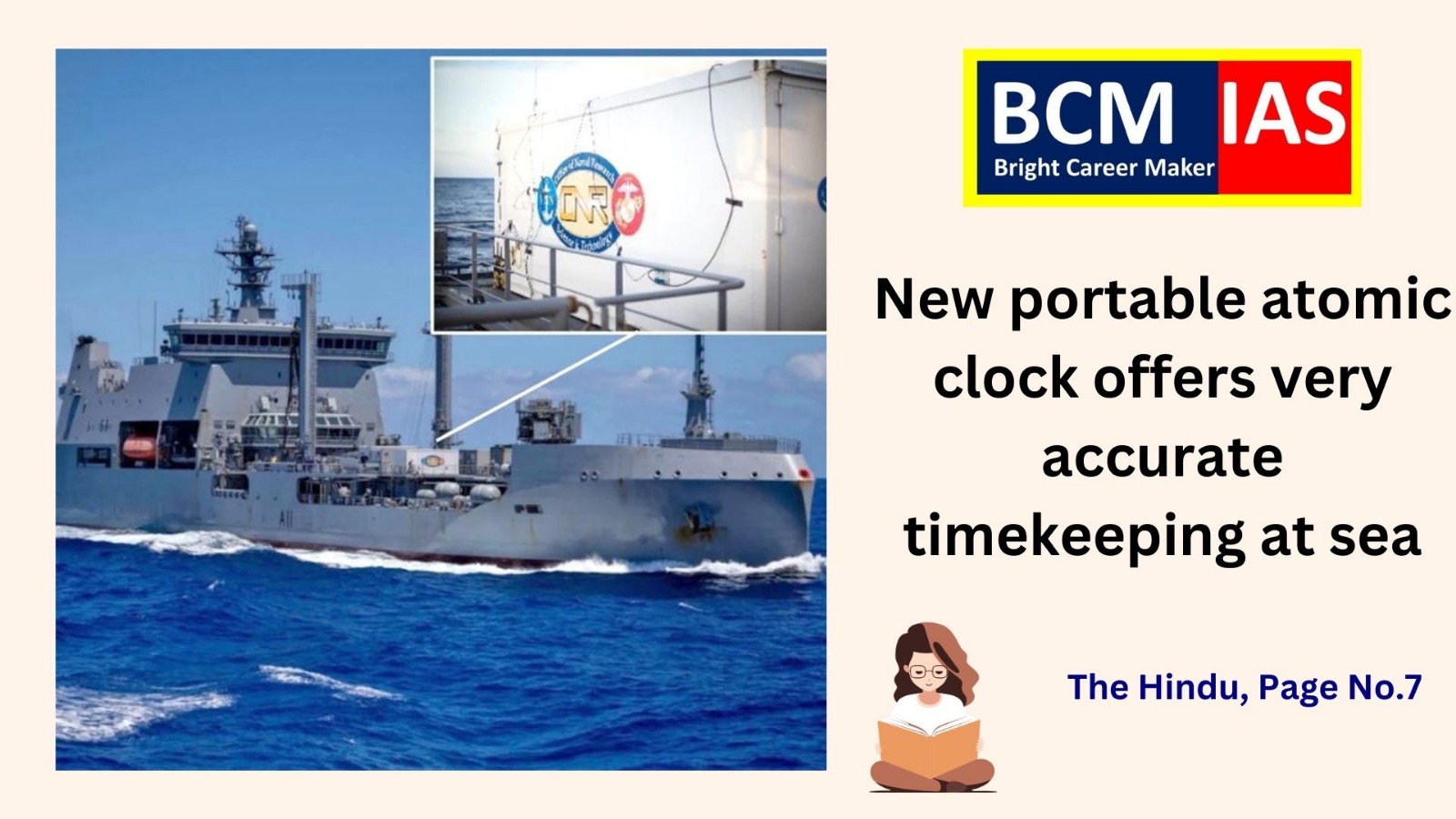
New portable atomic clock offers very accurate
timekeeping at sea
Meaning of Headline-
·
The headline indicates that researchers have developed a new type
of portable atomic clock that can be used on ships.
·
This clock provides highly accurate timekeeping, which is essential
for various maritime activities.
·
Despite its portability and robustness, it maintains superior
accuracy compared to other timekeeping devices used on vessels.
Related Topic (as per UPSC
Syllabus)
Prelims:
1. General Science
o
Basic Concepts: Understanding of atomic clocks, their
functioning, and applications.
o
Current Events: Recent advancements and innovations in
science and technology.
Mains:
1. General Studies Paper
III (GS-III)
o
Science and Technology - Developments and their
Applications and Effects in Everyday Life
§
Recent Developments: Introduction of portable atomic clocks for maritime applications.
§
Innovations: How technological advancements like
optical atomic clocks can enhance navigation and operations at sea.
o
Awareness in the fields of IT, Space, Computers,
Robotics, Nano-Technology, Bio-Technology and issues relating to Intellectual
Property Rights (IPRs)
§
Technological Innovations: Importance of precise timekeeping in GPS
and other navigation systems.
§
Applications: Uses of atomic clocks in various fields
including navigation, military, and scientific research.
Interview:
1. Science and Technology
o
Practical Applications: Discussing the significance of precise
timekeeping in maritime navigation and other applications.
o
Current Affairs: Understanding the latest technological advancements and their
implications on national security and economic development.
Note: This news item provides a practical example of the application of
atomic clocks, which is essential for understanding technological advancements
and their real-world applications. This knowledge is crucial for the UPSC exam,
especially in the context of science and technology topics.
News
Analysis
Introduction
- Context: Development of a
new portable optical atomic clock.
- Significance: Offers highly
accurate timekeeping at sea, essential for navigation, military, and
scientific operations.
Key Points
- Technological
Innovation:
- Development of a portable atomic clock that can
be used onboard ships.
- Maintains high accuracy despite being portable
and robust.
- Described as the most performant optical clock
at sea.
- Functioning
of Atomic Clocks:
- Based on the oscillation of atoms (commonly
Cs-133).
- Uses microwave radiation to measure the duration
of one second.
- Portable version uses strontium (Sr) atoms due
to their higher accuracy and stability.
- Applications:
- GPS and satellite navigation.
- Responding to emergencies.
- Organizing military operations.
- Scientific research.
- Research
and Testing:
- Initial tests conducted by U.S. National
Institute of Standards and Technology (NIST).
- Prototypes demonstrated stability and accuracy
even under challenging conditions (e.g., ship's motion, temperature
fluctuations).
Conclusion
The development of a new portable optical
atomic clock represents a significant advancement in timekeeping technology,
with wide-ranging applications in navigation, military operations, and
scientific research. For UPSC preparation, this topic is relevant across
multiple papers and stages of the examination, highlighting the importance of
staying updated with technological innovations and understanding their
practical applications and implications.
Top of Form
Bottom of Form
Mains Probable Question
Question: Discuss the significance of
portable atomic clocks in enhancing maritime navigation and operations.
Highlight their technological and practical implications.
Answer
Introduction
Atomic clocks are crucial
for maintaining the precise timekeeping necessary for various modern
technologies, including GPS and satellite navigation systems. The development
of portable optical atomic clocks marks a significant advancement,
allowing highly accurate timekeeping on board ships. This innovation addresses
the limitations of existing timekeeping methods in maritime environments and
offers enhanced accuracy and robustness, which is essential for navigation,
military operations, and scientific research.
Demand of the Question
1. Significance of Portable Atomic Clocks in Maritime Navigation:
o
Technological
Innovation: Understanding the functioning of atomic clocks and
the advancements made in portable versions.
o
Practical
Implications: Applications in maritime navigation, military
operations, and scientific research.
o
Challenges
and Solutions: Addressing the challenges of integrating portable
atomic clocks in maritime environments and potential solutions.
2. Technological and Practical Implications:
o
Precision and
Accuracy: Importance of precise timekeeping for navigation and
operations.
o
Enhanced Capabilities:
Improvements in GPS accuracy and reliability.
o
Broader Impact:
Implications for national security, economic development, and scientific
research.
Way Forward
1. Further Research and Development:
o
Innovations: Continued
advancements in atomic clock technology to enhance accuracy and robustness.
o
Field Testing: Extensive
testing in various maritime environments to ensure reliability and performance.
2. Integration with Existing Systems:
o
Collaboration: Working
with maritime and military organizations to integrate atomic clocks into
existing systems.
o
Training and
Education: Providing training for personnel to effectively use
and maintain atomic clocks.
3. Policy and Infrastructure Support:
o
Regulatory
Framework: Developing policies to support the deployment of
atomic clocks in maritime operations.
o
Investment: Encouraging
investment in research and infrastructure to facilitate the adoption of new
technologies.
Introduction
Atomic
clocks, known for their high precision and accuracy, are foundational to many
modern technologies. They provide the precise timekeeping necessary for GPS
systems, which are integral to navigation, communication, and military
operations. The recent development of portable optical atomic clocks represents
a significant technological breakthrough. These portable devices maintain
superior accuracy even in challenging maritime environments, addressing the
limitations of traditional timekeeping methods used on ships.
Portable
atomic clocks exploit the fundamental properties of atoms to measure time with
exceptional precision. The most commonly used atom in these clocks is
cesium-133 (Cs-133), which has been the standard for timekeeping. However, the
new portable versions often use strontium (Sr) atoms, which offer higher
accuracy and stability. This technological advancement has profound
implications for maritime navigation, military operations, and scientific
research.
Demand of the Question
1.
Significance of Portable Atomic Clocks in Maritime Navigation
Technological
Innovation: Portable atomic clocks are designed to function
accurately even under the dynamic conditions experienced at sea. Traditional
atomic clocks, while highly accurate, are often bulky, fragile, and require
significant power. The new portable versions are compact, robust, and
energy-efficient, making them suitable for use on ships. By leveraging the
precise oscillation frequencies of atoms, these clocks provide unparalleled
timekeeping accuracy, essential for various maritime applications.
Practical
Implications:
- Navigation: Accurate timekeeping is
crucial for maritime navigation. GPS systems rely on synchronized time
signals from multiple satellites to determine precise locations. Portable
atomic clocks on ships enhance the accuracy of these signals, leading to
more reliable navigation.
- Military Operations:
Military operations at sea require precise timing for coordinated
maneuvers, communications, and surveillance. Portable atomic clocks
improve the accuracy of navigation systems and enhance the effectiveness
of military strategies.
- Scientific Research:
Accurate timekeeping is vital for various scientific endeavors, including
oceanographic studies and climate research. Portable atomic clocks enable
precise measurements and data collection in maritime environments.
Challenges
and Solutions:
- Integration with Existing Systems: One of
the primary challenges is integrating portable atomic clocks with existing
navigation and communication systems on ships. This requires compatibility
with current technologies and infrastructure.
- Environmental Factors:
Maritime environments present unique challenges such as temperature
fluctuations, humidity, and motion. Portable atomic clocks must be
designed to withstand these conditions without compromising accuracy.
- Power Supply:
Ensuring a stable power supply for atomic clocks is essential. Innovative
power solutions, such as renewable energy sources and efficient battery
systems, can address this challenge.
2.
Technological and Practical Implications
Precision and
Accuracy: Portable atomic clocks provide a level of precision
and accuracy that surpasses other timekeeping methods. This is particularly
important in maritime navigation, where even small errors can lead to
significant deviations in location. By maintaining precise time, these clocks
enhance the reliability of navigation systems, reducing the risk of accidents
and improving safety at sea.
Enhanced
Capabilities: The improved accuracy of portable atomic clocks
enhances the capabilities of GPS systems. This is especially beneficial for
applications that require precise location data, such as search and rescue
operations, scientific research, and commercial shipping. Enhanced GPS accuracy
also contributes to more efficient route planning and fuel consumption, leading
to cost savings and reduced environmental impact.
Broader
Impact:
- National Security:
Portable atomic clocks play a critical role in national security by
enhancing the accuracy and reliability of military operations. Precise
timekeeping is essential for coordinating complex maneuvers,
communications, and surveillance activities.
- Economic Development:
Improved navigation and operational efficiency have significant economic
implications. More accurate navigation reduces shipping costs, minimizes
delays, and enhances the overall efficiency of maritime trade.
- Scientific Research:
Accurate timekeeping enables precise measurements and data collection,
contributing to advancements in various scientific fields. Portable atomic
clocks support oceanographic studies, climate research, and other
scientific endeavors by providing reliable time data.
Way Forward
1. Further
Research and Development
Innovations: Continuous
advancements in atomic clock technology are essential to enhance accuracy and
robustness. Research should focus on developing more compact and
energy-efficient designs, improving the stability of atomic oscillations, and
exploring new materials and techniques to increase precision.
Field Testing: Extensive
field testing in various maritime environments is crucial to ensure the
reliability and performance of portable atomic clocks. Real-world testing helps
identify potential challenges and areas for improvement, leading to more robust
and effective solutions.
2.
Integration with Existing Systems
Collaboration:
Collaboration with maritime and military organizations is essential to
integrate portable atomic clocks into existing systems. This includes working
with technology providers, shipbuilders, and regulatory bodies to ensure
compatibility and interoperability.
Training and
Education: Providing training for personnel is critical to
ensure the effective use and maintenance of portable atomic clocks. This
includes educating crew members on the importance of accurate timekeeping and
how to operate and troubleshoot the clocks.
3. Policy and
Infrastructure Support
Regulatory
Framework: Developing a supportive regulatory framework is
essential to facilitate the deployment of portable atomic clocks in maritime
operations. This includes setting standards for accuracy, reliability, and
environmental resilience, as well as addressing potential legal and logistical
challenges.
Investment: Encouraging
investment in research and infrastructure is crucial for the widespread
adoption of new technologies. Government and private sector funding can support
the development and deployment of portable atomic clocks, driving innovation
and ensuring their availability for maritime applications.
Conclusion
The
development of portable optical atomic clocks represents a significant
advancement in timekeeping technology, with wide-ranging implications for
maritime navigation, military operations, and scientific research. These clocks
offer unprecedented accuracy and robustness, addressing the limitations of
traditional timekeeping methods used at sea. For UPSC preparation,
understanding the technological innovations, practical applications, and
broader impact of portable atomic clocks is essential. This topic is relevant
across multiple papers and stages of the examination, highlighting the
importance of staying updated with technological advancements and understanding
their real-world applications and implications. Continued research,
collaboration, and policy support are necessary to fully realize the potential
of portable atomic clocks and enhance the efficiency, safety, and effectiveness
of maritime operations.
MCQs for Prelims Practice
1. Which of
the following elements is most commonly used in traditional atomic clocks to
define the second?
A. Hydrogen
B. Cesium-133
C.
Strontium-87
D.
Rubidium-87
Answer: B.
Cesium-133
Explanation: Cesium-133
is the element most commonly used in traditional atomic clocks to define the
second. The International Committee for Weights and Measures adopted this
definition in 1967, based on the precise oscillation frequency of cesium atoms.
2. What is
the primary advantage of portable optical atomic clocks compared to traditional
atomic clocks?
A. Higher
frequency
B. Larger
size
C. Greater
accuracy and robustness in dynamic environments
D. Lower
power consumption
Answer: C. Greater
accuracy and robustness in dynamic environments
Explanation: Portable
optical atomic clocks offer greater accuracy and robustness, especially in
dynamic environments such as on ships. They maintain precise timekeeping
despite movements, temperature fluctuations, and humidity changes, making them
more suitable for maritime applications.
3. How do
atomic clocks exploit the fundamental property of atoms to measure time?
A. By
measuring the decay of radioactive isotopes
B. By using
the oscillation frequency of atoms
C. By
tracking the movement of electrons
D. By
monitoring atomic mass changes
Answer: B. By using
the oscillation frequency of atoms
Explanation: Atomic
clocks measure time by exploiting the precise oscillation frequency of atoms.
This frequency is extremely stable and consistent, making atomic clocks highly
accurate timekeeping devices.
4. Which
scientific body conducted initial tests on portable optical atomic clocks in
the context of maritime applications?
A. European
Space Agency (ESA)
B. Indian
Space Research Organisation (ISRO)
C. National
Aeronautics and Space Administration (NASA)
D. U.S.
National Institute of Standards and Technology (NIST)
Answer: D. U.S.
National Institute of Standards and Technology (NIST)
Explanation: The U.S.
National Institute of Standards and Technology (NIST) conducted initial tests
on portable optical atomic clocks, demonstrating their stability and accuracy
under various maritime conditions.
5. In the
context of the article, which application does NOT directly benefit from the
use of portable atomic clocks?
A. GPS and
satellite navigation
B. Maritime
navigation
C. Climate
research
D.
Agricultural automation
Answer: D.
Agricultural automation
Explanation: While GPS and satellite navigation, maritime navigation, and climate research directly benefit from precise timekeeping provided by portable atomic clocks, agricultural automation is not directly related to the use of these clocks.


Comments on “New portable atomic clock offers very accurate timekeeping at sea”