


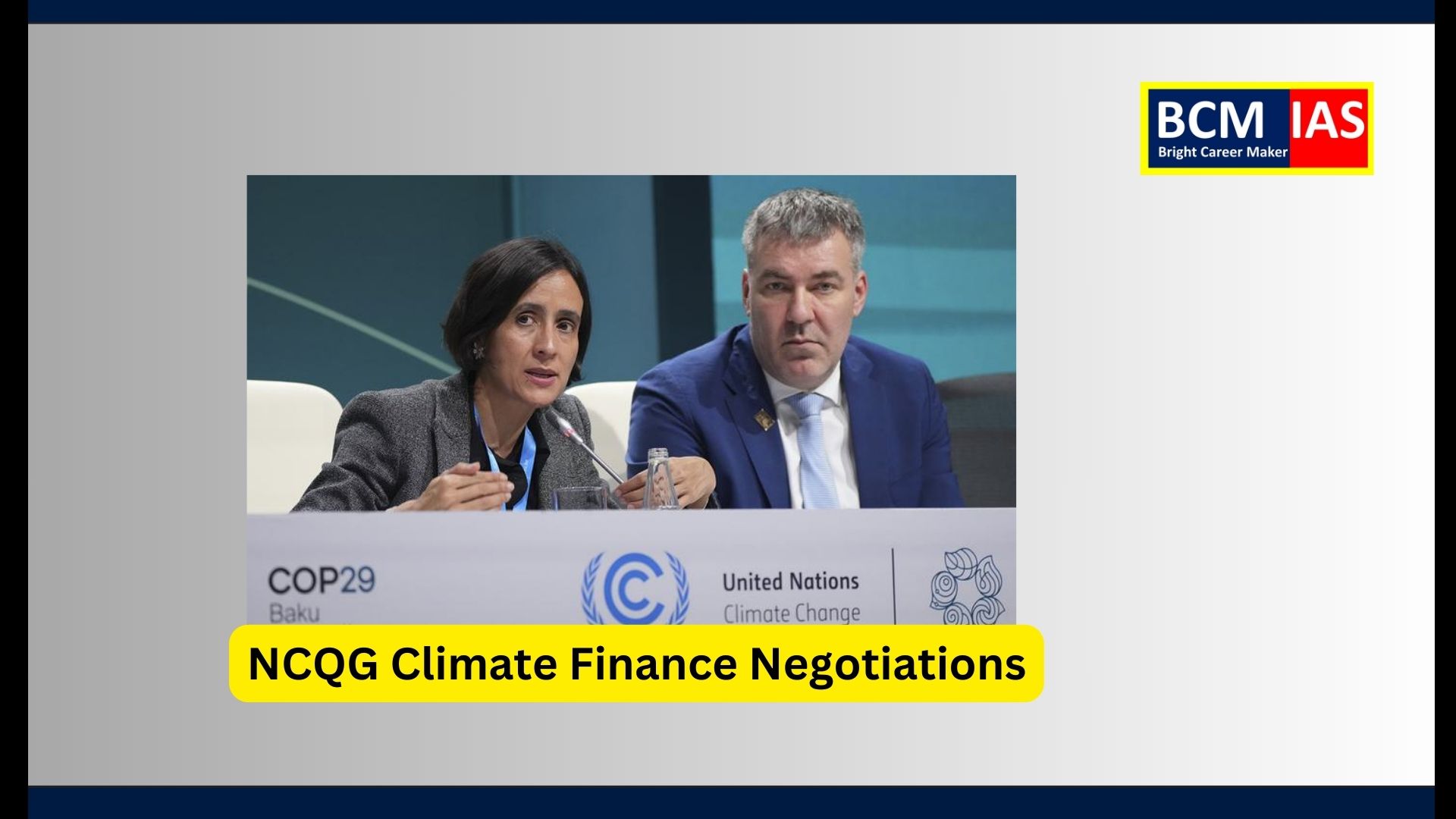
NCQG Climate Finance Negotiations
The news outlines ongoing
disagreements between developed and developing nations on establishing the New
Collective Quantified Goal (NCQG) for climate finance. This goal pertains
to financial commitments by developed countries to help developing nations
combat climate change. Here is a detailed breakdown:
1. Key
Background
- What is the NCQG?
- The NCQG is a financial target mandated
under the Paris Agreement, replacing the earlier $100 billion/year
target.
- It aims to fund developing countries in
transitioning away from fossil fuels, reducing greenhouse gas emissions,
and adapting to climate impacts.
- The new target must be agreed upon by 2025
and should address current and future climate challenges.
- Existing Commitments:
- Developed nations claim to have
mobilized $115 billion (2021-22), but developing nations argue that
earlier targets were not fully met.
- Global climate finance flows, including
private investments, reached $1.3 trillion annually in 2021-22, but much
of it is profit-driven and not purely grants or concessional loans.
2. Key Issues
of Disagreement
Quantum of Finance (How
Much?)
- Developing nations demand funding in trillions
of dollars annually, starting in 2025, to cover:
- Implementation of nationally
determined contributions (NDCs).
- Compensation for losses and damages
from climate change.
- Climate adaptation measures.
- Developed nations have not committed to
a specific figure, leaving it as “x” in the draft text.
Nature of Finance (Grants
vs. Loans)
- Developing Nations’ View:
- The funding should be provided as grants
or low-cost loans, avoiding profit-driven mechanisms.
- It should reflect the historical
contributions of developed countries to global carbon emissions and their
per capita GDP.
- Developed Nations’ View:
- The funds can come from a mix of public
and private sources, not limited to grants or loans.
Public vs. Private Finance
- Developing nations demand more public
funds, citing inequities in private finance, which often prioritizes
profits.
- Of the earlier $100 billion/year
target, only $20 billion came from public sources.
- Developed countries are hesitant to
commit to significantly increasing public financing.
Disproportionate Burden on
Least Developed Countries (LDCs) and Small Island Developing States (SIDS)
- LDCs and SIDS argue for specific
allocations from the NCQG, given their vulnerability to climate change.
- There is no agreement on what proportion
of the funds should be earmarked for these groups.
Broader Proposals
- Developing nations oppose the inclusion
of conditionalities like:
- Carbon pricing mechanisms.
- Macroeconomic or fiscal measures,
which they argue unfairly shift burdens onto developing economies.
3. Current State
of Negotiations
- Two Competing Versions:
- Developing nations propose NCQG as
grants/low-cost loans, focusing on compensation and equitable
contributions.
- Developed nations propose a flexible
approach, including private finance, with no clear commitment to grants
or low-cost loans.
- Disputes over Specificity:
- Developing nations demand clarity on:
- Structure, quantum, timeframe,
transparency, and review mechanisms for NCQG.
- Developed nations prefer vagueness,
especially regarding fixed targets and public financing commitments.
4. Key
Statements and Positions
- Developing Nations’ Demand:
- The NCQG must reach $1.3 trillion
annually and ensure transparency and equity.
- Contributions must reflect historical
emissions and economic capacities of developed nations.
- Developed Nations’ Position:
- Advocate for flexibility in sourcing
funds and oppose rigid commitments to public finance or fixed proportions
for LDCs/SIDS.
- Union Environment Secretary of India,
Leena Nandan:
- Stressed the need for clear,
unconditional goals focusing on structure, quantum, and review.
- Opposed conditions such as carbon
pricing and macroeconomic measures, which may undermine equity.
5. Broader
Implications
For Developed Nations:
- Their reluctance to commit to higher
public financing or grants reflects domestic fiscal pressures and their
preference for leveraging private investments.
For Developing Nations:
- Without significant climate finance,
their ability to meet NDCs and adapt to worsening climate impacts will be
severely hampered.
- LDCs and SIDS face disproportionate
risks, needing targeted assistance to address existential threats.
For Climate Diplomacy:
- The lack of consensus underscores the persistent
divide between the Global North and South, hindering progress in
global climate action.
- The outcome of these negotiations will
significantly influence the upcoming COP30 summit.
6. Conclusion
The NCQG discussions reflect
a deeper clash between developed and developing nations on equitable climate
finance. Resolving this requires balancing ambitious financial commitments
with the realities of fiscal constraints. The success of the Paris Agreement
hinges on ensuring that climate finance is not just a symbolic gesture but a
functional tool to address the growing climate crisis. A middle-ground
agreement, prioritizing transparency, equity, and clear timelines, will be
critical.
Mains Question
Q. "Equitable
and adequate climate finance is central to addressing the global climate
crisis." Critically analyze the challenges in achieving consensus on a new
collective quantified goal (NCQG) for climate finance. (250 words)
Answer
Climate finance is crucial
for supporting developing nations in transitioning to renewable energy,
reducing greenhouse gas emissions, and adapting to climate impacts. The New
Collective Quantified Goal (NCQG) under the Paris Agreement aims to replace the
earlier $100 billion/year target, but achieving consensus on its structure and
quantum remains elusive.
Challenges in Achieving
Consensus
1. Quantum
of Finance:
o Developing
countries demand funding in trillions annually, citing the scale of climate
impacts.
o Developed
nations are hesitant to commit, leaving the figure undefined.
2. Nature
of Finance:
o Developing
nations prefer grants and low-cost loans, ensuring equity and
accessibility.
o Developed
nations advocate for private investments, often profit-driven, to complement
public funds.
3. Public
vs. Private Financing:
o Only
$20 billion of the previous $100 billion/year goal was public finance,
highlighting a reliance on private sources.
o Developing
nations argue that private finance lacks accountability and often excludes
vulnerable regions.
4. Equity
Concerns:
o Least
Developed Countries (LDCs) and Small Island Developing States (SIDS) demand
targeted allocations due to their disproportionate vulnerabilities.
o Developed
countries resist binding commitments to prioritize these groups.
5. Conditionalities:
o Proposals
like carbon pricing and macroeconomic measures are seen as unfairly shifting
burdens to developing nations.
Conclusion
Achieving consensus requires
balancing equity with pragmatic financial mechanisms. Developed countries must
honor historical responsibilities by committing adequate public finance while
ensuring transparency and accessibility. Simultaneously, innovative financing
models can bridge gaps, enabling a just and inclusive global climate response.
Without such commitments, the Paris Agreement's goals risk becoming
unattainable.
MCQs
Q1. What is the New
Collective Quantified Goal (NCQG) on climate finance?
1. A
mechanism to impose carbon pricing on developing countries.
2. A
revised financial commitment by developed nations to support developing
countries in combating climate change.
3. A
global fund exclusively for renewable energy projects.
4. A
private financing initiative for Small Island Developing States (SIDS).
Answer:
- Correct Option:
2. A revised financial commitment by developed nations to support
developing countries in combating climate change.
Q2. Which of the following
is a primary disagreement between developed and developing nations regarding
the NCQG?
1. Inclusion
of private sector participation in climate finance.
2. Conditionalities
such as macroeconomic and fiscal measures imposed on developing nations.
3. Proportion
of funds allocated to Least Developed Countries (LDCs).
4. All
of the above.
Answer:
- Correct Option:
4. All of the above.
Q3. Which international
agreement mandates the establishment of the NCQG?
1. Kyoto
Protocol
2. Paris
Agreement
3. Montreal
Protocol
4. Rio
Declaration
Answer:
- Correct Option:
2. Paris Agreement.
Q4. Why do developing
nations demand climate finance in the form of grants or low-cost loans?
1. To
reduce their dependence on fossil fuels.
2. To
ensure equitable access to funds without profit-driven constraints.
3. To
address their vulnerability to climate change impacts.
4. All
of the above.
Answer:
- Correct Option:
4. All of the above.
Q5. Which of the following
statements about the $100 billion/year climate finance target is true?
1. It
was fully met by developed nations by 2021.
2. A
significant portion of the funds came from public finance.
3. It
was a collective commitment made under the Paris Agreement.
4. It
will be replaced by the NCQG by 2025.
Answer:
- Correct Option:
4. It will be replaced by the NCQG by 2025.


Comments on “NCQG Climate Finance Negotiations”