


Daily Current Affairs Analysis
11 november 2024
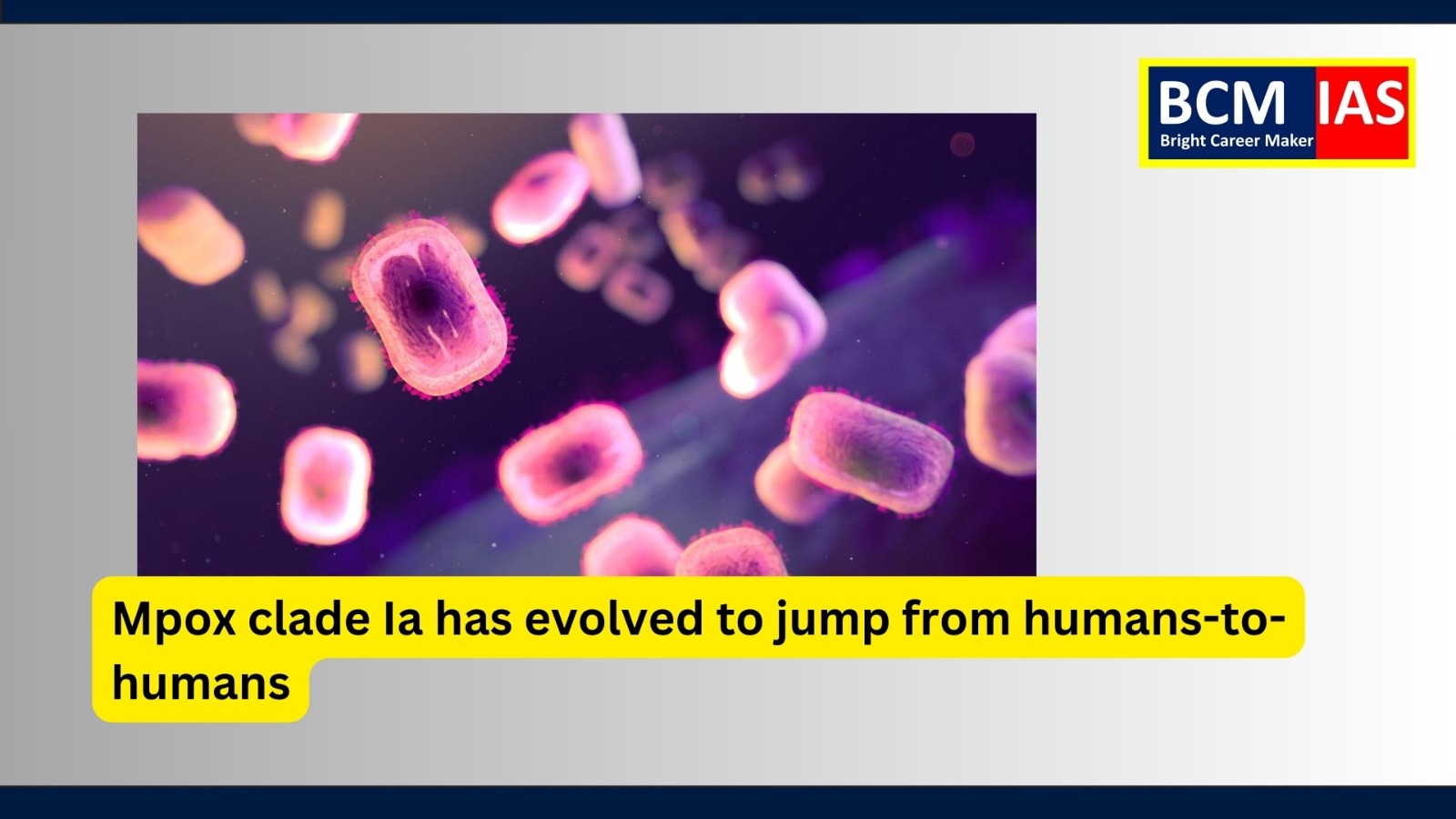
Mpox clade Ia has evolved to jump from humans-to-humans: new study
-------------------------------------------------------------------------------------------------------------
News Explanation
Analysis of Mpox Clade Ia: Emergence of
Human-to-Human Transmission
1. Background: Understanding Mpox and its
Variants
- Mpox Virus
Evolution: Originally
identified as “monkeypox,” the virus has been a concern since the
eradication of smallpox in 1980. The WHO has declared it a public
health emergency twice in recent years (2022 and 2023).
- Clades and Their
Behavior: The mpox virus
is categorized into two clades (I and II), further divided into
subclades (Ia, Ib, IIa, IIb).
- Clade Ia: Oldest known variant, historically limited to animal-to-human
transmission.
- Clade IIb: Responsible for the global outbreak in 2022,
with human-to-human transmission since 2016.
2. Key Discovery: Human-to-Human
Transmission of Clade Ia
- Mutation Patterns: Recent studies show that Clade Ia now exhibits signs of
sustained human-to-human transmission, a significant shift in its
behavior.
- Role of APOBEC
Proteins:
- APOBEC, an immune
protein, forces mutations in the viral DNA during replication.
- These mutations,
primarily cytosine-to-thymine changes, have been linked to human cellular
environments.
- Evidence:
- 63% of observed
mutations in Clade Ia infections align
with APOBEC-induced changes, strongly suggesting human origins.
3. Implications of Human-to-Human
Transmission
- Public Health
Concerns:
- Clade Ia,
previously limited to sporadic infections, can now spread more widely
among humans.
- This raises
concerns about potential outbreaks and differing antiviral drug
responses among clades.
- Vaccine and
Treatment Challenges:
- The limited
availability of vaccines in affected African nations poses a
significant challenge.
- Different clades
have varying responses to existing antiviral treatments,
complicating mitigation strategies.
4. Broader Scientific Insights
- Virus Evolution:
- The mutation rate
of mpox, though slow due to proofreading mechanisms, is accelerated by
APOBEC activity.
- APOBEC-induced
mutations show how human immune responses inadvertently influence viral
evolution.
- Role of Research:
- Studies using
advanced genomic sequencing have proven critical in understanding
transmission patterns and predicting outbreak trends.
5. Africa’s Vaccination Challenge
- Paucity of Doses:
- Only 15 African
nations have received vaccines, with several new to mpox outbreaks.
- Targeted
campaigns are underway, but the demand for vaccines far exceeds supply.
- Hope for
Containment:
- Africa relies
heavily on limited vaccine doses while hoping targeted campaigns
can mitigate the spread.
Conclusion
The emergence of human-to-human
transmission in Clade Ia represents a significant evolution in the
behavior of the mpox virus, raising concerns for public health. While Africa
struggles with vaccine shortages, ongoing research into APOBEC-induced
mutations provides critical insights into the virus's evolution and
potential treatment strategies. Coordinated global efforts are essential to
stem the tide of rising cases and ensure preparedness for future outbreaks.
Mains Probable Question
"Discuss
the significance of the APOBEC protein family in the context of viral
evolution, with specific reference to the mpox virus and its implications for
public health."
Model Answer
Introduction
The discovery of sustained human-to-human transmission in mpox Clade Ia,
the oldest variant of the virus, marks a significant shift in its
epidemiological behavior. This development poses fresh challenges for global
health governance, particularly in terms of containment strategies, vaccine
equity, and international cooperation.
Implications
for Global Health Governance
1. Increased Outbreak Risks:
o
Clade Ia was previously
limited to sporadic animal-to-human transmission, primarily in remote
regions. Its newfound ability for human-to-human transmission raises the
potential for wider outbreaks.
2. Challenges in Vaccine Distribution:
o
African nations, already
struggling with limited doses, face increased pressure to contain infections
amid rising cases.
o
Global vaccine inequity
highlights the need for international mechanisms to ensure equitable
distribution during health emergencies.
3. Evolving Treatment Protocols:
o
Mpox clades exhibit varying
responses to antiviral drugs, necessitating updated research and
treatment strategies.
o
Standardized protocols for clade-specific
treatments are essential to manage diverse outbreak scenarios effectively.
4. Importance of Mutation Surveillance:
o
APOBEC-induced mutations
underscore the need for genomic surveillance to monitor viral evolution
and predict transmission patterns.
o
Strengthening early warning
systems can aid in proactive containment efforts.
5. Global Collaboration:
o
The WHO’s repeated
declarations of mpox as a public health emergency of international concern
emphasize the role of multilateral cooperation in addressing such
challenges.
o
Coordinated efforts between
vaccine-producing and affected nations are crucial to mitigate further spread.
Steps Forward
for Global Health Governance
1. Strengthening Vaccine Equity:
o
Establishing global funds and
manufacturing hubs to ensure access to vaccines for vulnerable regions.
2. Enhanced Surveillance:
o
Expanding genomic sequencing capabilities
to track and respond to mutations in real time.
3. Preparedness for Emerging Threats:
o
Developing flexible frameworks
to manage emerging zoonotic diseases and their human-to-human
transmission potential.
4. Focus on Research and Development:
o
Investing in research for
clade-specific antiviral drugs and next-generation vaccines.
Conclusion
The discovery of sustained human-to-human transmission in mpox Clade Ia
highlights the evolving nature of viral threats and the importance of adaptive
global health governance. A robust, equitable, and collaborative approach
is essential to address emerging zoonotic diseases, protect vulnerable
populations, and prevent future pandemics.
MCQs for Prelims Practice
1. Consider
the following statements about mpox:
1. Mpox is caused by a virus that belongs to the DNA virus family.
2. The mutation rate in mpox is higher than RNA viruses like HIV and
influenza.
3. The World Health Organisation (WHO) declared mpox a public health
emergency of international concern in 2022.
Which of the
statements given above are correct?
A. 1 and 2 only
B. 1 and 3 only
C. 2 and 3 only
D. 1, 2, and 3
Answer: B
(Explanation: Statement 1 is correct as mpox is a DNA virus. Statement 3 is
correct; WHO declared mpox a public health emergency in 2022. Statement 2 is
incorrect; DNA viruses, including mpox, have a lower mutation rate than RNA
viruses.)
2. Which of
the following mechanisms contribute to mutations in the mpox virus?
1. APOBEC proteins in human cells
2. Viral polymerase activity
3. Cross-species transmission
A. 1 and 2 only
B. 2 and 3 only
C. 1 and 3 only
D. 1, 2, and 3
Answer: D
(Explanation: APOBEC proteins introduce mutations in viral DNA within human
cells, viral polymerase activity causes replication errors, and cross-species
transmission can drive genetic changes.)
3. Which of
the following statements regarding APOBEC proteins is correct?
A. APOBEC proteins increase the mutation rate of
RNA viruses.
B. APOBEC proteins specifically target adenine bases in DNA.
C. APOBEC proteins introduce cytosine-to-thymine mutations in DNA.
D. APOBEC proteins prevent mutations in viral DNA.
Answer: C
(Explanation: APOBEC proteins introduce cytosine-to-thymine mutations in viral
DNA as part of the immune response.)
4. What is
the significance of the recent discovery of human-to-human transmission in mpox
Clade Ia?
A. It indicates that mpox Clade Ia has a higher
mutation rate than RNA viruses.
B. It confirms that Clade Ia can spread widely without animal
intermediaries.
C. It proves that Clade Ia is the primary cause of the 2022 global
outbreak.
D. It shows that APOBEC proteins are ineffective in controlling mpox
mutations.
Answer: B
(Explanation: The discovery of human-to-human transmission in Clade Ia shows it
can spread directly among humans, unlike earlier patterns of animal-to-human
transmission.)
5. Consider
the following pairs of mpox clades and their characteristics:
|
Clade |
Characteristic |
|
1. Ia |
Oldest
known variant, now human-to-human transmission |
|
2. IIa |
Responsible
for the 2022 global outbreak |
|
3. IIb |
Causes
infections in western Africa |
Which of the
pairs given above are correctly matched?
A. 1 and 2 only
B. 1 and 3 only
C. 2 and 3 only
D. 1, 2, and 3
Answer: A
(Explanation: Clade Ia is the oldest variant now showing human-to-human
transmission. Clade IIb caused the 2022 outbreak, while Clade IIa is primarily
linked to western Africa.)
6. Which of
the following is a significant challenge in combating mpox outbreaks in Africa?
A. Lack of genomic sequencing technologies.
B. Vaccine shortage and inequity.
C. Ineffectiveness of antiviral treatments.
D. Absence of international cooperation.
Answer: B
(Explanation: Vaccine shortage and inequity are critical challenges for African
nations combating mpox outbreaks.)
7. Which of
the following global actions can help mitigate the impact of mpox outbreaks?
1. Establishing vaccine manufacturing hubs in Africa.
2. Expanding genomic surveillance of mpox mutations.
3. Increasing public awareness of zoonotic diseases.
4. Limiting the use of antiviral drugs to severe cases.
A. 1, 2, and 3 only
B. 2 and 4 only
C. 1 and 3 only
D. 1, 2, 3, and 4
Answer: A
(Explanation: Establishing vaccine hubs, genomic surveillance, and public
awareness are crucial steps. Limiting antiviral use is not a suitable global
mitigation strategy.)


Comments on “Mpox clade Ia has evolved to jump from humans-to-humans: new study”