


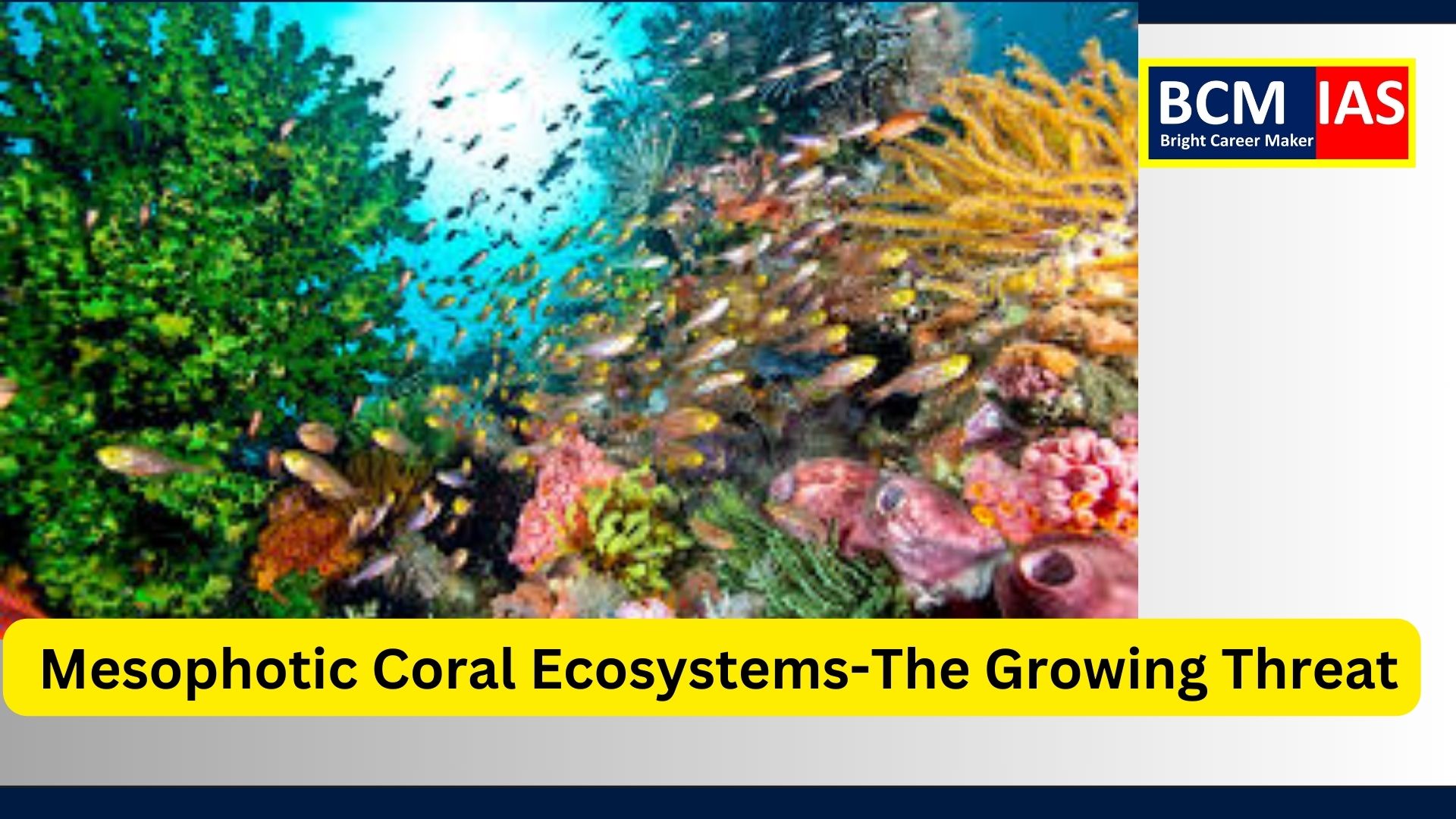
Mesophotic Coral Ecosystems- The
Growing Threat
The recent study on mesophotic coral ecosystems highlights
the growing threat to these vital marine habitats due to climate change. This
analysis provides insights into the significance of these ecosystems, the
implications of coral bleaching, and strategies for their conservation.
Mesophotic
Coral Ecosystems: Understanding and Significance
·
Mesophotic coral ecosystems are found in tropical and subtropical
regions at depths between 100 and 490 feet.
·
They serve as essential habitats for marine species,
supporting activities like spawning, breeding, and feeding.
·
These ecosystems are unique because they act as
potential refuges for shallow coral reefs and host specialized organisms that
could lead to medical advancements.
·
However, due to their depth, research on these
ecosystems has been limited, although recent advances in underwater technology
have improved our understanding.
Implications
for Mesophotic Coral Reefs Under Climate Change
1.
Climate Change Patterns:
o Climate models
predict that extreme La Niña and El Niño events may occur sequentially, leading
to rapid shifts in environmental conditions. These patterns can subject corals
to fluctuating warm and cold water, causing compounded stress.
o The Eastern
Tropical Pacific corals are especially at risk due to the dual exposure of warm
and cold water, which can result in significant coral bleaching and mortality.
2.
Cold-Water Bleaching:
o Unlike typical
warm-water bleaching, cold-water bleaching occurs when corals are exposed to
unusually low temperatures. This dual-stress situation exacerbates the damage
to mesophotic reefs, potentially leading to long-term disruption of their
health and functionality.
o Observations of
cold-water bleaching events suggest that the effects are not temporary, and the
ecosystems may take longer to recover, impacting biodiversity and marine
health.
3.
Global Vulnerability:
o The study
reveals that the threat to mesophotic coral ecosystems is not isolated. Reports
of similar bleaching events in regions like the Red Sea and Indian Ocean
indicate that coral ecosystems worldwide are increasingly vulnerable to
temperature variations caused by climate change.
Implications
of Coral Bleaching
1.
Loss of Biodiversity: Coral reefs support diverse marine
life. Bleaching leads to habitat destruction, which can cause a decline in
species that depend on corals for shelter and food, ultimately impacting the
entire marine ecosystem.
2.
Economic Impact: Reefs are important for tourism, fishing, and coastal
protection. Coral bleaching reduces fish populations and damages reef
aesthetics, negatively affecting tourism and fishing industries, crucial to
many coastal economies.
3.
Coastal Erosion: Healthy coral reefs act as natural barriers against
storm surges and waves, protecting coastlines. Bleached and dying reefs lose
their structural integrity, leaving coastal areas more vulnerable to damage.
4.
Climate Change Feedback Loop: Coral reefs play a role in carbon
sequestration. Their death due to bleaching reduces their capacity to absorb
carbon dioxide, thereby accelerating climate change.
5.
Decline in Medicinal Resources: Coral ecosystems are a source of
compounds used in developing new medicines. The loss of these ecosystems
reduces the potential for discovering new drugs that could benefit human
health.
Measures
to Save Coral from Bleaching
1.
Reduce Global Warming: The primary cause of coral bleaching
is rising ocean temperatures. Reducing greenhouse gas emissions through the
transition to renewable energy, promoting sustainable transportation, and
increasing energy efficiency can help slow down global warming and protect
coral ecosystems.
2.
Restore Coral Reefs: Active restoration programs, such as coral gardening
and transplanting healthy corals to degraded areas, can aid in reviving damaged
reefs. Breeding resilient coral species that can better withstand rising
temperatures is also crucial.
3.
Enhance Marine Protected Areas (MPAs): Expanding and effectively managing
MPAs can protect coral reefs from human activities, such as overfishing, and
provide safe environments for reefs to recover from bleaching events.
4.
Support Scientific Research: Investing in research to understand
coral resilience and develop species that are more tolerant to warmer waters
can play a key role in conservation. Scientists are working on studying
heat-resistant corals to promote their growth.
5.
Encourage Eco-friendly Tourism: Limiting harmful tourism activities
like anchoring boats on reefs, touching corals, or walking on them can help
preserve these fragile ecosystems. Sustainable tourism guidelines can minimize
human impact on coral reefs.
Conclusion
The study on mesophotic coral ecosystems underscores the
urgent need to address the dual threats of warm and cold-water exposure that
these corals face. The compounded stress due to climate change patterns like La
Niña and El Niño has far-reaching implications for coral health and
biodiversity. While global efforts to mitigate climate change and coral
conservation are ongoing, more stringent and immediate actions are necessary to
prevent the long-term loss of these vital marine habitats. Promoting renewable
energy, supporting scientific research, and expanding protected areas are some
of the key measures that can help safeguard coral reefs and their ecosystems
for future generations.
MCQs for Practice
1.
Which of the following best describes Mesophotic Coral
Ecosystems?
o (a) Coral
ecosystems found only at depths of 50 meters or less
o (b) Deep-sea
coral reefs located beyond 1,000 meters in depth
o (c) Coral
ecosystems found at depths between 30 and 150 meters in tropical and
subtropical regions
o (d) Coral
formations found exclusively in freshwater environments
Answer: (c) Coral ecosystems found at depths between 30 and 150 meters in
tropical and subtropical regions
2.
Consider the following statements regarding coral
bleaching:
1.
Coral bleaching occurs when corals expel the algae
living within their tissues.
2.
It is caused exclusively by rising ocean temperatures.
3.
Bleaching can lead to the death of corals if
prolonged.
Which of the statements given above is/are correct?
o (a) 1 and 2 only
o (b) 1 and 3 only
o (c) 2 and 3 only
o (d) 1, 2, and 3
Answer: (b) 1 and 3 only
3.
Which of the following events are associated with
coral bleaching?
1.
El Niño
2.
La Niña
3.
Ocean acidification
Select the correct answer using the codes given below:
o (a) 1 and 2 only
o (b) 2 and 3 only
o (c) 1 and 3 only
o (d) 1, 2, and 3
Answer: (d) 1, 2, and 3
4.
What role do coral reefs play in coastal protection?
o (a) They help in
water purification by filtering pollutants.
o (b) They act as
natural barriers against waves, storm surges, and erosion.
o (c) They
increase the salinity of seawater, protecting coastlines.
o (d) They attract
fish species that prevent coastal erosion.
Answer: (b) They act as natural barriers against waves, storm surges, and
erosion.
5.
Which of the following measures can help mitigate the
impact of coral bleaching?
1.
Reducing greenhouse gas emissions
2.
Expanding Marine Protected Areas (MPAs)
3.
Increasing the use of single-use plastics
Select the correct answer using the codes given below:
o (a) 1 and 2 only
o (b) 1 and 3 only
o (c) 2 and 3 only
o (d) 1, 2, and 3
Answer: (a) 1 and 2 only
6.
Which of the following oceans and seas have reported
cases of coral bleaching?
1.
Indian Ocean
2.
Red Sea
3.
Atlantic Ocean
Select the correct answer using the code given below:
o (a) 1 and 2 only
o (b) 2 and 3 only
o (c) 1 and 3 only
o (d) 1, 2, and 3
Answer: (d) 1, 2, and 3
7.
Consider the following statements about La Niña and
its effects on marine ecosystems:
1.
La Niña events are characterized by
cooler-than-average sea surface temperatures in the central and eastern
tropical Pacific.
2.
Major La Niña events can lead to unusually cold water
exposure to mesophotic coral ecosystems.
3.
La Niña events are beneficial to coral ecosystems and
prevent bleaching.
Which of the statements given above is/are correct?
o (a) 1 and 2 only
o (b) 2 and 3 only
o (c) 1 and 3 only
o (d) 1, 2, and 3
Answer: (a) 1 and 2 only
8.
Which of the following correctly explains the term
"cold-water bleaching" in coral ecosystems?
o (a) Bleaching
caused by a lack of sunlight reaching deep-sea coral reefs
o (b) Bleaching
that occurs due to exposure to unusually cold water temperatures
o (c) Bleaching
that affects corals exclusively in polar regions
o (d) Bleaching
due to exposure to excessive freshwater runoff
Answer: (b) Bleaching that occurs due to exposure to unusually cold water
temperatures
9.
Which of the following actions can directly contribute
to coral reef restoration?
1.
Coral gardening
2.
Transplanting healthy corals to degraded areas
3.
Introducing non-native species to coral ecosystems
Select the correct answer using the code given below:
o (a) 1 and 2 only
o (b) 1 and 3 only
o (c) 2 and 3 only
o (d) 1, 2, and 3
Answer: (a) 1 and 2 only
10.
What is the primary cause of coral bleaching globally?
o (a) Overfishing
near coral reefs
o (b) Ocean
acidification due to chemical runoff
o (c) Rising ocean
temperatures due to climate change
o (d) Increased
salinity levels in seawater
Answer: (c) Rising ocean temperatures due to climate change


Comments on “Mesophotic Coral Ecosystems- The Growing Threat”